Import and Export Between India and Dubai: License and Process

Topic Summary
Set Up a Dubai Free Zone Company
An Indian-owned company holding a UAE free zone trade license can buy goods from India and sell them in Dubai or beyond, or do the reverse. A Dubai South Business Hub company also gives you customs access, warehousing and a re-export base.
Choose Between General and Specific Licenses
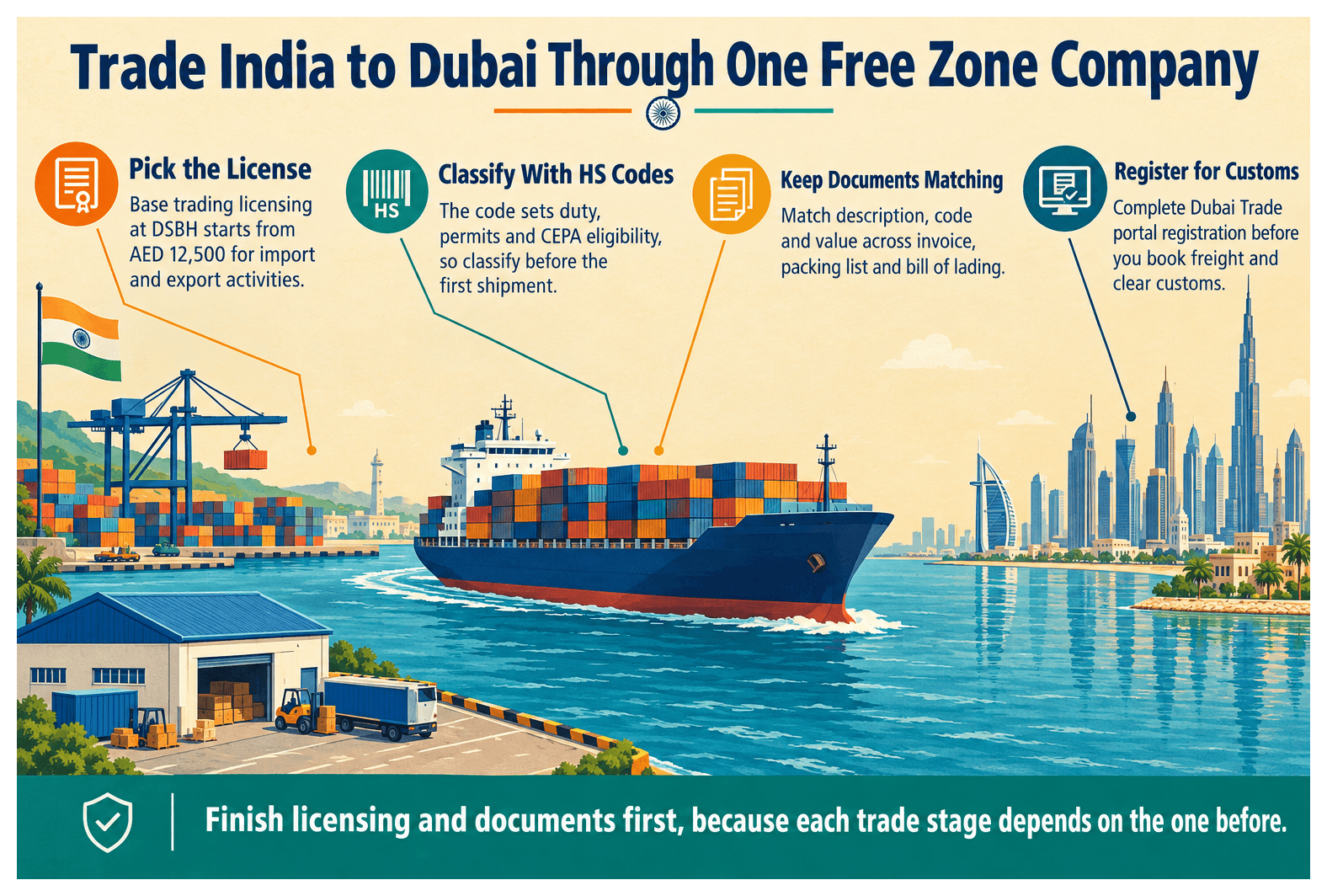
General trading licenses suit mixed cargo, while commodity-specific licenses suit regulated categories like food. Base licensing for trading, importing and exporting activities starts from AED 12,500 at DSBH.
Understand Ownership, Visas and Emirates ID
Free zone ownership can be 100% foreign. Owners apply for residency visas through GDRFA after the license is issued, and the Emirates ID follows the visa.
Classify Goods With Correct HS Codes
Customs in both countries uses HS codes to set duty, permits and CEPA eligibility. Classify goods before the first shipment and keep the same six-digit base across every document.
Match Your License Activity to Your Cargo
Your license activity must cover the product chapter you ship, so confirm it before booking a container. Mismatches between tariff schedules commonly hold cargo at the port.
Keep Invoices and Declarations Consistent
Description, code and value should match across the invoice, packing list and bill of lading. Even one vague description can trigger a port hold, so keep records for audit.
Follow the Registration-to-Delivery Process
Register the company, open a bank account, complete Dubai Trade portal registration, classify goods and secure permits. Then book freight, clear customs and deliver, finishing documents first because each stage depends on the last.
Dubai's non-oil foreign trade runs past AED 2.2 trillion a year (Dubai Chamber, 2024). Its ports handle over 14 million TEUs annually (DP World, 2025). This guide shows Indian traders how import export india dubai works through a Dubai South Business Hub (DSBH) company. It covers the license, HS codes, customs, tax and logistics. It also sits under our import and export between India and Dubai pillar.
What Is Import Export India Dubai and Why It Matters
Import export india dubai means an Indian-owned company holds a UAE free zone trade license to buy goods from India and sell them in Dubai or beyond, or the reverse. A DSBH company gives you a local license, customs access, warehousing and a re-export base for Africa and the Gulf.
How a Dubai Company Changes Your Trade Position
You can invoice in AED or USD and hold stock near buyers. Picture a Surat textile exporter keeping fabric in Dubai and shipping small lots to East African buyers. The Indian parent stays your supplier while the Dubai entity sells.
Who Benefits Most From a Dubai Trading Base
Food, textile, electronics, auto parts and building materials traders gain most. A Mumbai spice trader, for instance, can move from agent-led sales to direct Gulf distribution. The license also carries residency visa packages.
Choosing the Right License for an Indian Dubai Trading Company
Most traders need a general trading or commodity-specific license. Match the activity to your goods, because it controls what you can import, export or re-export. Broad licenses suit mixed cargo, while narrow ones suit regulated categories like food.
General Trading Versus Commodity-Specific Licenses
Base licensing for trading, importing and exporting business activities starts from AED 12,500 at DSBH. A rice and pulses trader picks a foodstuff activity (food may need extra approvals). An electronics dealer picks general trading. See our guide to an import export license in Dubai.
Ownership, Visas and Emirates ID Basics
Free zone ownership can be 100% foreign. Two Ahmedabad partners would apply for owner visas after license issuance through the General Directorate of Residency and Foreigners Affairs (GDRFA). Emirates ID follows the visa.
HS Codes and Product Classification for Cross-Border Trade
HS codes are the numeric product codes customs uses in both countries. Classify goods before the first shipment, because the code sets duty, permits and CEPA eligibility. Keep the same six-digit base across every document for trading between india and uae.
Matching HS Codes to Your License Activity
Your license activity must cover the chapter you ship. A tile exporter confirms the ceramic chapter before booking a container. Check both tariff schedules, since mismatches commonly hold cargo.
Keeping Invoices and Declarations Consistent
Match description, code and value everywhere.
Check invoice, packing list and bill of lading.
Keep records for audit.
One vague description can trigger a port hold.
Process for Import Export India Dubai From Registration to Delivery
Choose your activity, register the company, open a bank account, register for customs and the Dubai Trade portal, classify goods, book freight and clear customs. Each stage depends on the last, so finish documents first.
Company Setup and Customs Registration
Select your activity and submit documents.
Receive the license.
Complete visas and Emirates ID.
Open a corporate bank account.
Complete Dubai Trade portal registration.
Classify goods and secure permits.
Book freight, clear and deliver.
The Identity, Citizenship, Customs and Port Security authority (ICP) handles federal customs and port security matters. Timelines depend on document readiness.
Key Facts for Indian Traders Using a Dubai Free Zone Company
Topic | Key Fact |
|---|---|
License type | General trading for mixed cargo, commodity-specific for one category |
Base licensing | From AED 12,500 at DSBH |
Authorities | FTA for tax, ICP for customs and port security, GDRFA for residency |
Indian-side rules | Income Tax Department disclosure and RBI LRS remittance limits |
Trade agreement | India-UAE CEPA duty preferences with valid origin proof |
Documents Indian Traders Should Prepare
Passport copies and attested Indian documents.
An Importer Exporter Code (IEC) for Indian exports.
Invoice, packing list and bill of lading.
A certificate of origin, prepared early for CEPA.
Tax, Compliance and Trade Agreement Rules on Both Sides
Federal Decree-Law No. 47 of 2022 introduced UAE corporate tax, administered by the Federal Tax Authority (FTA). Qualifying free zone income can be taxed at a reduced rate. On the Indian side, the Income Tax Department, RBI LRS rules and the India-UAE CEPA apply to trading between india and uae.
UAE Corporate Tax and VAT Obligations
Qualifying free zone persons may access a 0% rate on qualifying income, subject to conditions (it isn't blanket tax freedom). A trader should test its re-export income against those conditions before filing. VAT registration becomes mandatory above AED 375,000 in taxable supplies (Federal Tax Authority, 2025), and exports are generally zero-rated.
Indian Rules: Income Tax Department, RBI LRS and CEPA
Resident Indians must disclose foreign assets and income. The Reserve Bank of India's Liberalised Remittance Scheme (LRS) caps individual remittances at USD 250,000 per financial year, so a founder funding share capital should document the purpose. CEPA offers preferential duty access for eligible goods. Take professional tax advice first.
Al Maktoum Logistics and Dubai Free Zone India Trade Advantages
Dubai South sits beside Al Maktoum International Airport and near Jebel Ali's sea corridor. Keeping license, storage and customs access in one place cuts handling for dubai free zone india trade.
Air and Sea Routes From India
Fresh produce flown from Mumbai can clear within hours. Bulk rice moves by sea from Nhava Sheva or Mundra. Road links then serve GCC buyers.
Warehousing and Re-Export Planning
Plan storage size and license activities together. A trader can hold stock in-zone and serve several GCC and African buyers. Our guide to setting up a re-export business covers costs.
Next Steps for Import Export India Dubai
Import export india dubai works best when license, HS codes, customs registration, tax position and logistics are settled before shipment one. Read about starting a Dubai trading company from India, then use the Business Activities and Cost Calculator to choose your activity and estimate the cost to set up or buy a license with Dubai South Business Hub.
References
Frequently Asked Questions