
Topic Summary
Pay the 5% GCC Common External Tariff
A 5% duty applies on the CIF value of most furniture under HS Chapter 94 at the first UAE port of entry. Free zone importers defer this duty rather than avoid it — it becomes payable when goods move to the mainland.
Secure MoIAT Conformity Certificates Before Arrival
Upholstered furniture, children's furniture, and flat-pack adhesive-assembled products require MoIAT-recognised test reports before the shipment reaches port. Missing certificates trigger holds charged to the importer.
Classify Your HS Code Precisely
Furniture falls under HS Chapter 94, codes 9401 to 9406, and a wrong 4-digit sub-code at Jebel Ali triggers a revised duty calculation and at least a 48-hour clearance delay. Accurate classification upfront prevents costly reassessments.
Register for VAT Before Your First Shipment
VAT at 5% applies on top of the duty-inclusive import value, and registration is mandatory once annual taxable turnover exceeds AED 375,000. Late registration carries a AED 10,000 penalty, with a separate AED 10,000 flat penalty for late corporate tax registration.
Submit Original Documents, Not Scanned Copies
A scanned certificate of origin instead of a stamped original can hold a container at a UAE port for up to six days. Ensuring all paperwork — commercial invoice, bill of lading, certificate of origin, and packing list — is complete and original prevents avoidable delays.
Check CITES Controls on Timber Furniture
Over 38,000 species are subject to CITES trade controls, and timber furniture is one of the most frequently held categories at UAE ports. Verifying species compliance before shipment avoids seizure or return of goods.
Retain All Customs Records for Five Years
UAE customs law allows post-clearance audits for a full five-year window, covering declarations, invoices, certificates of origin, and conformity documents. Gaps in records expose importers to retrospective penalty assessments.
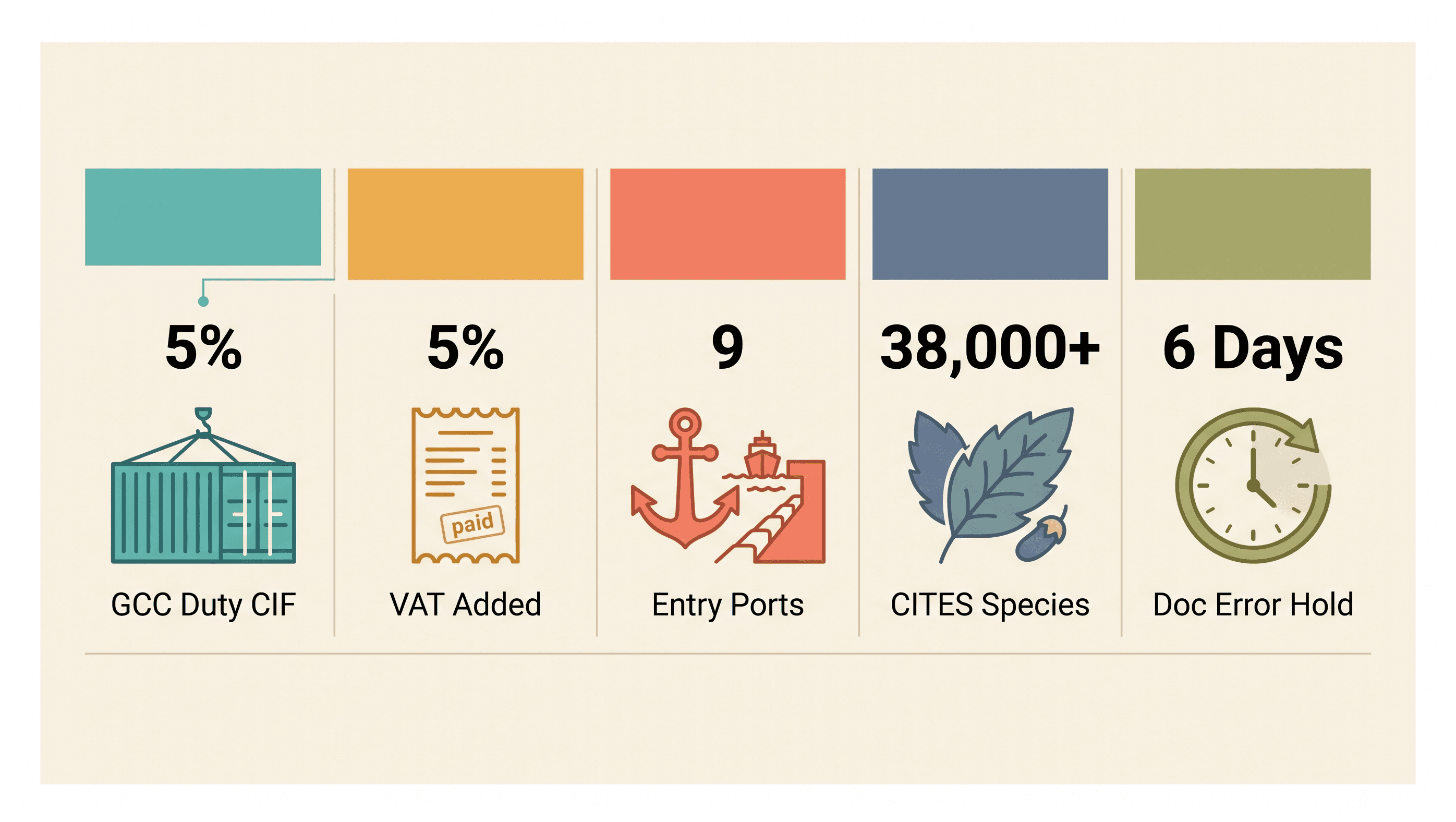
In 2026, the UAE furniture market is valued at over USD 2.8 billion, with imports accounting for the majority of domestic supply (Statista, 2025). The GCC Common External Tariff applies a 5% duty on most furniture under HS Chapter 94 [1]. VAT adds a further 5% on top of the duty-inclusive import value [2]. The UAE operates 9 designated entry ports, including Jebel Ali, Dubai Airport, and Abu Dhabi Port [3]. CITES lists over 38,000 species subject to trade controls, and timber furniture is one of the most frequently held categories at UAE ports [4]. A single documentation error, a scanned certificate of origin instead of a stamped original, can hold a container for up to six days [5].
This guide covers the regulatory requirements, the real cost of importing furniture into the UAE, and a step-by-step customs clearance process, so your shipment clears without delays.
What Import Rules for Furniture Entering the UAE Actually Cover
Importing furniture into the UAE requires compliance with Federal Customs Authority regulations, GCC Common External Tariff duties, Ministry of Industry and Advanced Technology (MoIAT) product standards, and port-of-entry documentation including a commercial invoice, bill of lading, certificate of origin, and packing list. Non-compliance triggers holds, fines, or return of goods. The import furniture entering UAE framework is multi-layered, understanding which body governs which requirement is the first step to a clean clearance.
The Regulatory Bodies That Govern Furniture Imports
Four authorities shape the import furniture UAE requirements landscape, and each has a distinct role:
Federal Customs Authority: Sets the overarching import framework for all UAE ports of entry and issues customs importer codes.
MoIAT (Ministry of Industry and Advanced Technology): Enforces product safety standards for furniture under UAE.S specifications, flammability, foam content, structural load-bearing.
Dubai Municipality / Abu Dhabi Quality and Conformity Council: Apply emirate-level conformity rules that sit alongside federal MoIAT requirements.
Ministry of Economy (moet.gov.ae): Oversees trade policy and anti-dumping measures affecting furniture categories imported from specific origins.
A Dubai-based trading company importing upholstered sofas from China must satisfy both Federal Customs Authority clearance requirements and MoIAT conformity marking before goods leave the port. Neither authority accepts the other's clearance as a substitute.
Which Furniture Categories Face Stricter Controls
Upholstered furniture: Must meet flammability and foam content standards under UAE.S specifications.
Children's furniture (cots, high chairs, bunk beds): Carries additional safety certification, load-bearing, guardrail spacing, and finish toxicity.
Timber and wood-based furniture: May require CITES documentation if made from species listed on Appendix I or II of the Convention on International Trade in Endangered Species. CITES covers over 38,000 species.
Flat-pack furniture with adhesives: May trigger VOC (volatile organic compound) content checks, supplier material safety data sheets should travel with the consignment.
A shipment of pine bunk beds from Europe requires both standard customs documentation and a CITES timber legality declaration if the wood species appears on Appendix II of the Convention. Children's furniture is among the highest-risk categories for UAE port holds, and a hold for safety testing is always at the importer's cost.
Core Documentation Requirements for Import Furniture UAE Shipments
Every furniture shipment entering the UAE needs a commercial invoice, bill of lading or airway bill, packing list, certificate of origin, and a conformity certificate where MoIAT standards apply. Timber products may additionally require a CITES permit. All documents must be attested or apostilled as required by the issuing country. Getting the import furniture UAE requirements right on paper before the vessel departs origin is far cheaper than fixing errors at the port.
Mandatory Documents for Every Furniture Consignment
Commercial invoice: Must state unit price, total value, country of origin, HS code, and Incoterms. Discrepancies between declared and assessed customs value trigger post-clearance audits.
Bill of lading (sea freight) or airway bill (air freight): Issued by the carrier; required for the customs declaration submission.
Packing list: Itemised breakdown of cartons, weights, and dimensions, must match the invoice exactly. Any mismatch leads to a physical inspection.
Certificate of origin: Must be the stamped original issued by the chamber of commerce in the exporting country. Photocopies are not accepted at UAE ports.
Conformity certificate or test report: Required for all product categories covered by MoIAT standards.
A logistics company importing office chairs from Italy presents a certificate of origin stamped by the Italian Chamber of Commerce together with an MoIAT-recognised lab test report. Without both, customs issues a hold notice, and the clock on demurrage starts immediately.
HS Codes and Correct Classification of Furniture
Furniture falls under HS Chapter 94 (codes 9401 through 9406), covering seats, medical furniture, bedroom furniture, and other furnishings. Incorrect classification is one of the most common causes of customs delays and penalty assessments for import furniture entering UAE.
Wooden seats, metal-frame furniture, and bedroom furniture each carry distinct 4-digit sub-codes within Chapter 94.
The applicable duty rate is determined by the sub-classification, not the chapter heading alone.
Verify HS codes against the GCC Customs Tariff Schedule before the shipment departs origin.
A trading firm classifying a metal-frame office desk under the wrong 4-digit HS code was reassessed at Jebel Ali, resulting in a revised duty calculation and a 48-hour clearance delay. The GCC Common External Tariff applies a standard 5% rate on most Chapter 94 furniture, but only if the code is correct.
Duties, Fees, and Other Costs You Need to Budget For
The standard GCC Common External Tariff on furniture is 5% of the CIF value. Free zone importers pay duty only when goods move to the UAE mainland. Additional costs include VAT at 5%, port handling fees, and conformity testing charges. Duty-suspended storage is available in designated free zones. Budgeting accurately for import furniture entering UAE means accounting for all four cost layers, not just the headline tariff.
GCC Customs Duty on Furniture
Standard rate: 5% of CIF value under the GCC Common External Tariff, applied at the first UAE port of entry.
Duty is calculated on CIF value, not FOB. Ensure your supplier's invoice reflects the correct Incoterms.
Goods imported into a free zone are duty-suspended, not duty-exempt. Duty becomes payable if goods enter the UAE mainland.
Preferential rates may apply under UAE bilateral trade agreements, confirm eligibility with a licensed customs agent before the shipment departs.
Here's a concrete example: a Dubai South free zone trader imports AED 500,000 worth of furniture CIF. No duty is assessed while goods remain in the free zone. On moving AED 200,000 worth to a mainland showroom, AED 10,000 in customs duty becomes payable, at that point, VAT is also triggered.
VAT, Port Fees, and Compliance Testing Costs
VAT at 5%: Applies to the import value plus customs duty for mainland imports. A mainland importer receiving AED 300,000 CIF of bedroom furniture pays AED 15,000 duty (5%) plus AED 15,750 VAT (5% on AED 315,000), before port and agent fees.
Port handling and documentation fees: Vary by port and freight forwarder, budget for these separately from duty and VAT.
MoIAT conformity testing: Fees depend on the product category and the accredited lab selected. Commission testing before the shipment departs origin to avoid port-side testing costs.
Storage and demurrage: Accrue quickly if documentation is incomplete on arrival. Confirm current port tariffs with your freight forwarder before booking.
VAT registration is mandatory once annual taxable turnover exceeds AED 375,000 (Federal Tax Authority, 2026). Late registration carries a AED 10,000 penalty, register before your first taxable import, not after.
Step-by-Step Guide to Clearing Import Furniture Entering the UAE
Clearing furniture through UAE customs involves eight key steps: confirm your trade license covers import activity, classify your goods under the correct HS code, prepare all required documents, obtain conformity certificates, appoint a licensed customs agent, file the customs declaration via Dubai Trade or the relevant emirate portal, pay duties and VAT, and collect your release order. Follow the import furniture entering UAE clearance sequence below, and retain every document for five years.
UAE Furniture Import Cost Breakdown: Free Zone vs. Mainland
Feature | Free Zone Importer | Mainland Importer |
|---|---|---|
Customs duty on arrival at UAE port | Duty suspended, 0% assessed while goods remain in the free zone | 5% of CIF value assessed immediately at port of entry |
Duty on mainland transfer | 5% of CIF value triggered only on the portion transferred to the mainland | Not applicable, duty paid in full at port of entry |
VAT treatment | VAT deferred until goods enter the mainland; 5% applies on duty-inclusive value at point of transfer | 5% VAT payable at customs clearance on import value plus duty |
Re-export without UAE duty | Yes, goods can be re-exported to GCC and global markets without UAE duty being triggered | No, duty is paid on import; re-export does not generate a refund without a formal drawback claim |
Direct sale to UAE consumers | Requires mainland transfer (triggering duty and VAT) or appointment of a mainland distributor | Yes, sell directly to UAE retailers and end consumers without an intermediary |
Customs importer code required | Yes, free zone entities must register with UAE Customs Authority for an importer code | Yes, mandatory for all importers regardless of license type |
Pre-Shipment Preparation
Confirm your trade license covers import activity. A trading license is the standard vehicle for furniture import. At Dubai South Business Hub Free Zone, it is issued in one business day.
Classify all items under the correct HS Chapter 94 code. Use the GCC Customs Tariff Schedule, codes 9401 through 9406. Verify at the 4-digit sub-code level, not just the chapter.
Obtain conformity certificates before departure. Commission MoIAT-accredited lab testing on any regulated furniture categories, upholstered items, children's furniture, before placing the purchase order.
Instruct your supplier on document standards. The commercial invoice must state HS code, Incoterms, unit price, and country of origin. The certificate of origin must be the stamped original from the exporting country's chamber of commerce.
A trading company setting up to import furniture obtains a trading license covering import activity in one business day, then immediately commissions MoIAT-accredited lab testing on upholstered samples before placing the purchase order, eliminating the risk of a port-side hold.
Port Clearance and Release
Appoint a licensed customs clearing agent. They file declarations on your behalf via the relevant emirate's customs portal. Confirm they hold a UAE Customs Authority license before engaging.
Submit the electronic customs declaration. For Dubai ports, use the Dubai Trade portal, attaching all required documents. Other emirates use their own customs portals.
Pay assessed customs duty and VAT online. After payment, obtain the electronic customs release order and coordinate with the port operator for container collection.
Retain all customs documents for five years. UAE customs is authorised to conduct post-clearance audits within that period, keep every declaration, invoice, and certificate of origin.
After filing the declaration through Dubai Trade and paying AED 25,000 in duty and VAT, a logistics company receives the electronic release order within four hours and books a collection slot at the terminal for the following morning, a smooth outcome that traces directly to complete pre-shipment documentation.
Is a customs clearing agent mandatory for furniture imports?
Yes. UAE customs regulations require that import declarations be filed by a UAE Customs Authority-licensed clearing agent or freight forwarder. Importers cannot self-declare at major ports. Appoint your agent before the shipment departs origin so they can review documents and flag issues in advance.
Free Zone vs. Mainland: How Your Setup Affects Import Furniture UAE Rules
Free zone companies can receive imported furniture duty-suspended and re-export without paying UAE customs duty. Goods transferred to the UAE mainland trigger the 5% GCC tariff and 5% VAT at the point of transfer. Mainland companies pay duty on arrival. The right structure for your import furniture UAE requirements depends on whether your end market is domestic or international.
Why Free Zone Status Matters for Furniture Traders
Goods entering a UAE free zone are duty-suspended, duty is deferred, not cancelled, until the goods move to the mainland.
References
Frequently Asked Questions