
Topic Summary
Basic Wage Is the Only Overtime Base
UAE overtime calculations use basic wage alone, excluding housing, transport, food, and any other allowances. An employee earning AED 6,000 basic plus AED 2,000 housing has an overtime base of AED 6,000, not AED 8,000.
Standard Hours Cap at 48 Per Week
UAE labour law sets a maximum of eight hours per day and 48 hours per week for private-sector employees. During Ramadan, the daily limit drops to six hours for Muslim employees, and overtime is measured against that reduced norm.
Daily Overtime Is Hard-Capped at Two Hours
Employees cannot legally work more than ten hours in a single day, meaning overtime is limited to two additional hours beyond the standard eight. Employers must build this absolute ceiling into every roster and shift schedule.
Normal Overtime Pays at 125% of Basic Rate
Any overtime worked outside the 9 pm–4 am window is compensated at a minimum multiplier of 1.25 times the basic hourly rate. This is a statutory entitlement under Federal Decree-Law No. 33 of 2021, not an optional employer benefit.
Night-Shift Overtime Carries a 150% Multiplier
Work performed between 9 pm and 4 am attracts a higher minimum rate of 1.50 times the basic hourly wage. This night-shift premium is set in the implementing regulations under Cabinet Resolution No. 1 of 2022.
Violations Can Trigger Fines Up to AED 1,000
MOHRE enforcement teams can impose fines of up to AED 1,000 per affected employee per breach for overtime violations. The Wage Protection System makes underpayment traceable, as employees can flag salary discrepancies directly through the MOHRE inquiry portal.
The 2021 Decree-Law Replaced All 1980 Rules
Federal Decree-Law No. 33 of 2021 came into force on 2 February 2022, fully superseding the 1980 Labour Law that some employers were still quietly applying. Any overtime policy still referencing the old statute is non-compliant and legally unenforceable.
Over 5 million private-sector employees in the UAE are covered by Federal Decree-Law No. 33 of 2021 (MOHRE, 2022), yet unpaid or miscalculated overtime remains one of the most frequently cited wage disputes filed through the Ministry of Human Resources and Emiratisation. The law came into force on 2 February 2022, replacing a 1980 statute that many employers were still quietly applying. Overtime violations can attract fines of up to AED 1,000 per affected employee per breach (u.ae, 2024). The daily overtime cap sits at a hard 10 hours total. Night-shift overtime carries a 1.50× multiplier. And the base for every overtime calculation is the basic wage only, not the full package.
This guide sets out the exact overtime calculation UAE rules you need to follow: standard hours, daily and weekly caps, the correct multipliers for normal overtime, night shifts, rest days and public holidays, fully worked numerical examples for each scenario, which employee categories are exempt, and what record-keeping obligations you carry as an employer.
What Is Overtime Pay UAE and How Does the Legal Framework Define It
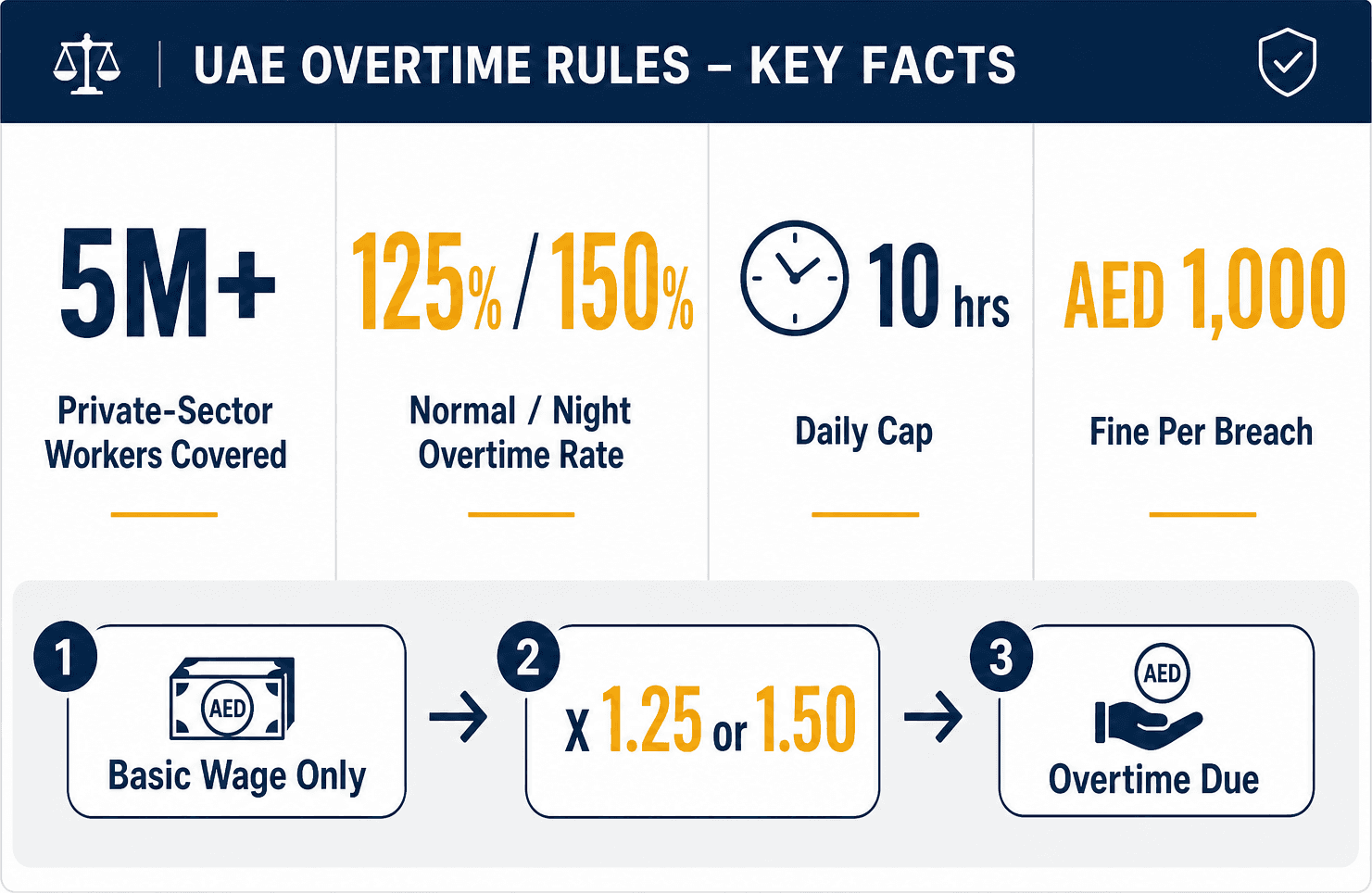
Overtime pay UAE refers to the additional wages owed when an employee works beyond their standard contracted hours. Under Federal Decree-Law No. 33 of 2021, overtime is compensated at a minimum of 125% of the basic hourly rate for normal hours and 150% for work performed between 9 pm and 4 am. This is not a discretionary benefit, it is a statutory entitlement that applies from the first day of employment.
The Core Legislation Governing Overtime in the UAE
Federal Decree-Law No. 33 of 2021 is the primary instrument governing private-sector employment in the UAE. It replaced the old 1980 Labour Law entirely. A Dubai-based retail employer still relying on the 1980 law for overtime calculations would be applying superseded rules, the 2021 Decree-Law is the binding instrument, full stop.
Cabinet Resolution No. 1 of 2022 contains the implementing regulations that set out overtime multipliers and caps in precise detail. MOHRE enforces compliance through its inspection teams and handles wage disputes via conciliation and formal complaint mechanisms. Free zone employees are generally subject to the same federal law unless their specific free zone operates under its own employment regulations.
How Overtime Fits Into the UAE Wage Structure
Here is the point that trips up most HR managers: overtime calculation UAE is based on the basic wage only. Housing allowances, transport allowances, food supplements and any other package components are excluded from the base. An employee earning AED 6,000 basic plus AED 2,000 housing allowance has an overtime base of AED 6,000, not AED 8,000.
The Wage Protection System (WPS) requires all MOHRE-registered private-sector employers to process salaries electronically. That makes overtime underpayment traceable. Employees can check their registered salary details through the MOHRE inquiry portal and flag discrepancies directly.
What Are the Standard Working Hours and Overtime Caps Under UAE Labour Law
Under UAE labour law, the maximum working hours UAE standard is eight hours per day or 48 hours per week. During Ramadan, hours reduce to six per day for Muslim employees. Overtime is capped at two additional hours per day, meaning no employee should work more than ten hours daily in total. These are the baseline figures every employer must build into their rostering system.
Daily and Weekly Hour Limits You Must Know
Standard daily limit: 8 hours per day
Standard weekly limit: 48 hours across a six-day working week
Daily overtime cap: 2 additional hours, bringing the absolute daily maximum to 10 hours
Effective weekly overtime ceiling: 12 hours across six working days (the daily cap applied consistently)
Ramadan: the working day shortens by 2 hours for Muslim employees; overtime is measured against the reduced daily norm during this period
A logistics company running a six-day week can roster a driver for a maximum of 10 hours per day. Scheduling 11-hour shifts without special approval breaches the daily cap and creates immediate liability under the overtime rules UAE labour law framework.
UAE Overtime Pay Multipliers by Scenario
Scenario | Multiplier |
|---|---|
Normal overtime (weekday, day hours) | 1.25× basic hourly rate |
Night-shift overtime (9 pm to 4 am) | 1.50× basic hourly rate |
Rest-day work (Friday or designated day off) | 1.50× basic hourly rate or substitute rest day |
Public holiday work | 1.50× basic hourly rate plus a substitute day off |
Emergency overtime beyond 10-hour cap | Same multipliers apply; MOHRE notification required |
When the Daily Cap Can Be Exceeded
Article 19 of Federal Decree-Law No. 33 of 2021 permits exceeding the 10-hour cap only in cases of actual or imminent accident, urgent work, or force majeure. The employer must notify MOHRE and document the justification in writing before or immediately after the event.
Employees cannot be required to work more than 5 consecutive hours without a rest break of at least one hour. A manufacturing plant facing equipment failure requiring overnight repair may push workers beyond 10 hours, but it must document the emergency, notify MOHRE, and pay the correct overtime rate for every additional hour worked. The emergency exception is not a general workaround.
How to Calculate Overtime UAE: 4 Scenarios With Line-by-Line Working
To calculate overtime in the UAE, divide the monthly basic wage by 30, then by 8 to get the hourly rate. Multiply by 1.25 for normal overtime, 1.50 for night-shift overtime (9 pm to 4 am), 1.50 for rest-day work, and 1.50 plus a substitute rest day for public holidays. Here is how that works in practice, line by line.
stepsh2> 1: Calculate the Basic Hourly Rate
The formula is straightforward:
Monthly basic wage ÷ 30 days ÷ 8 hours = basic hourly rate
Using a real example: Employee A earns AED 9,000 basic per month.
AED 9,000 ÷ 30 = AED 300 per day
AED 300 ÷ 8 = AED 37.50 per hour
That AED 37.50 is the foundation for every multiplier below. Always use the basic wage, not the gross package, to avoid systematic over or underpayment across your payroll.
Step 2: Apply the Correct Multiplier for Each Scenario
Using Employee A's hourly rate of AED 37.50, here is how each scenario plays out:
Worked example for a single week: Employee A works 3 hours of normal overtime on a Tuesday and 2 hours between 10 pm and midnight on Thursday.
Normal OT: 3 × AED 46.88 = AED 140.64
Night OT: 2 × AED 56.25 = AED 112.50
Total overtime for the week: AED 253.14
Which Employees Are Exempt From UAE Overtime Rules
Certain categories of employees are exempt from UAE overtime entitlements. These include senior managers and supervisors who have genuine authority over other employees, domestic workers, seafarers, and workers in certain agricultural roles. Exemption does not remove the employer's general duty of care or the employee's entitlement to annual leave.
Categories Excluded Under Federal Decree-Law No. 33 of 2021
Senior managers and supervisors: defined as employees with genuine managerial authority (hiring, dismissal, budget control) and a commensurate salary, not merely a senior-sounding job title
Domestic workers: governed separately by Federal Law No. 10 of 2017, which has its own working-hour and rest-day provisions
Seafarers: subject to maritime law rather than the standard labour decree
Agricultural workers: subject to separate ministerial decisions covering specific roles
Part-time and flexible workers: overtime thresholds are calculated against their contracted hours, not the standard 8-hour day
A regional sales director with authority to hire and dismiss staff and a total package of AED 35,000 per month would typically qualify as exempt. A team leader with no hiring authority and a package of AED 12,000 would not, regardless of the title on their business card.
How to Document Exemption Status Correctly
The employment contract must clearly state the employee's role, the scope of their authority, and the basis for any overtime exemption. Job descriptions should be kept on file and updated whenever duties change, because a change in responsibilities can remove or confer exempt status.
MOHRE labour inspectors assess actual duties performed, not job titles. An employer who reclassifies a warehouse supervisor as "Operations Manager" solely to avoid overtime liability, without changing actual duties, would not withstand a MOHRE inspection. If you are genuinely uncertain whether a role qualifies, paying overtime is always the safer default, non-payment to a non-exempt employee creates both financial and reputational exposure.
Does exempt status mean no protections at all?
No. Exempt employees retain full entitlements to annual leave, sick leave, end-of-service gratuity and the general protections in Federal Decree-Law No. 33 of 2021. Overtime exemption is narrow in scope and applies only to the additional-hours pay obligation.
Overtime Calculation UAE: Leave Entitlements You Must Factor In
Overtime obligations do not sit in isolation. Annual leave accrual, sick leave entitlements and rest-day rules all intersect with how you roster staff. Miscounting leave days or failing to grant substitute rest days after overtime-worked rest days are two of the most common compliance errors UAE employers make.
Annual Leave and Sick Leave Interaction With Overtime
Annual leave entitlement is 30 calendar days per year after one year of service. Leave days that fall on public holidays extend the leave period by those public holiday days. Plan your rosters with this in mind, it affects how many working days are actually available in any given month.
Sick leave provisions allow up to 15 days on full pay, then 30 days on half pay, and a further 45 days unpaid per year. A team of four where one member takes two weeks' sick leave will likely require the remaining three to cover additional hours. Those hours must be tracked and compensated at the correct overtime calculation UAE rate, they do not become a favour owed to the employer.
Overtime worked immediately before or after a leave period must still be calculated and paid in the relevant pay cycle. It cannot be deferred or absorbed into the following month. For a full breakdown of how leave accrues and interacts with rosters, see our guides on MOHRE services and entitlement checks.
Record Keeping and Non-Compliance Consequences for UAE Employers
UAE employers must maintain accurate time and wage records for all employees. Failure to pay overtime correctly can result in MOHRE fines, labour bans, civil claims and WPS suspension. Under the 2021 Decree-Law, wage violations carry fines of up to AED 1,000 per affected employee, with multipliers for repeated breaches.
What Records You Are Required to Keep
Time records: daily start and finish times for every employee, maintained for a minimum of two years
Overtime authorisation: written or digital approval for each overtime instance, signed by a manager
Pay records: monthly payslips showing basic wage, overtime hours worked, rate applied and total overtime amount
WPS records: salary transfer receipts via the Wage Protection System, which MOHRE can audit in real time
Employment contracts: must accurately state standard hours, overtime policy and any applicable exemptions
A Dubai hospitality business relying on spreadsheets without timestamped entries risks being unable to defend itself in a MOHRE dispute. Digital time-and-attendance systems with audit trails are strongly advisable, they protect both the employer and the employee.
Penalties for Getting Overtime Wrong
Financial penalties: fines of up to AED 1,000 per employee per violation; multiplied for repeat offenders
Labour ban: persistent non-compliance can bar the company from hiring new staff through MOHRE
WPS suspension: removal from the WPS system prevents electronic payroll processing, which effectively halts operations
Civil claims: employees can file for unpaid wages through MOHRE conciliation or the courts, with no filing fee for amounts under AED 100,000
Reputational risk: MOHRE's WPS performance rating is visible to employees, recruitment agents and business partners
A construction firm fined AED 1,000 per employee for underpaying overtime across 50 workers faces an immediate AED 50,000 penalty, before any court-awarded compensation to the affected staff. The numbers add up quickly. If you need support structuring compliant employment contracts and payroll systems from the outset, the business support services at Dubai South Business Hub Free Zone can connect you with the right PRO and advisory resources.
Overtime Rules UAE Labour Law: Six Questions Employers Ask Most
Common employer questions on UAE overtime include whether allowances count toward the base rate, how to handle overtime during probation, whether compensatory time off can replace overtime pay, and how to manage overtime for part-time or flexible workers. Each scenario has a specific answer under the 2021 Decree-Law.
The Six Questions You Need Answered
Q1: Can I offer compensatory time off instead of overtime pay?
Yes, but only with the employee's written consent. The substitute rest must be granted within a reasonable period. You cannot impose this unilaterally or make it a blanket policy without individual agreement.
Q2: Do allowances count toward the overtime base rate?
No. Only the basic wage is used. Housing, transport and meal allowances are excluded from the overtime calculation UAE base, regardless of how significant they are relative to the basic salary.
Q3: Are employees on probation entitled to overtime pay?
Yes. Probation does not suspend overtime entitlements. The same rules apply from day one. Probation under the 2021 Decree-Law has a maximum duration of 6 months, overtime obligations run throughout that period.
Q4: How does overtime work for part-time employees?
Overtime begins once the part-time employee exceeds their contracted daily hours. A part-time employee contracted for 4 hours per day who works 6 hours is entitled to 2 hours at 1.25× their hourly rate, the same multiplier structure applies regardless of contract type.
Q5: Can an employee refuse to work overtime?
Generally no, unless there is a genuine health or safety reason. The employer must stay within the daily 10-hour cap. Requiring overtime beyond the cap without an Article 19 emergency justification is a breach of the overtime rules UAE labour law framework.
Q6: What happens if overtime pay is included in a flat monthly salary?
A flat salary arrangement that purports to include overtime is only valid if the employment contract explicitly states this, the agreed hours are clearly defined, and the resulting effective overtime rate still meets or exceeds the statutory minimums. MOHRE will assess the actual hours worked against the effective hourly rate paid.
Is overtime pay required during the notice period?
Yes. If an employee works overtime hours during their notice period, those hours must be compensated at the applicable overtime rate. The notice period does not alter the employer's wage obligations. Any outstanding overtime must be settled in the final salary payment on or before the last working day.
Citations
Ministry of Human Resources and Emiratisation.. mohre.gov.ae. MOHRE UAE, 2025.
UAE Government Portal.. u.ae. UAE Government, 2025.
UAE Cabinet.. uaecabinet.ae. UAE Cabinet, 2025.
Frequently Asked Questions