
Topic Summary
Fixed-Term Contracts Are the Only Option
Since Federal Decree-Law No. 33 of 2021 took effect in February 2022, open-ended contracts are no longer valid in the UAE private sector. Every contract must be fixed-term, last no longer than 3 years, and include a specific end date.
Arabic Must Be the Governing Language
All UAE employment contracts must be written in Arabic, and Arabic controls in any dispute even if a dual-language version is used. One logistics firm learned this the hard way when an English-only contract was ruled inadmissible during a MoHRE proceeding.
Probation, Leave, and Key Entitlements Are Capped by Law
Probation periods cannot exceed 6 months, annual leave stands at 30 calendar days after the first year of service, and maternity leave is set at 60 calendar days. These figures are statutory minimums and cannot be contracted away.
Specific Mandatory Clauses Must Appear in Every Contract
The law requires contracts to include the employer's legal name and trade license number, the employee's passport details, job title, salary, allowances, working hours, notice period, and grounds for termination. Missing any of these elements can cause MoHRE to reject the filing.
MoHRE Registration Is Not Optional
Every contract must be uploaded to the MoHRE portal, and failure to do so can result in per-employee fines, immediate work permit suspension, and an inability to process new or renewed visas. One retail company was barred from renewing work permits until three unregistered contracts were filed and a corrective declaration submitted.
Offer Letters Must Align With the Final Contract
Any contract term that is less favorable to the employee than what the original offer letter promised is legally unenforceable. Employers should review both documents side by side before submission to avoid disputes.
Budget AED 500–2,000 for Legal Review
Having a qualified legal professional review a contract template typically costs between AED 500 and AED 2,000. Given the financial and operational penalties tied to non-compliance, this upfront cost is a practical safeguard for any UAE employer.
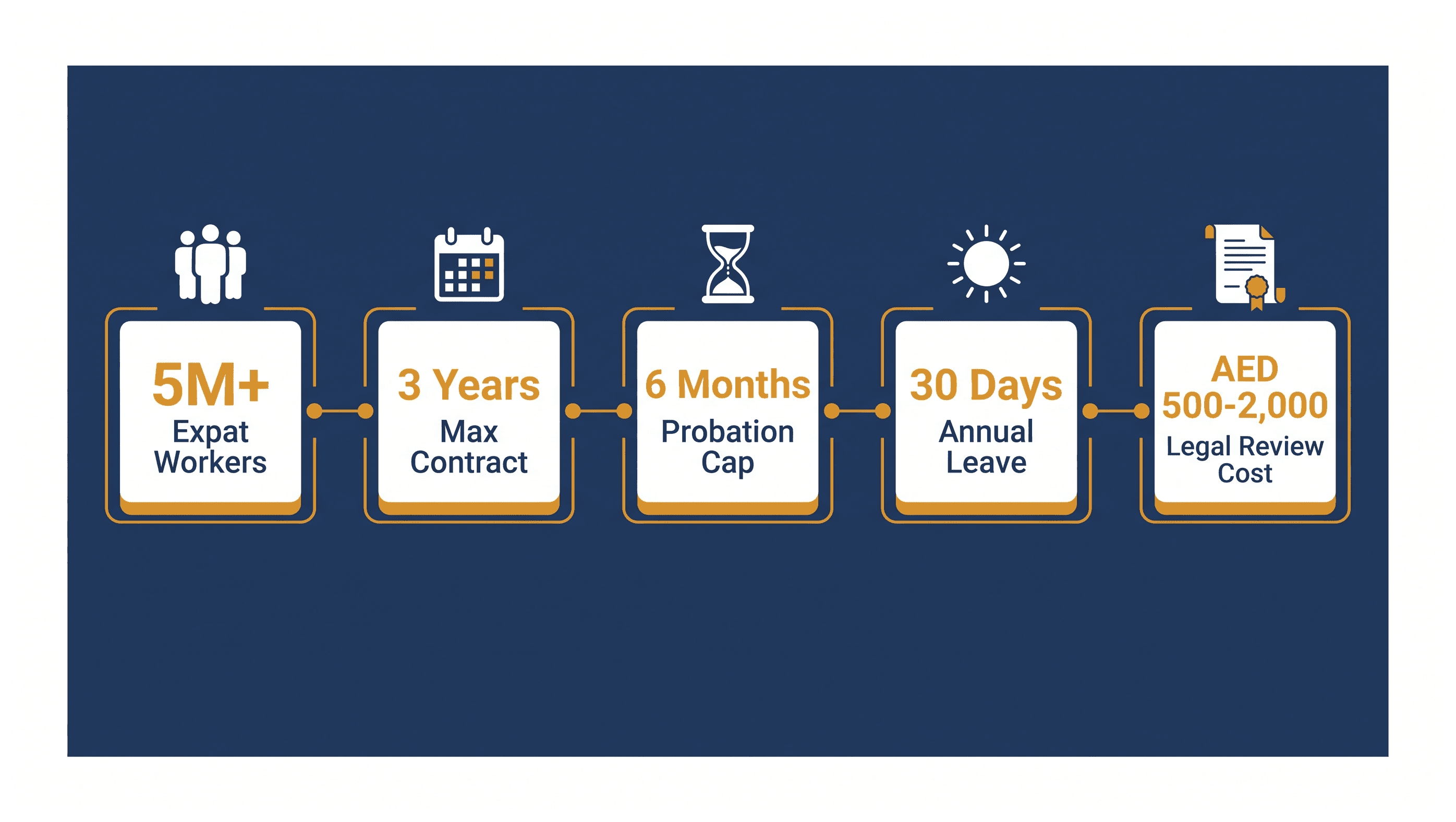
In 2026, the UAE's private sector employs over 5 million expatriate workers, and every single one of those employment relationships must be governed by a written, MoHRE-registered employment contract under Federal Decree-Law No. 33 of 2021, a requirement that carries real financial and legal consequences for non-compliance. The law took effect on 2 February 2022 (UAE Cabinet, 2022). Maximum contract duration is 3 years [1]. Probation is capped at 6 months [2]. Annual leave stands at 30 calendar days after year one [3]. Maternity leave is 60 calendar days [4]. Legal review of a contract template typically costs AED 500 to AED 2,000 [5].
This guide covers the mandatory requirements for employment contracts in the UAE, the associated costs, and the exact steps to draft, register, and file a compliant contract, so you can hire with confidence and avoid penalties.
What Is an Employment Contract in the UAE and Why It Matters
An employment contract in the UAE is a legally binding written agreement between an employer and employee that defines the terms of the working relationship. Under Federal Decree-Law No. 33 of 2021, all private-sector employment in the UAE must be governed by a fixed-term written contract registered with MoHRE.
The Legal Framework Governing UAE Employment Contracts
Federal Decree-Law No. 33 of 2021 replaced the previous Labour Law (Federal Law No. 8 of 1980) and made fixed-term contracts the only permissible arrangement in the UAE private sector. Open-ended contracts are no longer valid. Every employment contract in the UAE must be fixed-term, with a maximum duration of 3 years and a specific end date stated in the document (MoHRE, 2022).
All contracts must be in Arabic. A dual-language version, Arabic and English, is common practice and legally acceptable, but Arabic governs in any dispute. A logistics firm that issued an English-only contract found the document inadmissible during a MoHRE dispute; the Arabic version is always the operative text. Contracts must also align with the signed offer letter: any term less favourable to the employee than what the offer letter states is unenforceable.
Why Non-Compliance Carries Serious Risk
Operating without a registered employment contract in the UAE exposes you to a cascade of consequences. An HR manager at a mid-sized retail company discovered that three contracts had never been uploaded to the MoHRE portal, the company was barred from renewing work permits until all three were filed and a corrective declaration submitted.
The risks stack up quickly:
MoHRE fines applied per unregistered employee
Immediate work permit suspension upon confirmed non-compliance
Inability to process new visas or renew existing ones
Labour complaints that freeze company transactions until resolved
Burden of proof shifts to the employer in any dispute involving an unregistered contract
You can review how MoHRE disputes are initiated through the MoHRE inquiry guide, understanding the process before a complaint is filed is far better than reacting after one lands.
Mandatory Clauses Every Employment Contract in the UAE Must Include
Every UAE employment contract must include the employer's name and details, the employee's personal information, job title and description, start date, contract duration, probation period (if any), basic salary, allowances, working hours, leave entitlements, notice period, and grounds for termination, all as prescribed by Federal Decree-Law No. 33 of 2021 (still accurate as of 2026). For more detail, see our guide on UAE probation rules for employers. For more detail, see our guide on UAE maternity leave rules for employers. For more detail, see our guide on notice period requirements under UAE labour law. For more detail, see our guide on UAE employee termination rules for employers.
Employer and Employee Identification Details
Full legal name of the employer, trade license number, and registered address, not a trading name
Employee's full name as it appears on their passport, nationality, date of birth, and job title
Work permit number and visa category, referenced once issued
All details must match exactly what is submitted to MoHRE and ICP, discrepancies trigger rejection
A free zone employer that listed a trading name instead of the legal company name had every batch of contracts returned by MoHRE for correction. It's a small detail that costs significant time to fix after the fact.
Compensation, Hours, and Leave Entitlements
Basic salary must be stated separately from allowances (housing, transport, and other components), bundling into a single "all-inclusive" figure is non-compliant
Working hours: 8 hours per day / 48 hours per week standard; reduced to 6 hours per day during Ramadan for Muslim employees
Annual leave: 30 calendar days per year after completing one year of service; 2 days per month for employees with under one year
Sick leave: up to 90 days per year (first 15 fully paid, next 30 at half pay, remaining 45 unpaid)
Maternity leave: 60 calendar days (45 fully paid, 15 at half pay)
An employer who listed "AED 8,000 all-inclusive" in the contract was ordered by MoHRE to restate the salary with a basic of at least AED 5,000 and separate allowances. The split matters, gratuity, overtime, and end-of-service calculations all derive from the basic salary figure.
Contract Duration, Probation, and Termination Terms
Contract duration: maximum 3 years; must state a specific end date
Probation: maximum 6 months; either party may terminate with 14 days' notice during probation
Notice period: minimum 30 days, maximum 90 days, state the exact figure explicitly
Grounds for termination without notice under Article 44 must be referenced or incorporated by schedule
End-of-service gratuity: 21 days' basic salary per year for the first 5 years, 30 days per year thereafter
A technology company signed a 5-year contract with a senior developer, MoHRE rejected it because it exceeded the 3-year maximum. The contract was reissued for 3 years with a renewal clause, which is the correct approach.
What happens if a contract clause is less favourable than the offer letter?
Any clause in the employment contract that offers the employee less than what the signed offer letter promised is legally unenforceable in the UAE. MoHRE treats the offer letter as a binding commitment. If there is a conflict, the more favourable term for the employee prevails, and the employer bears full liability for the difference.
UAE Employment Contract Types at a Glance
Contract Type | Key Characteristics | Permit Requirement |
|---|---|---|
Full-Time | One employer only; standard 8 hrs/day, 48 hrs/week; full statutory benefits apply | Standard work permit, no additional ministerial permit needed |
Part-Time | Fewer than standard hours; employee may hold concurrent contracts with multiple employers; pro-rata benefits apply | Ministerial permit required before work permit issuance |
Temporary | Tied to a specific project or task; defined end date under 3 years; ends when project concludes | Standard work permit; misclassification risk if role recurs annually |
Flexible | Variable hours and days based on operational demand; minimum hours agreed in advance and stated in contract | Ministerial permit required before work permit issuance |
Remote / Telework | Work performed outside employer premises; contract must state employee location and connectivity obligations | UAE-based remote workers require standard work permit; overseas workers have separate visa implications |
Employment Contract Types in the UAE: A Numbered Overview
The UAE private sector recognises five main employment contract arrangements under Federal Decree-Law No. 33 of 2021: full-time, part-time, temporary, flexible, and remote work. All five must be documented in writing, registered with MoHRE, and comply with the same mandatory clauses regardless of the work pattern.
The Five Recognised Contract Arrangements
Full-Time: The employee works exclusively for one employer. Standard hours apply. This is the most common arrangement in the UAE private sector.
Part-Time: The employee works fewer than standard hours and may hold concurrent contracts with multiple employers. Benefits are calculated on a pro-rata basis.
Temporary: Tied to a specific project or task with a defined end date of under 3 years. The contract ends when the project concludes.
Flexible: Hours and days vary based on operational demand. Minimum hours must be agreed in advance and stated clearly in the contract.
Remote / Telework: The employee performs duties outside the employer's premises. The contract must specify the employee's location and connectivity obligations.
A media production house hired three videographers on a flexible contract, specifying a minimum of 20 hours per week with variable scheduling. MoHRE accepted the contract because the minimum hours and pay structure were clearly stated. That clarity is what protects both sides.
You can review which business activities in Dubai align with each staffing model, the nature of your licensed activity directly influences which contract type is appropriate for your workforce.
Choosing the Right Contract Type for Your Workforce
Misclassification is a real compliance risk. An employer classified a recurring annual project coordinator as a temporary employee for four consecutive years, MoHRE reclassified the relationship as full-time employment and ordered back-payment of accrued gratuity. If the role recurs, it's not temporary.
Part-time and flexible contracts require MoHRE approval of a specific ministerial permit before the work permit is issued. Remote work contracts must specify whether the employee is based inside or outside the UAE, since this affects visa and work permit obligations entirely. For more detail, see our guide on remote employee contracts and management in the UAE. For more detail, see our guide on MoHRE contract submission guide.
How to Register and File Employment Contracts in the UAE
To register an employment contract in the UAE, the employer drafts the contract on the MoHRE-approved template, uploads it through the MoHRE portal or Tasheel service centre, obtains the employee's e-signature, and receives digital confirmation. The process must be completed before the employee's work permit is activated.
Step 1: Draft the Contract on the MoHRE Template
Download the current bilingual (Arabic-English) contract template directly from MoHRE. Populate every mandatory field, if a section doesn't apply, write "N/A" explicitly rather than leaving it blank. An HR manager at a consulting firm used an outdated 2019 template; MoHRE rejected the submission because the template pre-dated Federal Decree-Law No. 33 of 2021 and lacked the required work pattern field.
Before submission, review the draft against the signed offer letter to confirm no clause is less favourable to the employee. Have a qualified PRO or legal counsel review the Arabic text, the Arabic version governs in all disputes, and a translation error can invalidate a clause entirely.
Step 2: Submit Through the MoHRE Portal or Tasheel
Log in to the MoHRE employer portal using your company's UAE Pass credentials
Upload the completed contract as a PDF; both employer and employee must e-sign through the portal
If the employee doesn't have UAE Pass access yet, submit in person at a Tasheel service centre
MoHRE issues a digital contract reference number upon successful registration, retain this for all subsequent work permit steps
A newly incorporated free zone company submitted contracts through Tasheel for its first three hires while setting up UAE Pass access. All three were registered within 48 hours. Tasheel is a reliable fallback, not a last resort.
Step 3: Activate the Work Permit and Residency Process
ICP will not activate a work permit without the MoHRE contract reference number, the two systems are linked. Visa processing stages (entry permit, status change, medical fitness test, Emirates ID) are handled separately and quoted independently of the contract registration fee.
For free zone employers, the establishment card issued by the free zone authority must be referenced in the work permit application. A Dubai South Business Hub Free Zone licensee completed contract registration on day one of onboarding, then submitted the work permit application referencing the MoHRE contract number, ICP processed the entry permit within 3 working days. You can find the full visa processing workflow through our UAE residency visa services.
Costs Associated with Employment Contracts in the UAE
The direct cost of drafting and registering an employment contract in the UAE includes MoHRE service fees, Tasheel transaction charges, and legal review costs. Work permit and visa processing fees are separate. Free zone employers also pay an establishment card fee, which varies by authority.
MoHRE and Tasheel Fee Structures
MoHRE charges a service fee per contract registration. The current fee schedule is published on MoHRE and varies by employee skill classification, skilled and unskilled workers fall into different fee bands. Tasheel service centres charge a transaction fee on top of the government fee, typically AED 30 to AED 60 per transaction at time of writing; verify current rates directly with MoHRE before budgeting.
A company registering contracts for 10 new employees budgeted separately for MoHRE government fees, Tasheel transaction charges, and medical fitness tests. Treating each as a distinct line item avoids budget surprises when the invoices arrive at different stages of the onboarding process.
Penalty Costs for Non-Compliant or Unregistered Contracts
Employing a worker without a registered employment contract in the UAE can result in fines per employee and suspension of the employer's ability to sponsor new work permits. MoHRE inspections can also trigger back-payment orders for any benefits understated in a non-compliant contract.
An employer discovered during an internal audit that two contracts listed a basic salary below the minimum required for the employees' visa categories. MoHRE ordered contract amendments and a salary correction backdated to the hire date, a far more expensive outcome than getting it right initially. Legal review of a contract template typically costs AED 500 to AED 2,000 depending on complexity. That's a fraction of the remediation cost. For broader compliance support, our business support services cover PRO services and government transaction management.
Is there a penalty for late contract registration in the UAE?
Yes. MoHRE applies late registration penalties on a per-employee basis when contracts are not filed within the required timeframe. Work permit suspension follows immediately upon confirmed non-compliance. The employer also loses the ability to sponsor new permits until all outstanding contracts are filed and any corrective declarations are submitted to MoHRE.
Setting Up a Company to Hire Compliantly in the UAE
Before you can issue employment contracts in the UAE, you need a valid trade license and an establishment card. A free zone license from Dubai South Business Hub Free Zone starts at AED 12,500, is issued in one business day, and allows 100% foreign ownership with no local sponsor required.
License Packages and What They Include
0 Visa Package, AED 12,500: Includes the trade license, Articles of Association, share register, flexi-desk space
1 Visa Package, AED 16,350: All of the above, plus one investor or partner visa allocation and the establishment card
2 Visa Package, AED 18,200: All of the above, plus two investor or partner visa allocations and the establishment card
The license is issued in one business day; 100% foreign ownership applies with no local sponsor required
Visa processing (entry permit, status change, medical fitness, Emirates ID) is always quoted separately
References
Frequently Asked Questions