
Topic Summary
What Running Two Companies at the Same Time in Dubai Actually Means
Running two companies at the same time in Dubai means holding two separate trade licenses, each with its own legal identity, activity scope, share register, and compliance calendar. UAE law permits this for individuals and corporate shareholders alike, with no cap on the number o
Rules You Must Know Before You Register a Second Same Time Company in Dubai
Rules You Must Know Before You Register a Second Same Time Company in Dubai
How to Register Two Companies at the Same Time in Dubai: Step-by-Step
To register two companies at the same time in Dubai, confirm two distinct trade names, select the activity list for each entity, choose a visa package per entity, submit both applications with shareholder documents, and receive each license within one business day of approval. Ea
Same Time Dubai Cost Breakdown: One-Off and Recurring Fees for Two Entities
The same time dubai cost for two entities depends on the visa packages selected. One-off costs cover two license packages ranging from AED 25,000 to AED 36,400 combined. Recurring costs include annual license renewals per entity. Visa processing, bank account fees, and any regula
Corporate Tax and VAT Obligations Across Two Entities
Each Dubai entity is assessed separately for VAT and corporate tax. VAT registration is mandatory once taxable supplies exceed AED 375,000 annually per entity. Corporate tax QFZP status requires meeting four conditions independently per entity. Late registration carries a AED 10,
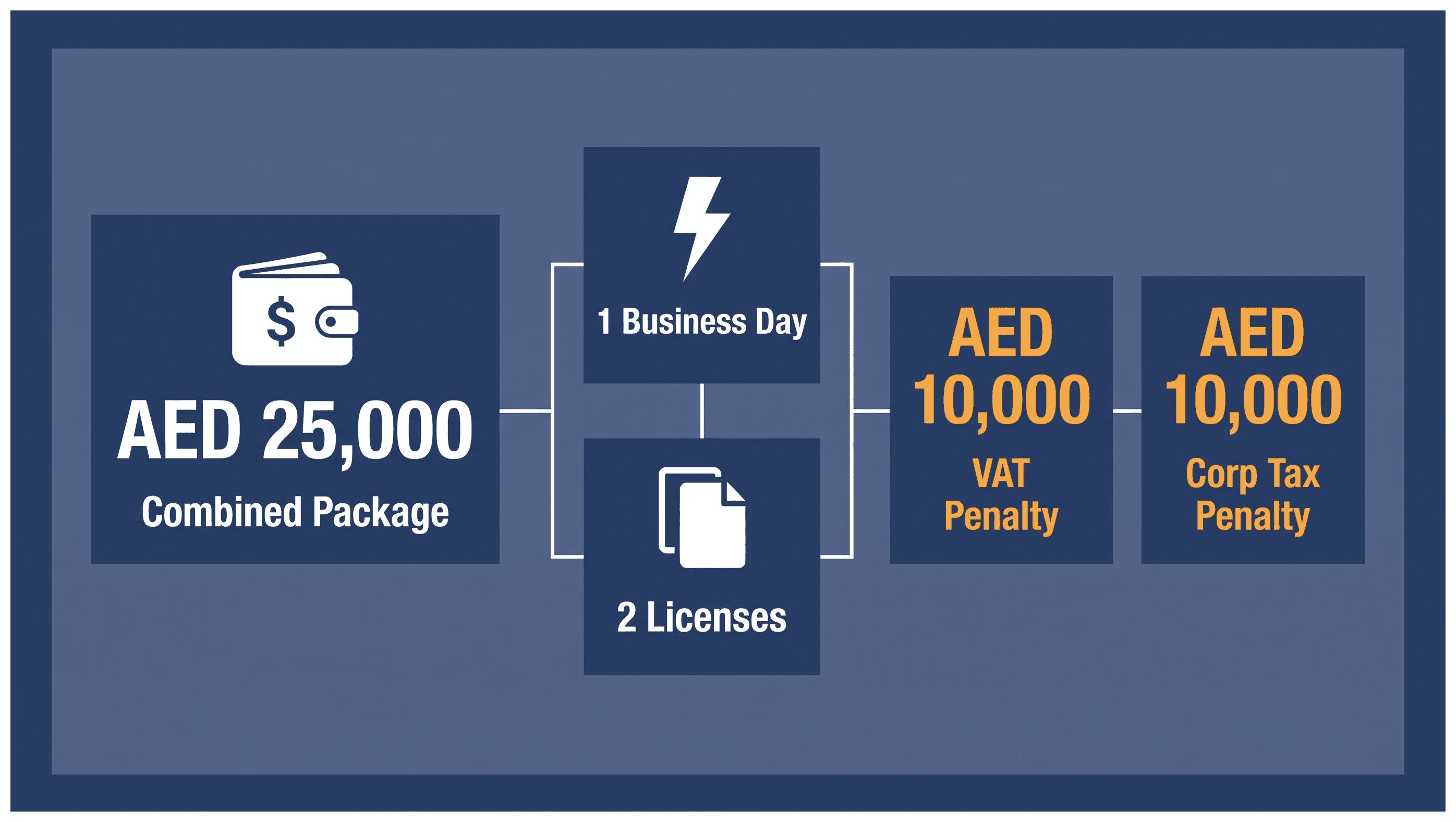
At Dubai South Business Hub Free Zone, a single shareholder can incorporate two entities concurrently, with each license issued in 1 business day, and combined one-off package costs starting at AED 25,000. The UAE imposes no statutory cap on the number of free zone entities one person may hold simultaneously. Each entity carries its own compliance calendar, tax registration obligations, and banking requirements from the moment its license is issued. Late VAT registration triggers a AED 10,000 penalty per entity, and the corporate tax late registration penalty is a separate AED 10,000 one-time flat charge per entity. This article explains the rules governing same time dubai company registration, breaks down every cost layer for running two entities in parallel, and shows exactly what each package includes so you can plan your budget before you commit.
What Running Two Companies at the Same Time in Dubai Actually Means
Running two companies at the same time in Dubai means holding two separate trade licenses, each with its own legal identity, activity scope, share register, and compliance calendar. UAE law permits this for individuals and corporate shareholders alike, with no cap on the number of entities a single person may own simultaneously.
How UAE Law Treats Parallel Entity Ownership
UAE free zone regulations treat each entity as a legally distinct vehicle. A shareholder's liability in each company is limited to their subscribed share capital in that specific entity only. Common shareholding across two entities creates no inter-entity conflict under UAE law, meaning Entity 1's obligations cannot be enforced against Entity 2's assets solely because they share an owner (UAE Cabinet, 2021).
At Dubai South Business Hub Free Zone, a single shareholder may hold multiple entities concurrently. Each is issued its own license, Articles of Association, share register, and flexi-desk lease agreement. A practical example: a logistics entrepreneur holds a trading company and a consultancy entity simultaneously, both licensed at the same free zone, both fully active, with no regulatory conflict between them.
Why Founders Run Two Entities Rather Than One
There are four clear commercial reasons to operate a same time company dubai structure rather than a single expanded license:
Activity separation. UAE license rules tie permitted activities to a specific license. ISIC Rev.4 covers 21 top-level sections and over 400 four-digit activity classes (UN Statistics Division, 2008). A second entity lets you operate in a different ISIC class without amending the first license. An owner whose first entity holds an ICT license in Dubai adds a second entity with a trading license to import hardware, keeping both revenue streams legally separate.
Liability ring-fencing. A high-risk activity in a separate entity protects the first company's assets from claims arising in the second.
Investor or partner structure. A second entity can hold a different shareholder mix, useful for joint ventures or sector-specific partners who don't need equity in the primary business.
Brand and market positioning. Two distinct trade names serve two different client audiences without confusion or cross-contamination of brand identity.
Rules You Must Know Before You Register a Second Same Time Company in Dubai
Before registering a second same time company in Dubai, confirm that each entity has a distinct trade name, a separately approved activity list, and its own capital structure. Visa allocations are capped at two per entity. Each company carries independent VAT and corporate tax registration obligations once the relevant thresholds are crossed.
Trade Name and Activity Restrictions Per Entity
Each company must carry a unique, approved trade name. The UAE trade name register rejects phonetically similar names, not just identical ones. An owner who tries to name a second company "Gulf Tech Solutions" when the first is already registered as "Gulf Technology Solutions" will find the register flags both as too similar and rejects the second submission. Use the trade name availability search tool before committing to a name for the second entity.
Activities are licensed per entity. You can't carry activities from Entity A on Entity B's license. For regulated activities, healthcare, financial services, and similar, Dubai South Business Hub Free Zone licenses the activity and the named regulator (for example, the Dubai Health Authority for healthcare) approves it separately. That dual-step process applies to each entity independently.
Visa Allocation Rules Across Two Entities
Maximum 2 visa allocations per entity. The allocation is the investor or partner visa entitlement for that entity.
Visa processing (entry permit, status change, medical, Emirates ID, stamping) is always quoted separately from the package price.
A shareholder can hold a visa under one entity while the second entity holds a separate allocation for a different investor. Two co-founders, for example, each take the investor visa under the entity where they hold shares.
You cannot pool visa allocations between two entities. Each entity's allocation is entirely independent.
Tax and VAT Registration for Two Entities
Each entity is a separate legal person for VAT purposes. If either crosses AED 375,000 in annual taxable supplies, it must register for VAT independently (Federal Tax Authority, 2026). An owner whose first entity is already VAT-registered and then launches a second entity sometimes assumes the registration carries over. It does not. The second entity must register separately once it crosses the threshold.
For corporate tax, each entity is assessed separately. Qualifying Free Zone Person (QFZP) status requires all four conditions to be met independently: adequate substance in the UAE, qualifying income, no election for the standard corporate tax regime, and full transfer pricing compliance. Running two entities doubles the compliance calendar, two sets of returns, two registration deadlines, two sets of financial statements.
How to Register Two Companies at the Same Time in Dubai: Step-by-Step
To register two companies at the same time in Dubai, confirm two distinct trade names, select the activity list for each entity, choose a visa package per entity, submit both applications with shareholder documents, and receive each license within one business day of approval. Each entity's compliance obligations begin on its own license issue date.
Step 1: Define Each Entity's Purpose and Activity Scope
Write a one-paragraph business case for each entity before you apply. This clarifies why two licenses are necessary and doubles as useful documentation for future banking due diligence. Map each entity's activities to the relevant ISIC class: for example, Entity 1 as a professional consultancy (ISIC Section M, Professional, Scientific and Technical Activities) and Entity 2 as a general trading company (ISIC Section G, Wholesale and Retail Trade). Activity descriptions must match the free zone's approved list exactly.
Check whether any intended activity is regulated. If it is, identify the corresponding regulator approval pathway before submitting. Review the full list of business activities in Dubai to confirm each entity's scope. Confirm that no regulated activity is included without that pathway identified, because the free zone license alone is not sufficient for regulated activities.
Step 2: Choose the Right Package for Each Entity
0 Visa Package, AED 12,500: Includes the license, Articles of Association, share register, flexi-desk space, and lease agreement. No visa allocation.
1 Visa Package, AED 16,350: Adds one investor or partner visa allocation and the establishment card.
2 Visa Package, AED 18,200: Adds two investor or partner visa allocations and the establishment card.
Packages can differ between the two entities. A sole founder might take the 2 Visa Package for Entity 1 (covering themselves and a business partner) and the 0 Visa Package for Entity 2, which functions as a holding structure with no staff requirement.
Same Time Dubai Cost Breakdown: One-Off vs Recurring Fees for Two Entities
Cost Item | One-Off Costs at Incorporation | Recurring Annual Costs |
|---|---|---|
0 Visa Package (per entity) | AED 12,500, includes license, AoA, share register, flexi-desk, lease | AED 12,500 annual renewal; mirrors original package price |
1 Visa Package (per entity) | AED 16,350, adds one investor/partner visa allocation and establishment card | AED 16,350 annual renewal; establishment card renewal included |
2 Visa Package (per entity) | AED 18,200, adds two investor/partner visa allocations and establishment card | AED 18,200 annual renewal; both allocations maintained on renewal |
Visa processing (entry permit, status change, medical, Emirates ID, stamping) | Quoted separately per visa allocation, not included in any package | Quoted separately on each visa renewal cycle |
Set by the receiving bank; not included in any package | No annual bank fee within the package; bank sets its own terms | |
Regulator approval fees (regulated activities only) | Additional, varies by regulator, budget separately per entity | May recur annually depending on the regulator's renewal schedule |
VAT and corporate tax compliance costs | Not included, engage a registered tax agent per entity | Not included, two entities mean two separate compliance retainers |
Step 3: Submit, Approve, and Activate Both Entities
Dubai South Business Hub Free Zone accepts concurrent applications for two entities from the same shareholder. Submit passport copies, chosen trade names, and activity lists for both at the same time. Each license is issued in 1 day once the application is approved. No additional inter-entity approval is required at free zone level.
After license issue, open a separate bank account for each entity. Banks treat each as a distinct legal person requiring its own full KYC pack: trade license, Articles of Association, share register, shareholder passport, proof of address, and business plan. A founder who already banks with a major UAE institution for Entity 1 can submit Entity 2's application through the same relationship manager, often cutting the onboarding timeline. Both licenses can be issued on the same day; the founder then opens two accounts in the following week, using each entity's own trade license and share register as the primary supporting documents.
Same Time Dubai Cost Breakdown: One-Off and Recurring Fees for Two Entities
The same time dubai cost for two entities depends on the visa packages selected. One-off costs cover two license packages ranging from AED 25,000 to AED 36,400 combined. Recurring costs include annual license renewals per entity. Visa processing, bank account fees, and any regulator approval fees are not included in any package.
One-Off Costs at Incorporation
Each entity's package price is a single one-off incorporation cost. It covers the license, Articles of Association, share register, flexi-desk space, and lease agreement. The 1 Visa and 2 Visa packages also include the establishment card and the relevant visa allocation.
The minimum combined one-off cost, both entities on the 0 Visa Package, is AED 12,500 + AED 12,500 = AED 25,000. The maximum, both entities on the 2 Visa Package, is AED 18,200 + AED 18,200 = AED 36,400. A finance manager budgeting for one operational entity with two visa allocations and one holding entity with no visa requirement would use AED 30,700 as the baseline: AED 18,200 for Entity 1 on the 2 Visa Package plus AED 12,500 for Entity 2 on the 0 Visa Package.
Recurring Annual Costs Per Entity
Each entity renews its license annually. Renewal fees mirror the original package price for the chosen tier.
An owner with both entities on the 1 Visa Package faces AED 16,350 x 2 = AED 32,700 in annual renewal costs, before visa processing or tax compliance.
Stagger incorporation dates if you want to spread cash flow impact across the year rather than facing two renewals simultaneously.
Flexi-desk lease agreements renew with the license. There's no separate lease renewal fee outside the package.
What Is Not Included in Any Package
Visa processing (entry permit, status change, medical, Emirates ID, stamping), quoted separately for each visa allocation across both entities.
Bank account opening fees, set by the receiving bank, not the free zone.
Regulator approval fees for regulated activities. A healthcare consultancy owner adding a second entity for medical device trading must budget for Dubai Health Authority (DHA) approval fees on top of the package cost for that second entity.
Accountancy, VAT filing, and corporate tax compliance costs, two entities mean two separate compliance engagements.
Calculate your full business setup cost in Dubai using the cost calculator before committing to any package combination.
Corporate Tax and VAT Obligations Across Two Entities
Each Dubai entity is assessed separately for VAT and corporate tax. VAT registration is mandatory once taxable supplies exceed AED 375,000 annually per entity. Corporate tax QFZP status requires meeting four conditions independently per entity. Late registration carries a AED 10,000 penalty each, and the corporate tax penalty is a one-time flat charge.
Qualifying Free Zone Person Conditions for Each Entity
QFZP status is assessed per entity, not per shareholder. An owner whose first entity qualifies as a QFZP must run a completely separate substance and income analysis for the second entity. The first entity's status does not carry over. Each entity must independently satisfy all four conditions: adequate substance in the UAE, qualifying income, no election for the standard corporate tax regime, and full transfer pricing compliance (Federal Tax Authority, 2026). An entity that fails any one condition loses QFZP status for that tax period and is taxed at the standard rate.
Is running two free zone entities more complex for tax than one?
Yes, in practice. Each entity files its own VAT returns, maintains its own corporate tax registration, and must independently satisfy QFZP conditions if it wants to benefit from the qualifying income regime. The compliance load is not simply doubled, intercompany transactions between the two entities add a transfer pricing layer that a single-entity structure avoids entirely.
Managing Two Compliance Calendars Without Overlap Errors
Assign each entity its own compliance tracker with separate VAT return due dates, corporate tax registration deadlines, and license renewal dates.
A finance manager who treats each entity as a separate internal client, setting calendar reminders 90 days before each deadline, avoids the most common missed-deadline errors in dual-entity structures.
AED 10,000 VAT late registration penalty applies per entity. AED 10,000 corporate tax late registration penalty also applies per entity as a one-time flat charge.
Consider appointing a single accountant or PRO service to oversee both entities. Shared oversight reduces the risk of a deadline slipping through the
References
Frequently Asked Questions