
Topic Summary
MoIAT ECAS Certification Is Non-Negotiable
Every solar panel model imported into the UAE must carry an MoIAT-approved conformity certificate under Cabinet Resolution No. 43 of 2017 before customs clearance is granted. Certificates are model-specific and wattage-specific, and remain valid for approximately three years.
IEC Standards Must Come From Accredited Labs
Crystalline silicon panels require IEC 61215 certification, thin-film panels require IEC 61646, and all module types must also meet IEC 61730 for safety qualification. Test reports are only accepted from ILAC-accredited laboratories — home-country certificates alone are not sufficient.
Arabic Labelling Is Mandatory, Not Optional
All solar panels sold in the UAE retail or wholesale market must carry Arabic labels under Federal Law No. 24 of 2006 on Consumer Protection. English-only labelling is enough to trigger a port hold, even if all other certifications are in order.
Grid-Tied Systems Need Extra Emirate-Level Approval
Beyond MoIAT certification, panels used in grid-tied installations must appear on the approved-product list of the relevant grid authority — DEWA, ADDC, or SEWA depending on the emirate. Off-grid systems are exempt from this additional layer of approval.
Classify Your HS Code Correctly Before Shipping
Photovoltaic cells and modules fall under HS Code 8541.40, but importers should confirm the exact 8-digit sub-heading with a licensed customs broker. Classification errors can trigger customs holds that delay entire shipments at Jebel Ali or Dubai International Airport.
Non-Compliance Costs Go Far Beyond the Fine
Panels seized at port are returned or destroyed at the importer's expense, and repeated violations can result in blacklisting of the importer's product registration account. Project delays caused by rejected shipments are typically passed on to the installer or developer client.
A Free Zone License Can Speed Up Market Entry
A trade license at Dubai South Business Hub covering electrical or renewable energy goods starts at AED 12,500 and can be issued in a single business day. VAT at 5% under Federal Decree-Law No. 8 of 2017 applies to all imported panels regardless of licensing structure.
In 2026, the UAE's installed solar capacity is on track to exceed 14 gigawatts as the country pushes toward its 44% clean energy target by 2050 (u.ae, 2024). That pipeline is pulling in a wave of trading and logistics companies looking to capitalise on solar panel import UAE opportunities before the market matures. The MoIAT Emirates Conformity Assessment Scheme (ECAS) is mandatory for all electrical imports under UAE Cabinet Resolution No. 43 of 2017. VAT applies at 5% under UAE Federal Decree-Law No. 8 of 2017. A free zone trade license at Dubai South Business Hub starts at AED 12,500 and is issued in one business day. And panels entering without a valid conformity certificate are seized at port at the importer's expense.
This guide covers the certification standards you must meet, the costs you should budget for, and the step-by-step import process, in that order, so you can move panels from port to project without a customs hold or a rejected shipment.
What Solar Panel Import UAE Certification Actually Means
Solar panel import UAE certification means every photovoltaic product entering the country must carry MoIAT-approved conformity marks, meet IEC performance standards, and clear UAE Federal Customs before sale or installation. Importers also need a valid trade license covering electrical or renewable energy goods and, for grid-tied systems, a separate DEWA technical approval.
Solar Panel UAE Requirements: Key Approvals at a Glance
Requirement | Applies To | Details |
|---|---|---|
MoIAT ECAS Conformity Certificate | All imported solar panel models | Mandatory before customs clearance; model-specific and wattage-specific; valid approximately three years (Cabinet Resolution No. 43 of 2017) |
IEC 61215 or IEC 61646 | Crystalline silicon (61215) or thin-film (61646) modules | Test reports must come from an ILAC-accredited laboratory; current IEC 61215 edition published 2021 |
IEC 61730 | All module types | Covers structural, electrical, and fire safety qualification; required alongside IEC 61215 or 61646 for MoIAT registration |
Arabic Labelling | All products sold in UAE retail or wholesale market | Mandatory under UAE Federal Law No. 24 of 2006 on Consumer Protection; English-only labels trigger port holds |
DEWA / ADDC / SEWA Approved-Product List | Grid-tied installations only | Emirate-specific approval required in addition to MoIAT; off-grid systems exempt from grid-authority approval |
HS Code 8541.40 | Photovoltaic cells and modules | Confirm exact 8-digit sub-heading with your customs broker; classification errors trigger customs holds |
Why the UAE Regulates Solar Panel Imports So Tightly
The UAE's 44% renewables target by 2050 makes panel quality a national infrastructure issue, not just a consumer protection matter (u.ae, 2024). Substandard photovoltaic modules have caused roof fires in markets with weaker oversight; MoIAT's mandate exists precisely to prevent that outcome on UAE rooftops and commercial facilities.
The UAE's membership of the Gulf Standardization Organization (GSO) also means technical harmonisation applies across the GCC. A product that fails UAE standards effectively fails the broader Gulf market.
Non-compliance carries real financial consequences:
Panels seized at Jebel Ali or Dubai International Airport cargo terminals
Return freight or destruction costs borne by the importer
Project delays passed on to the installer or developer client
Potential blacklisting of the importer's product registration account
A Chinese-manufactured 400W monocrystalline panel that passes IEC 61215 testing in its home country still requires UAE-specific MoIAT conformity registration before it can be cleared through Jebel Ali or Dubai International Airport cargo facilities. The home-country certificate is supporting evidence, not a substitute.
Which Government Bodies Oversee Solar Panel Imports
Four authorities have direct oversight of any solar panel import UAE shipment. Each has a distinct role, and satisfying one does not satisfy the others.
MoIAT (Ministry of Industry and Advanced Technology): issues UAE technical regulations and the ECAS conformity mark; mandatory for all electrical and electronic products under Cabinet Resolution No. 43 of 2017
UAE Federal Customs Authority: enforces HS code classification and clearance documentation at all ports of entry
DEWA (Dubai Electricity and Water Authority): approves grid-connected solar installations under its Smart Solar Programme, launched 2015
Ministry of Economy: registers importers and manages commercial licensing at the federal level
An importer clearing 500 panels through Dubai Trade's online portal must satisfy both Federal Customs (clearance) and MoIAT (product conformity) before the shipment is released. These are two parallel checks, not sequential ones. Many importers make the mistake of assuming customs clearance implies product conformity approval. It does not.
Solar Panel UAE Requirements: Standards and Conformity Marks
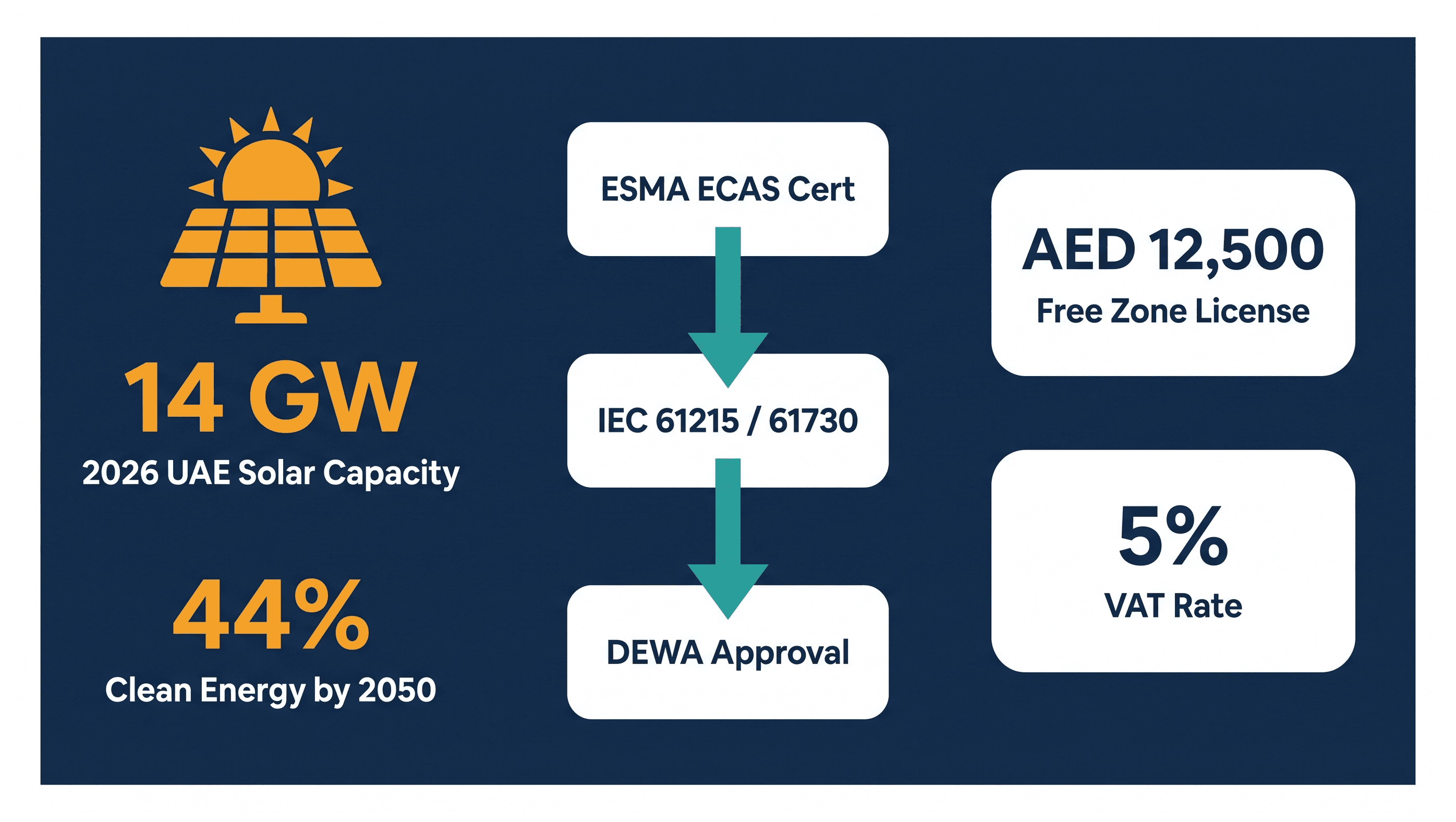
Solar panels imported into the UAE must comply with IEC 61215 (crystalline silicon) or IEC 61646 (thin film), carry the MoIAT ECAS conformity mark, and be tested by an accredited laboratory. Inverters must meet IEC 62109. Products without valid conformity certificates are blocked at UAE ports of entry.
IEC Standards Every Importer Must Know
These are the core standards you'll encounter when preparing an MoIAT ECAS application for solar panel import UAE purposes:
IEC 61215 (2021 edition): design qualification and type approval for crystalline silicon terrestrial PV modules
IEC 61646: equivalent performance standard for thin-film modules
IEC 61730: safety qualification covering structural integrity, electrical safety, and fire classification for all module types
IEC 62109 Parts 1 and 2: safety of power converters (inverters) for photovoltaic power systems
IEC 62305: may apply for lightning protection on larger commercial rooftop or ground-mount installations
A Dubai-based trading company importing bifacial PERC panels must hold valid IEC 61215 and IEC 61730 test reports from an ILAC-accredited laboratory. Presenting only a Chinese CQC certificate is not sufficient for MoIAT registration. The CQC mark confirms Chinese national standards compliance; MoIAT requires reports specifically issued by an ILAC-recognised body.
How MoIAT's ECAS Registration Works for Solar Products
The ECAS process follows a defined sequence. Don't skip steps or assume a previous registration covers a new product variant.
Create an account on the MoIAT online portal and initiate a product registration application
Compile the product dossier: IEC test reports from an ILAC-accredited lab, factory audit certificate, product datasheet, and Arabic and English label samples
Submit the dossier and pay the applicable registration fee (UNVERIFIED: confirm current AED fee with MoIAT before publishing)
MoIAT reviews the dossier; it may request additional documentation or order local market surveillance testing on random samples
On approval, MoIAT issues the ECAS certificate, which is valid for approximately three years
Worth flagging: the ECAS certificate is model-specific and wattage-specific. If you add a 450W version of a previously registered 400W panel to your import catalogue, you must file a separate ECAS application. The existing certificate does not automatically extend to the new model. Renewal at the three-year mark requires updated lab reports, not just a fee payment.
Labelling and Packaging Rules for Solar Panels
Every panel entering the UAE market must carry a label that includes:
The ECAS conformity mark
Manufacturer name and country of origin
Electrical ratings (wattage, voltage, current)
Arabic-language text covering all mandatory label fields
Arabic labelling is mandatory for all products sold in the UAE retail or wholesale market under UAE Federal Law No. 24 of 2006 on Consumer Protection. Country-of-origin marking on outer packaging must also match the customs declaration exactly; mismatches trigger automatic holds. A logistics company clearing a container at Jebel Ali with English-only labels will face a hold until Arabic-compliant labels are applied, either in a UAE customs zone or, preferably, before the shipment departs the origin country. Applying labels in a customs zone adds cost and time; getting them right before shipment costs nothing extra.
Grid-Connection and Technical Approval Requirements
Any solar panel system connected to the UAE grid requires a separate technical approval from the relevant distribution authority: DEWA in Dubai, ADDC or AADC in Abu Dhabi, or SEWA in Sharjah. Importers supplying grid-tied installers must confirm their panels appear on the authority's approved product list before delivery.
DEWA's Approved Product List and What It Means for Traders
DEWA maintains a list of pre-approved solar panel models for its Smart Solar Programme. Only panels on that list can be installed in grid-tied systems within Dubai. Manufacturers or their UAE agents apply directly to DEWA, submitting IEC test reports and full product data sheets.
Verify DEWA list status before accepting a purchase order from a Dubai installer
If a model is absent from the list, the installer's grid-connection permit will be refused
Off-grid (standalone) systems do not require DEWA product approval, but still need MoIAT ECAS conformity
DEWA's Smart Solar Programme launched in 2015 under the Dubai Clean Energy Strategy
A trading company that imports 1,000 panels for a Dubai villa developer must confirm each model is on the DEWA approved list. If even one model is absent, the developer's grid-connection permit will be refused, stalling the entire project. Check the list before you commit to a purchase order, not after the container ships.
Abu Dhabi and Northern Emirates Grid Approval Differences
Federal-level MoIAT certification is accepted across all seven emirates. Emirate-level grid approval is separate and emirate-specific. A panel model approved by DEWA is not automatically accepted by the Abu Dhabi Distribution Company (ADDC) or the Al Ain Distribution Company (AADC). Sharjah Electricity and Water Authority (SEWA) runs its own technical submission process as well.
Traders operating across multiple emirates need to track approval status with each distribution authority independently. In practice, this means maintaining a product approval matrix: one column per authority, one row per panel model. It's a small administrative task that prevents large commercial delays.
What does "approved product list" mean for a solar panel trader?
An approved product list is a register of specific panel models that a distribution authority has pre-cleared for grid-tied installation. MoIAT conformity proves a panel is safe; the approved product list proves it meets the authority's technical specifications for grid connection. Both are required for grid-tied supply contracts, and each authority maintains its own list independently.
Step-by-Step Guide to Importing Solar Panels Into the UAE
To import solar panels into the UAE: obtain a trade license covering renewable energy goods, register products under MoIAT's ECAS scheme, classify panels under the correct HS code, prepare a customs declaration via Dubai Trade, clear UAE Federal Customs, and verify DEWA or emirate grid-authority approval before supplying to installers.
Step 1: Secure the Right Trade License
Your trade license must explicitly cover the import activity. The activity description needs to reference electrical goods, renewable energy equipment, or solar panels. A generic trading license without the correct activity listed will not satisfy customs or MoIAT checks.
A trading license in Dubai through a free zone allows import, re-export, and wholesale distribution without requiring a UAE national partner. Dubai South Business Hub Free Zone issues licenses in one business day. Packages are:
0 Visa Package: AED 12,500, includes license, Articles of Association, share register, flexi-desk space
1 Visa Package: AED 16,350, adds visa allocation and establishment card
2 Visa Package: AED 18,200, adds two visa allocations and establishment card (up to six visa allocations, with published packages offering 0, 1 or 2)
Visa processing (entry permit, status change, medical, Emirates ID) is quoted separately
A Singapore-based solar distributor setting up a UAE import entity at Dubai South Business Hub Free Zone can have its trade license issued the same day it submits documents, then immediately begin the MoIAT product registration process in parallel. Sequence matters: license first, MoIAT application second, shipment booking third.
Step 2: Register Products Under MoIAT ECAS Before Shipment
Engage an ILAC-accredited laboratory to produce IEC 61215 (or 61646) and IEC 61730 test reports for each panel model
Compile the full product dossier: test reports, factory audit certificate, product datasheet, and Arabic and English label samples
Submit the dossier via the MoIAT online portal and pay the applicable registration fee
Wait for MoIAT confirmation before booking freight; do not assume approval is automatic
File the ECAS certificate by model and wattage; customs may request it at clearance
Booking a shipment before the ECAS certificate is issued is a common and costly mistake. Panels arriving at Jebel Ali without a valid conformity certificate are held in port storage at the importer's daily cost until documentation is resolved. There is no grace period. Getting the paperwork sequenced correctly costs nothing; getting it wrong can cost thousands in storage fees alone.
Step 3: Classify, Declare, and Clear Through UAE Customs
Required documents for customs clearance of a solar panel import UAE shipment:
Commercial invoice
Packing list
Certificate of origin (country-of-origin marking must match the customs declaration)
Bill of lading or airway bill
MoIAT ECAS conformity certificate for each panel model
References
Frequently Asked Questions