Topic Summary
What Is Status Change Inside Dubai and When It Applies
A status change inside Dubai is the process of converting your current UAE visa status to a new residency visa without exiting the country. It is available to holders of certain visa categories and allows founders to obtain investor or partner residency through a licensed UAE com
Status Change Dubai Cost: Full Fee Breakdown
Status Change Dubai Cost: Full Fee Breakdown
Step-by-Step Guide to Completing a Status Change Inside Dubai
Completing a status change inside Dubai involves five sequential steps: obtaining the free zone license, applying for the investor entry permit, paying the in-country status change fee, completing the medical fitness test and Emirates ID biometrics, and collecting the stamped res
When an Exit Is Still Required: Situations Status Change Cannot Resolve
A status change inside Dubai cannot be used in every situation. If your current visa is already expired, if you are on a visa category excluded by ICP rules, or if a prior residency cancellation has not been properly processed, you will need to exit the UAE and re-enter before th
How Status Change Company Dubai Works with a Free Zone License
A status change company Dubai setup links your free zone license directly to your investor residency application. The company provides the legal basis for the visa allocation, and the establishment card issued with the license authorises the free zone to sponsor your residency vi
Status Change Timeline: What to Expect at Each Stage
The status change inside Dubai timeline runs across five stages spanning 15 to 25 working days: license issuance (1 day), entry permit approval (3 to 5 working days), status change processing (2 to 4 working days), medical and Emirates ID (3 to 7 working days), and visa stamping
In 2026, government fees for a status change inside Dubai total AED 3,000 to AED 5,500 per applicant across five fee stages: entry permit, status change fee, medical fitness test, Emirates ID issuance, and visa stamping. The full process runs 15 to 25 working days under standard conditions (ICP, 2026). You complete it without leaving the UAE. No visa run, no exit stamp, no return flight booked in advance. This guide explains exactly what status change inside Dubai means, when it applies, what each fee stage covers, and when an exit is unavoidable, so you can plan your company setup costs accurately from day one.
What Is Status Change Inside Dubai and When It Applies
A status change inside Dubai is the process of converting your current UAE visa status to a new residency visa without exiting the country. It is available to holders of certain visa categories and allows founders to obtain investor or partner residency through a licensed UAE company while remaining in the UAE.
The Definition: What Status Change Actually Means
Status change is an in-country visa conversion. Your existing visa is cancelled and a new residency visa is issued without an exit stamp appearing in your passport. It is processed through the Federal Authority for Identity, Citizenship, Customs and Port Security (ICP) or GDRFAD depending on your emirate and visa type.
The process is distinct from visa renewal. Renewal extends the same visa category; status change converts you from one category to another entirely. The most common conversion is a tourist visa or visit visa converted to investor residency tied to a free zone company license.
Here is a concrete example: a founder enters Dubai on a 30-day tourist visa, incorporates a company at a free zone, and completes a status change to investor residency without booking a return flight. That is the route this guide covers.
Who Is Eligible for an In-Country Status Change
Holders of valid tourist visas, visit visas, and transit visas are generally eligible for an in-country status change inside Dubai.
Holders of an existing valid residency visa sponsored by another employer or free zone typically need to cancel that visa before proceeding.
Eligibility is confirmed at the time of entry permit application; the status type on your passport at that point determines the route available to you.
Overstay situations are not covered by standard status change procedures and require separate regularisation with ICP.
A founder on a 90-day multiple-entry visit visa can apply for an investor entry permit while in the UAE, then convert to full residency through the status change route. Check your UAE residency visa eligibility before committing any fees.
Status Change Dubai Cost: Full Fee Breakdown
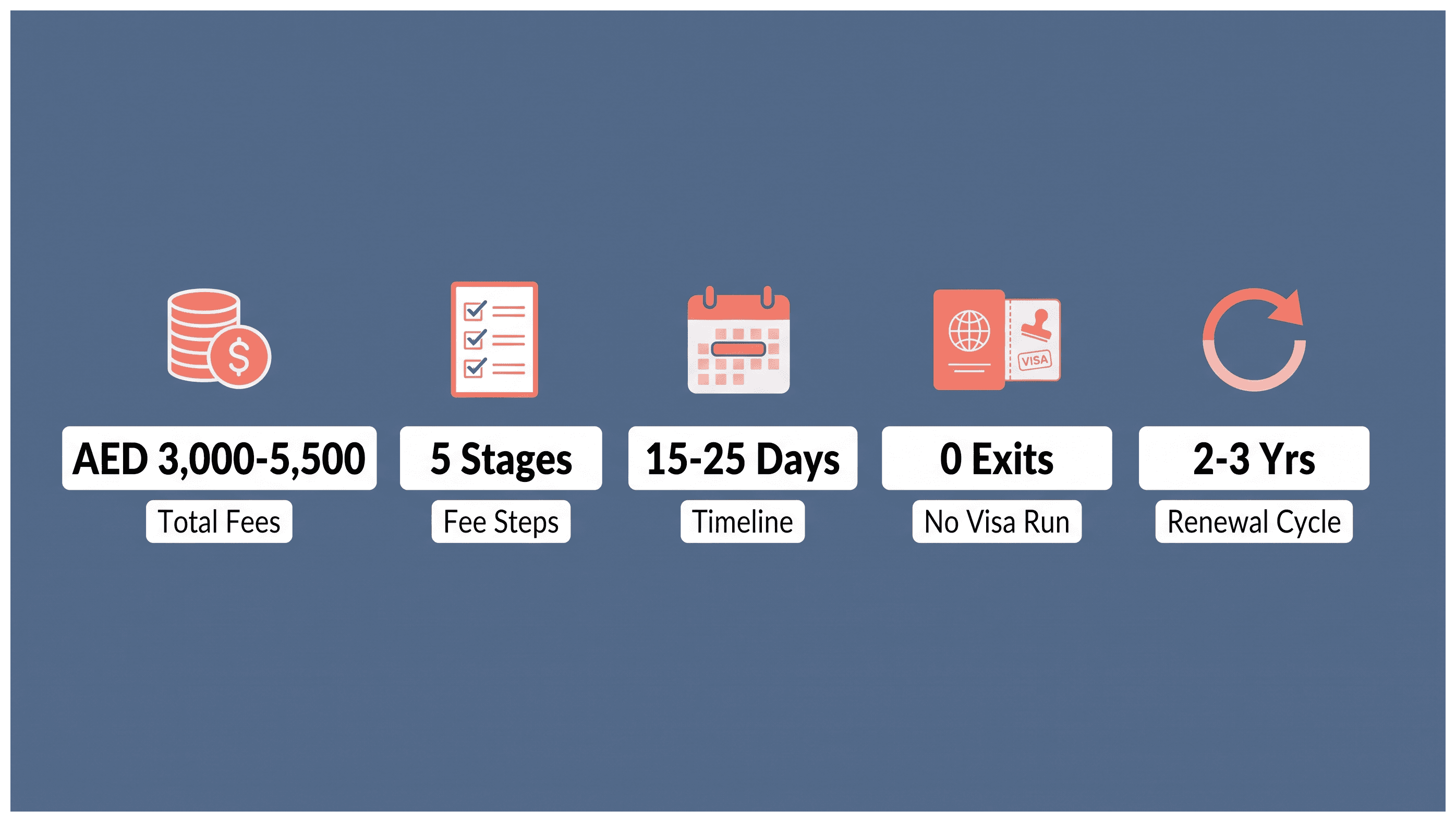
The status change Dubai cost covers five distinct fee stages: entry permit, status change fee, medical fitness test, Emirates ID, and visa stamping. Total government fees typically range from AED 3,000 to AED 5,500 per applicant. These fees are separate from any free zone license or package cost.
One-Off vs. Recurring Fees: What the Table Shows
Every fee in the status change inside Dubai sequence falls into one of two buckets: one-off costs you pay once per visa cycle, and recurring costs that return every two to three years at renewal. Separating them clearly is the only way to budget accurately for both your launch year and your ongoing residency obligations.
Status Change Inside Dubai: One-Off vs. Recurring Government Fees
Fee Item | One-Off Fees (per visa cycle) | Recurring Fees (every 2–3 years) |
|---|---|---|
Entry permit | UNVERIFIED: <AED figure>, paid once when applying for investor entry permit. Confirm before publishing. | Not applicable at renewal |
Status change fee | UNVERIFIED: <AED figure>, the in-country conversion fee paid to ICP. Confirm before publishing. | Not applicable at renewal |
Medical fitness test | UNVERIFIED: <AED figure>, conducted at a DHA-approved centre. Confirm before publishing. | Required again at each visa renewal cycle |
Emirates ID issuance | UNVERIFIED: <AED figure>, issued after biometrics at ICP or authorised typing centre. Confirm before publishing. | UNVERIFIED: <AED figure> renewal fee per cycle. Confirm before publishing. |
Visa stamping | UNVERIFIED: <AED figure>, residency visa printed in passport at final stage. Confirm before publishing. | UNVERIFIED: <AED figure> visa renewal fee per cycle. Confirm before publishing. |
Health insurance (mandatory) | Sourced independently, not included in any package or government fee schedule | Renewed annually; cost varies by provider and coverage level |
Note: All figures marked UNVERIFIED must be confirmed against current ICP and GDRFAD schedules before publishing. Source: ICP and GDRFAD, 2026.
PRO or business support service fees sit on top of all government fees and vary by provider. Always get a line-item quote so nothing is hidden.
What Is Not Included in the Status Change Fee
A founder purchasing the 1 Visa Package at AED 16,350 still needs to budget separately for the full visa processing sequence before their Emirates ID is issued. The package and the visa processing fees are two distinct cost layers.
Free zone license package: Priced separately from visa processing. DSBH offers three packages: 0 Visa Package at AED 12,500, 1 Visa Package at AED 16,350, and 2 Visa Package at AED 18,200.
Package inclusions: Every package includes the license, Articles of Association, share register, flexi-desk space, and lease agreement. The 1 and 2 Visa packages add the visa allocation and establishment card.
Visa allocation clarification: The visa allocation is the investor or partner visa slot. It is one slot per allocation, not two visas.
Maximum allocations: A maximum of 2 visa allocations per company applies. You cannot exceed this regardless of company structure.
Health insurance: Mandatory for all UAE residents. It is not included in any package and must be sourced independently before your residency visa is active.
Step-by-Step Guide to Completing a Status Change Inside Dubai
Completing a status change inside Dubai involves five sequential steps: obtaining the free zone license, applying for the investor entry permit, paying the in-country status change fee, completing the medical fitness test and Emirates ID biometrics, and collecting the stamped residency visa. The full sequence takes 15 to 25 working days.
Step 1: Secure Your Free Zone License and Visa Allocation
The license is the prerequisite for any visa application. At Dubai South Business Hub Free Zone, the license is issued in 1 day. Choose the 1 or 2 Visa Package to include a visa allocation because without it, visa processing cannot begin.
Confirm your chosen business activities at this stage. They appear on the license and cannot be changed without an amendment fee later. The establishment card is included in the 1 and 2 Visa packages and is required for investor visa applications.
A solo founder selects the 1 Visa Package at AED 16,350, receives the license and establishment card on day one, and is ready to begin visa processing the same week.
Step 2: Apply for the Investor Entry Permit
The entry permit application is submitted through ICP or via an authorised PRO service. Required documents typically include a passport copy, passport photo, license copy, and establishment card. Entry permit approval is usually issued within 3 to 5 working days.
Once the entry permit is approved, the in-country status change application can be submitted immediately. No exit is required. With the entry permit approved and still on a valid tourist visa, the founder submits the status change application the same day rather than flying out for a visa run.
Step 3: Medical, Emirates ID, and Visa Stamping
The medical fitness test is conducted at a DHA-approved centre. Results are typically available within 1 to 3 working days. Emirates ID biometrics are registered at an ICP or authorised typing centre; the ID card is delivered by post within UNVERIFIED: <number> working days. Confirm before publishing.
Visa stamping is the final step, resulting in the residency visa printed in your passport. A founder completing the medical test on day 6 and Emirates ID biometrics on day 7 can expect the stamped visa by working day 20 to 25 under standard processing.
When an Exit Is Still Required: Situations Status Change Cannot Resolve
A status change inside Dubai cannot be used in every situation. If your current visa is already expired, if you are on a visa category excluded by ICP rules, or if a prior residency cancellation has not been properly processed, you will need to exit the UAE and re-enter before the investor visa process can begin.
Expired Visa and Overstay Situations
If your visa has already expired, you are in overstay and the standard status change route is closed to you. Overstay fines apply per day and must be settled before any new visa process can begin. The daily fine is UNVERIFIED: <AED figure per day>. Confirm before publishing.
In overstay cases, the standard resolution is exiting the UAE, paying the fine at the airport, and re-entering on a fresh visa. A founder whose tourist visa expired three days before the license was issued must exit, pay the overstay fine, and re-enter before the entry permit application can proceed. ICP governs overstay regularisation (ICP, 2026).
Prior Residency Cancellation and Visa Category Restrictions
If you held a previous UAE residency visa that was cancelled but the cancellation was not correctly recorded with ICP, a status change application may be rejected mid-sequence. Certain visa categories issued by specific authorities may not be convertible in-country and require an exit-and-re-entry instead.
Checking your current visa status with ICP before starting the company formation process avoids costly delays. A founder previously sponsored by a mainland employer whose visa was cancelled six months ago should confirm ICP records are clean before relying on the status change route. A qualified PRO service can confirm eligibility before any fees are committed.
How Status Change Company Dubai Works with a Free Zone License
A status change company Dubai setup links your free zone license directly to your investor residency application. The company provides the legal basis for the visa allocation, and the establishment card issued with the license authorises the free zone to sponsor your residency visa through the in-country status change route.
The Role of the Free Zone License in Your Visa Eligibility
The free zone license is the legal entity that sponsors the investor visa. Without an active license, the visa cannot be issued. A founder who wants to set up a company at Dubai South Business Hub Free Zone and apply for investor residency selects the 1 Visa Package at AED 16,350, which includes the license, establishment card, and one visa allocation for the status change process.
The 2 Visa Package at AED 18,200 covers two founders or partners. The maximum is 2 visa allocations per company. Worth flagging: DSBH is not a designated zone and does not provide bonded warehousing. Free zone goods are duty-suspended, not duty-exempt, when moved into the UAE mainland customs territory.
Corporate Tax and VAT Obligations You Must Plan For
VAT late registration penalty: AED 10,000. Register before the mandatory threshold is crossed to avoid this flat penalty (Federal Tax Authority, 2026).
Corporate tax late registration penalty: AED 10,000, a one-time flat penalty. Register on time regardless of taxable income level.
0% corporate tax for Qualifying Free Zone Persons (QFZPs): Requires four conditions, all of which must be met: qualifying income, adequate substance, no mainland permanent establishment, and transfer pricing compliance.
Banking and taxation obligations: Once your company is active, review the banking and taxation guidance for a full picture of ongoing compliance requirements.
Status Change Timeline: What to Expect at Each Stage
The status change inside Dubai timeline runs across five stages spanning 15 to 25 working days: license issuance (1 day), entry permit approval (3 to 5 working days), status change processing (2 to 4 working days), medical and Emirates ID (3 to 7 working days), and visa stamping (1 to 3 working days).
Normal Processing vs. Priority Processing
Standard processing follows the 15 to 25 working day range for the full visa sequence. Priority or express processing is available for some steps through ICP and GDRFAD for an additional fee, reducing individual stage timelines. Priority medical appointments can also be booked at DHA-approved centres for faster turnaround.
References
Frequently Asked Questions