
Topic Summary
What Is the Tax Position of Lebanese Nationals Financial UAE Owners and How Does It Work
Lebanese nationals financial UAE owners face 9% corporate tax on taxable profit above AED 375,000, with 0% on qualifying free zone income. There's no UAE personal income tax. The company still has to register with the Federal Tax Authority, keep records and file every year.
How Free Zone Status Shapes Corporate Tax for a Dubai Company Lebanese National
How Free Zone Status Shapes Corporate Tax for a Dubai Company Lebanese National
VAT, Registration and Filing Obligations for UAE Business From Lebanon
UAE VAT is 5%. Registration is mandatory once taxable supplies and imports pass AED 375,000 in 12 months, and voluntary from AED 187,500 ( Federal Tax Authority , 2026). Registered businesses file returns, usually quarterly, and issue compliant tax invoices.
Lebanese Tax Residency and Personal Reporting Considerations
A UAE company doesn't remove Lebanese obligations automatically. Residency, income sourcing and reporting rules may still apply if you keep ties to Lebanon. Lebanese nationals financial UAE planning needs advice from a qualified Lebanese and UAE adviser before you remit dividends or salary.
Why Capital Controls at Home Make a UAE Account Essential for Lebanese Nationals Financial UAE Planning
Capital controls and banking restrictions in Lebanon make a UAE corporate account essential for client payments, Federal Tax Authority payments and company funds. It gives clean audit trails and supports tax filings without relying on restricted domestic channels.
Step-by-Step Process to Stay Tax Compliant With the Federal Tax Authority
Set up the licensed company, register for corporate tax, assess VAT, open a UAE account, keep accounts and file annually. Follow that order, and pay within nine months of year end.
Costs, Penalties and Common Mistakes Lebanese Owners Make
Budget for the license from AED 12,500 per year (quoted May 2026), plus accounting, audit and VAT filing. Skipped registration, mixed funds and weak substance can all trigger Federal Tax Authority penalties.
In 2026, a Dubai company owned by a Lebanese national pays 0% on qualifying free zone income and 9% on other taxable profit above AED 375,000 [1]. It must register for corporate tax and file annually, while personal income from the UAE isn't taxed, though you should check Lebanese reporting duties with an adviser. This guide is for Lebanese nationals financial UAE planners who want to know what they owe, and when.
What Is the Tax Position of Lebanese Nationals Financial UAE Owners and How Does It Work
Lebanese nationals financial UAE owners face 9% corporate tax on taxable profit above AED 375,000, with 0% on qualifying free zone income. There's no UAE personal income tax. The company still has to register with the Federal Tax Authority, keep records and file every year.
Corporate Tax Basics for a Dubai Company Lebanese National
The rate comes from Federal Decree-Law No. 47 of 2022, with the AED 375,000 threshold confirmed by the Ministry of Finance in 2023. Registration is mandatory even when you owe nothing. Picture a Lebanese consultant with AED 300,000 in annual profit: the 9% rate doesn't apply, yet she still registers and files. The return is due within nine months of financial year end.
No Personal Income Tax on UAE Earnings
Salary from your UAE company isn't taxed in the UAE.
Dividends are also free of UAE personal tax.
Company tax and owner tax are separate questions.
Home-country rules sit outside UAE law.
For setup basics, read what Lebanese founders need to know before setting up in Dubai.
How Free Zone Status Shapes Corporate Tax for a Dubai Company Lebanese National
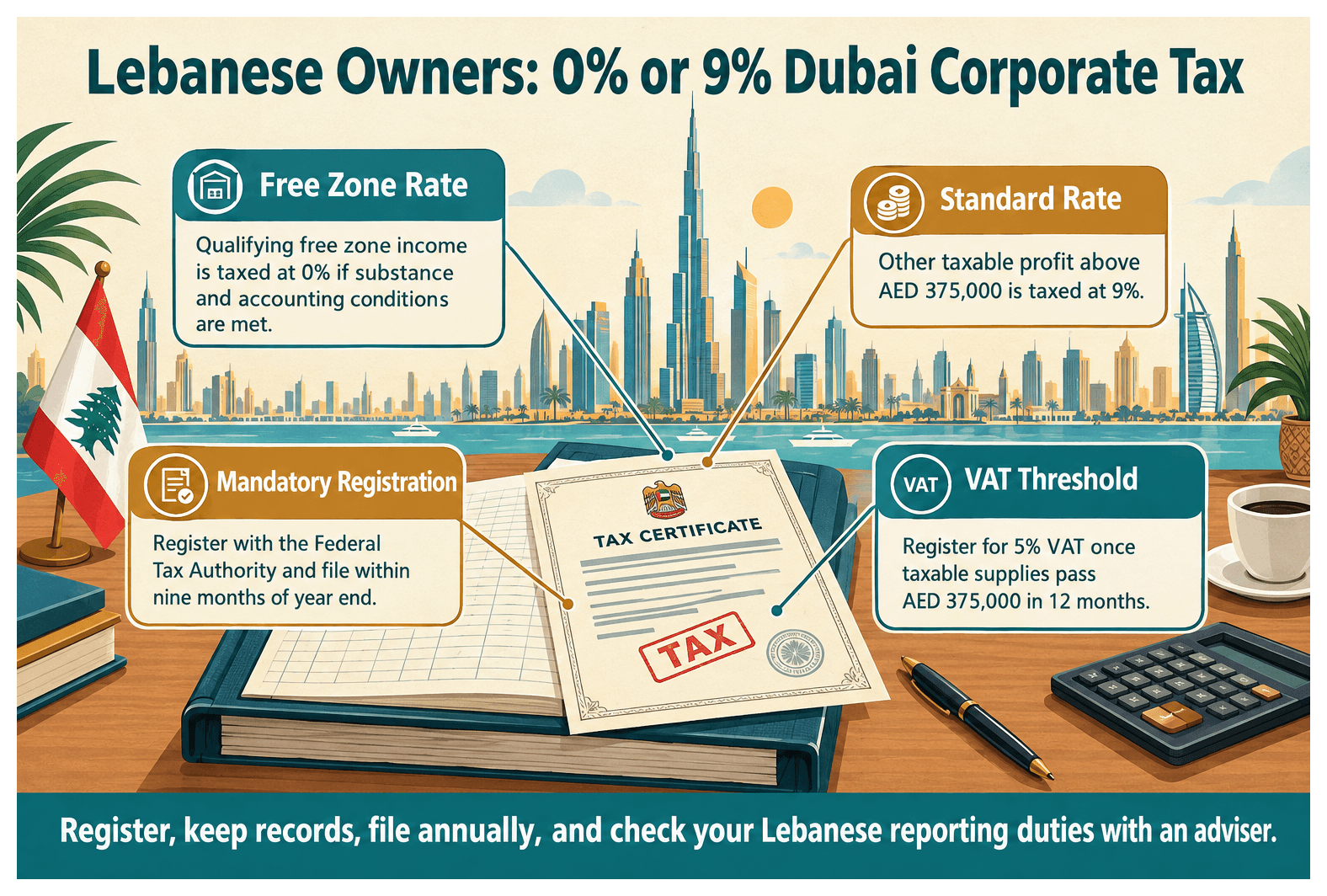
A free zone company can reach 0% on qualifying income if it meets substance, accounting and de minimis conditions. Non-qualifying income is taxed at 9% above AED 375,000. Never assume the result is tax free: your activity and records decide it.
Qualifying Free Zone Person Conditions
Adequate substance in the UAE.
Audited financial statements.
Qualifying, not excluded, activities.
Compliance with transfer pricing and de minimis limits.
Compare two traders. One sells to other free zone businesses and may qualify. The other sells to mainland consumers and could see that income taxed at 9%.
Choosing a License Activity That Supports Your Tax Position
Match the license to what you actually do. Dubai South Business Hub Free Zone licenses start from AED 12,500 per year (quoted May 2026). Run your trade name through the name check tool before filing. Service firms may also look at taxation procedures follow-up licenses. Our guide to setting up a company in Dubai South as a Lebanese national covers the process.
VAT, Registration and Filing Obligations for UAE Business From Lebanon
UAE VAT is 5%. Registration is mandatory once taxable supplies and imports pass AED 375,000 in 12 months, and voluntary from AED 187,500 (Federal Tax Authority, 2026). Registered businesses file returns, usually quarterly, and issue compliant tax invoices.
When VAT Registration Becomes Mandatory
Mandatory threshold: AED 375,000.
Voluntary threshold: AED 187,500.
Qualifying exports are zero-rated.
Track turnover on a rolling 12-month basis.
Invoicing and Record-Keeping Basics
Keep records for five years. An invoice to a Beirut client can be an export of services where conditions are met, so zero-rated. Goods trading adds license questions, covered in import and export between Lebanon and Dubai.
Lebanese Tax Residency and Personal Reporting Considerations
A UAE company doesn't remove Lebanese obligations automatically. Residency, income sourcing and reporting rules may still apply if you keep ties to Lebanon. Lebanese nationals financial UAE planning needs advice from a qualified Lebanese and UAE adviser before you remit dividends or salary.
Residency Status Changes the Analysis
Take an owner with a UAE investor visa who lives mostly in Dubai. Her Emirates ID and days spent in Lebanon become key evidence. The UAE hosts over 9 million expatriates (UAE Government Portal, 2024), so you're far from alone. See UAE investor visa for Lebanese nationals.
Dividends, Salary and Remittances
Document your source of funds.
File board resolutions for dividends.
Keep payroll records.
Ask an adviser about home treatment.
Why Capital Controls at Home Make a UAE Account Essential for Lebanese Nationals Financial UAE Planning
Capital controls and banking restrictions in Lebanon make a UAE corporate account essential for client payments, Federal Tax Authority payments and company funds. It gives clean audit trails and supports tax filings without relying on restricted domestic channels.
Banking Restrictions at Home and the UAE Alternative
The Central Bank of the UAE regulates more than 40 licensed commercial banks. A Lebanese trader can receive client payments directly in AED and pay tax from the same account. Read about opening a UAE corporate bank account.
Account Records That Support Tax Compliance
Statements back your audited accounts.
Separate personal and business funds.
Reconcile statements to VAT returns.
Tax and Compliance Obligations for a Dubai Company Lebanese National (AED)
Feature | Obligation | Rate, Trigger or Fee |
|---|---|---|
Free zone license | Renew the trade license annually | From AED 12,500 per year (quoted May 2026) |
Corporate tax | Register, even at 0% | 9% above AED 375,000; 0% on qualifying income |
VAT | Register and file returns | 5%; mandatory above AED 375,000 |
Personal income tax in UAE | None on salary or dividends | 0% |
Annual corporate tax return | File and pay any tax due | Within nine months of year end |
Step-by-Step Process to Stay Tax Compliant With the Federal Tax Authority
Set up the licensed company, register for corporate tax, assess VAT, open a UAE account, keep accounts and file annually. Follow that order, and pay within nine months of year end.
Step 1: Incorporate and Register for Corporate Tax
Obtain your license.
Register on the Federal Tax Authority portal promptly.
Budget with the cost calculator.
Step 2: Assess VAT and Open a UAE Bank Account
Review rolling turnover quarterly against AED 375,000.
Open the account before invoicing clients.
Step 3: Keep Accounts, Audit and File
Maintain bookkeeping and substance evidence.
Get audited statements if claiming free zone status.
Year end 31 December means filing by 30 September.
Need help? See corporate tax filing services in Dubai.
Costs, Penalties and Common Mistakes Lebanese Owners Make
Budget for the license from AED 12,500 per year (quoted May 2026), plus accounting, audit and VAT filing. Skipped registration, mixed funds and weak substance can all trigger Federal Tax Authority penalties.
Mistakes to Avoid
Skipping registration because profit is below AED 375,000.
Missing filing deadlines.
Choosing an activity that doesn't match real work.
Assuming you have no obligations at home.
Mixing personal and company money.
Does a Free Zone Company Need to Register at 0%?
Yes. A company with no tax to pay must still register with the Federal Tax Authority and file. Registration is a legal duty, not a bill, and missing it can bring administrative penalties regardless of profit.
Conclusion
Lebanese nationals financial UAE owners get 0% personal income tax, a 9% corporate rate above AED 375,000 and a possible 0% free zone rate. That only holds with registration, substance, a UAE bank account and clean records. Compare notes with how UK tax rules apply to Dubai company owners. Use the cost calculator and name check, then speak with Dubai South Business Hub to start your license and residency package.
References
Frequently Asked Questions


