Topic Summary
What Is Trade License Attestation in Dubai and Why It Matters Abroad
Trade license attestation in Dubai is the official process of having your UAE trade license verified by a chain of government authorities, starting with the issuing body, then the UAE Ministry of Foreign Affairs, and finally the destination country's embassy or consulate, so the
Which Authorities Approve Each Stage of the Attestation Chain
Which Authorities Approve Each Stage of the Attestation Chain
Step-by-Step Guide to Getting Your Trade License Attested for Use Abroad
To get a Dubai trade license attested for use abroad, collect certified copies from the free zone or DET, obtain a Dubai Chamber stamp if required, submit to MOFA for attestation or apostille, and then proceed to the destination country's embassy if that country is not a Hague Co
Trade License Attestation Cost Breakdown: One-Off vs Recurring Fees
Trade license attestation Dubai costs range from AED 1,500 to AED 4,500 or more depending on the destination country, document count, and service speed. The main one-off fees cover free zone certification, MOFA attestation, and embassy legalisation. Translation, courier, and agen
Regulated Activities and Additional Approvals Before Attestation
If your trade license covers a regulated activity such as healthcare, financial services, or education, the license alone is not sufficient for overseas use. The relevant UAE regulator must have issued its own approval, and that approval document may also need to enter the attest
In 2026, a single trade license attestation Dubai chain typically costs between AED 1,500 and AED 4,500 in government fees alone. Most overseas founders budget nothing for it until a bank, regulator, or overseas partner asks for a certified copy of their UAE company documents. The UAE joined the Hague Apostille Convention in January 2022, simplifying the process for 120+ member states. Full embassy legalisation still applies to Gulf states including Saudi Arabia, Qatar, and Kuwait. Total turnaround runs from 5 to 20 working days depending on destination. This guide explains what trade license attestation involves, which authorities sign off at each stage, what the process costs, and what every trade license company Dubai needs to prepare before starting.
What Is Trade License Attestation in Dubai and Why It Matters Abroad
Trade license attestation in Dubai is the official process of having your UAE trade license verified by a chain of government authorities, starting with the issuing body, then the UAE Ministry of Foreign Affairs, and finally the destination country's embassy or consulate, so the document is legally recognised outside the UAE.
The Definition: What Attestation Actually Certifies
Attestation confirms the authenticity of the issuing authority's signature and seal. It does not verify the content of the license itself. The process creates a verifiable chain of authority from the free zone or DET through UAE federal bodies to the foreign state.
Without attestation, most overseas banks, regulators, and government bodies will not accept a UAE trade license as a valid legal instrument. Worth flagging here: apostille is a simplified single-stamp alternative to full embassy legalisation, available for Hague Convention member states. The UAE joined the Hague Apostille Convention in January 2022 (u.ae, 2022), meaning apostille now replaces multi-stage embassy legalisation for 120+ member countries.
A Dubai South free zone company opening a bank account in Germany, for example, can use an apostille rather than full embassy legalisation, cutting one stage from the process and reducing turnaround by several days.
When a Trade License Company in Dubai Needs Attestation
You'll need trade license attestation Dubai in several common situations:
Opening a corporate bank account in a foreign jurisdiction
Registering a branch or subsidiary company overseas
Responding to due-diligence requests from international investors or partners
Obtaining a business visa or work permit for staff in a third country
Bidding on government or institutional contracts requiring certified company documents
An ICT license Dubai holder applying for a Singapore CorpPass account, for instance, must submit an attested trade license as part of its foreign company registration package. Most Gulf and Asian jurisdictions still require full embassy legalisation rather than apostille. Some also require notarisation before the MOFA attestation step.
Which Authorities Approve Each Stage of the Attestation Chain
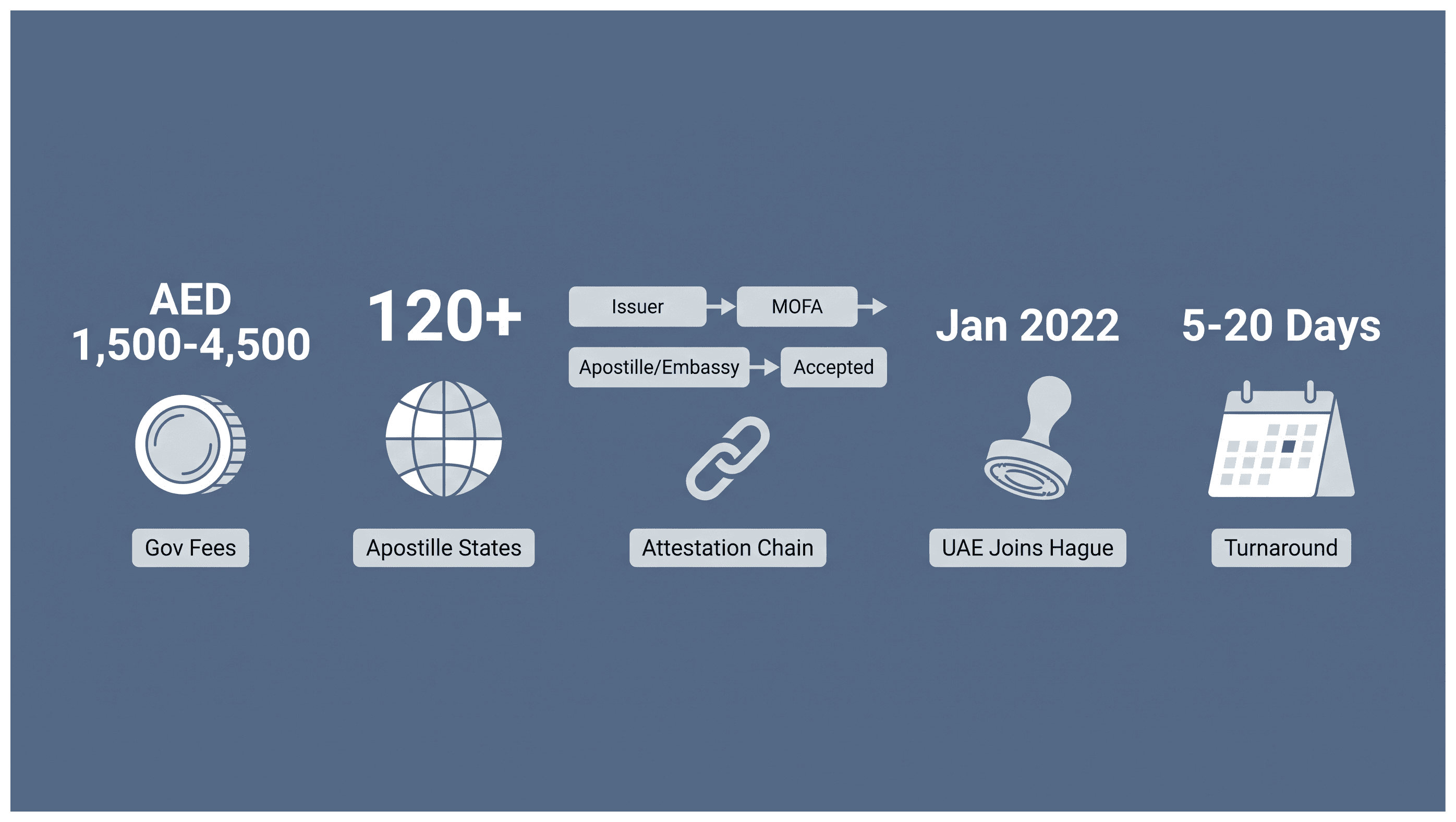
The standard trade license attestation chain in Dubai runs through four stages: the license-issuing authority (free zone or DET), the UAE Ministry of Foreign Affairs (MOFA), and then either a UAE apostille stamp for Hague Convention countries or the destination country's embassy in the UAE for all other states.
Stage One: The Issuing Authority's Certification
For mainland companies, DET issues the trade license and can certify a copy directly. For free zone companies, the free zone authority certifies the license copy and, where required, the Articles of Association and share register. Some free zones require the document to pass through the Dubai Chamber of Commerce for a stamp before it proceeds to MOFA (Dubai Chamber, 2024).
A trading license Dubai holder at a free zone submits the original license plus a certified copy of the Articles of Association to the free zone authority, which attaches its official seal before forwarding to MOFA. The Articles of Association and share register are separate documents that require their own attestation track. Confirm with your free zone exactly which documents must accompany the license before submitting anything.
Stage Two: UAE Ministry of Foreign Affairs (MOFA)
MOFA attestation is the federal-level verification that precedes any embassy or apostille step. You can complete it online via the MOFA smart services portal or in person at a MOFA service centre. For apostille destinations, MOFA issues the apostille certificate directly, completing the chain for Hague Convention countries.
A trade license company Dubai sending documents to France stops at the MOFA apostille step. No French embassy visit is needed. Standard processing takes 1 to 3 working days; same-day urgent service is available at a premium. The apostille eliminates the embassy stage for 120+ countries, which is a meaningful time saving when you're working to a bank or investor deadline.
Stage Three: Destination Country Embassy or Consulate
Embassy legalisation is required for countries not party to the Hague Convention. Saudi Arabia, Qatar, and Kuwait are not Hague Convention members as of 2026, so full embassy legalisation applies to all three. The destination country's embassy in the UAE reviews the MOFA-attested document and applies its own legalisation stamp. Some embassies require a certified Arabic or English translation before they'll accept the document.
A Dubai South company opening a representative office in Saudi Arabia must have its trade license attested by MOFA and then legalised by the Saudi Embassy in Abu Dhabi or Dubai before the Saudi Ministry of Commerce will accept it. Embassy appointment lead times can add 5 to 15 working days to your timeline. Book the appointment before you even start the MOFA step.
Step-by-Step Guide to Getting Your Trade License Attested for Use Abroad
To get a Dubai trade license attested for use abroad, collect certified copies from the free zone or DET, obtain a Dubai Chamber stamp if required, submit to MOFA for attestation or apostille, and then proceed to the destination country's embassy if that country is not a Hague Convention member. Allow 5 to 20 working days in total.
Step 1: Gather and Certify Your Source Documents
Obtain a current, valid copy of your trade license from the issuing authority (free zone or DET). Free zone license copies are usually issued the same day.
Collect accompanying documents: Articles of Association, share register, and Memorandum of Association if applicable.
Confirm with the destination institution exactly which documents they require. Do not attest documents that are not on their list.
Check whether a notarised translation is required before the attestation chain begins. Some banks also require a good-standing letter alongside the attested license.
James, a UK founder setting up a logistics consultancy through a Dubai free zone, contacted his target German bank before starting attestation. The bank's list included the trade license, Articles of Association, and a good-standing letter. Attesting a share register the bank had not requested would have wasted both time and fees.
Step 2: Dubai Chamber Stamp (Where Required)
Not all overseas jurisdictions require the Dubai Chamber step, but many do. Verify before skipping it. The Chamber stamps the document to confirm it originates from a legitimate business registered in Dubai. Dubai Chamber offers both in-person and online stamping services, with same-day turnaround for online submissions (Dubai Chamber, 2024).
In practice, skipping this step for a jurisdiction that mandates it means the overseas authority will reject the document even after MOFA has attested it. That costs you the full MOFA fee again plus another round of processing time.
Step 3: MOFA Attestation or Apostille
Submit via the MOFA smart services portal or at a physical MOFA centre.
Select apostille if the destination country is a Hague Convention member. Select standard attestation if it is not.
Pay the prescribed government fee per document.
Retain the MOFA-stamped originals. Most embassies will not accept photocopies of MOFA-attested documents. Urgent same-day MOFA service is available at a surcharge above the standard 1-to-3-working-day rate.
Step 4: Embassy Legalisation (Non-Apostille Countries)
Book an appointment at the destination country's embassy in the UAE. Walk-in is rarely accepted.
Submit the MOFA-attested documents with any required certified translations and the embassy fee.
Some embassies return documents within 2 to 3 working days; others take up to 3 weeks.
Upon arrival in the destination country, a further stamp from the local Ministry of Foreign Affairs may be required before banks or registrars will accept the document. Translation must be certified by a UAE-approved legal translation office before embassy submission in most cases.
Trade License Attestation Dubai: One-Off vs Recurring Cost Components
Cost Component | One-Off Fees (per attestation event) | Recurring / Additional Costs (not included in government tariff) |
|---|---|---|
Free zone or DET certified copy fee | Paid once per attestation event; varies by issuing authority | Repeats at every annual renewal when a fresh certified copy is needed |
Dubai Chamber stamp (where required by destination jurisdiction) | Paid per document per attestation event; online portal available at dubaichamber.com | Required again each time a new attested set is produced for a different overseas institution |
MOFA attestation or apostille fee (per document) | Paid per document; urgent same-day service carries a surcharge above standard rate | Repeats for every new attested copy; apostille fee applies per document, not per set |
Destination country embassy legalisation fee (non-Hague states) | Varies by country and document count; paid at time of embassy submission | Not applicable for Hague Convention countries; repeats for each non-Hague submission |
Certified legal translation (per page, per language pair) | Not a government fee; paid separately to a UAE-approved legal translation office | Recurring cost each time a new language pair or updated document requires translation |
PRO or agent handling and submission fee | Optional; paid per engagement if you use a service provider to manage submissions | Recurring if you outsource every attestation event; not included in any government tariff |
International courier or registered mail to overseas institution | Paid per shipment; tracked courier is essential for original attested documents | Recurring for each overseas submission; cost varies by destination and carrier |
Trade License Attestation Cost Breakdown: One-Off vs Recurring Fees
Trade license attestation Dubai costs range from AED 1,500 to AED 4,500 or more depending on the destination country, document count, and service speed. The main one-off fees cover free zone certification, MOFA attestation, and embassy legalisation. Translation, courier, and agent fees are separate and not included in government tariffs.
One-Off Government Fees per Attestation Event
Each stage in the attestation chain carries its own government fee, paid once per event. The fees stack up quickly when you need multiple document sets. A trade license company Dubai needing three attested sets of documents for a German bank, a Singapore regulator, and a UK investor would pay the MOFA apostille fee three times, once per document per submission.
Free zone or DET certified copy fee: varies by authority
Dubai Chamber stamp (if required): UNVERIFIED: confirm current fee at dubaichamber.com before publishing
MOFA standard attestation or apostille fee: UNVERIFIED: confirm current fee at mofa.gov.ae before publishing
Embassy legalisation fee: varies by destination country and document count
Urgent MOFA service: adds a surcharge above the standard fee
Recurring Costs and What Is Not Included
Attested copies carry no universal expiry date, but overseas institutions commonly reject copies older than 3 to 6 months. That means attestation is a recurring cost, not a one-time exercise. Here is what falls outside government tariffs:
Certified legal translation: cost depends on document length and language pair
International courier or registered mail to overseas institutions
PRO agent or typing centre fees if you use a service provider
Annual trade license renewal fee (paid to the free zone or DET, entirely separate from attestation)
The business setup cost in Dubai calculation is straightforward at formation, but the ongoing document compliance costs are worth mapping out before you take your company international.
Is it cheaper to use an agent for trade license attestation?
Using a PRO agent adds a handling fee but saves the time cost of managing portal submissions, embassy appointments, and courier logistics yourself. For founders based outside the UAE, the agent fee is often the more practical option, particularly when embassy visits require physical attendance in the UAE.
Regulated Activities and Additional Approvals Before Attestation
If your trade license covers a regulated activity such as healthcare, financial services, or education, the license alone is not sufficient for overseas use. The relevant UAE regulator must have issued its own approval, and that approval document may also need to enter the attestation chain separately.
How Regulated Activities Affect the Attestation Process
A free zone licenses the activity; the named regulator approves the practice. Both documents may be required by an overseas authority. The key regulated sectors and their named regulators are:
Healthcare: Dubai South Business Hub Free Zone licenses the activity; the Dubai Health Authority (DHA) approves clinical practice separately (DHA, 2024)
Financial services: the free zone licenses the activity; the relevant financial regulator issues its own approval
Education: the free zone licenses the activity; KHDA or the relevant education authority approves the curriculum or institution
A healthcare business license Dubai holder with both a free zone trade license and a DHA approval certificate must attest both documents separately when applying to register a branch in a Gulf state. Some overseas regulators require both documents to be attested within the same 90-day window, so timing matters.
Preparing Regulatory Approvals for the Attestation Chain
Request a certified copy of the regulatory approval directly from the issuing authority (DHA, CBUAE, KHDA, etc.).
Confirm whether the regulator's certificate needs notarisation before MOFA will accept it. CBUAE approval letters may require additional notarisation
References
Frequently Asked Questions