
Topic Summary
What Is Waste Compliance for a Dubai Business Premises
Waste compliance for a Dubai business premises is the set of legal obligations under Dubai Municipality regulations and UAE Federal Law No. 12 of 2018 requiring every commercial tenant or owner to segregate, store, and dispose of waste through licensed contractors, with penalties
Waste Compliance Dubai Cost: One-Off and Recurring Fees Broken Down
Waste Compliance Dubai Cost: One-Off and Recurring Fees Broken Down
Tadweer Requirements and What They Mean for Your Premises
Tadweer, Abu Dhabi's waste management authority, applies specifically to Abu Dhabi Emirate premises. Dubai businesses fall under Dubai Municipality rather than Tadweer. Confusing the two authorities is common among companies with multi-emirate operations and leads to incorrect co
Six Steps to Achieving Waste Compliance on a Dubai Premises
Achieving waste compliance on a Dubai business premises involves six steps: classify your waste streams, procure segregation infrastructure, engage a Dubai Municipality-licensed contractor, register the contract with the relevant authority, train staff on segregation protocols, a
Who Is Responsible for Waste Compliance Under a Commercial Lease
Under a standard Dubai commercial lease, the tenant is responsible for all waste compliance obligations relating to waste generated during their occupation. The landlord typically provides shared bin infrastructure and central collection points. Hazardous waste disposal, contract
What Is Not Included in Standard Waste Compliance Costs
Standard waste compliance costs for a Dubai business premises do not include hazardous or clinical waste disposal, e-waste collection, grease trap cleaning for F&B units, pest control triggered by waste issues, municipal fines, or the cost of a compliance consultant. Each carries
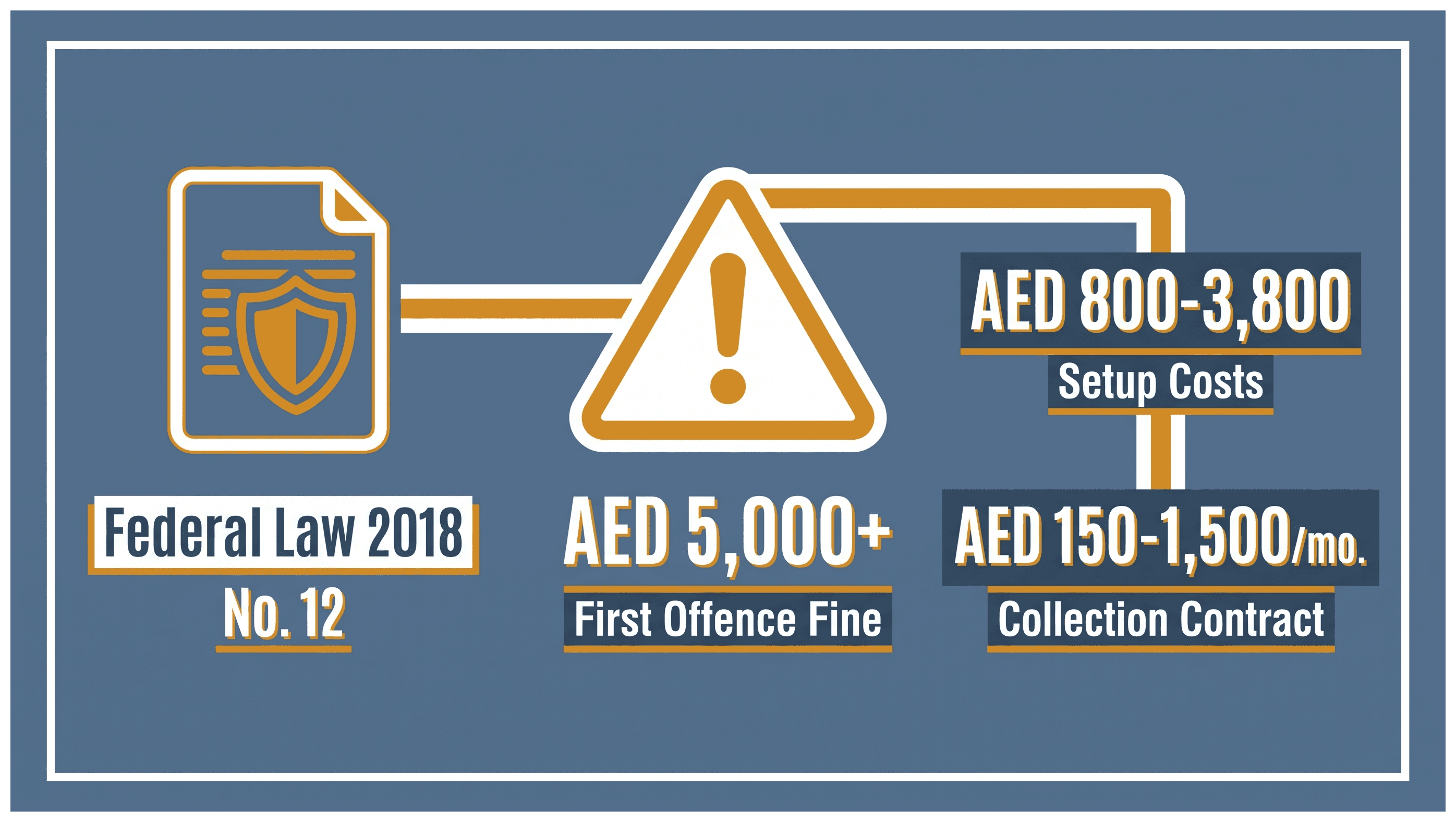
In 2026, a Dubai business premises can face a municipal fine of AED 5,000 or more for a single waste management violation, yet most finance managers budget nothing for waste compliance until an inspection notice arrives. UAE Federal Law No. 12 of 2018 sets the national baseline for commercial waste handling. Dubai Municipality imposes additional local requirements on top of that. First-offence fines start at AED 5,000 (u.ae, 2018). Recurring collection contracts run AED 150 to AED 1,500 per month depending on premises type. One-off setup costs typically fall between AED 800 and AED 3,800. This article breaks down every cost associated with waste compliance premises dubai, separates one-off setup fees from recurring annual charges, clarifies what is not included in standard estimates, and explains exactly which party carries legal responsibility under a commercial lease.
What Is Waste Compliance for a Dubai Business Premises
Waste compliance for a Dubai business premises is the set of legal obligations under Dubai Municipality regulations and UAE Federal Law No. 12 of 2018 requiring every commercial tenant or owner to segregate, store, and dispose of waste through licensed contractors, with penalties for non-compliance starting at AED 5,000.
The Legal Framework Behind Commercial Waste Obligations
UAE Federal Law No. 12 of 2018 on Integrated Waste Management sets the national baseline for all commercial waste handling. It mandates source segregation, proper storage, and disposal exclusively through licensed waste management contractors (u.ae, 2018). Dubai Municipality's Waste Management Regulations layer additional local requirements on top, covering bin labelling standards, collection frequency minimums, and contractor licensing criteria.
Non-compliance doesn't just generate advisory warnings. It triggers fines, premises closure notices, and license renewal blocks. A retail unit in a mixed-use building that disposes of cardboard in general waste bins rather than a dedicated recycling stream can receive a notice of violation and a fine at the next municipal inspection. That fine starts at AED 5,000 for a first offence, before any remediation costs.
Which Premises Types Are Covered
Every commercial premises type falls under these obligations, regardless of whether you're on the mainland or in a free zone:
Offices and co-working spaces with dedicated tenancy agreements
Warehouses and light industrial units
Retail outlets and showrooms
Food and beverage units
Health and wellness premises
Free zone companies operating a physical premises must comply with both the free zone authority's rules and Dubai Municipality requirements where applicable. A logistics company leasing a 500 sq m warehouse in a Dubai industrial area must register a waste collection contract with a Dubai Municipality-licensed waste contractor. A consultant operating from a shared flexi-desk space, by contrast, has no equivalent direct obligation, the building operator handles compliance centrally. Check the full range of business activities to confirm which premises type your license requires.
Waste Compliance Dubai Cost: One-Off and Recurring Fees Broken Down
Waste compliance costs for a Dubai business premises split into one-off setup charges, typically AED 500 to AED 2,000 for contractor registration and signage, and recurring annual or monthly fees of AED 1,800 to AED 18,000 depending on premises size and waste volume. Municipal fines and hazardous-waste surcharges are separate.
One-Off Setup Costs You Pay at the Start
Before your premises opens, you'll face a cluster of one-time costs to get the compliance framework in place. An events management company taking a 200 sq m office in a commercial tower, for example, budgets AED 1,200 for contractor onboarding and AED 600 for labelled segregation bins, a one-time outlay of AED 1,800 before operations begin. Always request an itemised quote from the auditing firm; rates vary considerably.
Waste Compliance Costs: One-Off vs. Recurring
Cost Item | One-Off Costs | Recurring Costs |
|---|---|---|
Contractor fee | AED 500 to AED 1,500 onboarding | AED 150 to AED 400/month (office) |
Segregation bins | AED 300 to AED 800 procurement | AED 600 to AED 1,500/month (F&B) |
Premises waste audit | AED 500 to AED 2,000 if required | AED 300 to AED 1,500 per hazardous event |
Compliance consultant | AED 1,500 to AED 5,000 if engaged | Annual permit renewal: UNVERIFIED. Confirm before publishing. |
Not included | Fines, grease trap cleaning, clinical waste contractor approval | E-waste, pest control from waste, third-party audits |
Recurring Annual and Monthly Waste Collection Fees
Monthly collection contracts are the main ongoing cost. Standard office premises pay AED 150 to AED 400 per month. F&B and food production units pay AED 600 to AED 1,500 per month due to organic waste volumes and more frequent collection schedules.
A small F&B kiosk generating high organic waste volume may pay AED 900 per month for twice-weekly collection, totalling AED 10,800 per year, more than six times the cost of a comparable-size office unit. Hazardous waste disposal is charged per collection event and is never bundled into a standard monthly contract. Budget your annual total for a typical small office at AED 1,800 to AED 4,800, excluding specialist streams (Dubai Chamber, 2025). Use the business setup cost calculator to factor compliance into your full premises budget from day one.
Tadweer Requirements and What They Mean for Your Premises
Tadweer, Abu Dhabi's waste management authority, applies specifically to Abu Dhabi Emirate premises. Dubai businesses fall under Dubai Municipality rather than Tadweer. Confusing the two authorities is common among companies with multi-emirate operations and leads to incorrect contractor selection, failed inspections, and duplicated compliance spend.
Tadweer vs. Dubai Municipality: Which Authority Applies to You
The distinction matters more than most finance managers realise. Here's a direct comparison:
Dubai Municipality Environment Department: sole licensing authority for waste contractors operating in Dubai; conducts premises inspections; issues violation notices and fines
Tadweer (Abu Dhabi Waste Management Centre): governs all waste management across Abu Dhabi Emirate; has no jurisdiction in Dubai whatsoever
A waste compliance company in Dubai serving clients across the UAE must hold a Dubai Municipality contractor license to service Dubai premises and a separate Tadweer registration to service Abu Dhabi sites. The two are not interchangeable. Companies with premises in both emirates must maintain separate compliance arrangements with each authority. Referencing Tadweer standards in a Dubai compliance plan does not constitute compliance with Dubai Municipality requirements (DET, 2024).
Dubai Municipality Contractor Licensing and What to Check
Only contractors holding a valid Dubai Municipality waste management license may legally collect and transport commercial waste from Dubai premises. You can verify a contractor's license status directly through the Dubai Municipality portal before signing anything, it's free and takes under five minutes.
Here's the critical point: if you engage an unlicensed contractor, the fine falls on your business, not the contractor. Contractor license categories cover general solid waste, hazardous waste, clinical waste, and construction debris. A printing company generating chemical ink waste must use a contractor licensed for hazardous waste collection, not a general solid waste contractor. Using the wrong category invalidates the compliance record during an inspection, even if waste was physically removed from the premises.
Is a services license in Dubai enough to cover waste compliance obligations?
No. A services license in Dubai authorises your business activity but does not satisfy waste compliance requirements. You must separately engage a Dubai Municipality-licensed waste contractor and maintain disposal records regardless of your license type.
Six Steps to Achieving Waste Compliance on a Dubai Premises
Achieving waste compliance on a Dubai business premises involves six steps: classify your waste streams, procure segregation infrastructure, engage a Dubai Municipality-licensed contractor, register the contract with the relevant authority, train staff on segregation protocols, and maintain disposal records for at least two years for inspection readiness.
Steps 1 to 3: Classification, Infrastructure, and Contractor Selection
Classify your waste streams before engaging any contractor. Identify general solid waste, recyclables, hazardous materials, and food or organic waste separately. This classification determines which contractor license categories you need.
Procure colour-coded, labelled segregation bins in quantities matching your daily waste volume. Dubai Municipality guidelines specify minimum bin sizes by premises type. Budget AED 300 to AED 800 for a standard small premises.
Select a Dubai Municipality-licensed waste contractor whose license category covers every stream you generate. Request the license certificate before signing. Verify it free via the Dubai Municipality portal.
A technology consultancy generating only paper, cardboard, and small electronics waste classifies two streams, general recyclables and e-waste, and selects a contractor holding both general solid waste and e-waste collection categories. That two-minute classification exercise prevents a compliance gap that could invalidate the entire waste management record during an inspection.
Steps 4 to 6: Registration, Staff Training, and Record-Keeping
Register the signed collection contract with Dubai Municipality where required. In multi-tenant buildings, the building management team sometimes handles this centrally, confirm in writing before assuming it's covered.
Conduct a staff induction on segregation protocols. No formal certification is required for most business types, but document the session date and attendees. That record matters during an inspection.
Retain all waste transfer notes, collection receipts, and contractor invoices for a minimum of two years. During a Dubai Municipality premises inspection, an inspector may ask to see the last six months of waste collection receipts. A company that stores these digitally in a shared folder can produce them in under two minutes; one without a filing system faces an automatic compliance query.
The business support services at Dubai South Business Hub can assist with the administrative side of contractor registration and documentation filing as part of a broader operational support package (Ministry of Economy, 2024).
Who Is Responsible for Waste Compliance Under a Commercial Lease
Under a standard Dubai commercial lease, the tenant is responsible for all waste compliance obligations relating to waste generated during their occupation. The landlord typically provides shared bin infrastructure and central collection points. Hazardous waste disposal, contractor engagement, and record-keeping remain the tenant's direct legal responsibility throughout the lease term.
What Landlords Typically Provide and What They Do Not
Landlord Obligation | Tenant Obligation |
|---|---|
Shared waste collection points in common areas | Hazardous and specialist waste contractor engagement |
Building-level general solid waste contract | Clinical and food waste above standard thresholds |
General bins in lobbies and corridors | Waste transfer note retention for two years |
A beauty salon leasing a retail unit in a commercial complex discovers that the building's waste contract covers general solid waste only. Chemical waste from hair treatments must be disposed of under a separate hazardous waste contract the salon arranges and pays for independently. Always request the building's waste management plan from the landlord before signing.
Lease Clauses to Review Before You Sign
Waste management clause: specifies which party holds the municipal contractor registration and who bears fines for non-compliance
Reinstatement clause: may require tenants to remove waste-related fit-out items at lease end at their own cost
Service charge schedule: itemises which waste services are included so you can identify gaps before budgeting
Silence defaults to tenant liability under UAE contract law, if a clause doesn't mention hazardous waste, assume it falls to you
A company that reviews the lease service charge schedule before signing identifies that organic waste collection is not included, allowing it to negotiate either inclusion or a rent reduction, a saving of up to AED 7,200 per year for an F&B operator. If you're planning to set up a company in Dubai, build this review into your pre-signing checklist (Dubai Chamber, 2025).
What Is Not Included in Standard Waste Compliance Costs
Standard waste compliance costs for a Dubai business premises do not include hazardous or clinical waste disposal, e-waste collection, grease trap cleaning for F&B units, pest control triggered by waste issues, municipal fines, or the cost of a compliance consultant. Each carries a separate fee structure and requires independent contractor engagement.
Specialist Waste Streams That Carry Separate Costs
Hazardous waste (chemicals, solvents, paints, batteries): AED 300 to AED 1,500 per collection event depending on volume
Clinical and medical
References
Frequently Asked Questions