
Topic Summary
What Is a Business Current Account vs a Savings Account in the UAE and Why It Matters
A business current account is a transactional account for daily payments, payroll, cheques and supplier transfers, usually paying no interest. A business savings account holds surplus cash and earns profit, with limits on withdrawals. Most free zone companies need a current account first.
Key Differences Between a Business Current Account and a Savings Account in the UAE
Key Differences Between a Business Current Account and a Savings Account in the UAE
Which UAE Banks Offer Each Account Type for Free Zone Companies
Emirates NBD, Mashreq, RAKBank, FAB, ADCB and Wio all serve free zone companies, mostly starting with a business current account. Savings or deposits usually follow. Match the bank to your activity and cash profile.
Step-by-Step Guide to Opening a Business Current Account or Savings Account in the UAE
Get your free zone license, gather documents, choose a bank, apply, pass compliance, and fund the account. Allow roughly two to six weeks, depending on the bank and how complete your file is.
When to Use a Business Current Account vs a Savings Account in the UAE
Use a current account for revenue, expenses, payroll and tax payments. Use savings for cash you won't need for months. A common split keeps one to two months of expenses in current and moves surplus into savings.
Common Mistakes With a Business Current Account vs a Savings Account in the UAE
The usual errors are opening only a savings account, ignoring minimum balance fees, mixing personal and business funds, submitting inconsistent documents, and applying to several banks at once. Most are avoidable.
Next Steps
Understanding a business current account vs a savings account in the UAE comes down to purpose: current accounts run operations, savings grow idle cash. Open current first, pick a bank that fits your balance profile, and add savings as reserves build. Speak with the DSBH banking support team to set up your Dubai South Business Hub company and prepare your bank application.
The UAE has more than 40 licensed banks supervised by the Central Bank of the UAE [1], yet roughly 40% of first-time free zone founders face a delay or decline. Many open the wrong account first. This guide explains a business current account vs a savings account in the UAE, so you know which to open and when.
What Is a Business Current Account vs a Savings Account in the UAE and Why It Matters
A business current account is a transactional account for daily payments, payroll, cheques and supplier transfers, usually paying no interest. A business savings account holds surplus cash and earns profit, with limits on withdrawals. Most free zone companies need a current account first.
Business Current Account Defined
It's built for daily operations: customer receipts, WPS payroll, cheque books and cards. Fees usually depend on your average balance and transaction volume. Picture a Dubai South trading company receiving AED 80,000 from customers, then paying three suppliers and salaries from that one account.
Business Savings Account Defined
This one holds idle cash and pays tiered rates. Expect withdrawal limits and often a higher minimum balance. Some banks want a current account in place first. A consultancy might keep one month of expenses in current and six months of reserves in savings. Rates vary, so confirm them with the bank.
Why Free Zone Owners Should Care
The wrong product means fees or idle cash.
Clean records support tax filing: 9% above AED 375,000 of profit (Federal Tax Authority, 2025).
Banks check that the account matches your license activity.
A savings-only account can't issue cheques or run payroll.
Key Differences Between a Business Current Account and a Savings Account in the UAE
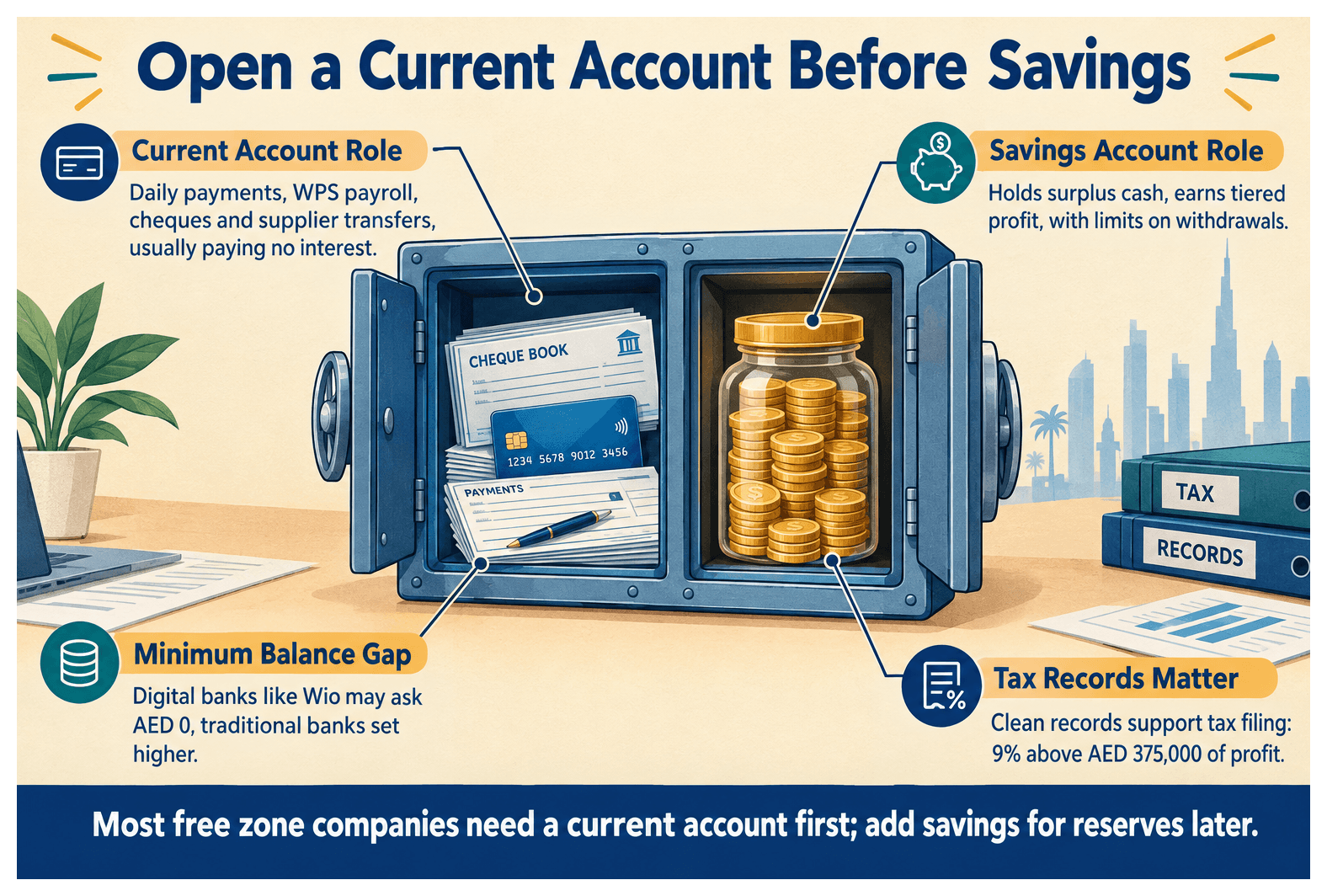
The main differences are purpose, returns, access and cost. A current account supports unlimited daily transactions with little or no interest. A savings account limits transactions, pays profit, and often needs a higher minimum. Your cash flow pattern decides.
Access, Transactions, and Payment Tools
Current: cheques, cards, direct debits, IBAN transfers.
Savings: restricted withdrawals, rarely a cheque book.
Payroll under the WPS (Wages Protection System, run with MoHRE) runs from the current account.
Returns, Fees, and Minimum Balances
Current accounts waive monthly fees above an average balance threshold. Savings profit rates rise with balance tiers. Digital banks like Wio may ask for AED 0 minimums, while traditional banks set higher ones. Compare thresholds against your real average balance, say AED 25,000. Our guide on the minimum balance for a UAE business bank account covers this in depth.
Side-by-Side Comparison
Business Current Account vs Savings Account in the UAE
Feature | Business Current Account | Business Savings Account |
|---|---|---|
Main purpose | Daily receipts, supplier payments, payroll | Holding reserves and surplus cash |
Interest or profit | Usually none | Tiered profit by balance |
Withdrawals and transfers | Unrestricted daily use | Limited number or value |
Cheque book and payroll (WPS) | Available, WPS runs here | Typically not available |
Typical minimum balance and fees | AED 0 at some digital banks, higher at traditional banks; fee waived above threshold | Often a higher minimum to earn profit |
Which UAE Banks Offer Each Account Type for Free Zone Companies
Emirates NBD, Mashreq, RAKBank, FAB, ADCB and Wio all serve free zone companies, mostly starting with a business current account. Savings or deposits usually follow. Match the bank to your activity and cash profile.
Traditional banks (Emirates NBD, FAB, ADCB) offer savings, fixed deposits and trade finance, but want stricter paperwork and higher balances. Onboarding runs roughly 2-6 weeks. A trading company needing letters of credit should start here.
SME and digital options (Mashreq, RAKBank, Wio) onboard faster and ask for less. A two-person consultancy can often start invoicing within days when documents are complete. Confirm current terms with each bank.
Match the bank to trade volume and expected reserves.
Check multi-currency business bank account support if you invoice in USD or EUR.
Compare an instant IBAN route with traditional opening.
Step-by-Step Guide to Opening a Business Current Account or Savings Account in the UAE
Get your free zone license, gather documents, choose a bank, apply, pass compliance, and fund the account. Allow roughly two to six weeks, depending on the bank and how complete your file is.
Step 1: Secure Your License and Residency
Your Dubai South Business Hub trade license and residency visa come first. Keep the Memorandum of Association, share certificate and registered address ready.
Step 2: Prepare the Document Pack
Passports, Emirates ID, visa, proof of address.
Business plan and two customer or supplier contracts.
Source of funds and expected monthly turnover.
Matching names and activity descriptions everywhere.
Step 3: Apply, Pass Compliance, and Fund
Apply by branch, relationship manager or portal. Answer KYC (know your customer) queries within 24-48 hours. Fund the current account, then add savings once it's active. Our walkthrough on opening a corporate bank account for your Dubai free zone company goes further.
Practical Tips to Avoid Rejection
Be specific about activity and counterparties.
Don't apply to many banks at once.
Keep personal and company money separate.
Ask DSBH banking support to review your file first.
When to Use a Business Current Account vs a Savings Account in the UAE
Use a current account for revenue, expenses, payroll and tax payments. Use savings for cash you won't need for months. A common split keeps one to two months of expenses in current and moves surplus into savings.
In year one, a single current account is usually enough, and it avoids tying up cash against minimums. A new consultancy can run everything through one digital account.
A company with AED 400,000 surplus might move AED 250,000 to savings.
Set aside funds for corporate tax and VAT.
Consider multi-currency accounts for cross-border revenue.
Common Mistakes With a Business Current Account vs a Savings Account in the UAE
The usual errors are opening only a savings account, ignoring minimum balance fees, mixing personal and business funds, submitting inconsistent documents, and applying to several banks at once. Most are avoidable.
Missing average balance thresholds triggers monthly fees. One company paid for six months before noticing.
Skipping the fee schedule for transfers and cheques.
Declaring AED 5 million turnover without contracts invites a decline.
Slow KYC replies stall approval.
Read our business bank account requirements before you apply.
Next Steps
Understanding a business current account vs a savings account in the UAE comes down to purpose: current accounts run operations, savings grow idle cash. Open current first, pick a bank that fits your balance profile, and add savings as reserves build. Speak with the DSBH banking support team to set up your Dubai South Business Hub company and prepare your bank application.
References
Frequently Asked Questions