
Topic Summary
Gather All Required Business Documents First
A valid trade license, certificate of incorporation, memorandum of association, and shareholding structure are mandatory for any UAE business bank account application. Having these ready before you apply prevents delays and signals to banks that your business is well-organized.
Prepare Full Identification for Every Shareholder
All shareholders and authorized signatories must provide passport copies, visa pages, Emirates ID (if available), and proof of address. Some banks also request a professional CV to evaluate each shareholder's background and relevance to the business activity.
Define Your Transactional Profile Clearly
Banks will assess your projected monthly turnover, the geographic origin of your clients, and the payment channels you plan to use. Presenting this information in clear, straightforward terms significantly improves your chances of approval, especially for service-based businesses.
Choose the Right Account Type for Your Business
Options typically include current accounts for daily payments, foreign currency accounts for international trade, and SME accounts with low or zero minimum balances for startups. Matching the account type to your business size and transaction needs helps avoid unnecessary fees and restrictions.
Expect Extra Scrutiny in Higher-Risk Sectors
Businesses in crypto, forex, or iGaming face stricter compliance checks, longer review timelines, and a higher likelihood of follow-up questions from UAE banks. Understanding this in advance allows founders in these sectors to prepare stronger documentation and justifications.
Match Your Application to the Right Bank
Different UAE banks cater to different business profiles, from local startups to international trading firms. Researching which institutions align with your specific business model before applying reduces the risk of rejection and wasted time.
Consider Digital Banks for Faster Onboarding
Some digital banks in the UAE offer online onboarding without requiring an in-person branch visit, which can speed up the process considerably. Traditional banks may still require a physical visit, so knowing your options helps you choose the most efficient path.
The United Arab Emirates continues to attract entrepreneurs drawn by its stable economy and well-regulated banking system. Once a company is established, opening a business bank account in the UAE is a necessary step to operate compliantly and manage day-to-day finances.
In practice, the process is not always straightforward. Banks apply strict compliance and due-diligence checks, particularly for non-resident founders or businesses operating in higher-risk sectors such as crypto, forex, or iGaming. This often means additional documentation, longer review timelines, and a higher likelihood of questions or delays.
However, with the right preparation and a clear understanding of how banks assess risk, approvals are achievable. Different banks in the UAE cater to different business profiles, from startups and service companies to international trading firms. Knowing which institutions align with your business model is key. For more detail, see our guide on best banks for UAE startups. For more detail, see our guide on eligibility for a UAE business loan. For more detail, see our guide on business credit card options for UAE startups. For more detail, see our guide on UAE importer letter of credit guide.
This guide outlines the requirements, process, and bank options to help you open a business bank account in the UAE with fewer obstacles and clearer expectations.
Understanding the requirements
UAE banks apply strict compliance and due diligence standards to all business bank account applications. The basic needs are similar whether you are opening a small business bank account UAE based or a business company bank account.
Documentation of business license and registration
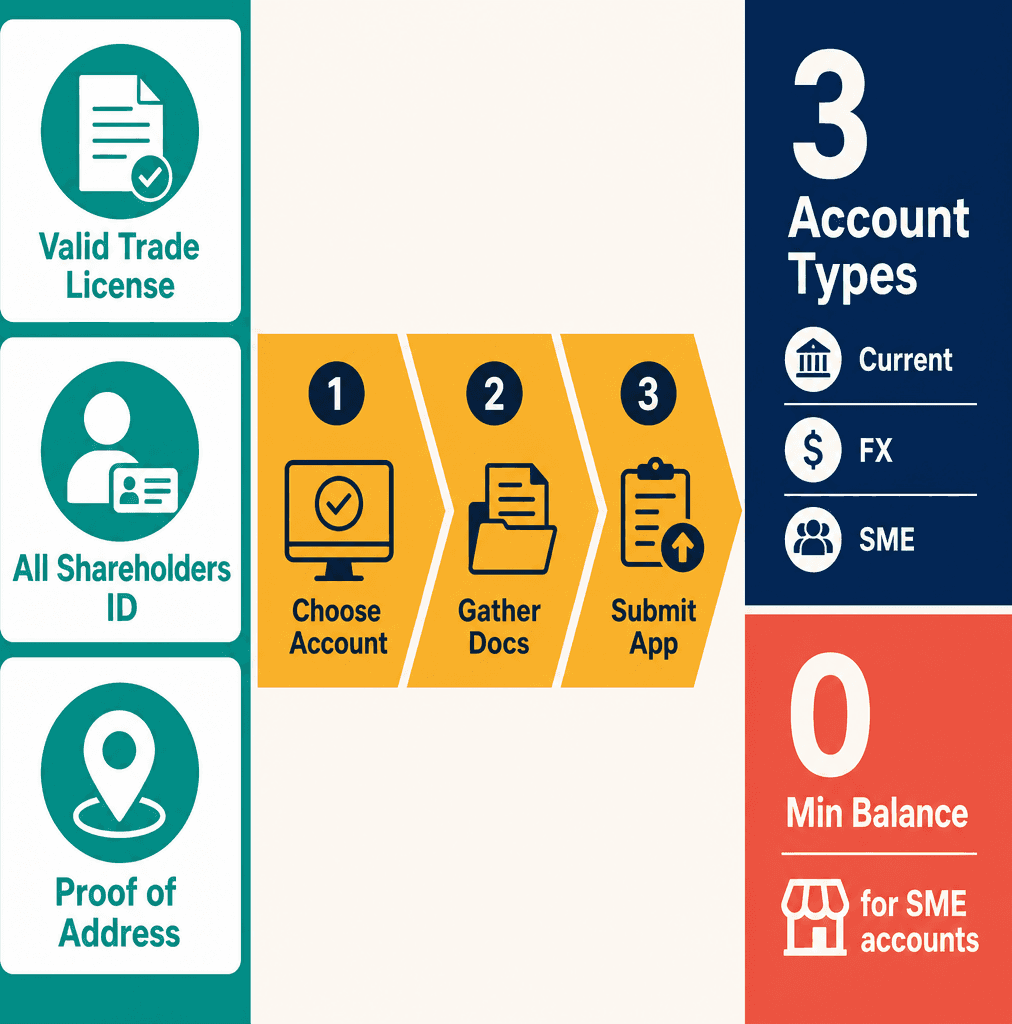
A valid trade license is mandatory when applying for a business bank account in the UAE. Besides your certificate of incorporation, banks also require the memorandum of association and shareholding structure. Licenses issued by Dubai South Business Hub Free Zone are provided electronically, allowing applicants to submit complete documentation without waiting for physical copies. For more detail, see our guide on bank accounts in Dubai for foreigners. For more detail, see our guide on why UAE business bank accounts get rejected.
Shareholder identification and director identification
All shareholders and authorized signatories must submit a copy of passport, visa page and Emirates ID (if available) and a proof of address. Some banks may also request a professional CV to assess the shareholder's background, experience, and relevance to the proposed business activity.
Business operations and transactional profile
When considering your application, banks will consider projected monthly turnover, where the funds are coming from and geography of customers (region where you expect most of•‚your clients) as well as payment channels used. Business justifications should be presented in clear, straightforward terms, particularly for service-based companies where transaction flows may not be immediately obvious.
Step 1: Select•‚an appropriate account type
Start by choosing an account that matches your business and transaction needs. Typically, there are business current accounts for day-to-day payments, foreign currency accounts for international trading, and SME accounts for startups with a minimum balance of zero or very low. The choice depends on your business size, target markets, and expected transaction volumes.
Step 2: Gather the•‚documentation needed
Collect your trade license, certificate of formation, passports of your shareholders, Emirates ID cards for residents, and a proof of address, and fill out some details about your business activity and source of funds.
Step 3: Submit Your Application
This can be done by visiting a bank or using online onboarding services offered by some digital banks. For most traditional banks that may be what they want to do but for the digital banks just complete an application if you qualify to be one of their customers. For more detail, see our guide on digital versus traditional banking in the UAE.
Step 4: Complete KYC and Compliance Checks
Banks carry out KYC and AML reviews of your business activity, ownership structure, and financial profile to ascertain your trustworthiness.
Step 5: Receive Approval and Activate the Account
After your request has been approved the bank opens your business account and issues access to online banking and cards.
Best business bank Accounts in the UAE for Non-Residents:
The best bank for a business account depends on the business type, owner's residency status, expected transaction volumes, and necessity of multi-currency options.
Emirates NBD and First Abu Dhabi Bank are commonly used by medium to large companies requiring trade finance and international treasury services. These banks typically require at least one UAE-resident authorised signatory. Mashreq NeoBiz and RAKBANK offer SME-focused accounts with lower minimum balance requirements and faster onboarding, making them suitable for startups and service-oriented businesses. Large global lenders like HSBC and Standard Chartered can also provide cross border banking networks for•‚businesses, but they have more stringent compliance and higher balance minimums. For more detail, see our guide on banking requirements for free zone companies. For more detail, see our guide on banking guide for UAE startups. For more detail, see our guide on bank account guide for UAE businesses. For more detail, see our guide on banking requirements for Dubai South companies. For more detail, see our guide on working capital and banking for a new Dubai company.
The choice which best suits•‚you will depend on what sort of business you run, your compliance profile, and your anticipated long-term transaction plans.
The Bottom Line
Opening a business bank account in the UAE requires preparation, accurate documentation, and a clear understanding of bank compliance requirements. While the process can involve multiple checks, especially for non-resident founders or regulated sectors, it becomes far more manageable when the business profile has been structured correctly. With the right setup and supporting documents in place, founders can move through the process with clearer expectations and fewer delays.
1) Who•‚is eligible to open a business bank account in UAE?
Any mainland or free zone company registered in the UAE is eligible to open a business bank account in the UAE provided that the company is licensed and the shareholders/ directors are compliant. For more detail, see our guide on UAE free zone company bank account. For more detail, see our guide on how to open a corporate bank account for your free zone company. For more detail, see our guide on corporate card for a UAE company.
2) What are the common reasons for application rejection?
Incomplete paperwork, business activities that are not clear, high-risk countries, and financials that are not consistent are all reasons to get rejected.
3) Which documents are required to open a business bank account in UAE?
You will need a trade license, the documents for incorporation, shareholder passports, visa copies, Emirates ID (if you have one) and description of business activities.
Useful Resources
UAE corporate tax explained
Citations
Central Bank of the UAE.. centralbank.ae. CBUAE, 2024.
Federal Tax Authority.. tax.gov.ae. FTA UAE, 2023.
Federal Authority for Identity, Citizenship, Customs and Port Security.. icp.gov.ae. ICP UAE, 2024.
Dubai Economy and Tourism.. dubaidet.gov.ae. DET Dubai, 2024.
UAE Government Portal.. u.ae. UAE Government, 2024.
Frequently Asked Questions