Topic Summary
What Is a Tax Agent in the UAE and What Does One Do
A tax agent in the UAE is an individual registered with the Federal Tax Authority who represents taxable persons in dealings with the FTA. Agents prepare and submit VAT, Corporate Tax and excise filings, handle registrations, respond to audits and file disputes, all under a formal appointment on EmaraTax.
When Do You Need a Tax Agent in the UAE
When Do You Need a Tax Agent in the UAE
How to Verify an FTA Registered Tax Agent Before You Hire
To verify an FTA registered tax agent, check the agent's name and registration number against the FTA's public list of approved agents, confirm the agency's trade license covers tax services, and request proof of experience. Never share EmaraTax credentials with anyone.
How Does Tax Agent Appointment in the UAE Work Step by Step
Tax agent appointment in the UAE is completed on EmaraTax in five steps: confirm the agent's FTA registration, log in to your taxable person account, add the agent's details, assign tax types and permissions, and have the agent accept the link. The FTA then shows the agent as authorised.
How Much Does a Tax Agent in the UAE Cost Compared With Other Options
A tax agent in the UAE typically charges per filing or on a retainer, and ranges vary by firm and complexity. Against an in-house hire or an accountant-only arrangement, an agent suits companies needing FTA representation without full-time headcount. Confirm fees in writing and note the quote date.
Which Mistakes Should You Avoid When Appointing a Tax Agent in the UAE
Common mistakes when appointing a tax agent in the UAE include skipping FTA register checks, sharing credentials, leaving scope vague, assuming the agent carries your liability, and appointing too late. Each can mean filing errors, fines of AED 1,000 or more, and a weak audit defence.
What Should You Do Next to Appoint a Tax Agent in the UAE
To appoint a tax agent in the UAE, confirm your tax registrations and deadlines, shortlist FTA registered agents, compare written quotes in AED, and complete the EmaraTax appointment. If you're still setting up, secure your free zone license and company name first so your tax records start clean.
A tax agent in the UAE is an individual registered with the Federal Tax Authority (FTA) who represents a taxable person and files on their behalf. You need one when your tax affairs are too complex, frequent or risky to handle in-house, though appointing one is never legally mandatory.
The stakes are real. More than 400,000 UAE businesses are VAT-registered [1], and a late VAT return costs AED 1,000 on a first offence and AED 2,000 on a repeat within 24 months [1]. Late VAT registration costs AED 10,000 [1]. This guide is for owners and finance leads who want to decide quickly and appoint correctly.
What Is a Tax Agent in the UAE and What Does One Do
A tax agent in the UAE is an individual registered with the Federal Tax Authority who represents taxable persons in dealings with the FTA. Agents prepare and submit VAT, Corporate Tax and excise filings, handle registrations, respond to audits and file disputes, all under a formal appointment on EmaraTax.
Legal Definition Under FTA Rules
An FTA registered tax agent is a natural person, though they may work through a registered tax agency. You grant authority by linking them to your account in EmaraTax. The FTA keeps a public register of approved agents.
Here's the catch: liability stays with you. Picture a Dubai South trading company that links an agent to file its quarterly VAT return. If the agent miscalculates input tax, the FTA still pursues the company.
Services a Tax Agent Can Perform
Tax registration and deregistration.
Return preparation and submission.
Voluntary disclosures, penalty waivers and refund claims.
Representation in audits and reconsideration requests.
For instance, an agent can file a reconsideration request after the FTA issues an administrative penalty. If you're facing a review, read our guide to the tax audit in the UAE procedure.
Tax Agent vs Tax Consultant vs Accountant
Only a registered agent can represent you before the FTA. Consultants advise but can't file for you unless they're also registered. Accountants keep books and prepare financials, and many firms hold several roles.
A common setup: an in-house accountant handles bookkeeping, while an external agent handles FTA correspondence. See choosing an accountant for your Dubai company for that side of the team.
When Do You Need a Tax Agent in the UAE
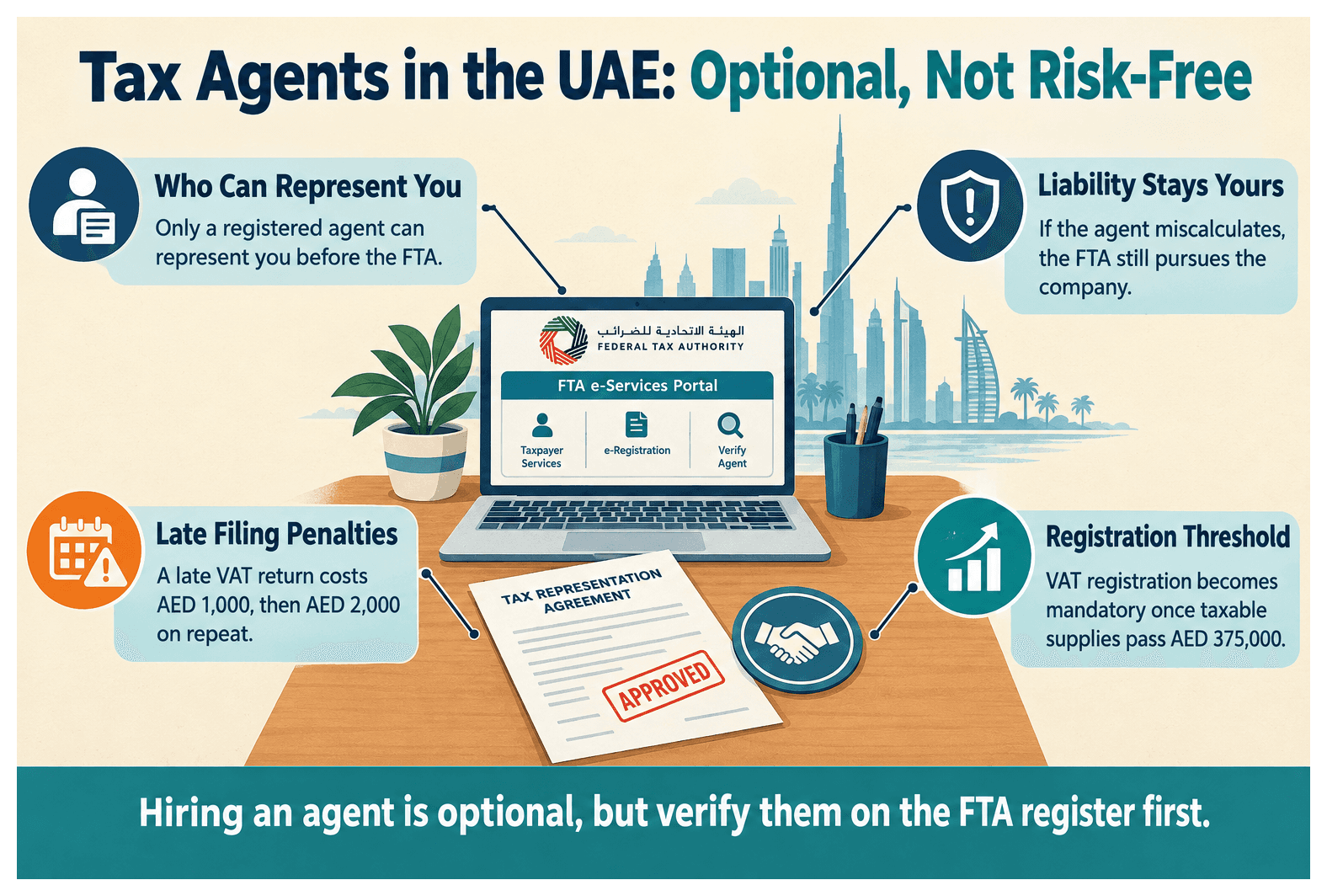
You need a tax agent in the UAE when your VAT or Corporate Tax obligations are complex, when you face an FTA audit or penalty, when you lack in-house tax skills, or when you operate across mainland and free zone activities. Appointment is optional by law, but it reduces filing errors and penalty exposure.
Legal Triggers That Make an Agent Worth It
VAT registration becomes mandatory once taxable supplies pass AED 375,000 (voluntary from AED 187,500).
Corporate Tax registration applies to all taxable persons, free zone entities included.
Qualifying Free Zone Person (QFZP) status needs testing and audited financials.
Take a free zone company crossing AED 375,000 in taxable supplies. Miss the registration window and the AED 10,000 penalty applies (FTA, 2026). Our post on adding a tax agent on EmaraTax covers thresholds and fines in detail.
Business Situations That Signal Risk
Mixed taxable and exempt supplies, cross-border services with reverse charge, and prior notices all raise risk. So does an open audit. Consider an e-commerce seller with imports and re-exports that receives an FTA notice. A late reply there can turn a query into a penalty.
When You Can Manage Without One
A small consultancy with one activity, low transaction volumes and a capable finance lead can file its own annual Corporate Tax return. There's no legal requirement to appoint an agent. A hybrid works too: hire an agent once, for registration only.
How to Verify an FTA Registered Tax Agent Before You Hire
To verify an FTA registered tax agent, check the agent's name and registration number against the FTA's public list of approved agents, confirm the agency's trade license covers tax services, and request proof of experience. Never share EmaraTax credentials with anyone.
Registration and Eligibility Checks
Search the public register on tax.gov.ae.
Confirm the status is active.
Check qualifications and UAE residency.
Match the number before signing the engagement letter.
License and Engagement Terms
The agency should hold a valid license for taxation procedures or tax consultancy. Learn what that license involves in our guide to the tax consultant business license in Dubai. Insist on a written scope, such as VAT returns, the Corporate Tax return and audit support, plus deadlines and a liability clause.
Red Flags to Avoid
Requests for your EmaraTax password.
Guaranteed penalty waivers.
No FTA number or a vague fee structure.
An unregistered intermediary offering a cheap flat fee.
How Does Tax Agent Appointment in the UAE Work Step by Step
Tax agent appointment in the UAE is completed on EmaraTax in five steps: confirm the agent's FTA registration, log in to your taxable person account, add the agent's details, assign tax types and permissions, and have the agent accept the link. The FTA then shows the agent as authorised.
Step 1: Confirm the Agent and Gather Documents
The agent's FTA registration number.
Your Tax Registration Number (TRN) and license copy.
A signed engagement letter.
Step 2: Log In to EmaraTax and Add the Agent
Use your taxable person account, enter the agent's details in the tax agent section and select the tax types. You can limit permissions, for example authorising VAT and Corporate Tax only.
Tax Agent vs In-House Team vs Accountant Only (AED, fees dated)
Feature | FTA Registered Tax Agent | In-House Team or Accountant Only |
|---|---|---|
Representation before the FTA | Can act for you once linked on EmaraTax | Staff act only as your own authorised users; an unregistered accountant can't represent you |
Cost structure in AED (dated) | Per-filing fee or monthly retainer; confirm quotes in writing (June 2026) | Fixed salary plus visa and benefits, or a bookkeeping fee (June 2026) |
VAT and Corporate Tax filing capability | Specialist in both, including QFZP testing | Strong on books; tax depth varies by hire |
Audit and dispute support | Handles reconsideration requests and audit correspondence | Can supply records but needs an agent to argue the case |
Scalability as the business grows | Scope scales up without new headcount | Adds salary cost with each extra hire |
Step 3: Agent Acceptance and Ongoing Monitoring
The agent accepts the link on their side. Review every filing before submission, since you stay accountable. When the contract ends, remove the agent straight away, as a finance lead would after a lapsed retainer.
How Much Does a Tax Agent in the UAE Cost Compared With Other Options
A tax agent in the UAE typically charges per filing or on a retainer, and ranges vary by firm and complexity. Against an in-house hire or an accountant-only arrangement, an agent suits companies needing FTA representation without full-time headcount. Confirm fees in writing and note the quote date.
Typical Fee Structures in AED
Per-return fees for VAT and Corporate Tax.
Monthly retainers for ongoing compliance.
Hourly rates for audits and disputes.
Late VAT return penalties: AED 1,000, then AED 2,000 (FTA, 2026).
Any range you're quoted is indicative only. Compare a fixed quarterly VAT fee against a monthly retainer before choosing.
Estimating Your Total Compliance Budget
A 15-person trading firm should weigh a retainer against a salaried hire. Add license and visa costs too: use the cost calculator for setup figures. If you claim QFZP status, budget for audited financials, covered in choosing an approved auditor in the UAE.
Which Mistakes Should You Avoid When Appointing a Tax Agent in the UAE
Common mistakes when appointing a tax agent in the UAE include skipping FTA register checks, sharing credentials, leaving scope vague, assuming the agent carries your liability, and appointing too late. Each can mean filing errors, fines of AED 1,000 or more, and a weak audit defence.
Process and Documentation Errors
No engagement letter.
Wrong tax types authorised.
No review before submission.
One company discovered its agent was never authorised for Corporate Tax, so nothing could be filed on time.
Timing and Oversight Errors
Appointing after the deadline is costly. So is ignoring FTA notices sent to your account or failing to track the agent's filing calendar. A handover gap between two agents is a classic cause of a missed return. See our guide to corporate tax filing services in Dubai for deadline planning.
What Should You Do Next to Appoint a Tax Agent in the UAE
To appoint a tax agent in the UAE, confirm your tax registrations and deadlines, shortlist FTA registered agents, compare written quotes in AED, and complete the EmaraTax appointment. If you're still setting up, secure your free zone license and company name first so your tax records start clean.
Build Your Shortlist and Compare Quotes
Verify each agent on the FTA register.
Compare scope and dated AED fees, not just price.
Ask about free zone experience.
Agents are often tax consultancies themselves; our guide to tax consultancy business setup in Dubai explains how they're licensed.
Set Up Your Dubai South Business Hub Company Correctly
Start by running your company name through the name check tool, then estimate costs. You can then form a Dubai South Business Hub Free Zone company with a trade license and residency visa package, and appoint your agent. Corporate Tax and VAT obligations may still apply, so plan for them from day one. Talk to the team and start your setup today.
Bottom Line
A tax agent in the UAE is an FTA registered professional who files and represents on your behalf. You need one when complexity, risk or time pressure outstrips your in-house capacity. Verify the agent, complete the EmaraTax appointment correctly, and keep oversight, because liability stays with you.
References
Federal Tax Authority, VAT registration, penalties and tax agent guidance, 2026.
Ministry of Finance, Corporate Tax guidance, 2026.
Frequently Asked Questions