Dubai Company Against a French SAS or SARL: Cost and Reporting Compared

Topic Summary
100% Foreign Ownership in Dubai
A DSBH free zone company allows full foreign ownership and a single shareholder. A French SAS offers flexible statutes, while a SARL is manager-led with partner limits.
Lower Annual Administration Costs in Dubai
A DSBH license starts from AED 12,500, or from AED 18,350 for a sole founder with one visa in year one. A French SAS or SARL carries registration, accountant, legal notice and social charge costs every year.
Lighter Corporate Tax and VAT Reporting
UAE companies register with the Federal Tax Authority and file a return, with 0% only on qualifying free zone income. French entities file corporate tax, VAT and annual accounts, so reporting is heavier.
Watch the Hidden Dubai Costs
Visa renewals, Emirates ID, banking and French tax advice can raise the true total. Each extra visa also moves the year-one figure noticeably.
Residency Is Tied to the License
A DSBH license comes with a visa package that leads to an Emirates ID. A French SAS or SARL has no residency link.
Moving the Company Doesn't Move Your Tax Residency
Setting up in Dubai doesn't automatically change where you are tax resident. French tax exposure, including DGFiP rules and the exit tax, still needs review.
Keep Both Entities for Different Purposes
A founder can keep a French SARL for domestic clients and hold a DSBH license for Gulf and international work. Two entities can each serve a clear purpose.
France's top marginal income tax rate is 45% (Statista, 2024). That's why a Dubai company against a French SAS or SARL is now a serious question for founders. This guide helps you compare ownership, cost, tax and reporting, then pick the structure that fits.
What Is a Dubai Company Against a French SAS or SARL and Why It Matters
A Dubai company against a French SAS or SARL is a comparison between a Dubai South Business Hub (DSBH) free zone company and a French limited-liability structure. The free zone company allows 100% foreign ownership and no personal income tax for UAE residents. The SAS or SARL carries French social charges, corporate tax and annual filings.
How a DSBH Free Zone Company Works
A DSBH company is a UAE legal entity holding a free zone trade license. It comes with full foreign ownership and a residency visa package tied to that license. The SAS offers flexible governance and share-based capital. The SARL is manager-led, with a cap on partners.
Take a Lyon consultant who invoices French clients through a SARL. She could keep that SARL for domestic work and hold a DSBH license for Gulf and international clients. Two entities, two clear purposes.
Dubai Company Against a French SAS or SARL: Key Differences
Feature | French SAS or SARL | DSBH Free Zone Company |
|---|---|---|
Ownership rules | SAS has flexible statutes; SARL has a manager regime and partner limits | 100% foreign ownership, single shareholder allowed |
Setup and annual cost | Registration, legal notices, accountant, social charges every year | License from AED 12,500; sole founder year one from AED 18,350 |
Corporate tax and reporting | French corporate tax return and annual accounts filing | FTA registration and annual return; 0% only on qualifying income |
VAT and bookkeeping | French VAT returns and statutory record retention | 5% UAE VAT once registration applies; invoices and records kept |
Residency and Emirates ID | No residency link; ownership follows French company law | Visa package tied to the license, then Emirates ID |
Why French Founders Run This Comparison
The drivers are tax load, payroll charges, bookkeeping burden and access to Gulf and Asian markets. A Paris design studio owner, for example, may want Gulf clients without opening a physical shop.
Here's the honest part: moving the company doesn't automatically change where you're tax resident. Our guide to moving from France to Dubai covers that side in full.
Dubai Company Against a French SAS or SARL: Cost Comparison
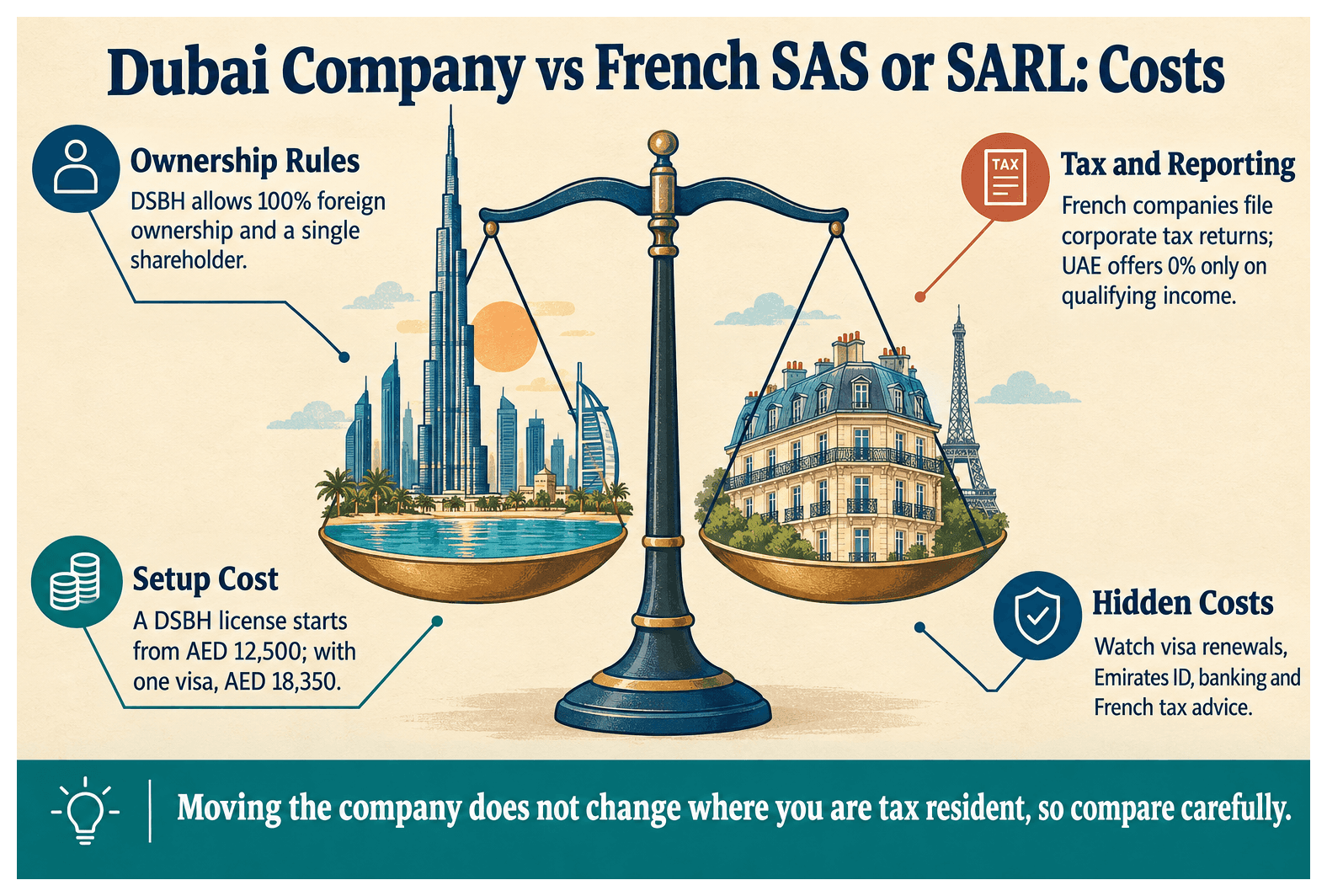
A DSBH license starts from AED 12,500, while a French SAS or SARL carries registration, accountant, legal publication and social charge costs every year. The Dubai route usually costs less in annual administration. You still need to add visa, office and compliance costs for the true total.
Setup and Annual Running Costs Side by Side
Picture a solo founder comparing first-year totals. On the Dubai side: a license plus one visa, from AED 18,350. On the French side: a SARL with an accountant, legal notices, annual accounts filing and URSSAF contributions on the manager's pay. Your final DSBH figure depends on visas and activity.
Where the Real Savings and Real Costs Sit
Savings come from a lighter filing load and no French payroll charges on a non-French-resident owner. They don't come from skipping compliance. Watch the hidden lines: visa renewals, Emirates ID, banking and French tax advice.
A two-partner trading business that adds one extra visa will see its year-one total move noticeably. Run your own numbers in the Cost Calculator.
Corporate Tax and VAT Reporting Compared Side by Side
Under Federal Decree-Law No. 47 of 2022, UAE companies register with the Federal Tax Authority and file corporate tax returns, with a 0% rate on qualifying free zone income. A French SAS or SARL files corporate tax, VAT and annual accounts in France, so reporting stays heavier there. For a Dubai free zone French founder, that gap is the main attraction.
UAE Corporate Tax Under Federal Decree-Law No. 47 of 2022
The Corporate Tax Law sets a 9% standard rate. The 0% rate applies only to qualifying free zone income, such as services billed to non-UAE clients. A DSBH company earning mainland UAE revenue may see that income taxed at 9%. Registration and annual returns go through the Federal Tax Authority (FTA), as shown on the FTA website.
VAT, Bookkeeping and Annual Accounts
UAE VAT is 5%. French VAT is higher and comes with its own filing calendar. A French e-commerce seller must keep invoices under VAT rules in both countries.
UAE: keep invoices and records, with audited accounts where required.
France: file annual accounts and VAT returns.
Simpler in the UAE: fewer routine filings.
Not simpler: cross-border invoicing still needs care.
How to Choose Between a Dubai Company and a French SAS or SARL
Choose by working through five checks in order: where you'll live, where your clients are, your income level, your activity and your exit plan. If you'll live in the UAE and sell internationally, a DSBH company usually fits. If you stay French resident, keep the SAS or SARL.
Confirm tax residency. Residency decides personal tax, not the company address. A founder splitting the year between Paris and Dubai may still owe French tax. See how Dubai affects your French tax position.
Match activity and clients. A consultant serving Gulf clients fits Dubai. A retailer needing a French shop doesn't. Check the business activities list.
Check the name and plan the exit. Run the Name Check first. Then plan how profits leave and what happens if you return to France.
Residency, Emirates ID and Ownership Rules for French Founders
A DSBH license can come with a residency visa package, processed through the General Directorate of Residency and Foreigners Affairs (GDRFA) and the Federal Authority for Identity, Citizenship, Customs and Port Security (ICP). Once approved, you receive an Emirates ID. A French SAS or SARL has no equivalent. That's the core of a Dubai company for French founders.
Residency Visa, GDRFA and ICP in Practice
The steps are a medical test, biometrics and Emirates ID issue. A French founder attends biometrics in Dubai, then collects the card. Timing varies, so confirm it with the authorities: ICP and GDRFA.
Ownership and Governance Compared
DSBH: 100% foreign ownership, one shareholder allowed.
SAS: flexible statutes.
SARL: manager regime, partner limits.
Emirates ID handles banking and daily admin in the UAE.
French Tax Exposure: DGFiP and the French Exit Tax
Moving a company or your residence to Dubai doesn't erase French obligations. The French tax administration can still tax you if you remain French resident, and the French exit tax may apply to unrealised gains on certain shareholdings.
When the DGFiP Still Has a Claim
The Direction Générale des Finances Publiques (DGFiP) applies residency tests. A founder who keeps a Paris flat and family there while running a DSBH company is exposed. So is a Dubai company managed from France. Speak to a French tax adviser before any move.
How the French Exit Tax Can Apply to Your SAS or SARL Shares
The French exit tax charges latent gains on qualifying shareholdings when your tax residence leaves France. Thresholds and deferral rules exist. Check them with an adviser before you leave, especially with a valuable SAS.
Which Structure Fits Which Founder
One founder stays in Bordeaux with local clients: keep the SAS or SARL. Another moves to Dubai with global clients: choose the DSBH company.
Your Next Step
For a Dubai company against a French SAS or SARL, the verdict is simple. Relocating founders with international clients fit DSBH. Founders who stay French resident fit the SAS or SARL. Review DGFiP and exit tax rules first. Price your setup in the Cost Calculator, confirm your name with Name Check, then set up or buy your DSBH license.
References
dubai-company-against-a-french-sas-or-sarl