General Trading Setup in Dubai from India: Cost, CEPA and Customs Code

Topic Summary
One License, Many Product Categories
A general trading license at Dubai South Business Hub lets you import, export and re-export multiple product lines. Restricted goods such as food, chemicals and medical items need separate approvals.
Match HS Codes to Activities
Check each Harmonized System code against your permitted activities before you apply. Listing HS codes for your top ten products helps avoid customs problems later.
Budget Beyond the AED 12,500 License
The DSBH license starts from AED 12,500 a year, before visas, office or warehouse space and bank charges. Run your numbers through a cost calculator to see the full first-year spend.
Register Remotely From India
Attested passport copies, a photo and shareholder details are enough to start registration without traveling. You pay after approval and then receive the license.
Get Your Customs Code Early
The Customs Code requires a valid license and tenancy, and you need it before declaring any shipments. Apply for it right after the license is issued.
Understand Residency and Visa Steps
ICP processes the visa and GDRFA handles entry status. Medical clearance leads to the Emirates ID, and visa processing typically takes two to three weeks.
Use CEPA to Improve Trade Margins
The India-UAE CEPA can reduce duties on eligible goods, which affects your pricing and margins. India-UAE non-oil trade tops USD 48 billion a year, so the corridor is well established.
India–UAE non-oil trade tops USD 48 billion a year, and India is the UAE's largest trading partner by volume (Dubai Chamber, 2024) [1]. Over 45% of UAE-registered businesses hold a trading license [2]. A Dubai South Business Hub (DSBH) license starts from AED 12,500 a year [3]. Dubai Customs handles over 22 million declarations annually [4]. This guide shows Indian founders how general trading setup in dubai from india works, from license to first shipment.
What Is General Trading Setup in Dubai from India and Why It Matters
General trading setup in dubai from india means forming a free zone company, such as one at Dubai South Business Hub, that holds a trade license to import, export and re-export multiple product categories. You own the company from India, hold a Customs Code, and route goods through nearby airport and port logistics.
How a General Trading License Works
One license covers many product categories, though restricted goods need extra approval. DSBH issues the license and ties it to a visa package. Sales to mainland buyers must follow the proper route, so confirm your sales model first.
Picture a Pune electronics distributor importing accessories from Shenzhen and re-exporting to East Africa on a single license. That's a classic dubai company for indian founders.
Why Indian Founders Choose This Route
Flights from major Indian cities take about three hours.
Remote registration works with attested documents.
Buyer networks reach Asia, the Gulf and Africa.
A Mumbai spice exporter, for example, invoices Gulf and African buyers from its Dubai entity. For the wider picture, see our India relocation guide.
Choosing the Right License and Trading Activities
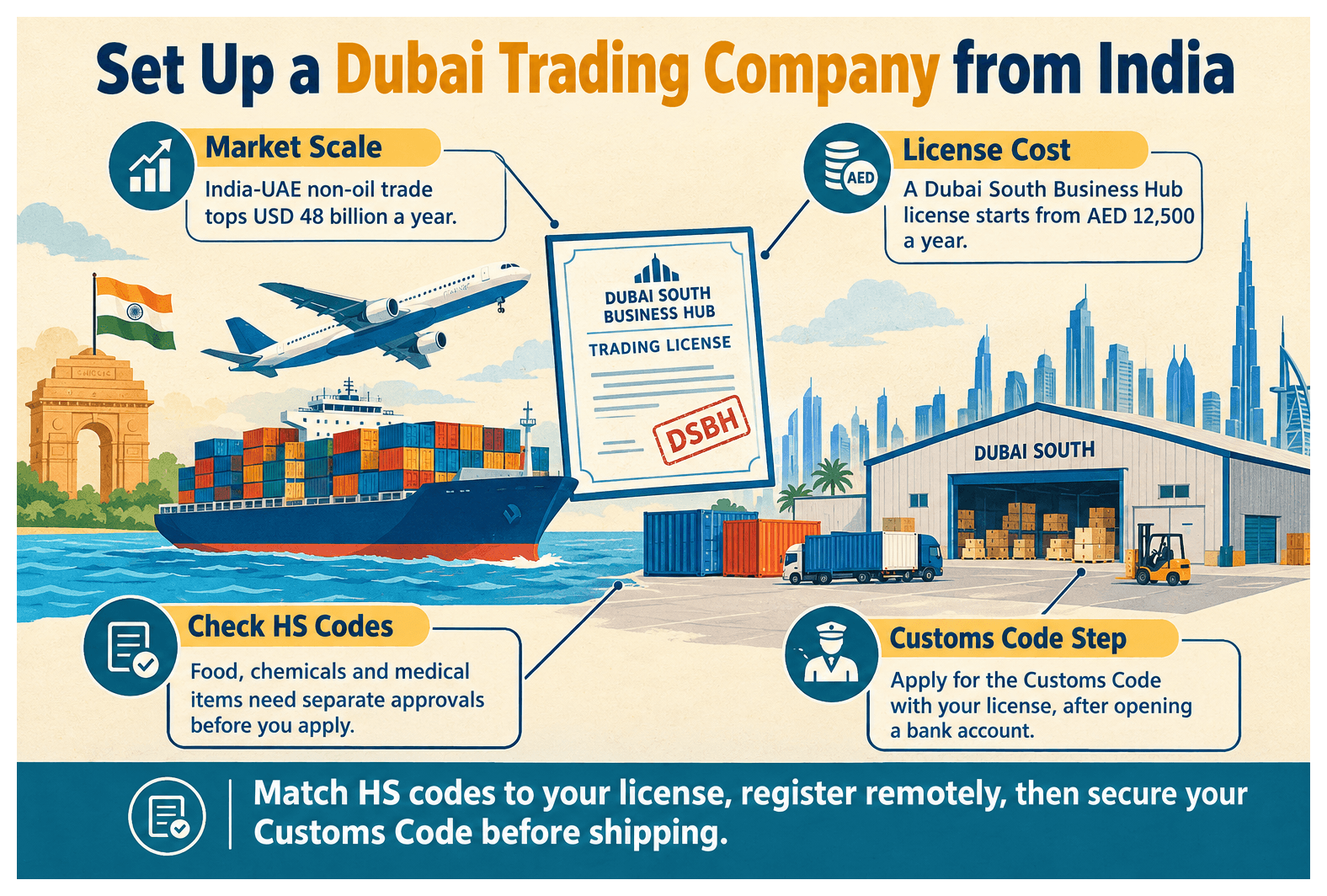
Choose a general trading license for several product lines, or an activity-specific license for one category. Check each HS (Harmonized System) code against your permitted activities first, because food, chemicals and medical items need separate approvals. This matters for any business setup in dubai from india.
A Chennai textile trader can carry home textiles and garments under one general license. A tighter activity license can be cleaner for customs if you sell a single line.
List HS codes for your top ten products.
Confirm activity codes on Business Activities before filing.
Allow extra processing time for regulated goods.
Decide between re-export and local sale early.
A Gujarat ceramics exporter maps tile HS codes to licensed activities before applying. Smart move.
Step-by-Step Guide to General Trading Setup in Dubai from India
To complete general trading setup in dubai from india, pick your activities, choose a license and visa package, submit attested passports and forms, receive the license, open a bank account, apply for the Customs Code, then process residency through ICP and GDRFA with medical clearance and the Emirates ID.
Step 1: Confirm Activities and Budget
Shortlist HS codes and product lines.
Run numbers through the Cost Calculator.
Pick visa count and desk or warehouse space.
Step 2: Submit Documents and Receive the License
Send passport copies, a photo and shareholder details.
Register remotely, as a Bengaluru founder can, without traveling.
Pay after approval to receive the license.
Step 3: Bank, Customs Code and Residency
Open a corporate account and prepare KYC papers.
Apply for the Customs Code with your license.
The Federal Authority for Identity, Citizenship, Customs and Port Security (ICP) processes the visa.
The General Directorate of Residency and Foreigners Affairs (GDRFA) handles entry status.
The Emirates ID follows medical clearance, about a week later for a Hyderabad importer.
Visa processing typically takes two to three weeks.
Key Facts for General Trading Setup in Dubai from India
Item | What You Need to Know |
|---|---|
License starting cost at DSBH | From AED 12,500 a year, before visas, space and bank charges. |
Customs Code requirement | Needs a valid license and tenancy; required before you declare shipments. |
India-UAE CEPA benefit | Reduced or zero duty on many Indian-origin goods, subject to rules of origin. |
Corporate tax (Federal Decree-Law No. 47 of 2022) | 9% above AED 375,000 profit; qualifying free zone income may be taxed at 0%, with conditions. |
RBI LRS funding route | Remit through an authorized dealer bank within the annual individual limit. |
What a Dubai South Free Zone Company Costs Indian Founders
A DSBH general trading license starts from AED 12,500 a year. Your total depends on visas, office or warehouse space, medical and Emirates ID fees, and bank charges. Model your package on the Cost Calculator before committing.
Think of a dubai free zone indian founder with two visas comparing a lean desk package against a warehouse-linked one. The license fee is the floor, not the ceiling. Check renewal timing too, so fees don't surprise you in year two.
How the India-UAE CEPA Shapes Your Trading Margins
The India-UAE Comprehensive Economic Partnership Agreement (CEPA) cuts or removes duties on many Indian-origin goods entering the UAE and eases services trade. Benefits depend on rules of origin, so you need origin documents and correct HS classification per shipment.
Goods That Benefit Most
Gems, jewelry, textiles, engineering goods and agri-products.
Confirm tariff lines before quoting buyers.
Carry certificates of origin, as a Surat jewelry exporter does.
Rules of Origin and Re-Export Limits
Third-country goods you re-export may not qualify. Keep invoices, origin certificates and shipping records, and check each HS code individually. One trader we'd point to keeps Indian-origin and Chinese-origin lines on separate tariff sheets.
Getting Your Customs Code and Import-Export Flow Running
After your license is issued, you apply for a Customs Code to declare shipments through Dubai's system. Then pick a route: air cargo through Al Maktoum International, sea freight through Jebel Ali, or nearby warehousing before re-export.
Applying for the Customs Code
You need a valid license and tenancy, then register on Dubai Trade and link a clearing agent. A Kolkata founder secured the code before booking the first container. Our guide on registering with Dubai Customs walks through it.
Shipping and Warehousing
Air cargo suits high-value or urgent goods.
Sea freight suits bulk.
Trucking hops from DSBH are short.
Store goods before onward dispatch and track duty status.
One trader stores consumer goods for three weeks before shipping to Africa. Clean paperwork keeps that smooth.
Funding Your Dubai Company Through RBI LRS
Under the Reserve Bank of India Liberalised Remittance Scheme (RBI LRS), resident individuals can remit funds abroad within an annual limit (currently USD 250,000 per financial year) for permitted purposes. Confirm current rules on overseas investment with your authorized dealer bank before transferring capital to your dubai company for indian founders.
Keep purpose codes and documents, and time remittances around license payment. One founder sent license fees and working capital in two tranches. Disclose the Dubai shareholding in your Indian returns, and ask a chartered accountant to check it. Our business support team can point you in the right direction.
Tax, Compliance and Reporting Duties for Indian Founders
Your Dubai company answers to the Federal Tax Authority (FTA) for corporate tax under Federal Decree-Law No. 47 of 2022, and for VAT where applicable. As an Indian resident, you also report to the Income Tax Department. Qualifying free zone income may get favorable treatment, subject to conditions.
Register with the FTA in your first year.
Watch qualifying-income and trading limits.
Test your Indian tax residency each year.
Report foreign income and assets in India.
Check double taxation relief between India and the UAE.
Your Next Move
General trading setup in dubai from india comes down to six moves: pick activities, secure a DSBH license, plan around CEPA, obtain the Customs Code, fund via RBI LRS, and stay compliant with the FTA and the Income Tax Department. Review Business Activities, then run your numbers on the Cost Calculator to set up or buy a license.
References
Frequently Asked Questions