E-Commerce Company Setup in Dubai from India: License, Cost and Payments

Topic Summary
Register a Free Zone Company Remotely
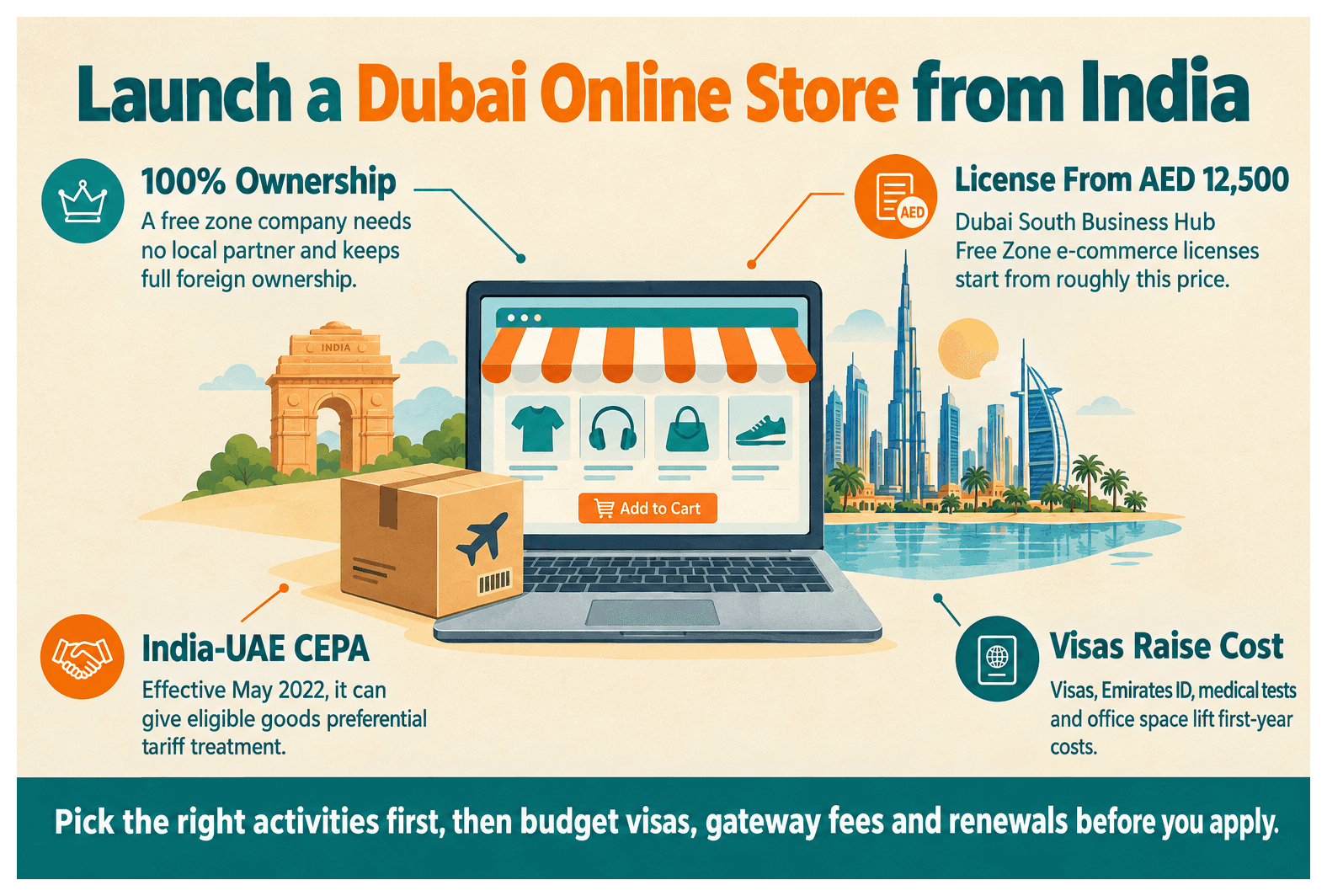
E-commerce setup means registering a UAE free zone company with a trade license covering online sales, then opening a bank account and payment gateway. Most steps can be handled from India, and you keep 100% foreign ownership.
Pick License Activities That Fit Products
Choose an e-commerce or online retail activity, then add others that match your goods, such as general trading. The activity list decides what you can invoice, import and advertise, and regulated goods may need extra approvals.
Use the India-UAE CEPA Wisely
The CEPA, in effect since May 2022, can give eligible goods preferential tariff treatment. Confirm your HS code and origin rules first, since not every product qualifies.
Budget Beyond the License Fee
A Dubai South Business Hub Free Zone e-commerce license starts from roughly AED 12,500. First-year cost rises with visas, Emirates ID, medical tests and any office or warehouse space.
Watch for Hidden Costs
Indian founders often miss INR remittance conversion margins, gateway rolling reserves, chargeback fees and annual renewal cycles. Reserves can tie up cash within the first few months.
Follow the Six-Stage Setup Process
The process runs from choosing activities and checking the trade name to submitting documents, receiving the license and completing visa formalities. Planning each stage in advance keeps the timeline predictable.
Plan Payments and Fund Transfers Early
Set up a UAE bank account and payment gateway to accept multi-currency payments from Gulf buyers. Compare provider fees and settlement terms before choosing how to move funds back to India.
The UAE e-commerce market is projected to reach USD 9 billion in 2026 (Statista, 2026) [1]. If you're an Indian founder, e-commerce company setup in Dubai from India gives you a Gulf-facing store with full ownership. This guide covers the license, first-year cost, payment gateways and tax, so you can plan before you apply.
What Is E-Commerce Company Setup in Dubai from India and Why It Matters
E-commerce company setup in Dubai from India means registering a UAE free zone company with a trade license covering online sales, then opening a UAE bank account and payment gateway. You manage most of it remotely and keep 100% foreign ownership.
How a Dubai Company for Indian Founders Works
A free zone company is a separate legal entity with its own license, bank account and visa quota. You don't need a local partner. Picture a Pune home-décor seller who registers at Dubai South Business Hub Free Zone, sells across the GCC and ships from a Dubai fulfilment partner. Our Moving to Dubai guide for Indians covers the wider relocation picture.
Why Indian Sellers Choose Dubai Over Staying Domestic Only
Gulf buyers are reached faster from a Dubai base.
Multi-currency payments ease settlement.
License costs are defined upfront.
The India-UAE Comprehensive Economic Partnership Agreement (CEPA) supports bilateral trade.
Choosing the Right License and Activities for Indian Founders
Business setup in Dubai from India starts with the activity list. Choose a free zone license with an e-commerce or online retail activity, then add activities that match your goods. The list decides what you can invoice, import and advertise. Many a Dubai free zone Indian owner learns this late.
Matching Your Product Range to License Activities
Pick by sales model: own store, marketplace seller or B2B. A fashion label might combine online retail with general trading, so it can sell direct and supply boutiques. Regulated goods may need extra approvals, so confirm first. Browse the full list on Business Activities, or read our e-commerce license guide.
Using the India-UAE CEPA to Your Advantage
The India-UAE CEPA took effect in May 2022. It can give eligible goods preferential tariff treatment. Confirm your HS code and origin rules before shipping. A textile exporter, for example, should check whether its product codes qualify before sending stock to Dubai. Don't assume every product benefits.
Cost Breakdown for Setting Up a Dubai Company for Indian Founders
A Dubai South Business Hub Free Zone e-commerce license starts from roughly AED 12,500. First-year cost rises with visas, Emirates ID, medical tests and any office or warehouse. Gateway fees and bank charges are ongoing and vary by provider and turnover.
Key Facts Table: Setup Cost Components
Final quotes depend on your activities and visa count. A founder with one partner visa and one investor visa will pay far more than a license-only buyer. Use the Cost Calculator for your own figure.
Key Facts: E-Commerce Setup Costs for Indian Founders
Cost Component | What to Expect |
|---|---|
Free zone e-commerce license (from AED 12,500) | Entry price; rises with extra activities. |
Investor or partner residency visa | Priced per visa; depends on your visa quota. |
Emirates ID and medical test | Charged per person, and needs a Dubai visit. |
Corporate bank account and gateway fees | Bank and gateway charges vary by provider and turnover. |
Annual license and visa renewal | Recurring yearly; budget it from day one. |
Hidden Costs Indian Founders Often Miss
INR remittance conversion margins.
Gateway rolling reserves and chargeback fees.
License and visa renewal cycles.
One seller budgeted only the license, then found cash tied up in a gateway reserve by month three. Plan for it. Our e-commerce setup cost article goes deeper.
Step-by-Step Process for E-Commerce Company Setup in Dubai from India
E-commerce company setup in Dubai from India runs in six stages: choose activities, check the trade name, submit documents, receive the license, complete visa formalities, then open the bank account and gateway. Only biometrics and medical tests need a Dubai visit.
Step 1: Confirm Activities and Shareholder Documents
Gather passport copies, photographs and Indian proof of address.
Decide your visa count.
Agree the shareholding. Two co-founders might split 50: 50.
Step 2: Check Your Trade Name and Submit the Application
Run the name check before filing.
Avoid restricted words.
Match the name to your storefront brand. If your first choice is taken, pick a variant.
Step 3: Complete Residency, Emirates ID and Banking
The Federal Authority for Identity, Citizenship, Customs and Port Security (ICP) processes visas and Emirates ID.
The General Directorate of Residency and Foreigners Affairs (GDRFA) handles Dubai residency matters.
Complete the medical test and biometrics in one short trip, then fly home while the card is processed.
Open the corporate bank account, then apply for the gateway.
Setting Up UAE Payment Gateways and Moving Funds from India
To accept payments, open a UAE corporate bank account, then apply to a UAE-licensed gateway with your license, shareholder documents and website details. Capital from India moves under the Reserve Bank of India Liberalised Remittance Scheme (RBI LRS), so keep records for both countries.
Opening a Gateway That Accepts AED and Foreign Currency
Gateways review your website, refund policy, product category and license activity. The Central Bank of the UAE regulates payment services. Ask about multi-currency settlement, payout timelines and cash-on-delivery handling. Adding cards and local wallets cuts cart abandonment among Gulf shoppers.
Remitting Capital Under RBI LRS Rules
Individuals remit within the annual LRS limit (USD 250,000 per financial year) and must meet declaration and tax-collection requirements. A founder might wire share capital in two documented transfers and keep the bank advice. Speak to a chartered accountant on structuring and permitted purposes.
Tax, Compliance and Residency for Indian Owners of a Dubai Free Zone Company
A Dubai free zone Indian owner must register for UAE corporate tax and for VAT where turnover requires it. You may also owe disclosure and tax in India, so plan filings in both countries and keep clean accounts.
UAE Corporate Tax and VAT Basics
Federal Decree-Law No. 47 of 2022 (the Corporate Tax Law) requires registration. Qualifying free zone treatment has conditions, so your company isn't simply tax free. The Federal Tax Authority (FTA) handles registration and filings. VAT registration becomes mandatory above AED 375,000 in taxable turnover, and tax invoices belong in your checkout flow.
Indian Tax Residency and Reporting Obligations
The Income Tax Department expects foreign asset and income disclosure from Indian residents. Your residency status changes how Dubai company income is treated. Build a yearly compliance calendar and hire a cross-border adviser.
Check your Indian residency status.
List foreign assets.
Match UAE and Indian filing dates.
Your Next Move
E-commerce company setup in Dubai from India comes down to four decisions: license activities, a realistic first-year budget, a gateway that fits your customers, and tax planning in both countries. Review the options on Business Activities, then use the Cost Calculator to decide whether to set up a new company or buy a license.
References
Frequently Asked Questions