Tax Treaty Between the UAE and India: What It Means for Your Company

Topic Summary
What Is the Tax Treaty UAE India Framework and Why It Matters
The tax treaty UAE India framework combines two instruments. The UAE India double tax agreement (DTAA) allocates taxing rights and caps withholding on dividends, interest and royalties. The India-UAE Comprehensive Economic Partnership Agreement (CEPA) is a trade pact. Together they shape what your company pays, and where.
What the India-UAE CEPA and the Treaty Cover
What the India-UAE CEPA and the Treaty Cover
Which Taxes Are Reduced or Eliminated for Your Dubai South Company
Treaty relief reduces or removes double taxation, not all tax. Qualifying free zone income can access a 0% rate, but non-qualifying income is taxed at 9%. Never assume an india company dubai tax position is fully exempt.
How to Claim Tax Treaty UAE India Benefits Step by Step
To claim the tax treaty UAE India benefits, confirm your license activity, secure UAE residency, obtain the FTA certificate, present it, and keep records.
Staying Compliant on Both Sides of the Border
Compliance means matching substance to the treaty claim. Poor records are the usual reason treaty claims fail.
Choosing Your Next Move With Tax Treaty UAE India Rules in Mind
Map your activities, income flows and residency, then pick a license and check costs. A consulting founder might compare a fresh license with a purchased one first.
The tax treaty UAE India framework matters because bilateral trade runs above USD 85 billion a year. The 2022 corporate tax law (Federal Decree-Law No. 47 of 2022) set a 9% rate above AED 375,000 (Federal Tax Authority, 2023). This guide shows Indian founders with a Dubai South license what the treaty changes.
What Is the Tax Treaty UAE India Framework and Why It Matters
The tax treaty UAE India framework combines two instruments. The UAE India double tax agreement (DTAA) allocates taxing rights and caps withholding on dividends, interest and royalties. The India-UAE Comprehensive Economic Partnership Agreement (CEPA) is a trade pact. Together they shape what your company pays, and where.
Treaty and CEPA Defined in Plain Terms
The DTAA decides which country taxes which income. The CEPA covers tariffs and services access, not income tax rates. A Mumbai founder assumed the CEPA exempted his dividends, then learned that withholding and residency rules sit in the DTAA.
Why Residency Decides Everything
Treaty access depends on UAE tax residency, proven by a certificate from the Federal Tax Authority (FTA). Here's the catch: a director who spends most of the year in India may still count as an Indian resident. Read our guide on double tax treaties and your UAE company for the wider rules.
What the India-UAE CEPA and the Treaty Cover
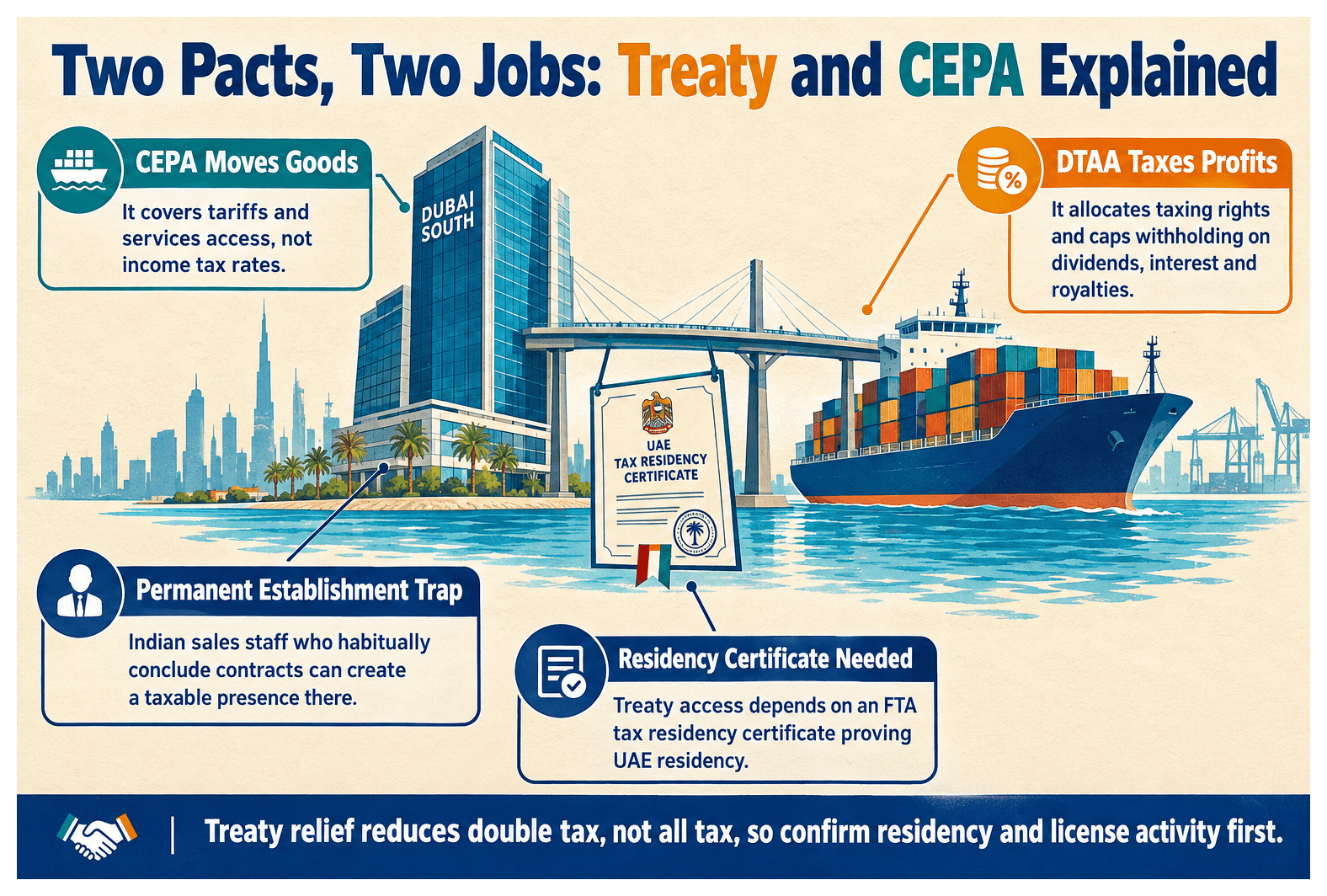
The CEPA covers tariff cuts, services access, rules of origin and investment. The DTAA covers business profits, dividends, interest, royalties, permanent establishment and double taxation relief. You need both lenses: CEPA for moving goods, the treaty for taxing profits.
Trade Benefits Under the CEPA
Preferential tariffs on many Indian goods entering the UAE.
Services and investment access for a Dubai sales arm.
Origin rules apply to goods routed through your license.
See import and export between India and Dubai for customs detail.
Key Facts: India-UAE CEPA Versus the Double Tax Agreement
Feature | India-UAE CEPA | UAE India Double Tax Agreement |
|---|---|---|
Main purpose | Cuts trade barriers in goods and services | Prevents the same income being taxed twice |
Taxes or duties affected | Customs duties and tariffs | Income tax, withholding on dividends, interest, royalties |
Who benefits most | Traders and manufacturers moving goods | Founders earning cross-border income |
Proof needed to claim | Origin documentation for the goods | FTA tax residency certificate |
Key limit to remember | Does not change income tax rates | Reduces double tax, not all tax |
Income Tax Rules Under the Double Tax Agreement
Permanent establishment is the trap. If your Indian sales team habitually concludes contracts in India, your Dubai company can create a taxable presence there. Dual residents fall under tie-breaker rules.
Which Taxes Are Reduced or Eliminated for Your Dubai South Company
Treaty relief reduces or removes double taxation, not all tax. Qualifying free zone income can access a 0% rate, but non-qualifying income is taxed at 9%. Never assume an india company dubai tax position is fully exempt.
UAE Side: Corporate Tax and Free Zone Status
A Dubai South trading company earning qualifying and non-qualifying income is taxed differently on each. Confirm your license activity first. That's what decides whether a Dubai free zone Indian owner gets the 0% rate.
India Side: Withholding and Residency Rules
The DTAA caps Indian withholding at 10% on dividends and royalties and 12.5% on interest (verify current rates). The Income Tax Department taxes residents on worldwide income, with credit for UAE tax paid. Read whether Indian founders pay tax twice on Dubai profits.
How to Claim Tax Treaty UAE India Benefits Step by Step
To claim the tax treaty UAE India benefits, confirm your license activity, secure UAE residency, obtain the FTA certificate, present it, and keep records.
Step 1: Set Up the License and Residency Documents
Obtain your Dubai South license with a visa package.
Residency is processed through the Federal Authority for Identity and Citizenship (ICP) and the General Directorate of Residency and Foreigners Affairs (GDRFA).
Receive your Emirates ID as residency evidence.
Start with business setup in Dubai from India.
Step 2: Obtain the Tax Residency Certificate
Apply to the FTA with your license, lease and financial records.
Check whether the certificate is issued per treaty and period.
Step 3: Present the Certificate and File Correctly
Give the certificate to Indian payers to apply the treaty rate.
Claim foreign tax credit on your Indian return.
Keep board minutes, invoices and payroll.
Staying Compliant on Both Sides of the Border
Compliance means matching substance to the treaty claim. Poor records are the usual reason treaty claims fail.
Substance and Record Keeping
Hold board meetings, an office lease and staff in the UAE.
Document related-party invoices at arm's length rates.
Moving Money Under the RBI LRS
The Reserve Bank of India Liberalised Remittance Scheme (RBI LRS) governs individual remittances, currently USD 250,000 per financial year (verify before relying). A founder funding share capital should document the purpose code. See repatriating profits to India.
Choosing Your Next Move With Tax Treaty UAE India Rules in Mind
Map your activities, income flows and residency, then pick a license and check costs. A consulting founder might compare a fresh license with a purchased one first.
Setting Up or Buying a License
Match the activity to your income so free zone and treaty positions hold. Review what a Dubai company costs an Indian founder.
Where to Go Next
Use the Business Activities and Cost Calculator to set up or buy a Dubai South Business Hub Free Zone license today.
The tax treaty UAE India rules work when the CEPA, the DTAA and your license line up with real UAE residency and clean records. Treaty relief reduces double taxation. It doesn't make income fully tax free.
References
Frequently Asked Questions