VAT Obligations for Indian Entrepreneurs With a Dubai Company

Topic Summary
What Is VAT Obligations Indian Dubai Company and Why It Matters
VAT obligations for an Indian-owned Dubai company are the legal duties to register once taxable supplies pass AED 375,000, charge 5% on standard-rated sales, zero-rate qualifying exports, keep records and file on time. A free zone license doesn't remove them.
Registration Thresholds for a Dubai Free Zone Company
Registration Thresholds for a Dubai Free Zone Company
Zero-Rating for Exports and Cross-Border Services
Exports outside the GCC and qualifying international services carry 0% VAT. They still count toward the threshold and let you recover input VAT. Every India entrepreneur UAE VAT file needs proof: customs documents, contracts and invoices.
How VAT Registration Works for Your Free Zone License
Registration has five stages: confirm eligibility, gather documents, create an FTA account, submit and receive your Tax Registration Number (TRN). These are the VAT obligations Indian Dubai company owners meet first.
Filing Requirements and Deadlines for UAE VAT Returns
Most businesses file quarterly, within 28 days of period end. Returns show output tax, input tax and net payable. The UAE VAT India founder routine is simple, but penalties apply to late filing and late payment.
Indian Compliance Links That Sit Beside UAE VAT
UAE VAT is one layer. Indian residents still report foreign income and assets to the Income Tax Department, and remittances must respect Reserve Bank of India (RBI) LRS limits.
Next Actions to Stay VAT Compliant With Your Dubai South License
Check your threshold, confirm your license activities, set up VAT-ready invoicing and diarise filing dates.
In 2026, the mandatory VAT threshold in the UAE is AED 375,000 in taxable supplies over a rolling 12 months, and the Federal Tax Authority (FTA) fines late registration AED 10,000 (FTA, 2026). This guide is for Indian founders holding a Dubai South Business Hub free zone license. Afterwards you'll know when to register, what to zero-rate and when to file.
What Is VAT Obligations Indian Dubai Company and Why It Matters
VAT obligations for an Indian-owned Dubai company are the legal duties to register once taxable supplies pass AED 375,000, charge 5% on standard-rated sales, zero-rate qualifying exports, keep records and file on time. A free zone license doesn't remove them.
VAT Is Separate From Corporate Tax
Federal Decree-Law No. 47 of 2022 governs corporate tax, which hits profit. VAT is a 5% transaction tax. A Pune consulting founder assumed his license meant no VAT, then discovered his UAE client sales were taxable.
UAE VAT Key Facts for Indian Founders
Item | Rule |
|---|---|
Mandatory registration threshold | AED 375,000 in taxable supplies, rolling 12 months |
Voluntary registration threshold | AED 187,500 in supplies or expenses |
Standard VAT rate | 5% |
Export and international services rate | 0% with proof, input VAT recoverable |
Return filing frequency and deadline | Usually quarterly, within 28 days of period end |
Why Indian Founders Get Caught Out
Many compare this with India's GST and assume the thresholds match. They don't. A trader's invoices crossed the limit in month nine because nobody tracked the rolling total. Our guide on when to register your Dubai company for VAT covers the timing.
Registration Thresholds for a Dubai Free Zone Company
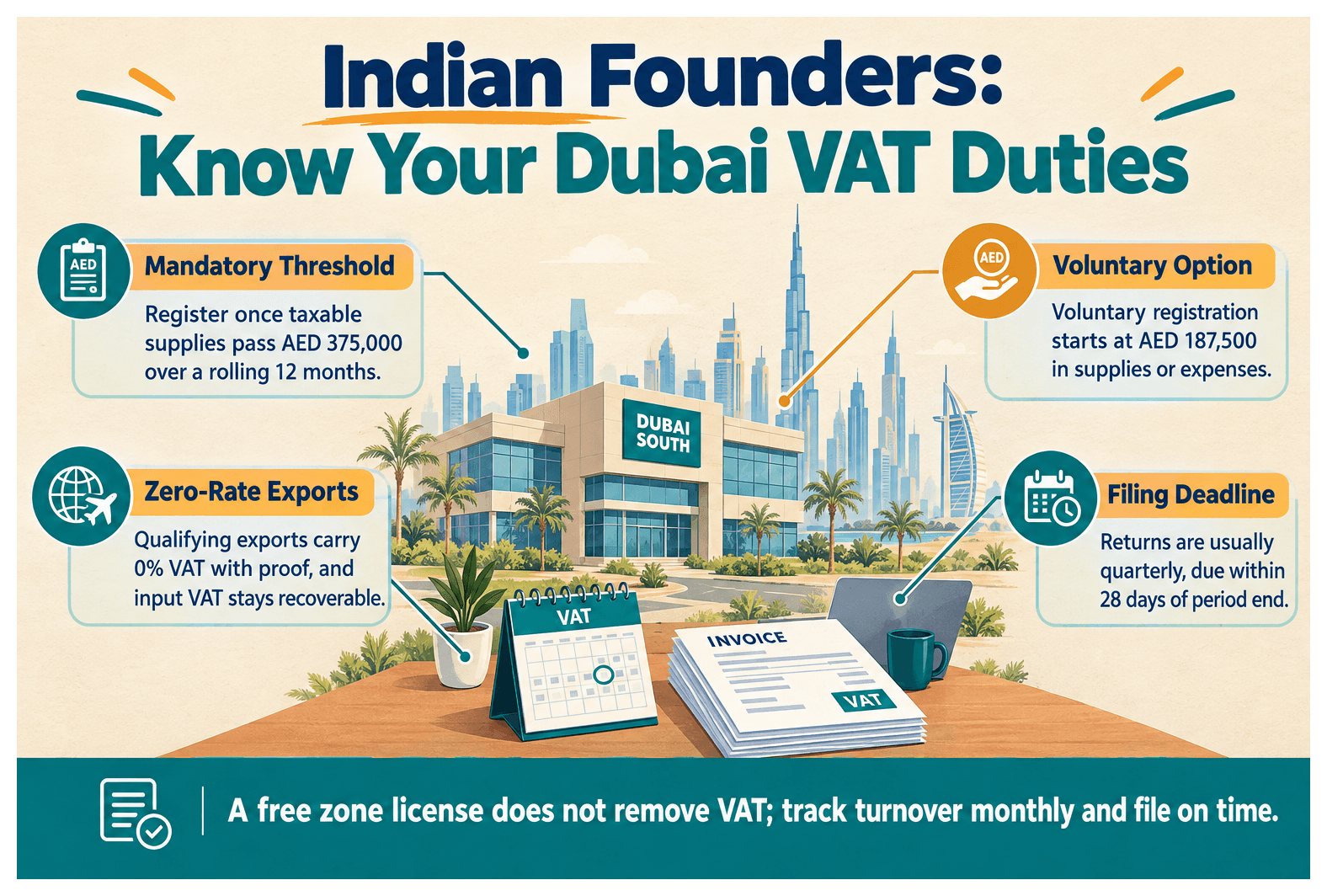
Registration is mandatory above AED 375,000 over the previous 12 months, or when you expect to pass it within 30 days. Voluntary registration starts at AED 187,500. Dubai free zone VAT Indian founders face is tracked monthly, not yearly.
Mandatory Versus Voluntary Registration
Mandatory: AED 375,000, with a 30-day forward test.
Voluntary: AED 187,500.
Apply through the FTA portal.
Heavy launch costs? Register early to reclaim input VAT.
Tracking Your Rolling Turnover
Count every taxable supply, zero-rated exports included. Keep a spreadsheet totalling the trailing 12 months, and set an alert at 80% of the limit.
Zero-Rating for Exports and Cross-Border Services
Exports outside the GCC and qualifying international services carry 0% VAT. They still count toward the threshold and let you recover input VAT. Every India entrepreneur UAE VAT file needs proof: customs documents, contracts and invoices.
Goods Exported to India
A Surat textile trader shipping fabric from Dubai South keeps export declarations on file. Indian import duty and GST are handled separately in India, and the India-UAE CEPA only affects trade duties, not VAT. Zero-rated isn't exempt.
Services to Clients Outside the UAE
Use a written contract, like a software founder billing Mumbai.
Show the correct tax treatment on the invoice.
Input VAT stays recoverable.
See our note on invoicing clients from a Dubai company.
How VAT Registration Works for Your Free Zone License
Registration has five stages: confirm eligibility, gather documents, create an FTA account, submit and receive your Tax Registration Number (TRN). These are the VAT obligations Indian Dubai company owners meet first.
Step 1: Confirm Eligibility and Collect Documents
Trade license, Memorandum of Association, passport copy.
Emirates ID, issued by the Federal Authority for Identity, Citizenship, Customs and Port Security (ICP).
Twelve months of invoices as turnover proof.
Step 2: Create the FTA Account and Submit
Declare expected supplies accurately. Your residency record at the General Directorate of Residency and Foreign Affairs (GDRFA) must match. One applicant's visa spelling differed from his passport, and the application was rejected.
Step 3: Receive the TRN and Set Up Records
Put the TRN on every invoice the same day. Keep records for five years.
Filing Requirements and Deadlines for UAE VAT Returns
Most businesses file quarterly, within 28 days of period end. Returns show output tax, input tax and net payable. The UAE VAT India founder routine is simple, but penalties apply to late filing and late payment.
Quarterly Cycle and Payment
A January to March return is due 28 April. Read VAT return filing for Dubai companies for the box-by-box detail.
Common Filing Mistakes
Treating zero-rated sales as exempt.
Missing invoice detail that blocks input tax recovery.
Filing on time but paying two days late.
Indian Compliance Links That Sit Beside UAE VAT
UAE VAT is one layer. Indian residents still report foreign income and assets to the Income Tax Department, and remittances must respect Reserve Bank of India (RBI) LRS limits.
Income Tax Department Reporting
Your residency status drives Indian taxation. A Bengaluru founder reconciles Dubai financials with Indian filings yearly. Read whether Indian founders pay tax twice on Dubai profits.
RBI LRS and Moving Profits Home
RBI caps outward remittances per individual each year. Keep bank advices beside your VAT records, and document the source of setup capital. The Central Bank of the UAE regulates the UAE side of banking.
Next Actions to Stay VAT Compliant With Your Dubai South License
Check your threshold, confirm your license activities, set up VAT-ready invoicing and diarise filing dates.
Your Compliance Checklist
Track turnover against AED 375,000 monthly.
Keep an export evidence folder.
Diarise the 28-day deadline.
Where to Go Next
The VAT obligations Indian Dubai company founders carry are manageable with a 15-minute monthly review. Price your activities in the Business Activities and Cost Calculator to set up or buy a Dubai South Business Hub license. Then read our guide to moving an Indian business operation to Dubai.
References
Frequently Asked Questions