Moving a UK Limited Company to Dubai: Cost, Steps and What Transfers

Topic Summary
It's a Restructure, Not a Transfer
UK company law has no simple route to re-domicile a Ltd into a UAE free zone. Founders usually form a new Dubai entity and move contracts, IP and staff across.
What Can Move to Dubai
Customer contracts, IP, trademarks, equipment and staff can move through novation, assignment or fresh agreements. Client consent is needed for novation, and IP needs a written assignment.
What Stays Behind in the UK
The UK company number, Companies House record, UK VAT registration, payroll scheme and bank mandates do not transfer. Many founders keep a UK account for GBP receipts.
Three Restructuring Routes to Compare
You can close the UK company and relaunch in Dubai, keep the UK company and add a Dubai entity, or place the UK company under a Dubai holding company. Your UK client base and tax position decide the best fit.
Price Intercompany Transfers at Arm's Length
Assets moved between related entities should be valued at arm's length. Keep valuation evidence on file and take advice before moving high-value IP.
Licensing Links Directly to Residency
A Dubai free zone license allows 100% foreign ownership and supports visa sponsorship for founders. The Dubai entity sponsors the visa.
Check Tax Residency and Costs Early
The Statutory Residence Test determines your UK tax status after you move, so review it before restructuring. Budget for closure, licensing and advisory costs as well.
Moving a UK limited company to Dubai is a question for roughly 240,000 British nationals living in the UAE (u.ae, 2024). This guide is for British founders who want to know what transfers, which route fits, and what happens first. For the wider picture, start with moving from the United Kingdom to Dubai.
What Is Moving a UK Limited Company to Dubai and Why It Matters
Moving a UK limited company to Dubai means relocating its operations, ownership or management to the UAE, usually by forming a new free zone company and either winding down or keeping the UK entity. A UK company can't simply re-register in Dubai, so the move is a restructure.
Why a Transfer Is Really a Restructure
UK company law offers no simple re-domiciliation into a UAE free zone. So most founders form a Dubai entity and move contracts, IP and staff across. The UK company is then kept, left dormant or closed.
Picture a London consultancy that forms a Dubai South Business Hub company, novates its client contracts, then dissolves the UK Ltd after final accounts.
Why British Founders Are Making the Move
A Dubai company for British founders offers 100% foreign ownership in a free zone, access to Gulf clients, and residency tied to the company license. An e-commerce founder serving Gulf buyers, for instance, gains a local base for logistics and banking.
What Transfers and What Stays Behind When Moving a UK Limited Company to Dubai
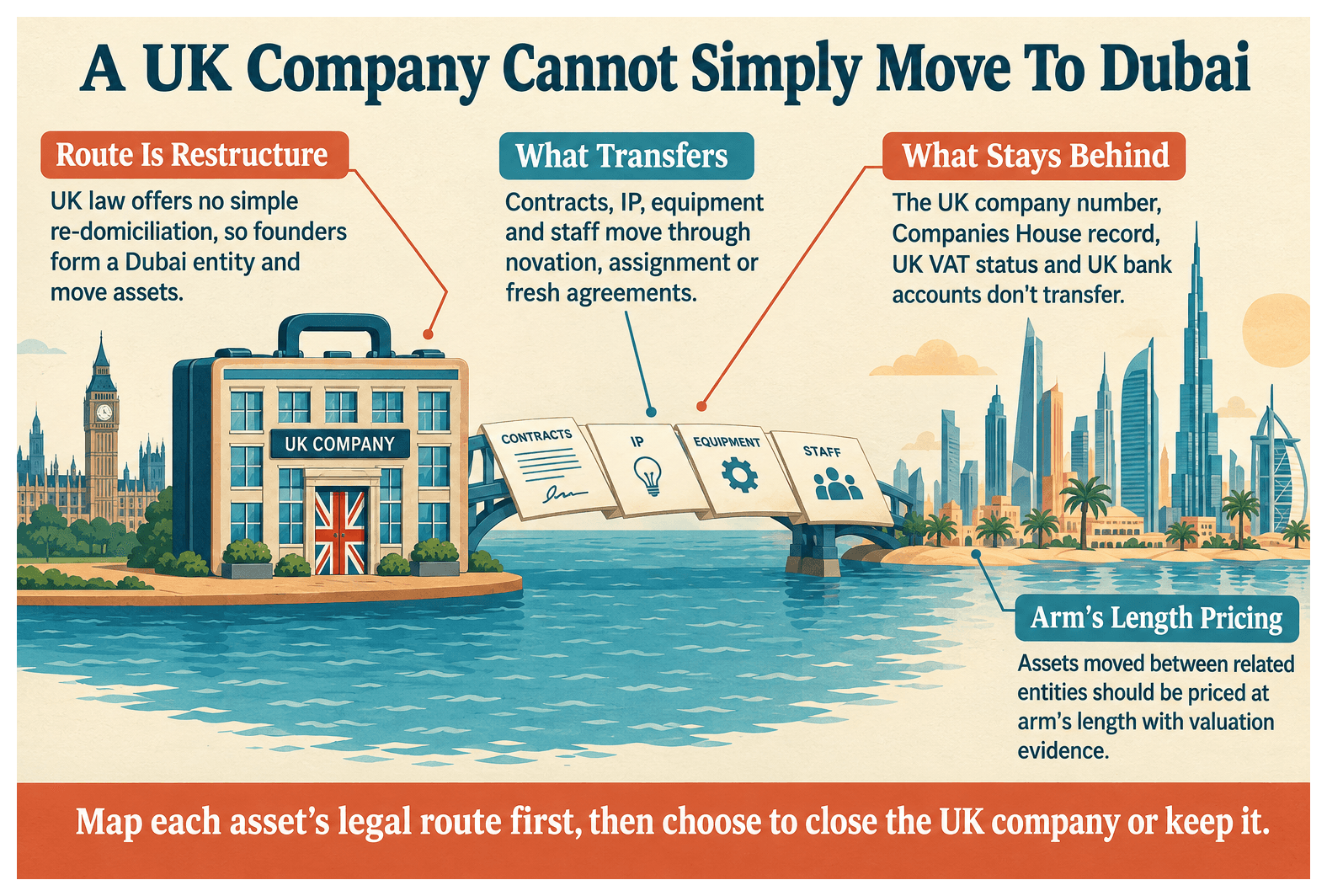
Contracts, brand, IP, clients, equipment and staff can move to a Dubai entity through novation, assignment or fresh agreements. The UK company number, Companies House registration, UK VAT status and UK bank accounts don't transfer. Map each asset's legal route before you restructure.
Assets and Contracts You Can Move
Customer contracts, via novation with client consent.
IP and trademarks, through written assignment.
Equipment and stock, sold at fair value.
A SaaS founder, for example, assigns software IP from the UK Ltd under a documented intercompany agreement.
Restructuring Options for a UK Limited Company Moving to Dubai
Feature | Close UK and Relaunch in Dubai | Keep UK and Add Dubai Entity |
|---|---|---|
UK company status | Struck off after final accounts and tax clearance | Stays active on Companies House |
Best suited for | Founders with few UK ties and mainly Gulf clients | Agencies and traders with UK customers and GBP invoicing |
UK client continuity | Needs novation before closing | Unchanged, UK contracts stay in place |
Complexity and advice needed | Moderate, with UK accountant for closure | Higher, needs intercompany agreements |
Residency link through Dubai license | Visa sponsored by the sole Dubai entity | Visa sponsored by the Dubai entity only |
What Cannot Be Carried Across
The UK company number and Companies House record.
UK VAT registration and payroll scheme.
Existing UK bank mandates.
Many founders keep a UK account for GBP receipts and open a UAE account for the new entity.
Transfer Pricing and Valuation Basics
Assets moved between related entities should be priced at arm's length. Keep valuation evidence on file, and take advice before moving high-value IP, such as a software license portfolio.
Restructuring Options Compared for British Founders
A Dubai company for British founders usually follows one of three routes: close the UK company and start fresh, keep it and add a Dubai entity, or place the UK company under a Dubai holding company. Your UK clients, tax position and share of business moving decide it.
Close the UK Company and Relaunch in Dubai
This is cleanest when UK ties are few. You file final accounts, obtain tax clearance and apply for strike-off, after novating contracts. A consultancy with mostly Gulf clients fits well.
Run the UK and Dubai Entities Side by Side
This keeps UK customers and GBP invoicing while a Dubai South Business Hub entity handles regional contracts and residency. You'll need clear intercompany agreements. See running a UK and a Dubai company side by side.
Use a Dubai Holding Structure Over the UK Company
A share exchange puts the UK Ltd under a Dubai parent. Get UK tax advice on share transfers and exit charges first. It suits scaling groups with a profitable UK trading company.
Step-by-Step Process for Moving a UK Limited Company to Dubai
Business setup in Dubai from the UK is document-led. The process runs in seven stages: goals, UK tax check, structure, name check, license application, banking and residency, then contract and asset transfer. Most founders finish the Dubai side in a few weeks once documents are ready.
Step 1: Confirm Goals and Check Your UK Tax Position
List clients, IP and staff, then decide what moves.
Speak to a UK adviser about HMRC exposure.
Note any exit charges before you act.
Step 2: Choose the Structure and Check the Name
Pick close, side by side or holding.
Run your brand through the company name check.
Reserve a Dubai trade name matching your UK brand.
Step 3: Apply for the License and Move Residency
Prepare apostilled UK documents.
Obtain the free zone license, then visa and Emirates ID.
Open a UAE bank account, then novate contracts.
Licensing and Visas for Your Dubai Company
A Dubai free zone license sets your permitted activities, and the company can then sponsor residency visas. The Federal Authority for Identity, Citizenship, Customs and Port Security (ICP) issues the Emirates ID, and the General Directorate of Residency and Foreigners Affairs (GDRFA) handles Dubai visa processing.
Choosing a Free Zone License Activity
Match the license to your actual trade. Dubai South Business Hub offers trade licenses with 100% foreign ownership, and visa packages are tied to the license. A UK importer should pick an activity covering re-export.
Residency Visas and the Emirates ID
A medical test and biometrics are part of the process. A founder and spouse can both obtain visas, subject to the company quota.
Tax Residency and the SRT Test When Moving a UK Limited Company to Dubai
Moving the company doesn't change your personal UK tax status. HM Revenue and Customs (HMRC) decides residency using the Statutory Residence Test (SRT), which counts UK days, ties and work patterns. The Federal Tax Authority (FTA) handles UAE corporate tax registration under Federal Decree-Law No. 47 of 2022.
How the SRT Test Affects You Personally
Keep travel records and track UK days every tax year. Ask a UK adviser about split-year treatment. See your UK tax residency.
Corporate Tax and Registration in the UAE
The UAE isn't 100% tax free. Corporate tax applies at 9% above AED 375,000, and qualifying free zone rules can change the outcome (Ministry of Finance, 2023). A Dubai entity should register and assess qualifying income.
What Moving a UK Limited Company to Dubai Costs
Costs fall into four groups: license and registration, visa and Emirates ID fees, UK-side closure or advisory costs, and apostille and translation. Totals vary by activity, visa count and structure, so use the Cost Calculator and get a written quote.
Setup and Visa Cost Components
License, registration and office or flexi-desk.
Visa, medical and Emirates ID.
Renewals each year.
UK-Side and Hidden Costs to Budget For
Accountant and tax adviser fees.
Apostille and certified translation.
Final UK filings and exit tax advice.
Your Next Move When Moving a UK Limited Company to Dubai
Moving a UK limited company to Dubai is a restructure: assets and contracts move, the UK registration doesn't, and the SRT still governs your HMRC residency. Choose the route that fits your UK ties, budget early and keep records.
Speak to Business Support about your structure, then estimate your license and visa package.
References
Frequently Asked Questions