Topic Summary
Know Which Content Triggers Disclosure
Any post where you receive cash, free products, discounts, event access, or affiliate commissions requires a clear disclosure label. This applies regardless of your follower count or which platform you use.
Use Approved Labels Placed Prominently
Acceptable tags include #Ad, #Sponsored, or your platform's native paid-partnership label. These must appear at the start of a caption or within the first three seconds of a video to count as compliant.
The NMC Enforces Rules With Real Penalties
The UAE National Media Council can issue content removal orders, suspend licenses, and levy financial fines that may exceed the value of the brand deal itself. Non-compliance is a commercial risk, not just a legal technicality.
Brands Share Liability for Creator Non-Compliance
Larger advertisers now routinely include disclosure compliance clauses in creator contracts because they can face shared liability when a partner fails to label paid content correctly. Always confirm disclosure requirements before publishing.
Platform Rules Stack on Top of NMC Requirements
Disabling TikTok's branded content toggle or bypassing Instagram's paid-partnership tag still leaves you in breach of NMC guidelines and may simultaneously violate the platform's own community standards. Both sets of rules apply at once.
Budget for Licensing and Tax Thresholds Early
Free zone commercial licenses start at AED 12,500, and VAT registration becomes compulsory once annual turnover exceeds AED 375,000. Missing corporate tax registration carries a one-time AED 10,000 penalty, so factor these costs into your business plan from the start.
The UAE's creator economy is growing fast. Brand partnerships across Instagram, TikTok, YouTube, and short-video platforms now represent a significant income stream for creators at every follower level, yet a large share of paid posts still appear without any visible disclosure label. The UAE National Media Council (NMC) enforces advertising disclosure rules with real penalties. Free zone licenses start at AED 12,500. VAT registration is compulsory once turnover passes AED 375,000 (Federal Tax Authority, 2026). Corporate tax late registration carries a one-time AED 10,000 penalty. This guide covers the advertising disclosure requirements every UAE creator must meet, the exact costs of setting up a compliant commercial entity, and the steps to get your license issued and your first brand deal published within the rules.
What Are Advertising Disclosure Rules for UAE Creators and Why They Matter
Advertising disclosure rules for UAE creators are legally binding requirements to label paid, sponsored, or gifted content with a clear, visible tag such as #Ad or #Sponsored. Governed by the UAE National Media Council, these rules apply to every monetised post across all social platforms and carry penalties for non-compliance.
The Regulatory Framework Behind Creator Disclosures
The UAE National Media Council is the named authority that licenses and regulates all media and publishing activities, including digital content monetised through brand partnerships. Its guidelines sit alongside the UAE Consumer Protection Law, which requires that commercial communications not mislead audiences about the paid nature of content (u.ae, 2024).
Three triggers activate the advertising disclosure obligation for creators in the UAE:
Receiving direct payment for a post, story, reel, or video
Receiving a product, service, or event access with no cash fee
Earning commission through affiliate links or promo codes tied to the content
Worth flagging: these rules apply regardless of follower count or platform. A micro-creator with 2,000 followers and a brand deal faces the same advertising disclosure obligation as a creator with two million. A Dubai-based lifestyle creator who posts a sponsored hotel stay on Instagram without #Ad or the native paid-partnership tag is in breach of NMC guidelines, even if the caption clearly describes the property.
Why Non-Compliance Carries Real Commercial Risk
Penalties under NMC enforcement include license suspension, content removal orders, and financial fines that can exceed the value of the brand deal itself. That makes disclosure a commercial issue, not just a legal one.
Brands contracting with non-compliant creators can face shared liability in some circumstances, which is why larger advertisers now include disclosure compliance clauses in their contracts. Platform-level enforcement is tightening too. A fashion creator who disables TikTok's branded content toggle to avoid the on-screen label still triggers the NMC advertising disclosure requirement and may simultaneously breach TikTok's own community guidelines, doubling the exposure.
Advertising Disclosure UAE Requirements: What You Must Label and How
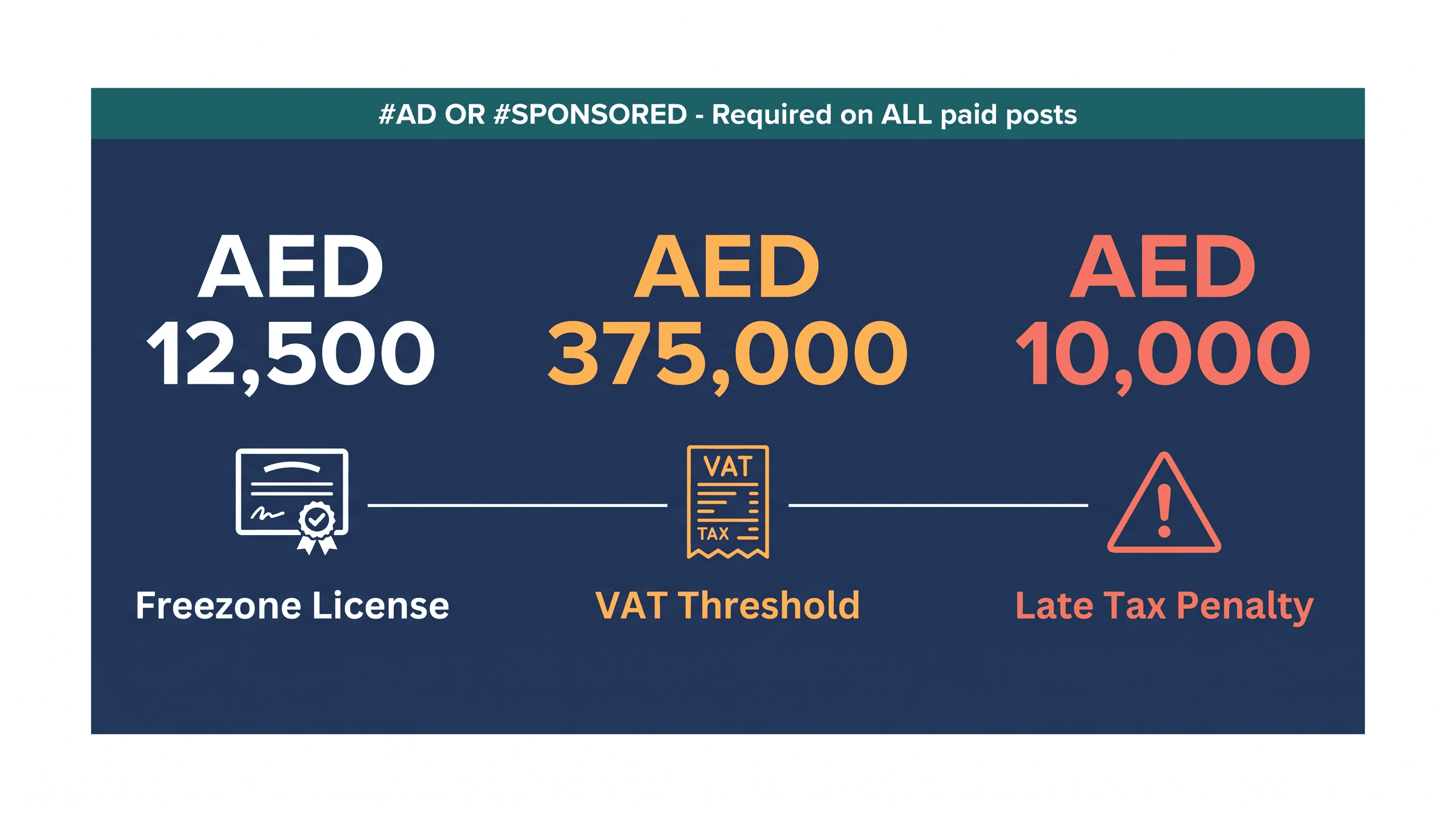
UAE advertising disclosure requirements apply to any content where a creator receives payment, free products, discounts, or any other benefit in exchange for a post. Acceptable labels include #Ad, #Sponsored, or a platform's native paid-partnership tag, placed prominently at the start of a caption or within the first three seconds of a video.
Which Content Types Require a Disclosure Label
All four of the following benefit types trigger the advertising disclosure obligation under UAE guidelines:
Paid cash partnerships: any post, story, reel, or video for which the creator receives a direct fee
Gifted product reviews: items sent without charge in exchange for coverage, even if no script or brief is provided
Affiliate and commission arrangements: content containing trackable links or promo codes that generate creator revenue
Equity or contra arrangements: content produced in exchange for services, equity stakes, or event access
A tech creator who receives a free smartphone and posts an unboxing video without #Ad is in breach even if no cash changed hands. The product itself constitutes a benefit received, and that's enough to trigger the rule.
Accepted Disclosure Formats Across Platforms
Platform-specific requirements matter because the NMC expects the disclosure to be visible to the actual audience, not just technically present. Here's how to meet the standard on each major platform:
Instagram and Facebook: use the native Paid Partnership label in post settings, or open the caption with #Ad or #Sponsored before any other text
TikTok: activate the Branded Content toggle, which auto-generates a disclosure banner; supplement with #Ad in the caption
YouTube: check the paid promotion box in video settings and include a verbal or on-screen disclosure within the first 30 seconds
X (formerly Twitter): place #Ad or #Sponsored at the start of the post, not buried in a thread reply
Burying a disclosure label inside a block of 15 hashtags at the end of a caption does not meet the visibility standard under UAE guidelines. A food creator posting a sponsored restaurant review on Instagram should open the caption with "Ad | [Restaurant Name]" and activate the Paid Partnership tag in settings, satisfying both platform and NMC requirements simultaneously.
Does the disclosure language need to match the caption language?
Yes. A UAE creator posting in Arabic who adds '#Ad' only in English at the end of a long Arabic caption may not satisfy the NMC's intelligibility standard for the target audience. The label must be recognisable and understandable to the primary audience reading the content, which in practice means matching the dominant language of the caption.
How to License Your Creator Business in the UAE: Step-by-Step
To legally publish paid content in the UAE, creators must hold a valid commercial license and obtain NMC approval for media activities. The process involves choosing a free zone, selecting the correct activity, submitting documents, receiving the license, and completing NMC registration before signing any brand deal.
Step 1: Choose Your Activity and Check Name Availability
Start by selecting the correct licensed activity from the free zone's list of business activities in Dubai. Relevant categories for creators include Social Media Management, Digital Content Creation, Media Production, and Advertising Services. The activity you select determines which regulator approvals are needed downstream, so getting this right at the start saves time later.
Check that your proposed company name is available and complies with UAE naming conventions: no offensive terms, no names of ruling families, and no abbreviations that imply a government connection. A creator running a parenting channel who also sells branded merchandise should confirm whether both Digital Content Creation and E-commerce activities can sit on the same license at DSBH before submitting.
Step 2: Select a Package and Submit Your Documents
Dubai South Business Hub Free Zone offers three standard packages. Every package includes the license, Articles of Association, share register, flexi-desk space as standard. The 1 Visa and 2 Visa packages add the investor or partner visa allocation and establishment card on top.
DSBH Free Zone Package Comparison for Creator Businesses
Feature | 0 Visa, AED 12,500 | 1 Visa, AED 16,350 | 2 Visa, AED 18,200 |
|---|---|---|---|
License fee | AED 12,500 | AED 16,350 | AED 18,200 |
Articles of Association | Included | Included | Included |
Share register | Included | Included | Included |
Flexi-desk space and lease agreement | Included | Included | Included |
Investor or partner visa allocation | Not included | 1 allocation included | 2 allocations included (maximum) |
Establishment card | Not included | Included | Included |
Visa processing (entry permit, medical, Emirates ID) | Quoted separately | Quoted separately | Quoted separately |
Required documents are minimal: a passport copy, your proposed company name, and a confirmed activity list. UAE residency is not required, and non-residents can incorporate remotely. A UK-based creator relocating to Dubai would select the 1 Visa package at AED 16,350 to cover both the license and the investor visa allocation, then budget separately for visa processing fees.
Step 3: Complete NMC Approval and Open a Business Bank Account
DSBH licenses the media or digital content activity commercially. The National Media Council approves it separately as the named regulator for all UAE media and publishing activity. Both are required before any monetised content goes live.
Submit the NMC application with your trade license, passport copy, and a description of planned content. Once both approvals are confirmed, open a bank account in the UAE in the company's name before signing any brand partnership agreement. A creator who receives a brand deal offer the week their trade license is issued should hold off on accepting payment until the NMC approval is confirmed and a business account is active.
Advertising Disclosure UAE Guide: Costs and Fees at a Glance
Setting up a licensed creator business in the UAE involves a free zone license fee starting at AED 12,500, separate visa processing costs, NMC registration fees, and VAT registration if annual turnover exceeds AED 375,000. Corporate tax registration is compulsory for all entities, with a one-time AED 10,000 penalty for late filing.
Free Zone License and Visa Package Costs
The three DSBH packages are priced as follows:
0 Visa Package: AED 12,500, license, Articles of Association, share register, flexi-desk space, and lease agreement
1 Visa Package: AED 16,350, adds the investor or partner visa allocation and establishment card
2 Visa Package: AED 18,200, adds up to two investor or partner visa allocations and establishment card (maximum two allocations)
Visa processing costs (entry permit, status change, medical, Emirates ID) are always quoted separately from the package price. A solo creator who plans to sponsor one employee in their first year would select the 1 Visa package at AED 16,350 and budget for visa processing fees on top. You can calculate your business setup cost before committing to a package.
Tax Registration Obligations and Penalties
VAT registration is compulsory once annual taxable turnover reaches AED 375,000. Late registration carries a flat AED 10,000 penalty (Federal Tax Authority, 2026). A creator earning AED 400,000 in brand deal income in their first year must register before passing that threshold to avoid the penalty.
Corporate tax registration is compulsory for all juridical persons regardless of size. Late registration carries a one-time flat AED 10,000 penalty. Qualifying Free Zone Persons may access a 0% corporate tax rate, but only if they meet all four QFZP conditions:
Adequate substance in the UAE
Qualifying income as defined under the Corporate Tax Law
No election to be subject to standard rates
Compliance with transfer pricing rules
DSBH is not a designated zone, so standard free zone VAT rules apply rather than designated zone treatment (UAE Cabinet, 2023).
Common Advertising Disclosure Mistakes UAE Creators Make
The most common advertising disclosure mistakes UAE creators make include burying #Ad in hashtags, failing to disclose gifted products, using vague terms like "in collaboration with", omitting disclosures from Stories, and publishing paid content before holding a valid commercial license and NMC approval.
Labelling Errors That Regulators Flag
Using "collab", "partner", or "thanks to [brand]" instead of a clear #Ad or #Sponsored label, these phrases don't satisfy the transparency standard
Placing the disclosure label after a "more" truncation on Instagram so followers must tap to expand before seeing it
Omitting disclosures from Instagram Stories, TikTok Lives, and YouTube Shorts, which carry the same obligation as standard posts
Using a disclosure in one language when the majority of the audience reads in another, the label must be intelligible to the primary audience
A UAE creator posting in Arabic who adds '#Ad' only in English at the end of a long Arabic caption may not satisfy the NMC's intelligibility standard for the target audience. In practice, the safest approach is to include the disclosure in both languages if the audience is mixed.
Structural Mistakes That Create Legal Exposure
Accepting brand payments before a commercial license is in place constitutes unlicensed commercial activity under UAE law, regardless of the fee amount. A creator who invoices a brand directly from a personal account before incorporating their company is in breach from the moment the first payment lands.
Signing brand contracts under a personal name rather than a registered company also removes the liability protections a corporate structure provides. And failing to register for corporate tax before the filing deadline triggers the one-time AED 10,000 flat penalty, which applies even if no tax is actually owed. A professional license in Dubai puts the correct legal entity in place before any of these risks arise.
How DSBH Free Zone Supports Creator Business Setup
Dubai South Business Hub Free Zone issues media and digital content licenses in one business day, with packages starting at AED 12,500. It licenses the commercial entity, while the National Media Council approves the regulated media activity separately. Non-residents can complete the full incorporation process remotely.
What the Free Zone License Covers
The DSBH free zone license covers the commercial operation of digital content creation, social media management, media production, and related advertising services activities. Every package includes the license, Articles of Association, share register, flexi-desk space as standard. An ICT license in Dubai sits within the same licensing framework for creators working across technology and content.
The
References
Frequently Asked Questions