
Topic Summary
What Are Notice Periods Under UAE Labour Law and Why They Matter
Notice periods under UAE labour law are the mandatory waiting periods, between 30 and 90 days, that must be observed before an employment contract ends. Governed by Federal Decree-Law No. 33 of 2021, they apply to both employer-initiated terminations and employee resignations, an
Notice Period Requirements Every UAE Employer Must Know
Notice Period Requirements Every UAE Employer Must Know
Employer Obligations and Costs During the Notice Period
An employer who fails to honour the full notice period must pay the employee a compensation amount equal to the total wage for the remaining notice days. This payment-in-lieu covers basic salary plus all contractual allowances and is calculated on a daily rate based on the employ
Step-by-Step Guide to Managing Notice Periods Under UAE Labour Law
To manage notice periods under UAE labour law correctly: issue written notice on the trigger date, confirm the notice window in the employment contract, continue full pay and benefits, grant the weekly job-search day, process terminal dues within 14 days of the last working day,
Situations Where Notice Periods Under UAE Law Do Not Apply
UAE labour law permits immediate termination without notice in specific gross-misconduct scenarios listed in Article 44 of Federal Decree-Law No. 33 of 2021. These include fraud, physical assault, repeated absence, and disclosure of trade secrets. Outside these defined grounds, a
How Notice Periods Interact With End-of-Service Gratuity
End-of-service gratuity in the UAE is calculated on the employee's last basic salary and accrues for every year of continuous service. The notice period counts as part of continuous service, so gratuity accrues until the actual last working day, not the date notice is issued. Gra
In 2026, a UAE employer who terminates an employee without serving the correct notice period faces a compensation liability equal to the full notice-period wage, payable as a lump sum regardless of how quickly a replacement is hired (MoHRE, 2024). Under Federal Decree-Law No. 33 of 2021, the minimum notice period is 30 days and the maximum is 90 days. The law has governed all UAE private-sector employment since February 2022. Non-compliance with notice obligations triggers a quantifiable financial penalty, not a discretionary one. Terminal dues must be settled within 14 days of the last working day. Work permit cancellation must follow within 30 days. Miss either deadline and you face a separate MoHRE violation.
This guide covers exactly what notice periods under UAE labour law require, what they cost an employer who gets them wrong, and the step-by-step process for handling a notice period compliantly, whether you are issuing a termination or accepting a resignation.
What Are Notice Periods Under UAE Labour Law and Why They Matter
Notice periods under UAE labour law are the mandatory waiting periods, between 30 and 90 days, that must be observed before an employment contract ends. Governed by Federal Decree-Law No. 33 of 2021, they apply to both employer-initiated terminations and employee resignations, and non-compliance triggers a compensatory wage liability. For more detail, see our guide on employee probation and notice period in the UAE. For more detail, see our guide on terminating an employee in the UAE rules.
UAE Notice Period Rules: Key Thresholds at a Glance
Scenario | Notice Requirement |
|---|---|
Standard employment contract (employer terminates) | Minimum 30 days, maximum 90 days; as specified in the employment contract |
Standard employment contract (employee resigns) | Minimum 30 days, maximum 90 days; same window as employer termination |
Employer terminates during probation | 14 calendar days notice required |
Employee resigns during probation to join another UAE employer | 1 month notice required; new employer may be jointly liable for recruitment costs |
Employee resigns during probation (not joining another UAE employer) | 14 calendar days notice required |
Mutual written agreement to waive notice | Notice period can be waived or shortened; written agreement signed by both parties is mandatory |
The Legal Framework: Federal Decree-Law No. 33 of 2021
Federal Decree-Law No. 33 of 2021 replaced the old Labour Law (Law No. 8 of 1980) and is now the governing statute for all private-sector employment across the UAE mainland and most free zones. It standardised notice periods at a floor of 30 days and a ceiling of 90 days, removing the ambiguity that existed under older fixed-term contract arrangements (MoHRE, 2022).
Both parties, employer and employee, are bound by the same notice window. An employment contract may specify a longer period, but never a shorter one. Any clause setting a notice period below 30 days is void and unenforceable from the moment it is written.
Consider this: a logistics company in Dubai employs a warehouse supervisor on a fixed-term contract specifying a 60-day notice period. If the company restructures and terminates the role, it must either serve all 60 days or pay 60 days of basic salary plus allowances in lieu. There is no middle ground.
Which Employment Contracts Are Covered
Since February 2022, all UAE private-sector contracts must be fixed-term, with a maximum duration of 3 years (renewable). Unlimited contracts were phased out and converted under the transition provisions of Federal Decree-Law No. 33 of 2021. Notice obligations apply to fixed-term contracts terminated before the agreed end date, this is distinct from a contract that simply expires at its natural term.
Mainland employees: fully governed by Federal Decree-Law No. 33 of 2021
Free zone employees: most UAE free zones incorporate Federal Decree-Law No. 33 by reference; verify your specific free zone's employment regulations
Domestic workers: covered under a separate statute, Federal Law No. 10 of 2017, with different notice rules, do not apply the same thresholds
Notice Period Requirements Every UAE Employer Must Know
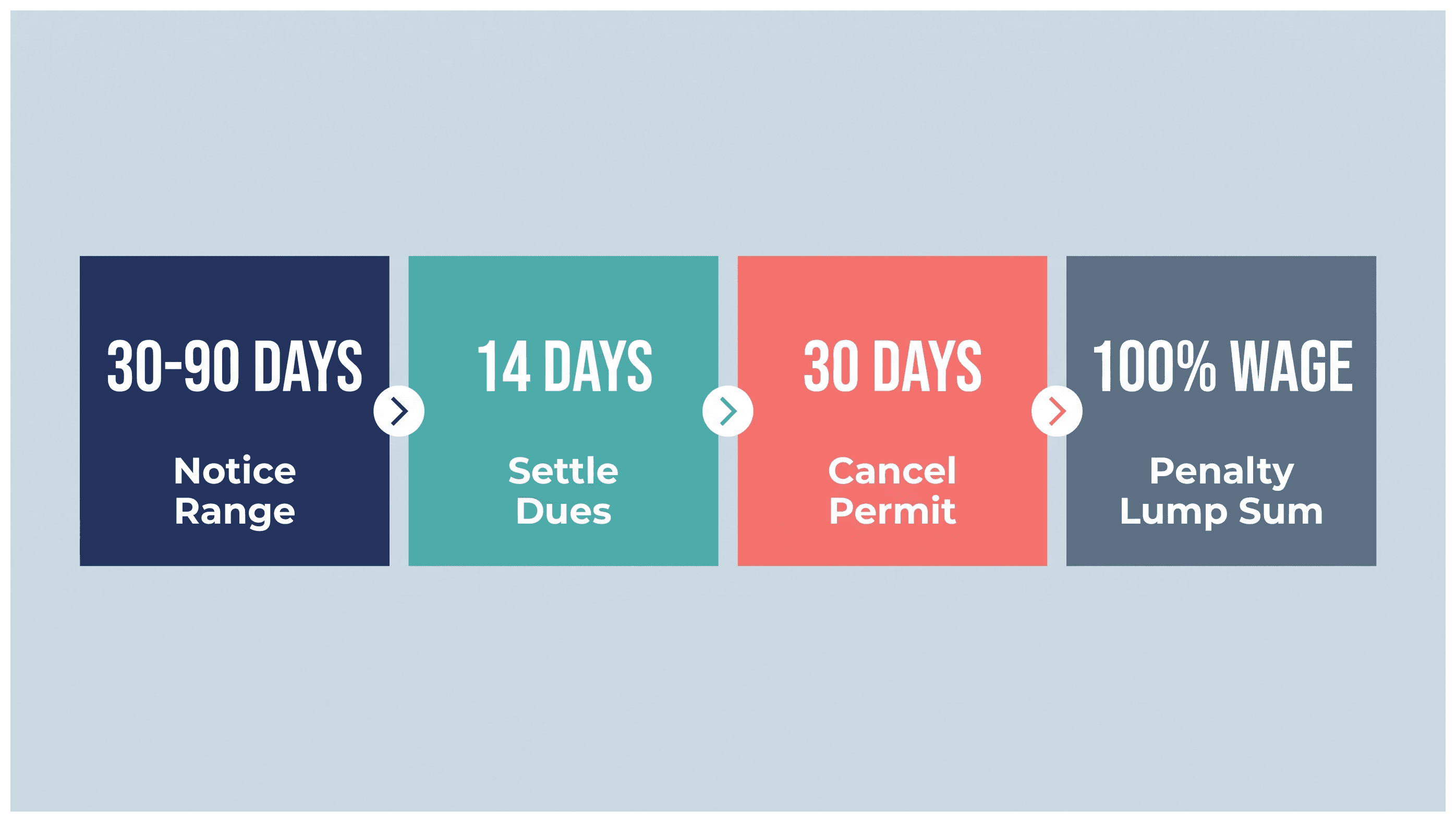
UAE employers must give written notice of 30 to 90 days, continue paying full salary and benefits throughout, and allow the employee one paid day per week to search for a new role. The notice period begins the day after written notification is delivered, not the day it is drafted.
Minimum and Maximum Notice Windows
30-day floor: any contractual clause below this is void and unenforceable
90-day ceiling: a contract cannot impose a longer notice obligation on the employee
Silent contract: if the employment contract does not specify a notice period, 30 days applies by default
Calendar days: the notice period runs continuously through weekends and public holidays, it is not measured in working days
That last point catches employers out more often than you'd expect. A 30-day notice issued on 1 June ends on 30 June, not 30 working days later in mid-July.
Employee Rights During the Notice Period
Notice periods under UAE requirements are not just about the length of the window. The employee retains full entitlement to basic salary, housing allowance, transportation allowance, and any other contractual benefits throughout the notice window. Gratuity accrual continues, it does not freeze on the date notice is given.
Job-search day: one paid working day per week (or 8 hours per week, agreed with the employer) for the employee to seek alternative employment
Unused annual leave: must be taken during the notice period or paid out; the employer cannot forfeit it
Gratuity: continues accruing until the actual last working day
A practical example: a marketing manager earning AED 18,000 per month basic salary gives 30 days' notice. During those 30 days, she is entitled to one paid day per week for job searching, four days total, without any salary deduction. That is a statutory right, not a courtesy.
Probationary Period Notice Rules
During probation (maximum 6 months under Federal Decree-Law No. 33), a shorter notice window applies. If the employer terminates, 14 calendar days' notice is required. If the employee resigns to join another UAE employer, 1 month's notice applies. If the employee resigns without joining another UAE employer, 14 days applies.
Worth flagging: an employee who leaves during probation to join a competitor may trigger a compensation claim by the original employer. The new employer can be jointly liable for recruitment costs. This is a common compliance gap for fast-growing businesses hiring quickly, and it's one the business support UAE team sees regularly when onboarding new clients.
Employer Obligations and Costs During the Notice Period
An employer who fails to honour the full notice period must pay the employee a compensation amount equal to the total wage for the remaining notice days. This payment-in-lieu covers basic salary plus all contractual allowances and is calculated on a daily rate based on the employee's last monthly package.
Payment in Lieu of Notice: How the Cost Is Calculated
The daily rate formula is straightforward: (basic salary + contractual allowances) divided by 30, which is the UAE standard working month. So an employee on an AED 15,000 total monthly package with 45 days remaining on notice would cost AED 500 per day multiplied by 45 days, equalling AED 22,500 in payment in lieu.
A technology firm in Dubai wanted a senior developer to stop working immediately rather than serve a 60-day notice period. The developer earned AED 20,000 per month total. The firm had to pay AED 20,000 as payment in lieu for the remaining 30 days it was waiving. That payment is separate from end-of-service gratuity, unused annual leave, and any other terminal benefits, not a combined figure.
When an Employee Resigns Without Serving Notice
If the employee abandons the role or resigns without serving the contractual notice period, the employer has a legal basis to deduct equivalent wages from any terminal dues. The deduction cannot exceed the notice-period wage, the employer cannot impose a penalty above that statutory cap (u.ae, 2024).
Document everything. Record the resignation date, any written warnings, and all correspondence. If the matter is contested at a MoHRE inquiry, a paper trail is your primary evidence. Verbal instructions or informal messages are difficult to rely on at a formal hearing.
Step-by-Step Guide to Managing Notice Periods Under UAE Labour Law
To manage notice periods under UAE labour law correctly: issue written notice on the trigger date, confirm the notice window in the employment contract, continue full pay and benefits, grant the weekly job-search day, process terminal dues within 14 days of the last working day, and cancel the work permit within the regulatory deadline.
The Six-Step Notice Period Process for Employers
Issue written notice. Deliver a signed notice letter stating the termination or acceptance of resignation, the date notice begins, and the last working day. Email with read receipt is acceptable alongside a physical copy.
Verify the contractual notice period. Cross-check the employment contract against the statutory minimum of 30 days. If the contract says less, apply 30 days regardless.
Maintain full salary and benefits. Do not reduce salary, remove allowances, or restrict system access in a way that prevents the employee from performing their role during the notice window.
Schedule the weekly job-search day. Agree with the employee which day each week they will use for job-search leave and record it in writing.
Calculate and process terminal dues. End-of-service gratuity, unused annual leave, and any other contractual terminal payments must be settled within 14 days of the last working day under Article 18 of the Executive Regulations (MoHRE, 2022).
Cancel the work permit. Submit the MoHRE work permit cancellation within 30 days of the last working day. Then proceed with immigration visa cancellation through the General Directorate of Residency and Foreigners Affairs.
Documents and Records Employers Must Retain
Signed notice letter with date of delivery
Written acknowledgement from the employee (or documented proof of delivery if refused)
Payroll records showing full salary paid throughout the notice period
Signed terminal settlement form and proof of bank transfer for all dues
MoHRE work permit cancellation receipt and immigration visa cancellation confirmation
Retain all offboarding documents for a minimum of 2 years. MoHRE inspectors can request records retroactively, and an incomplete file is treated as a compliance failure regardless of whether the underlying payment was correct.
Situations Where Notice Periods Under UAE Law Do Not Apply
UAE labour law permits immediate termination without notice in specific gross-misconduct scenarios listed in Article 44 of Federal Decree-Law No. 33 of 2021. These include fraud, physical assault, repeated absence, and disclosure of trade secrets. Outside these defined grounds, any termination without notice triggers the payment-in-lieu obligation.
Article 44 Gross Misconduct Grounds for Immediate Dismissal
Article 44 of Federal Decree-Law No. 33 of 2021 lists the only legally recognised grounds for summary dismissal without notice or end-of-service gratuity. The employer must conduct a documented investigation before executing a summary dismissal, a verbal decision is not sufficient.
False identity or forged documents presented at hiring
Causing financial loss or damage to the employer
Disclosing confidential trade information to a third party
Being found intoxicated or under the influence during work hours
Assaulting the employer, a manager, or a colleague
Repeated absence exceeding 20 non-consecutive or 7 consecutive unauthorised days in a year
If the employer cannot substantiate the Article 44 ground at a MoHRE hearing, the dismissal is reclassified as arbitrary. At that point, notice-period compensation becomes payable in full, on top of any other terminal dues.
Mutual Agreement to Waive or Shorten the Notice Period
Both parties may agree in writing to waive or shorten the notice period. This is a common commercial arrangement when a new employer wants the candidate to start immediately. The waiver must be documented and signed by both parties, a verbal agreement is not enforceable.
The employee cannot be pressured to sign a waiver. Any coercion invalidates the document and restores the full notice-period entitlement. If you need HR documentation reviewed before an offboarding, the PRO services Dubai team can help you structure it correctly.
How Notice Periods Interact With End-of-Service Gratuity
End-of-service gratuity in the UAE is calculated on the employee's last basic salary and accrues for every year of continuous service. The notice period counts as part of continuous service, so gratuity accrues until the actual last working day, not the date notice is issued. Gratuity and notice pay are separate, additive obligations.
Gratuity Calculation: What Counts as the Last Working Day
The gratuity formula is: 21 days of basic salary per year for the first 5 years of service, then 30 days per year for each year thereafter. If the employer releases the employee early via payment in lieu, gratuity is calculated to the actual release date, with the notice-period wage paid separately on top.
Here is a worked example: an employee with 6 years of service and a basic salary of AED 10,000 per month is released 30 days early. Gratuity = (5 years x 21 days x AED 333.33) + (1 year x 30 days x AED 333.33) = AED 35,000 + AED 10,000 = AED 45,000, paid separately from the AED 10,000 notice payment in lieu. Employers who combine these figures routinely underpay, and that is a common trigger for MoHRE complaints (u.ae, 2024).
References
Frequently Asked Questions