
Topic Summary
What Activity Restrictions Mean When Setting Up Without Checking in Dubai
Activity restrictions are UAE regulatory rules that prohibit or condition certain business activities on a specific jurisdiction, license type, or secondary approval from a named regulator. Setting up without checking these rules means your license may be issued with the wrong ac
The Real Cost of Setting Up Without Checking: Amendment Fees and Delays
The Real Cost of Setting Up Without Checking: Amendment Fees and Delays
The Six Most Common Activity-Restriction Mistakes, Ranked by Frequency
The six most frequent activity-restriction mistakes when setting up in Dubai are: selecting a mainland-only activity for a free zone license; omitting a required regulator approval for a health or financial activity; listing too many unrelated activities; choosing a restricted co
How to Check Activity Restrictions Before You Apply
Before applying for a UAE free zone license, verify your activity against the free zone's published activity list, identify any named regulator whose approval is required, confirm the activity is not mainland-only, and check commodity-level permit requirements with Dubai Trade. C
Regulated Activities That Require a Named Regulator Approval
Regulated activities in Dubai require approval from a named government authority in addition to the free zone license. The free zone issues the license; the regulator approves the activity scope. Healthcare, financial services, education, and cybersecurity are the four most commo
Setting Up Without Dubai Activity Checks: What the Amendment Process Looks Like
An activity amendment at a Dubai free zone involves submitting a formal request, paying the amendment fee, waiting for authority processing (typically 3 to 5 working days), and, for regulated activities, completing a separate regulator approval. The process pauses business operat
In 2026, roughly 40% of first-time founders who contact a formation agent discover their chosen activity is restricted, regulated, or unavailable on their chosen jurisdiction, after they have already committed to a package price and timeline. Setting up without Dubai activity checks is not a minor oversight; it is a direct path to amendment fees starting at AED 500, license cancellations that forfeit setup costs from AED 12,500, and compliance gaps that attract Federal Tax Authority penalties of AED 10,000 each for VAT and corporate tax late registration. Free zone licenses at Dubai South Business Hub Free Zone are issued in 1 day once documentation is complete, but that speed only works in your favour if the activity list is right from the start. This guide ranks the most common activity-restriction mistakes by frequency, shows you the cost each one creates, and walks you through exactly how to verify your activity list before you submit a single form.
What Activity Restrictions Mean When Setting Up Without Checking in Dubai
Activity restrictions are UAE regulatory rules that prohibit or condition certain business activities on a specific jurisdiction, license type, or secondary approval from a named regulator. Setting up without checking these rules means your license may be issued with the wrong activity list, triggering costly amendments or a full license cancellation.
The Difference Between a Permitted and a Restricted Activity
A permitted activity is one the free zone authority can approve on the same day the license is issued. A restricted activity requires a secondary approval from a named government regulator before that activity can legally be exercised, the free zone issues the license, the regulator approves the scope. Both steps are required. Neither replaces the other.
Some activities are outright unavailable in certain free zones regardless of regulator approval. Jurisdiction matters as much as category. A healthcare consultancy license at Dubai South Business Hub Free Zone, for example, is issued by the free zone authority, but the Dubai Health Authority (DHA) must separately approve the clinical scope before the business can see a single patient or client.
A founder who registers a 'medical equipment trading' activity discovers post-issuance that DHA approval is required, adding 4 to 8 weeks and a separate government fee to the timeline. The license arrived in one day. The authority to operate took considerably longer.
Why Free Zones and Mainland Rules Differ
Free zone companies operate under their own authority's rulebook. That rulebook may exclude activities reserved for mainland licenses governed by the Dubai Department of Economy and Tourism (DET). Mainland activities carry a broader catalogue but require either a local sponsor or a 100% foreign-ownership approval under the UAE Commercial Companies Law.
Cross-jurisdictional confusion is one of the top reasons founders face post-issuance amendments. A trading founder who assumes 'customs clearing agent' is available in any free zone because it appears on the DET activity list will be disappointed: that activity is not available at Dubai South Business Hub Free Zone. Worth flagging too: Dubai South Business Hub Free Zone is not a designated zone and does not provide bonded warehousing, so activities that depend on designated-zone status cannot be exercised there.
The practical takeaway is simple. Verify against the specific free zone's activity catalogue, not a generic UAE activity directory, before you choose a jurisdiction. The business activities list at Dubai South Business Hub Free Zone is the authoritative source for what is and is not available on that jurisdiction (DET, 2025).
The Real Cost of Setting Up Without Checking: Amendment Fees and Delays
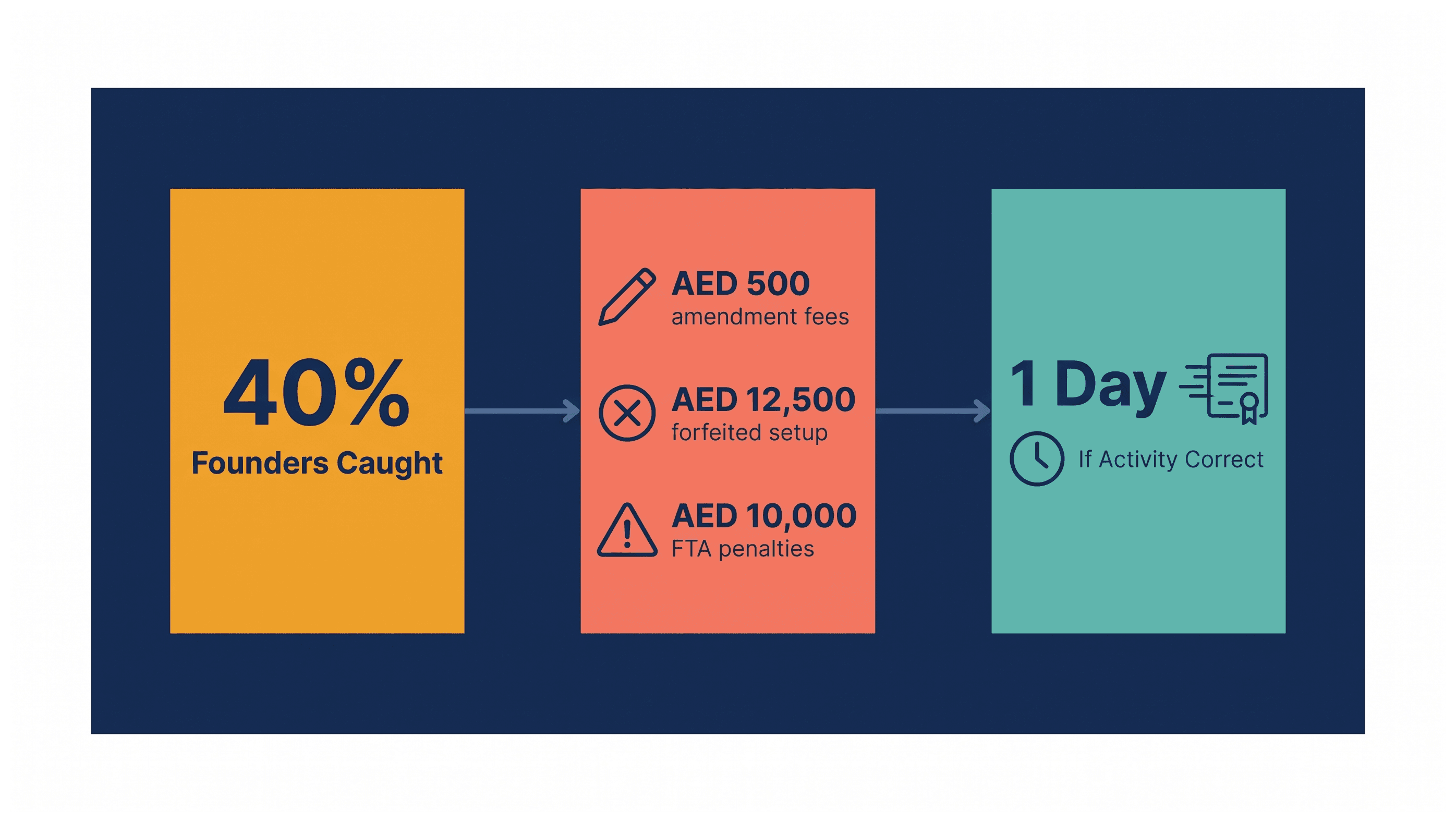
Discovering an activity restriction after licensing typically costs AED 500 to 2,000 in amendment fees plus the time lost to resubmission, regulator queues, and potential visa freezes. In the most serious cases, where the activity is entirely unavailable on the chosen jurisdiction, the license must be cancelled and reissued, forfeiting the original setup fee.
Activity Amendment After License Issuance
Adding or changing an activity post-issuance requires a formal amendment application to the free zone authority. Processing time for a standard activity change is typically 3 to 5 working days. For regulated activities, regulator approval time is added on top of that window.
During the amendment window, the activity in question cannot legally be conducted. Any invoices raised under the unapproved activity create compliance exposure, both regulatory and tax-related. A software consultancy founder who adds 'cybersecurity services' post-issuance discovers it is a regulated activity requiring Telecommunications and Digital Government Regulatory Authority (TDRA) approval, extending the timeline by several weeks and pausing any client work in that category.
Activity Restriction Mistakes: Frequency, Fix, and Cost
Mistake | Fix | Cost if Discovered Post-Issuance |
|---|---|---|
Mainland-only activity selected for free zone license | Cross-reference the specific free zone activity catalogue before choosing a jurisdiction | Full license cancellation and reissuance; new license from AED 12,500 |
Named regulator approval omitted for health or financial activity | Identify the named regulator at the activity-selection stage and contact them before applying | Amendment fee plus regulator application fee; activity cannot operate until approval is granted |
Too many unrelated activities on one license | Limit the activity list to genuinely related activities within a coherent business scope | Activity removal amendment fee; possible application rejection requiring resubmission |
Restricted commodity under general trading license | Verify commodity-level restrictions with the free zone authority before submitting | Activity amendment fee plus applicable commodity permit fee; customs hold risk for physical goods |
ICT sub-category confusion (e.g., cybersecurity vs. IT consultancy) | Select correct ICT sub-activities from the free zone's published list; flag cybersecurity for TDRA pre-approval | TDRA application fee plus amendment processing time; client work paused during approval window |
Import or export permit requirement ignored for physical goods | Confirm permit requirements with Dubai Trade before licensing | Permit application fees plus potential customs hold costs; shipment delays on arrival |
When the License Must Be Cancelled and Reissued
If the required activity is entirely outside the free zone's permitted catalogue, no amendment is possible. The license must be cancelled and a new one issued on a suitable jurisdiction. Cancellation forfeits the original setup fee.
A new license at Dubai South Business Hub Free Zone starts from AED 12,500 for the 0 Visa Package (includes the license, Articles of Association, share register, flexi-desk space). The 1 Visa Package is AED 16,350 and adds a visa allocation and establishment card. The 2 Visa Package is AED 18,200 and covers up to six visa allocations, with published packages offering 0, 1 or 2. Visa processing, entry permit, status change, medical, Emirates ID, is quoted separately in all cases.
Visa allocations tied to the cancelled license are also cancelled, requiring fresh visa processing at additional cost. A founder who cancels a general trading license after discovering the specific commodity requires a mainland DET license loses the original AED 16,350 (1 Visa Package) plus all associated visa processing fees. That financial exposure is the single strongest argument for checking activity restrictions before applying (UAE Ministry of Economy, 2025).
The Six Most Common Activity-Restriction Mistakes, Ranked by Frequency
The six most frequent activity-restriction mistakes when setting up in Dubai are: selecting a mainland-only activity for a free zone license; omitting a required regulator approval for a health or financial activity; listing too many unrelated activities; choosing a restricted commodity under a general trading license; confusing ICT sub-categories; and ignoring import or export permit requirements for physical goods.
Mistakes One Through Three: The Most Frequent Errors
Selecting a mainland-only activity for a free zone license (most frequent). Activities such as real estate brokerage, certain retail categories, and customs clearing are DET-governed and unavailable in most free zones. Fix: cross-reference the specific free zone activity catalogue before choosing a jurisdiction. Cost: full license cancellation and reissuance if discovered post-issuance.
Omitting a required regulator approval for a health or financial activity (second most frequent). Healthcare activities require DHA or MOHAP approval; financial activities require Central Bank of the UAE or DFSA approval. The free zone issues the license; the named regulator approves the activity separately. Skipping step two means the activity cannot legally operate. Fix: identify the named regulator at the activity-selection stage. Cost: amendment fee plus regulator application fee.
Listing too many unrelated activities on one license (third most frequent). Free zones permit multiple activities on one license, but each must fall within a coherent business scope. An activity list that mixes food trading with financial consulting raises compliance flags and may trigger a rejection or a forced activity removal. Fix: limit the list to genuinely related activities. Cost: activity removal amendment fee.
A founder applying for a healthcare license in Dubai lists 'pharmaceutical wholesale' as a secondary activity without realising it requires a separate MOHAP wholesale permit. The license is issued without the pharmaceutical activity, and a post-issuance amendment adds six weeks to the timeline (MOHAP, 2025).
Mistakes Four Through Six: Less Frequent but Costly
Choosing a restricted commodity under a general trading license (fourth most frequent). A general trading license covers a broad range of goods, but specific commodities, arms, certain chemicals, precious metals, food for human consumption in some jurisdictions, carry individual permit requirements. Fix: verify commodity-level restrictions with the free zone authority before submitting. Cost: activity amendment plus applicable commodity permit fee.
Confusing ICT sub-categories (fifth most frequent). Founders often bundle software development, IT consultancy, and cybersecurity under a single ICT activity without realising that cybersecurity is separately regulated by TDRA. Fix: select the correct ICT sub-activities from the free zone's published list; flag cybersecurity for TDRA pre-approval. Cost: TDRA application fee plus amendment processing time. If you are planning an ICT license in Dubai, check each sub-activity individually against the free zone catalogue before submitting.
Ignoring import or export permit requirements for physical goods (sixth most frequent). Free zone trading licenses in Dubai cover buying and selling; physically importing or exporting specific goods, food, electronics, medical devices, may require additional permits from Dubai Trade or sector regulators. Fix: confirm permit requirements with Dubai Trade before licensing. Cost: permit application fees plus potential customs hold costs.
A tech founder selects 'IT security solutions' assuming it falls under a standard ICT license, then discovers TDRA approval is required before any cybersecurity service can be delivered to a UAE client. The license was correct; the activity scope was not.
How to Check Activity Restrictions Before You Apply
Before applying for a UAE free zone license, verify your activity against the free zone's published activity list, identify any named regulator whose approval is required, confirm the activity is not mainland-only, and check commodity-level permit requirements with Dubai Trade. Completing these four checks before submission prevents post-issuance amendments and the fees they carry.
Step 1: Match Your Activity to the Free Zone's Published List
Every free zone publishes an activity catalogue. Dubai South Business Hub Free Zone's list covers trading, services, ICT, healthcare, education, and professional categories. Search it by keyword and, where available, by ISIC code. ISIC Rev.4 four-digit class codes align with UAE activity descriptions and help you identify the precise category, matching at the four-digit class level gives the most accurate alignment.
If your intended activity does not appear on the list, contact the free zone authority directly before committing to a package. A logistics founder who searches 'customs broker' on the Dubai South Business Hub Free Zone activity list, finds it absent, and contacts the authority discovers in 24 hours that the activity requires a mainland DET license, saving the cost of a misdirected application entirely.
Step 2: Identify the Named Regulator and Pre-Approval Requirement
For each activity on your list, identify whether a named regulator must approve the activity separately from the free zone license. This is a non-optional dual-step process. Common regulators by sector: DHA or MOHAP for healthcare; Central Bank of the UAE for financial services; TDRA for telecoms and cybersecurity; Knowledge and Human Development Authority (KHDA) for education.
Contact the named regulator's licensing department before submitting your free zone application. A financial advisory founder who contacts the Central Bank of the UAE before applying learns the activity requires a Category 4 financial advisory license, a process with its own capital requirements and a multi-month timeline, allowing the founder to plan accordingly rather than face a licensed but non-operational entity.
Is setting up without Dubai activity checks ever recoverable?
Yes, but recovery is expensive. An activity amendment costs AED 500 to 2,000 and takes 3 to 5 working days for non-regulated activities. If the activity is outside the free zone's catalogue entirely, the license must be cancelled and reissued, forfeiting the original setup fee. Prevention at the pre-application stage costs nothing.
Regulated Activities That Require a Named Regulator Approval
Regulated activities in Dubai require approval from a named government authority in addition to the free zone license. The free zone issues the license; the regulator approves the activity scope. Healthcare, financial services, education, and cybersecurity are the four most commonly misunderstood regulated categories among first-time founders setting up in Dubai.
Healthcare and Financial Services: The Highest-Risk Categories
Healthcare activities, clinical consultation, medical equipment trading, wellness services, require DHA approval for Dubai-based operations or MOHAP approval for federal-scope activities. Dubai South Business Hub Free Zone licenses the entity; DHA or MOHAP approves the clinical scope. These are two separate processes with two separate fee schedules.
Financial services, investment advisory, brokerage, payment services, require Central Bank of the UAE licensing for most categories. The free zone entity is the vehicle, not the license to practice financial services. Founders in both sectors consistently underestimate regulator approval timelines, producing a licensed but non-operational entity for months after incorporation. A wellness clinic founder receives a free zone license in one day but cannot open to patients for eight weeks while awaiting DHA facility approval and practitioner registration (DHA, 2025).
Education and Cybersecurity: Frequently Overlooked Regulated Sectors
Education activities, training, e-learning, tutoring, require KHDA approval for Dubai. Founders who list 'education consultancy' assuming it is unregulated are regularly surprised by the KHDA facility and curriculum review process. An education license in Dubai requires this secondary step; the free zone license alone is not sufficient to begin delivering courses.
Cybersecurity activities fall under TDRA regulation. An ICT license does not automatically cover cybersecurity services. An e-learning startup that lists 'online education services' on its free zone license and begins selling courses before KHDA approval receives a compliance notice requiring retrospective approval, resulting in a service suspension and a penalty. The fix in both cases is identical: contact KHDA or TDRA at the activity-selection stage, not after the license arrives.
Setting Up Without Dubai Activity Checks: What the Amendment Process Looks Like
An activity amendment at a Dubai free zone involves submitting a formal request, paying the amendment fee, waiting for authority processing (typically 3 to 5 working days), and, for regulated activities, completing a separate regulator approval. The process pauses business operations for the affected activity and creates a gap in your legal authority to invoice for that service.
The Amendment Submission and Processing Steps
Submit an activity amendment request to the free zone authority with the updated activity list, supporting documents, and the amendment fee.
The free zone reviews the request and either approves the change or flags a conflict. A flagged conflict requires resolution before the amended license is reissued.
For regulated activities, the amended license is conditional on the named regulator's approval being filed concurrently or subsequently.
The amended license certificate is reissued with the new activity list; the original license date and company number are retained.
A consulting firm that adds 'management consulting' to its existing IT services license has the amendment processed in four working days and receives the updated license by email. That is the best-case scenario for a non-regulated activity. Regulated activities take considerably longer.
The Compliance Gap During the Amendment Window
During the amendment window, the activity in question is not on the issued license. Any invoices raised, contracts signed, or services delivered under the unapproved activity create a legal compliance gap. This is not a technicality, it is a direct regulatory exposure.
VAT registration errors tied to unapproved activities can attract a late registration penalty of AED 10,000 from the Federal Tax Authority, a flat, one-time penalty. Corporate tax misclassification linked to an incorrect activity list carries the same flat penalty: AED 10,000. A founder who invoices a client for a financial advisory session while the Central Bank approval is pending has technically issued an invoice under an unlicensed activity, creating both a regulatory and a VAT compliance exposure. The safest position is to pause the affected activity entirely until the amended license is in hand. For a broader look at how these penalties interact with your entity structure, the banking and taxation guide at Dubai South Business Hub Free Zone is a useful reference (Federal Tax Authority, 2025).
A four-step timeline showing the activity amendment process at a Dubai free zone, from submission to reissued license.
References
Frequently Asked Questions