
Topic Summary
What Is a Valid Tax Invoice and Why It Matters
A valid tax invoice in the UAE is a document that meets the Federal Tax Authority 's mandatory field requirements under UAE VAT Law. It allows your client to recover input VAT and protects your business from penalties. Missing even one required field can invalidate the document e
VAT Compliance and Invoice Requirements for Dubai Companies
VAT Compliance and Invoice Requirements for Dubai Companies
Costs to Factor In When Invoicing Clients From a Dubai Company
The direct cost of invoicing clients from a Dubai company is minimal. Accounting software runs from AED 50 to AED 500 per month. The real financial risk lies in penalties: AED 10,000 for late VAT registration, AED 10,000 for late corporate tax registration, and FTA fines for non-
How to Build a Compliant Invoicing Process: Step-by-Step
This invoicing clients Dubai guide covers the four operational steps every Dubai company needs. To build a compliant invoicing process when invoicing clients from a Dubai company: register for VAT, obtain your TRN, set up FTA-compliant software, configure mandatory fields, establ
Invoicing International Clients From a Dubai Free Zone Company
Invoicing international clients from a Dubai free zone company typically involves zero-rated VAT on qualifying export supplies. You must still issue a UAE-format tax invoice with your TRN, retain export evidence, and report the supply on your VAT return, even though no VAT is col
How to Set Up and Start Invoicing From a Dubai Company
To start invoicing clients from a Dubai company, you need an active trade license covering your invoiced activities, VAT registration if turnover exceeds AED 375,000, a UAE corporate bank account, and an FTA-compliant invoice template. Here's how the setup sequence works.
In 2026, over 350,000 VAT-registered businesses operate across the UAE (Federal Tax Authority, 2025), yet non-compliant invoices remain one of the leading causes of input tax recovery disputes. The mandatory VAT registration threshold sits at AED 375,000. Late registration carries a flat AED 10,000 penalty. A missing Tax Registration Number (TRN) alone can invalidate a client's input tax claim. The five-year document retention rule catches many companies unprepared. And the corporate tax late registration penalty adds another AED 10,000 on top. These are not edge cases, they're the most common findings in FTA audits. This guide covers what a valid invoice must include under UAE law, the VAT rules that apply when invoicing clients from a Dubai company, and the exact steps to build a compliant invoicing process from day one.
What Is a Valid Tax Invoice and Why It Matters
A valid tax invoice in the UAE is a document that meets the Federal Tax Authority's mandatory field requirements under UAE VAT Law. It allows your client to recover input VAT and protects your business from penalties. Missing even one required field can invalidate the document entirely. When you're invoicing clients from a Dubai company, getting this right from invoice number one is non-negotiable. For more detail, see our guide on recovering bad debt from a UAE customer. For more detail, see our guide on retainer and invoicing for UAE agency businesses. For more detail, see our guide on UAE tax invoice numbering guide. For more detail, see our guide on tax invoice requirements for UAE businesses.
Full Tax Invoice vs. Simplified Tax Invoice
The type of invoice you issue depends on the supply value and whether your client is VAT-registered. A full tax invoice is required for B2B supplies where the client is VAT-registered. A simplified invoice applies only to supplies not exceeding AED 10,000.
Free zone companies invoicing mainland or international clients almost always need full tax invoices. The distinction matters practically: a simplified invoice does not need to show the buyer's name or VAT registration number, which means it can't support a B2B input tax recovery claim.
A Dubai South Business Hub Free Zone consultancy billing a UAE mainland distributor AED 50,000 for services must issue a full tax invoice, not a simplified one. That's not a choice, it's a legal requirement.
Full Tax Invoice vs. Simplified Tax Invoice: Key Differences
Feature | Full Tax Invoice | Simplified Tax Invoice |
|---|---|---|
Supply value threshold | Above AED 10,000 | AED 10,000 or below |
Buyer name required | Yes | No |
Buyer TRN required | Yes, if buyer is VAT-registered | No |
Seller TRN required | Yes | Yes |
VAT amount in AED | Must be shown explicitly | Must be shown explicitly |
Used for B2B input tax recovery | Yes, full recovery supported | Restricted, cannot support most B2B claims |
Mandatory Fields Every Invoice Must Carry
The words "Tax Invoice" must appear explicitly on the document, not "invoice", not "receipt". Every full tax invoice issued when invoicing clients from a Dubai company must include all of the following:
Your company name and registered address
Your TRN (Tax Registration Number)
Invoice date and supply date (if different)
Sequential invoice number
Description of goods or services supplied
Unit price and quantity
Applicable VAT rate (5%, 0%, or exempt)
VAT amount in AED
Total amount payable in AED
Buyer's name, address, and TRN (for full tax invoices)
For cross-border supplies, also state the foreign currency and the AED equivalent where VAT applies. A technology consultancy in a Dubai free zone issuing an invoice to a Saudi client must still show the UAE TRN and AED VAT amount even if the supply is zero-rated. The TRN field is not optional for overseas clients. For more detail, see our guide on purchase order process for UAE businesses.
VAT Compliance and Invoice Requirements for Dubai Companies
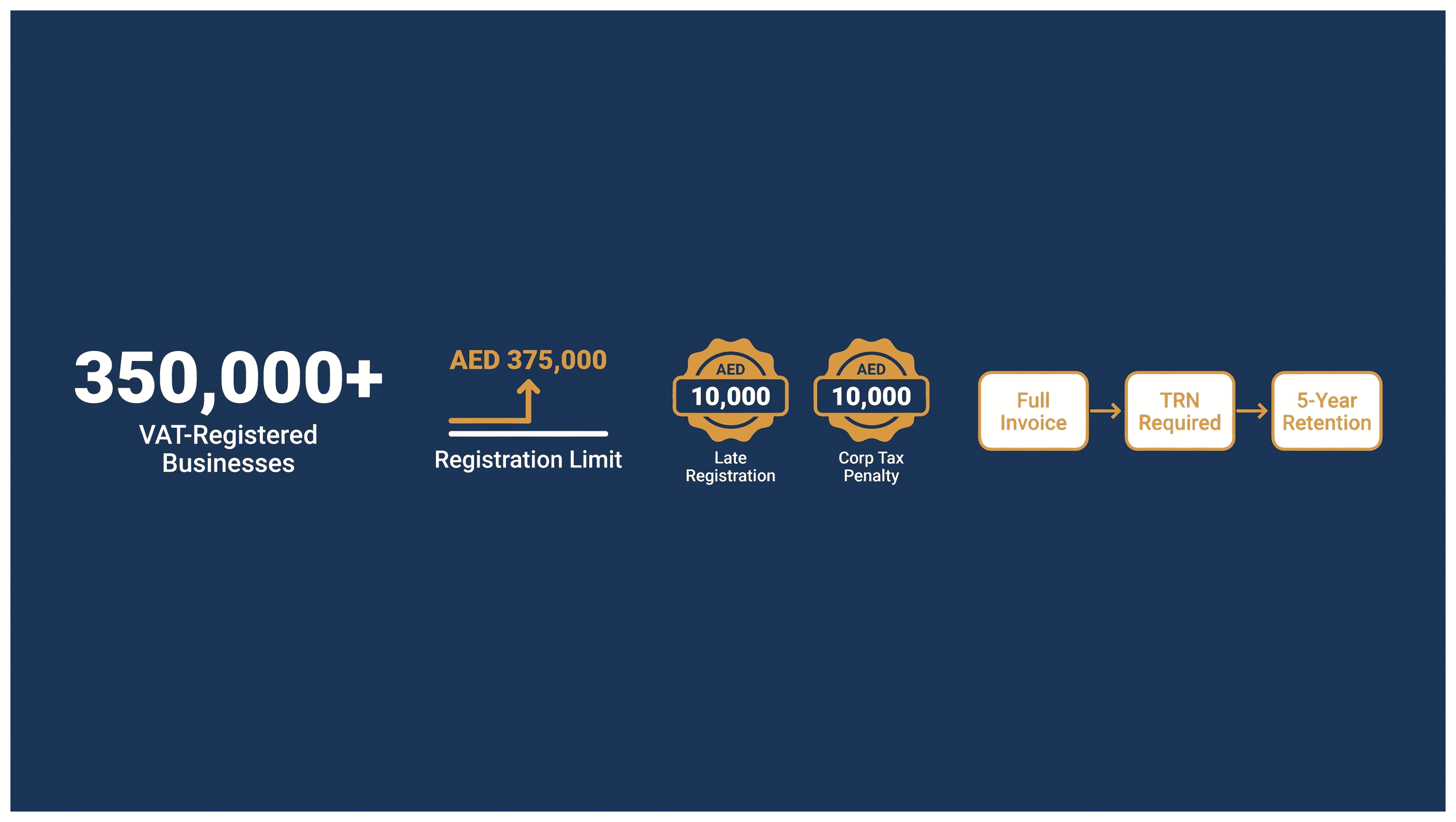
When invoicing clients from a Dubai company, you must charge 5% VAT on standard-rated supplies, apply zero-rating for qualifying exports, and register with the Federal Tax Authority once turnover exceeds AED 375,000. These invoicing clients Dubai requirements apply equally to free zone and mainland companies. Late registration carries a flat AED 10,000 penalty with no discretionary waiver.
When to Register for VAT Before Issuing Your First Invoice
Mandatory VAT registration applies once your taxable supplies exceed AED 375,000 in any 12-month period. Voluntary registration is available from AED 187,500, a smart move if you want to recover input VAT on startup costs before hitting the mandatory threshold.
A newly licensed Dubai free zone trading company that signs an AED 400,000 annual supply contract on day one must register for VAT immediately, before issuing its first invoice. Issuing invoices without a TRN when registration is required creates a retrospective compliance problem that's expensive to unwind.
Apply through the FTA's EmaraTax portal. The AED 10,000 late registration penalty is a flat charge, it doesn't scale with your turnover, which means even a small business faces the same fine as a large one.
Zero-Rating, Exemptions, and Out-of-Scope Supplies
Not all supplies attract 5% VAT. Here's how the categories break down:
Zero-rated (0%): Exports of goods and qualifying international services. You invoice, report on your VAT return, but charge no VAT. You must hold evidence of the export.
Exempt: Certain financial services and residential property. No VAT charged, and no input VAT recovery on related costs.
Out of scope: Supplies made entirely outside the UAE. Not reported on the VAT return at all.
A Dubai free zone consultancy providing advisory services to a client based in Germany invoices at 0% VAT, correctly zero-rated as an export of services, but must still hold the client contract, correspondence, and payment records as evidence. Getting the category wrong creates a liability for the difference plus surcharges (Ministry of Finance, 2025).
Costs to Factor In When Invoicing Clients From a Dubai Company
The direct cost of invoicing clients from a Dubai company is minimal. Accounting software runs from AED 50 to AED 500 per month. The real financial risk lies in penalties: AED 10,000 for late VAT registration, AED 10,000 for late corporate tax registration, and FTA fines for non-compliant invoice formats that can trigger a full tax assessment.
Software and Accounting System Costs
UAE-compliant accounting software must generate sequential invoice numbers, calculate VAT automatically, and produce FTA-ready reports. Cloud platforms suited to free zone companies typically cost AED 50 to AED 500 per month depending on transaction volume.
Check that your chosen tool lets you record both your TRN and your client's TRN on each invoice, not all entry-level tools include this by default. A two-person ICT company at Dubai South running a cloud accounting tool at AED 150 per month handles up to 500 invoices monthly, at a cost far below a single FTA penalty. Integrating your invoicing tool with your bank feed also cuts VAT return preparation time significantly.
Penalty Exposure for Non-Compliant Invoices
The penalty landscape for non-compliant invoicing is straightforward but steep:
Late VAT registration:AED 10,000 flat penalty
Late corporate tax registration:AED 10,000 one-time flat penalty
Non-compliant invoice fields: FTA administrative penalties per infraction
Incorrect VAT treatment: Assessment for the underpaid tax plus surcharges
A company that invoices AED 500,000 in services at 0% VAT without holding export evidence can face an FTA assessment reclassifying those supplies as standard-rated, creating an AED 25,000 VAT liability in one audit cycle. Clean records from the start cost a fraction of that. You can review business setup costs in Dubai to plan your full compliance budget before your first invoice goes out.
How to Build a Compliant Invoicing Process: Step-by-Step
This invoicing clients Dubai guide covers the four operational steps every Dubai company needs. To build a compliant invoicing process when invoicing clients from a Dubai company: register for VAT, obtain your TRN, set up FTA-compliant software, configure mandatory fields, establish sequential numbering, confirm VAT treatment per supply, and file quarterly. Here's how each step works in practice.
Step 1: Confirm Your License and VAT Registration Status
Your trade license must be active and correctly list the business activities in Dubai you're invoicing for. A professional services firm licensed for management consultancy must not invoice for IT implementation under the same license without adding that activity first, that's a regulatory exposure, not just a paperwork issue.
Check whether your projected turnover triggers mandatory VAT registration before your first invoice. Apply for your TRN through the FTA's EmaraTax portal and allow up to 20 business days for approval. At Dubai South Business Hub Free Zone, the license is issued in 1 day, so your VAT application can follow in the same week.
Step 2: Configure Your Invoice Template and Numbering System
Build a master template with all 14 FTA-mandatory fields locked as non-removable elements. Set up sequential invoice numbering from the start, gaps in the sequence are an immediate audit flag. A trading company at Dubai South that locks its TRN and VAT rate cells and assigns numbers automatically passes FTA spot checks without amendments.
Store a digital copy of every issued invoice for a minimum of five years, as required under UAE VAT law. Both your company's registered address and your client's registered address must appear on every full tax invoice.
Step 3: Confirm VAT Treatment Before Issuing Each Invoice
For each client and each supply, determine the correct VAT category: standard-rated (5%), zero-rated (0%), exempt, or out of scope. An international client does not automatically mean zero-rated. The place of supply rules determine the VAT treatment, not the client's location alone.
A Dubai free zone marketing agency billing a London client for digital advertising services applies 0% VAT under export of services rules, but retains the client contract and bank transfer records as evidence. When in doubt, treat the supply as standard-rated and seek an FTA ruling before issuing a zero-rated invoice without documentation.
How often do Dubai companies need to file VAT returns?
Most UAE businesses file VAT returns quarterly, with the deadline set at 28 days after the end of the tax period. A free zone company reconciling invoices monthly takes under two hours to prepare each quarterly return. Companies that leave reconciliation until year-end regularly face days of back-correction work and risk late filing penalties on top of any unpaid tax.
Invoicing International Clients From a Dubai Free Zone Company
Invoicing international clients from a Dubai free zone company typically involves zero-rated VAT on qualifying export supplies. You must still issue a UAE-format tax invoice with your TRN, retain export evidence, and report the supply on your VAT return, even though no VAT is collected. Free zone status provides no special invoice-level exemptions for overseas billing.
Currency, Exchange Rates, and AED Conversion on Invoices
You can invoice in any currency your client agrees to, but VAT amounts must also appear in AED. Use the Central Bank of the UAE exchange rate on the invoice date for the conversion. A Dubai free zone company invoicing a European client EUR 20,000 must show the AED equivalent at that day's Central Bank rate alongside the euro total.
Currency mismatches between invoices and bank receipts are a common FTA audit trigger. Keep your conversion records, the rate used, the date, and the source, attached to each cross-currency invoice.
Common Mistakes When Invoicing Overseas Clients
Omitting the TRN for overseas clients. The TRN is required on every UAE tax invoice regardless of where the client is based.
Zero-rating without export evidence. This is the single most common FTA audit finding. Hold the contract, delivery confirmation, or shipping documents before issuing at 0%.
Assuming overseas client = zero-rated. Place of supply rules apply. Services performed inside the UAE for an overseas parent company can still be standard-rated at 5%.
Not reporting zero-rated supplies on the VAT return. They still appear in Box 1 and Box 2, omitting them creates a filing discrepancy.
A consultancy invoicing its overseas parent at 0% VAT for UAE-based project management services is doing this incorrectly. The place of supply is the UAE, making the supply standard-rated at 5%. That's a common and costly assumption to get wrong.
How to Set Up and Start Invoicing From a Dubai Company
To start invoicing clients from a Dubai company, you need an active trade license covering your invoiced activities, VAT registration if turnover exceeds AED 375,000, a UAE corporate bank account, and an FTA-compliant invoice template. Here's how the setup sequence works.
License, Activities, and Corporate Bank Account
Your invoice must relate to a licensed business activity. Billing for an unlicensed activity creates both regulatory and contractual risk, clients can dispute invoices, and the FTA can question the legitimacy of the supply.
Dubai South Business Hub Free Zone issues licenses in one day. Package options are:
0 Visa Package: AED 12,500, includes license, Articles of Association, share register, flexi-desk space
1 Visa Package: AED 16,350, adds one visa allocation (investor or partner visa) and establishment card
2 Visa Package: AED 18,200, adds two visa allocations and establishment card
Open a UAE corporate bank account before issuing invoices. Personal accounts are not acceptable for business receipts. A founder setting up a marketing consultancy at Dubai South can receive the license on day one, apply for VAT registration the same week, and open a corporate account within 10 business days, ready to invoice before the first client meeting. You can explore bank account opening in the UAE as part of your post-license checklist.
Choosing Business Activities That Match Your Invoice Scope
The activities on your license define what you can legally charge clients for. Review them carefully before finalising your invoice categories. A Dubai free zone company with an Federal Tax Authority
Frequently Asked Questions