
Topic Summary
Know Your DNFBP Classification From Day One
Federal Decree-Law No. 20 of 2018 classifies precious metals dealers as DNFBPs from the date their license is issued, not from their first large transaction. This means AML obligations apply immediately, and non-compliance is treated as a primary breach, not a procedural oversight.
Register on goAML Before Your First Trade
UAE precious metals dealers must complete goAML registration with the Financial Intelligence Unit before conducting any transactions. Skipping this step is a violation regardless of your business size or transaction volume.
Apply Customer Due Diligence at AED 55,000
Mandatory customer due diligence is triggered on any transaction at or above AED 55,000, covering every covered dealer without exception. Businesses with transactions below this threshold still carry baseline AML obligations, including a written policy and goAML registration.
Appoint a Compliance Officer and Write Your Policy
Dealers must name a dedicated compliance officer and maintain a formal written AML policy as core internal controls. These are not optional best practices but legally required elements of the DNFBP framework.
Screen Customers Against Sanctions Lists Consistently
Ongoing sanctions screening is a mandatory obligation for UAE precious metals dealers, not a one-time onboarding step. Dealers must check customers against relevant sanctions lists throughout the business relationship.
File Suspicious Transaction Reports Promptly
Any transaction that raises red flags must be reported to the UAE Financial Intelligence Unit via goAML as a Suspicious Transaction Report. Failure to report is a violation under Federal Decree-Law No. 20 of 2018, which carries fines of up to AED 5,000,000 per breach.
Retain All AML Records for Five Years Minimum
The Ministry of Economy requires dealers to keep records of customer due diligence, transactions, and compliance activities for at least five years. This retention requirement supports regulatory inspections and enforcement actions.
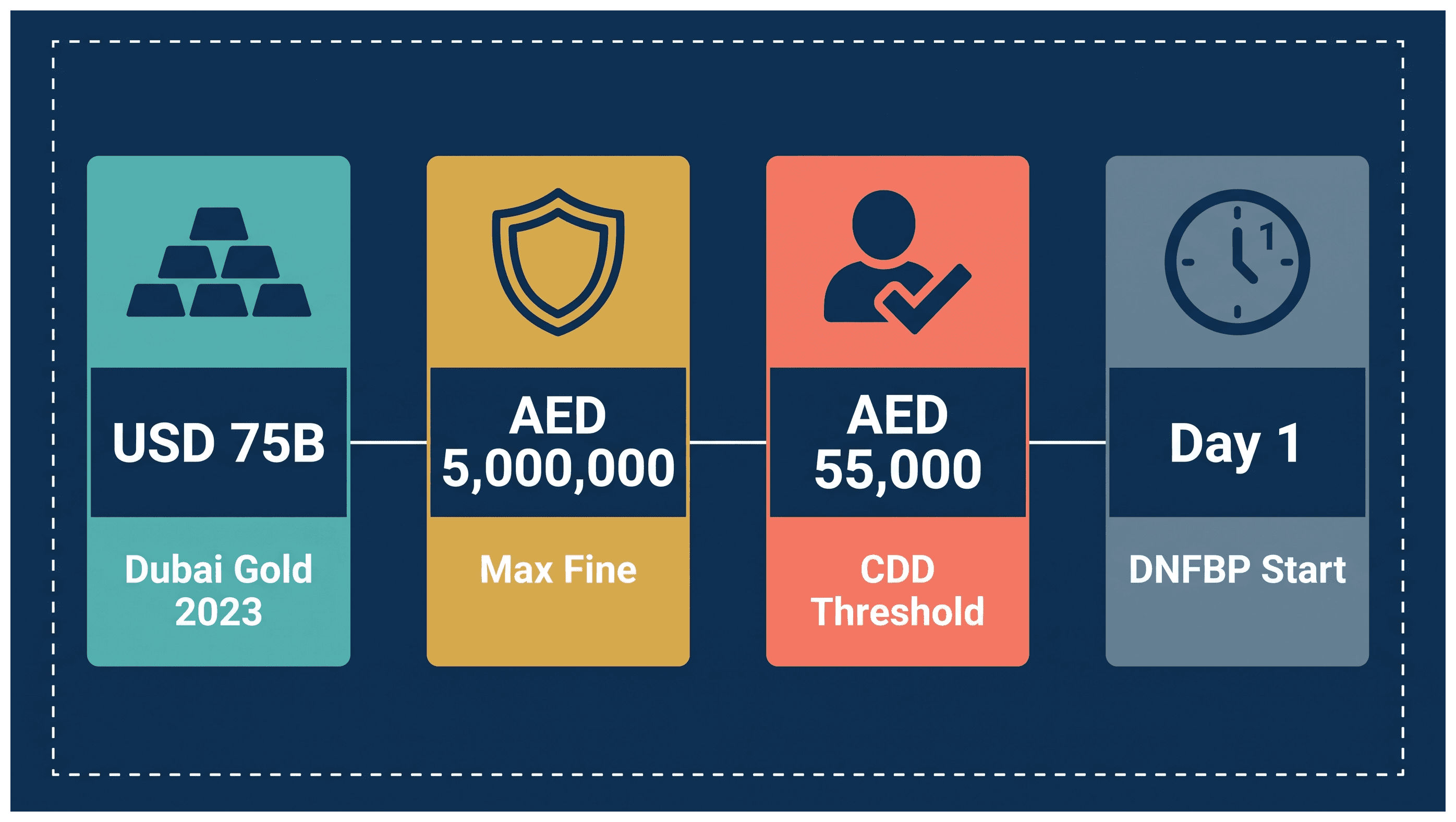
Dubai processed an estimated USD 75 billion in gold trade in 2023, making it one of the world's largest bullion hubs (Ministry of Economy, 2024). That volume puts precious metals dealers directly in the sights of UAE anti-money laundering regulators. Federal Decree-Law No. 20 of 2018 [1] carries fines up to AED 5,000,000 per violation [2]. The AED 55,000 cash threshold for mandatory customer due diligence [3] applies to every covered dealer, regardless of business size [4]. goAML registration must be completed before your first transaction [5]. This guide covers the aml duties dealers uae must meet: what the DNFBP framework requires, how to register on goAML, the customer due diligence thresholds that apply to your transactions, and the step-by-step process for staying compliant from your first trade. This article is general information, not legal advice.
What Are AML Duties for UAE Dealers in Precious Metals
AML duties for UAE dealers in precious metals are legally mandated obligations under Federal Decree-Law No. 20 of 2018. They require dealers classified as DNFBPs (Designated Non-Financial Businesses and Professions) to register on goAML, conduct customer due diligence on transactions at or above AED 55,000, and report suspicious activity to the UAE Financial Intelligence Unit (Ministry of Economy, 2024).
The DNFBP Classification and What It Means for Your Business
Federal Decree-Law No. 20 of 2018, read alongside Cabinet Decision No. 10 of 2019, formally classifies dealers in precious metals and stones as DNFBPs. That classification is not a light administrative label. It places your business inside the same AML/CFT (Combating the Financing of Terrorism) framework that applies to law firms, real estate brokers, and trust service providers.
The Ministry of Economy acts as the supervisory authority for DNFBP dealers, separate from the Central Bank of the UAE, which supervises financial institutions. That distinction matters: your regulator is the Ministry of Economy, and its inspection and penalty powers apply directly to your trade license.
Critically, the DNFBP classification applies from the date your license is issued, not from the date you first reach the AED 55,000 transaction threshold. A gold trading company licensed in Dubai that sells directly to retail customers is a DNFBP on day one. Non-compliance is treated as a primary AML breach, not a procedural oversight, so the clock starts immediately.
Which Businesses Are Covered Under This Framework
The scope of the DNFBP dealer definition is broader than most founders expect. Covered businesses include:
Dealers buying or selling gold, silver, platinum, diamonds, and other precious stones
Pawnbrokers handling precious items, who carry the same obligations as dedicated dealers
Manufacturers who also sell directly to end customers, captured by the dealer classification at the point of sale
Businesses conducting occasional transactions below the AED 55,000 threshold, which still carry baseline AML obligations including goAML registration and a written policy
A jewelry retailer at a Dubai mall that accepts cash payments for high-value pieces is a covered dealer even if its primary identity is retail, not trading. The activity, not the business identity, determines the classification. You can explore the full range of business activities in Dubai to understand where precious metals trading sits within the broader licensing framework.
AML Duties UAE Requirements: The Core Obligations You Must Meet
Core aml duties uae requirements for precious metals dealers include appointing a compliance officer, maintaining a written AML policy, conducting ongoing customer due diligence, screening customers against sanctions lists, filing suspicious transaction reports, and retaining all records for a minimum of five years as required by the Ministry of Economy (moet.gov.ae, 2024).
Internal Controls You Must Put in Place
Appoint a named compliance officer. This person must be senior enough to have real authority over transaction decisions. A Dubai-based bullion dealer with three employees still needs a designated compliance officer on record with the Ministry of Economy, even if that role is held by one of the founders.
Draft a written AML/CFT policy. The policy must be tailored to your specific business activities, not a generic template. It should cover customer risk rating, CDD procedures, and STR filing protocol.
Conduct an internal risk assessment. Cover customer types, transaction channels (cash, wire transfer, crypto), and geographic exposure to high-risk jurisdictions.
Implement sanctions screening. Screen against the UAE local terrorist list, the UN Consolidated List, and the OFAC SDN List before onboarding any customer. Free public lists are available; commercial tools automate the process in real time.
AML Obligations by Trigger: UAE Precious Metals Dealers
Obligation | Requirement / Threshold |
|---|---|
Standard CDD threshold (cash transactions) | Full CDD mandatory at or above AED 55,000 in a single cash transaction |
STR filing deadline | 35 days from the date suspicion arises (not the transaction date) |
Document retention period | Minimum 5 years from transaction date or end of business relationship |
Beneficial ownership identification threshold | Any individual owning 25% or more of a corporate customer must be identified |
Maximum penalty per violation | AED 5,000,000 under Cabinet Decision No. 16 of 2021 |
Minimum penalty per violation | AED 50,000 under Cabinet Decision No. 16 of 2021 |
Record-Keeping Rules That Apply to Every Transaction
Five-year minimum retention. All customer identification documents, transaction records, and due diligence files must be kept for at least five years from the transaction date or the end of the business relationship, whichever is later.
Retrievable on request. Records must be stored in a format that regulators can access within a reasonable timeframe. "It's in a folder somewhere" is not a compliant answer during a Ministry of Economy inspection.
Digital storage is acceptable but must be secure, access-controlled, and auditable. A basic cloud system with access logs satisfies this requirement in practice.
Failure to produce records is treated as a separate compliance breach, distinct from the underlying transaction issue. Two breaches mean two potential fines.
Customer Due Diligence Thresholds Every Dealer Must Know
UAE precious metals dealers must apply full customer due diligence on any cash transaction at or above AED 55,000. This includes verifying the customer's identity, recording the source of funds, and screening against sanctions lists. Enhanced due diligence applies for politically exposed persons and high-risk jurisdictions regardless of transaction size (Central Bank of the UAE, 2024).
Standard CDD: What the AED 55,000 Threshold Requires
Trigger point is AED 55,000 in a single cash transaction. Full CDD is mandatory before completing the sale, not after.
CDD documentation includes: a government-issued photo ID (Emirates ID or passport), proof of address, and documentation of the source of funds. A customer purchasing AED 60,000 worth of gold bars in cash must present these before the transaction completes.
Corporate customers require beneficial ownership verification. Identify any individual owning 25% or more of the entity. Request the company's trade license, memorandum of association, and shareholder register.
Structuring is a reportable offence. A customer who splits a AED 70,000 purchase into two AED 35,000 cash payments on the same day is structuring. You must report it, not complete it.
Enhanced Due Diligence for High-Risk Customers
Politically exposed persons (PEPs) require enhanced due diligence regardless of transaction size. This covers current or former senior government officials and their close associates, under the definition in Cabinet Decision No. 10 of 2019.
Customers from FATF high-risk or monitored jurisdictions trigger enhanced scrutiny automatically. Check the FATF list at each transaction, as it is updated three times per year.
Enhanced CDD means three additional steps: senior management approval before onboarding, verification of source of wealth (not just source of funds for the specific transaction), and increased frequency of ongoing monitoring.
Shell companies with opaque ownership should be treated as high-risk by default. If you cannot identify the ultimate beneficial owner, do not proceed with the transaction.
What counts as "ongoing monitoring" for existing customers?
Ongoing monitoring means periodically reviewing existing customer relationships to confirm their transaction patterns remain consistent with their stated business purpose. For a retail jewelry buyer making one or two purchases per year, an annual review is proportionate. For a wholesale trader with frequent high-value transactions, quarterly checks are more appropriate under DNFBP guidance from the Ministry of Economy.
Step-by-Step Guide to AML Compliance for UAE Precious Metals Dealers
To meet aml duties uae requirements as a precious metals dealer, you must obtain the correct trade license, complete goAML registration, appoint a compliance officer, draft an AML policy, apply customer due diligence at the AED 55,000 threshold, screen all customers against sanctions lists, and file suspicious transaction reports within 35 days (moet.gov.ae, 2024).
Step 1: Obtain the Correct License and DNFBP Registration
Secure a trade license covering precious metals dealing. Dubai South Business Hub Free Zone licenses the activity. You can review the trading license in Dubai options to confirm the activity codes that apply to your business.
Submit your DNFBP registration application to the Ministry of Economy separately from your free zone license application. Required documents include your trade license, owner identification, and a description of your business activities.
Keep both registrations current. A lapsed trade license or an expired DNFBP registration triggers automatic non-compliance status. Renewals are not optional.
Note on registration fees: No annual DNFBP registration fee is published by the Ministry of Economy as of this writing. UNVERIFIED: Confirm before publishing.
Step 2: Register on the goAML Portal
Navigate to goaml.ae, the portal operated by the UAE Financial Intelligence Unit (UAE FIU).
Create an institutional account using your trade license number, compliance officer details, and Emirates ID. The process is fully online.
Registration opens up STR submission. Once registered, your compliance officer can file Suspicious Transaction Reports and access FIU typology guidance directly through the portal.
Timing is critical. A newly licensed gold trading company in Dubai must complete goAML registration during the pre-opening phase, before it accepts its first customer inquiry. There is no grace period after trading begins.
Step 3: Build Your Compliance Framework and Start Trading
Draft your AML/CFT policy document covering customer risk rating methodology, CDD procedures for standard and enhanced cases, your sanctions screening workflow, and your STR filing protocol.
Formally document your compliance officer's role in writing. A signed role description stored in your company records satisfies the Ministry of Economy's documentation requirement.
Set up sanctions screening. Free options include the UN Consolidated List (available at un.org) and the OFAC SDN List (available at ofac.treasury.gov). Paid commercial tools offer real-time automated screening that flags matches before a transaction completes.
Train customer-facing staff on red-flag indicators before they handle a single transaction. Training records should be retained as part of your compliance file.
How to Report Suspicious Transactions as a UAE Precious Metals Dealer
UAE precious metals dealers must file a Suspicious Transaction Report (STR) through the goAML portal within 35 days of the suspicion arising. The report must describe the transaction, the basis for suspicion, and the customer's details. Disclosing the report's existence to the customer, known as tipping off, is a criminal offence under Federal Decree-Law No. 20 of 2018 (UAE Cabinet, 2018).
Red Flags That Should Trigger an STR
Customer insists on paying in cash for large purchases without a credible business explanation
Customer is reluctant to provide identification or produces documents that appear inconsistent or altered
Transaction has no apparent commercial purpose, or the customer shows unusual knowledge of the AED 55,000 threshold
Multiple smaller purchases by the same customer that aggregate above AED 55,000 within a short period (structuring pattern)
Customer requests unusual packaging, routing, or delivery arrangements inconsistent with normal trade practice
Here's a concrete example: a walk-in customer who pays AED 50,000 in cash, declines to provide ID, and asks for the receipt to be made out to a different name is exhibiting multiple red flags simultaneously. Each flag alone may be explainable; together, they warrant an STR regardless of whether the transaction is below the CDD threshold.
The 35-Day Filing Rule and Tipping-Off Prohibition
The 35-day window starts when suspicion arises, not when the transaction completes. If you notice a red flag on day one and wait 40 days to file, you are already in breach.
You may delay a pending transaction while you assess the suspicion. Do not alert the customer to the reason for the delay.
Tipping off carries criminal liability for both the individual employee who discloses and the business entity. This is not a civil matter.
Good-faith STR protection applies. Filing an STR that does not result in enforcement action carries no civil liability for the dealer. You will not be sued for reporting a genuine suspicion that turns out to be innocent.
AML Duties UAE Guide: Costs, Penalties, and What Non-Compliance Risks
Non-compliance with aml duties uae requirements exposes precious metals dealers to Ministry of Economy fines ranging from AED 50,000 to AED 5,000,000 per violation, trade license suspension, and criminal prosecution. Compliance costs, primarily staff time, screening tools, and training, are modest relative to the penalty exposure and reputational damage (Ministry of Economy, 2024).
What AML Compliance Actually Costs to Set Up
AML/CFT policy drafting: Handled internally or by a legal consultant. UNVERIFIED: AED 3,000 to AED 8,000 for a consultant-drafted policy. Confirm before publishing.
Sanctions screening software: Free tier options use
References
Frequently Asked Questions