Attested Birth Certificate for Child Sponsorship: Steps, Cost and Common Delays

Topic Summary
Complete the Full Four-Link Authentication Chain
Every birth certificate must pass through the local registrar, home country foreign ministry, UAE embassy abroad, and UAE MOFA in Dubai. Skipping even one link renders the document invalid at ICP, triggering a full restart of the process.
Apostille Countries Get a Faster Route
If your home country is one of over 100 Hague Convention signatories, a single apostille stamp replaces the foreign ministry and UAE embassy steps. UAE MOFA accepts it directly, cutting weeks off the overall timeline.
Never Submit a Notarised Copy to ICP
Notarisation only confirms a signature is genuine, while attestation confirms the document itself is authentic — ICP treats these as entirely different things. Submitting a notarised photocopy instead of a properly attested original is one of the most common rejection triggers.
Budget AED 800–2,500 for Attestation and Translation
The combined cost of the attestation chain and UAE-licensed translation typically falls between AED 800 and AED 2,500, with child visa processing fees charged separately at ICP. Planning for this range upfront prevents budget surprises mid-application.
Complete UAE MOFA Attestation Inside the UAE
The final MOFA stamp must always be obtained within the UAE after the document arrives in the country — it cannot be done abroad. Many applicants lose time by assuming this step can be handled before travel.
Use Only a UAE-Licensed Translator for Arabic Documents
If the birth certificate is not in Arabic or English, it must be translated by a translator licensed in the UAE before ICP submission. Translations prepared outside a UAE-licensed office are a leading cause of application delays.
Act Quickly to Avoid MOFA Attestation Expiry
Leaving a visa file untouched for around six months can cause the MOFA attestation to expire, forcing the entire authentication chain to restart. Submitting the ICP application promptly after attestation is complete protects against this avoidable delay.
Name mismatches cause an estimated 30–40% of initial document rejections at GDRFAD (2024). Standard UAE MOFA processing costs AED 150 per document. Non-Apostille countries face 6–14 weeks of home-country steps before MOFA even sees the file. Over 120 countries are Hague Convention signatories, cutting that chain short. Re-attestation after a rejection costs the same as the first attempt, every dirham and every day lost.
Every parent sponsoring a child on a UAE residence visa must submit one key paper first: an attested birth certificate for child sponsorship. Miss a single stamp in the chain and GDRFAD will not open your file. This guide covers what the document is, the full attestation chain, current costs, typical timelines, and the delays that catch most families off guard.
What Is an Attested Birth Certificate for Child Sponsorship and Why It Matters
An attested birth certificate for child sponsorship is an officially verified document that confirms a child's identity and parental relationship. UAE authorities require it before granting a child residence visa. Attestation involves a chain of stamps from your home country's authorities and the UAE Ministry of Foreign Affairs, making the document legally recognised in the UAE.
UAE law requires foreign documents to be legalised before they carry legal weight inside the country. A plain birth certificate, even a notarised one, has no standing at GDRFAD without the full attestation chain. This requirement applies regardless of the child's nationality or the parent's visa type. Any UAE resident sponsoring a child under 18 for a residence visa needs an attested birth certificate, including employed residents, company-license holders, adoptive parents, and step-parents.
Apostille vs. Full Legalisation: Which Path Applies to You
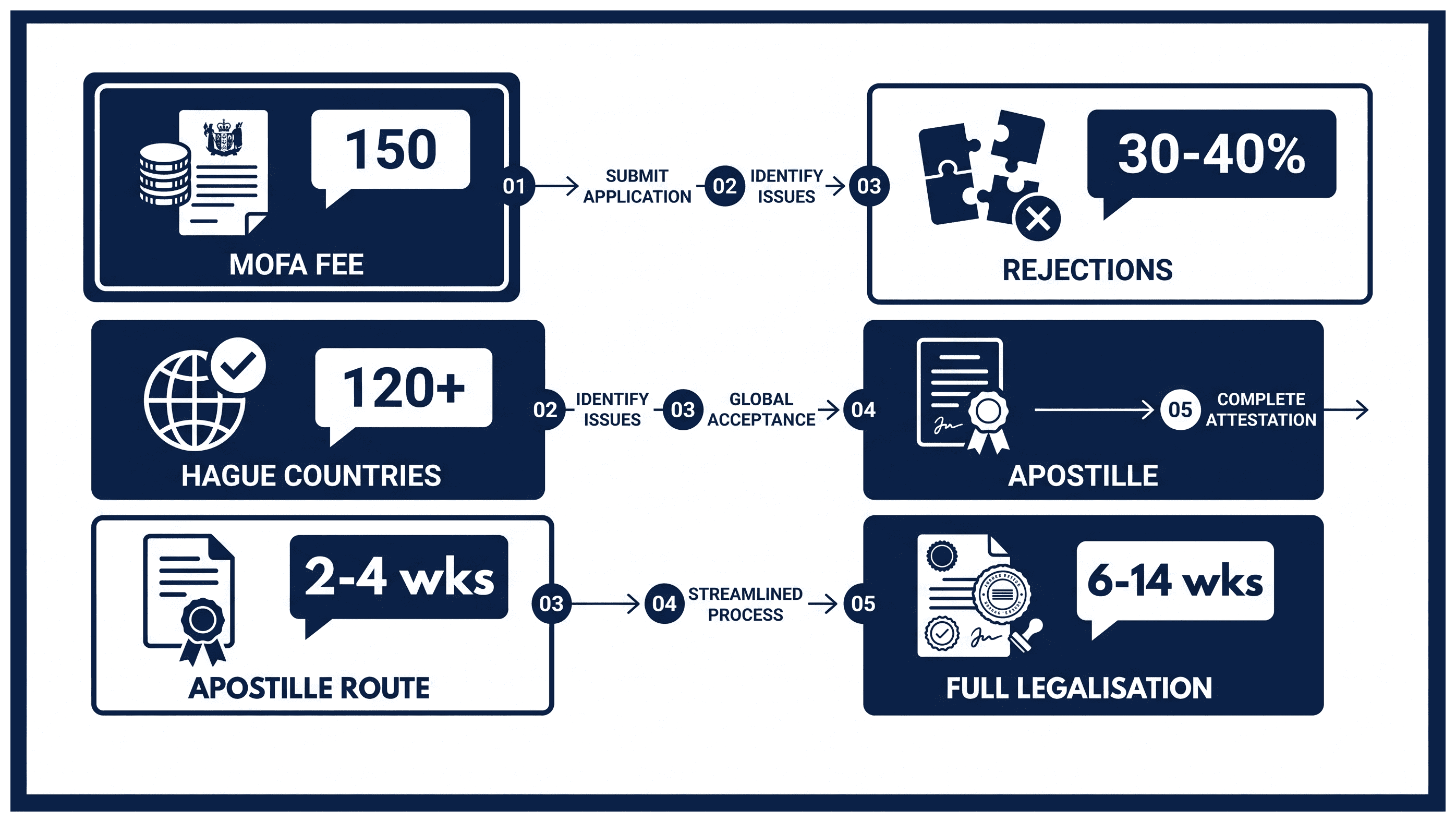
If your home country is a Hague Convention signatory, you need only an Apostille stamp, no embassy visit required. If your country is not a signatory, you must complete full legalisation: notarisation, home-country foreign ministry stamp, UAE embassy stamp, then UAE MOFA. The path you follow determines your timeline and total cost.
Apostille Countries: The Shorter Route
Hague Convention members, including the US, UK, Canada, Australia, and most EU countries, use the Apostille process. A single Apostille stamp from the designated home-country authority satisfies the first stage. After that, UAE MOFA attestation is still required; that step is non-negotiable regardless of nationality (u.ae, 2025). Total timeline: typically 2–4 weeks end to end.
Non-Apostille Countries: The Longer Chain
Countries not party to the Hague Convention, many in South Asia, Africa, and the Middle East, require full legalisation. The sequence is: local notarisation, home-country Ministry of Foreign Affairs stamp, UAE Embassy or consulate stamp, then UAE MOFA final attestation. This full chain can take 6–14 weeks. Starting before you travel to the UAE cuts delays significantly.
Step-by-Step Guide to Attesting a Birth Certificate for Child Sponsorship
Attesting a birth certificate for child sponsorship involves five core steps: obtain a certified copy, get it notarised locally, complete home-country foreign ministry authentication, add the UAE embassy stamp (non-Apostille countries only), then submit to UAE MOFA. After MOFA, submit the attested document to ICP or GDRFAD with your child's visa application.
Step 1: Obtain a Certified Copy of the Birth Certificate
Request an official certified copy from the civil registry or vital records office in the country of birth. Don't use a photocopy of the original, it won't be accepted. Some UAE authorities require a copy issued within the last 6 months, so check before ordering. Verify the child's name, date of birth, and both parents' names match the passport exactly. Name mismatches cause an estimated 30–40% of initial rejections at GDRFAD (GDRFAD, 2024).
Step 2: Complete Home-Country Authentication
For Apostille countries, obtain the Apostille stamp from the designated national authority, the FCDO in the UK or the Secretary of State office in the US. For non-Apostille countries, notarise the document, then collect stamps from the home-country foreign ministry and the UAE Embassy. Keep certified copies at every stage, originals can be lost in transit.
Step 3: UAE MOFA Attestation and Final Submission
Submit the home-country-authenticated document to UAE MOFA, in person at a service centre or via the MOFA Smart Services portal. The standard fee is AED 150 per document. Turnaround is typically 1–3 business days. After MOFA, submit the complete file to ICP or GDRFAD for the child's residence visa.
Cost Breakdown for Birth Certificate Attestation
Total attestation costs range from AED 150 for Apostille-country applicants (MOFA fee only) to AED 800–2,000+ for non-Apostille countries when you include notarisation, foreign ministry fees, UAE embassy charges, and courier costs. Using a professional attestation service adds AED 200–600 but saves significant time and reduces rejection risk.
UAE MOFA fee: AED 150 per document, fixed regardless of nationality
Apostille stamp (home country): typically USD 10–50 or equivalent
Non-Apostille route: home-country foreign ministry fee plus UAE embassy fee can add USD 50–200
Translation fees (if document is not in Arabic or English): AED 100–300 per page
Courier and handling: AED 100–400 depending on speed and service
Rush MOFA processing: can double the standard AED 150 charge
Re-attestation after rejection costs the same as the first attempt. Translation must be completed by a UAE Ministry of Justice-approved legal translator; unlicensed translations are rejected outright.
Common Delays and How to Avoid Them
The most common delays include name mismatches between documents, missing home-country authentication steps, expired certificates, and using unlicensed translators. Most delays are avoidable with careful document checking before starting the attestation chain.
Name mismatches between the birth certificate, passport, and visa application, the leading rejection cause (30–40% of initial rejections, GDRFAD, 2024)
Inconsistent transliteration (e.g., "Mohammed" vs "Muhammad") flags a file immediately
Skipping the home-country foreign ministry step invalidates all subsequent stamps
Using a photocopy instead of a certified original at any stage restarts the process
UAE embassy delays during peak periods can add 2–4 weeks to the non-Apostille route
UAE MOFA offers urgent same-day service for AED 300–450. Home-country steps, however, run on the issuing country's own timeline. Plan around public holidays in both your home country and the UAE, particularly Eid periods when UAE embassies in South Asian countries often operate on reduced schedules.
Supporting Documents Required Alongside the Attested Birth Certificate
Alongside an attested birth certificate, child sponsorship applications to ICP or GDRFAD typically require the sponsor's valid UAE residence visa, Emirates ID, passport copies for both parent and child, and recent passport-size photos. Additional documents may be required depending on the child's circumstances.
Sponsor's valid UAE residence visa (copy)
Sponsor's Emirates ID (copy, front and back)
Sponsor's passport (copy, valid for at least 6 months)
Child's passport (valid, with blank visa pages)
Attested birth certificate (original with MOFA stamp)
Child's passport photo (white background, 35x45mm, UAE specs)
Attested marriage certificate: required when the sponsoring parent is the mother
Court orders or guardianship documents: required for single parents or legal guardians
Adoption papers: require additional legal attestation beyond the standard birth certificate process
A single mother sponsoring her child in the UAE must submit both an attested birth certificate and an attested marriage or divorce certificate. GDRFAD needs both to verify the sponsorship relationship and confirm parental authority.
References
Frequently Asked Questions