
Topic Summary
What Is a Preference Share and How Does a Dubai Company Issue Preference Shares
A preference share is a class of equity that gives its holder priority over ordinary shareholders, usually on dividends or liquidation proceeds. A Dubai company issue preference shares by creating the class in its Articles of Association, approving it by shareholder resolution and registering the change with its licensing authority.
Which Company Structures Let a Dubai Company Issue Preference Shares
Which Company Structures Let a Dubai Company Issue Preference Shares
Step-by-Step Process to Issue Preference Shares in a UAE Company
To issue preference shares, define the class rights, amend the Articles, pass a shareholder resolution, sign a subscription agreement, file with the licensing authority and update the share register. The change takes legal effect only once the authority approves it.
Rights Attached to Preferred Equity in the UAE
Preferred equity in the UAE typically carries dividend priority, a liquidation preference and sometimes conversion or redemption rights. Voting is often limited. These terms live in the Articles and are reinforced in a shareholder agreement, so both documents must match.
Costs and Share Classes in a UAE Company Compared
Costs depend on the structure, the amendment fee and legal drafting. Treat every AED figure as indicative until the authority confirms it. A single ordinary class costs least to maintain, while a share classes UAE company setup adds drafting and registration steps.
Common Mistakes When a Dubai Company Issues Preference Shares
The most common Mistakes are issuing shares before amending the Articles, copying overseas term sheets the registrar won't accept, leaving the shareholder agreement out of step with the Articles, and failing to update registers. Each can delay the deal or weaken the investor's rights.
What Should You Do Next to Issue Preference Shares in Dubai
Confirm your structure allows classed shares, agree the preferred terms with your investor, then amend the Articles and file with your licensing authority. If you haven't incorporated yet, check your company name and estimate setup costs first.
More than three in five new UAE company registrations involve two or more founders (Ministry of Economy, 2026). Yes, a Dubai company can issue preference shares, but how far it can go depends on its legal structure and the registering authority's rules.
This guide is for founders, directors and their advisers. You'll learn which structures allow it, how to amend the Articles, what rights to attach, what to budget and where deals go wrong. Whether a Dubai company can issue preference shares is never just a drafting question. It's a registration question too.
What Is a Preference Share and How Does a Dubai Company Issue Preference Shares
A preference share is a class of equity that gives its holder priority over ordinary shareholders, usually on dividends or liquidation proceeds. A Dubai company issue preference shares by creating the class in its Articles of Association, approving it by shareholder resolution and registering the change with its licensing authority.
Preference Shares Versus Ordinary Shares
Ordinary shares carry votes and residual profit. Preference shares carry priority rights instead, over dividends, liquidation payout or both. They're a constitutional and contractual construct, not a tax product.
Picture a founder holding ordinary shares while an angel investor takes preference shares with a 1x liquidation preference. On exit, the investor gets money back first. The founder shares in what remains. A 1x preference is a common baseline in early-stage deals.
Why Founders Use Preferred Equity in the UAE
Investors accept downside protection instead of fighting over valuation.
Founders keep voting control while raising capital.
The cap table looks structured and investor-ready.
Think of a Dubai South trading startup raising from two co-investors without ceding board control. That's preferred equity UAE founders use in practice. Dubai Chamber data shows how common multi-owner companies are (Dubai Chamber, 2026). Related read: issuing new shares in a UAE free zone company.
Which Company Structures Let a Dubai Company Issue Preference Shares
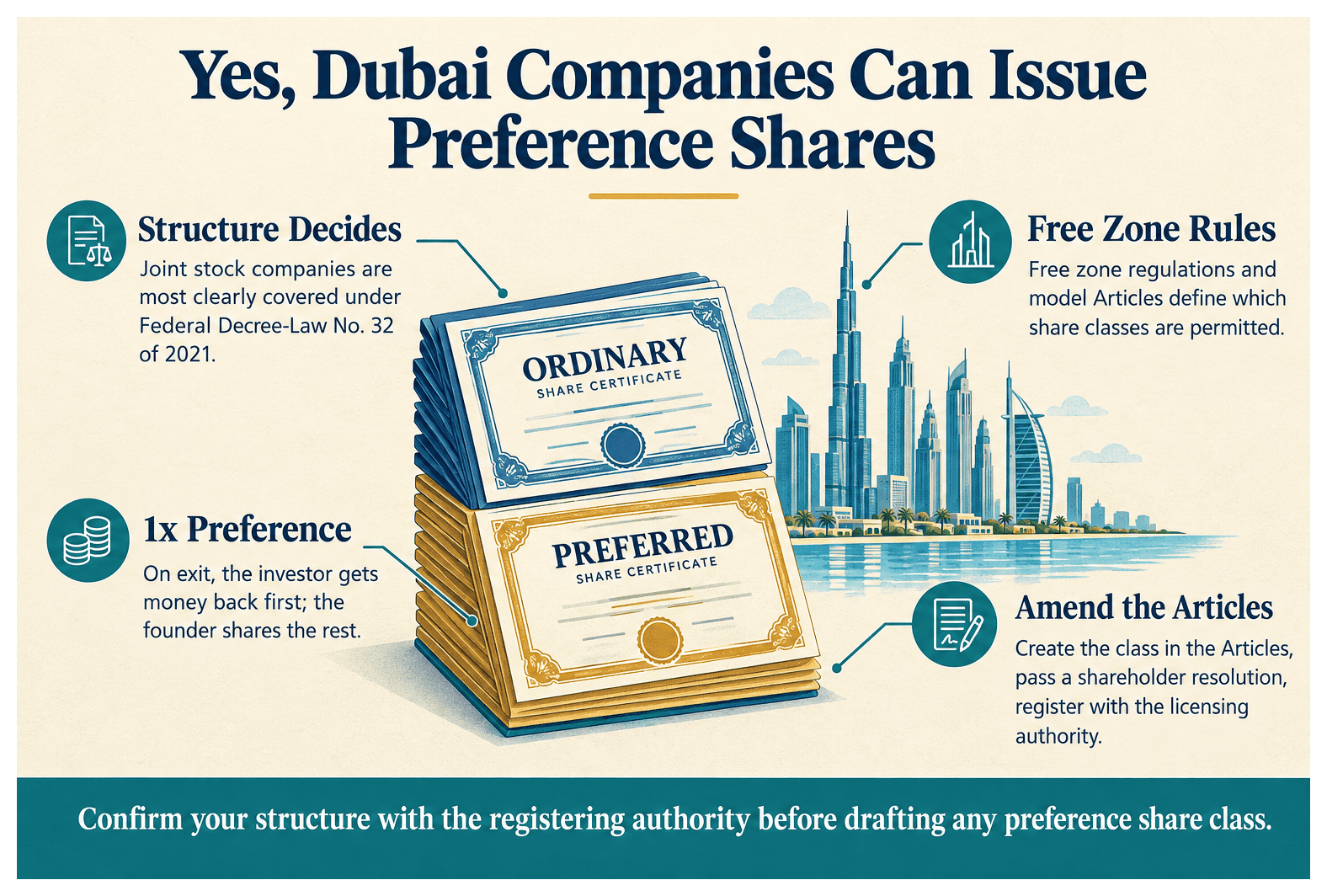
Preference shares are most clearly provided for in joint stock companies under the UAE Commercial Companies Law. LLCs and free zone companies have more limited, rule-dependent flexibility. Confirm with the registering authority before drafting, because the Articles and the free zone's regulations decide which share classes are permitted.
Mainland Companies and the Commercial Companies Law
Federal Decree-Law No. 32 of 2021 governs share classes in joint stock companies (UAE Cabinet, 2021). A private joint stock company can issue a preferred class to a venture investor. LLC share classes depend on the Articles and on what the licensing authority will register. Confirm current limits with a UAE legal adviser.
Free Zone Companies and Share Class Flexibility
Free zone regulations and model Articles define allowed share classes. For an FZ-LLC or FZCO, check whether the registrar accepts classed shares. At Dubai South Business Hub Free Zone, an Articles amendment needs registrar approval before it takes legal effect. A Dubai South FZCO adding a Class B preferred share is the typical case. Permitted classes depend on current regulations, so confirm before drafting.
When a Corporate Investor Holds the Preferred Class
Corporate shareholders need constitutional documents and proof of authorised signatories.
Foreign corporate investors can usually hold preferred equity, subject to registrar KYC.
More than 45% of new Dubai free zone licenses sit with companies whose ultimate shareholder is a foreign legal entity.
An overseas holding company subscribing to preferred shares in a Dubai South company is a standard example. See the rules for a corporate shareholder in a Dubai company. Reserving your name first helps, so run a name check.
Step-by-Step Process to Issue Preference Shares in a UAE Company
To issue preference shares, define the class rights, amend the Articles, pass a shareholder resolution, sign a subscription agreement, file with the licensing authority and update the share register. The change takes legal effect only once the authority approves it.
Step 1: Define the Rights of the Preferred Class
Set dividend priority, liquidation preference, conversion and redemption terms.
Decide voting rights: none, limited or full.
Match the term sheet, for example a cumulative 8% dividend with a 1x non-participating preference.
Step 2: Amend the Articles and Pass the Resolution
Draft the new share class clause in the Articles.
Get approval by the majority that law and the Articles require.
Record it, for instance a special resolution creating Class B preferred shares.
Step 3: Sign Subscription Documents and Register the Change
Sign the subscription agreement and submit the investor KYC pack.
File with the authority and wait for approval.
Then update the share register and issue certificates.
Step 4: Record the Change in Your Statutory Documents
Update the share register, UBO register and shareholder file.
Expect banks to request the new cap table after a preferred round.
Missing shareholder documents can trigger account suspension within 48 hours.
Pair this with a shareholder agreement in the UAE so the terms match.
Rights Attached to Preferred Equity in the UAE
Preferred equity in the UAE typically carries dividend priority, a liquidation preference and sometimes conversion or redemption rights. Voting is often limited. These terms live in the Articles and are reinforced in a shareholder agreement, so both documents must match.
Dividend and Liquidation Preferences
Dividends can be fixed or discretionary.
Preference can be participating or non-participating.
An investor putting in AED 500,000 with a 1x preference gets AED 500,000 back before ordinary shareholders on exit.
Distributions sit within corporate tax rules (Federal Tax Authority).
Ordinary Shares Versus Preference Shares in a UAE Company
Feature | Ordinary Shares | Preference Shares |
|---|---|---|
Dividend priority | Paid from residual profit after other classes | Paid first, fixed or cumulative if the Articles say so |
Liquidation priority | Receives what remains after preferred holders | Typically 1x return first, such as AED 500,000 on AED 500,000 |
Voting rights | Full votes, so founders keep control | Often limited, with vetoes on reserved matters |
Drafting and filing effort | Single class, minimal drafting | Articles amendment, resolution and registrar approval |
Indicative cost in AED (state date) | Lowest to maintain; check the cost calculator (2026) | Adds drafting and filing fees; confirm with the registrar (2026) |
Voting, Conversion and Minority Protections
Reserved matters and veto rights usually sit in the shareholder agreement. A preferred holder might get a veto over new share issues, plus conversion into ordinary shares at a later round. That matters: more than 40% of UAE startup disputes reaching arbitration trace back to a missing or poor shareholder agreement. See the rights of a minority shareholder.
Costs and Share Classes in a UAE Company Compared
Costs depend on the structure, the amendment fee and legal drafting. Treat every AED figure as indicative until the authority confirms it. A single ordinary class costs least to maintain, while a share classes UAE company setup adds drafting and registration steps.
Share Capital Implications and Budgeting
Issued capital changes once investors subscribe. A founder budgeting for an amendment before a funding close should allow for legal drafting, the amendment filing and updated registers. I won't quote a fee here that I can't date and verify, so use the cost calculator for current AED figures. Also review share capital requirements before you commit.
Common Mistakes When a Dubai Company Issues Preference Shares
The most common Mistakes are issuing shares before amending the Articles, copying overseas term sheets the registrar won't accept, leaving the shareholder agreement out of step with the Articles, and failing to update registers. Each can delay the deal or weaken the investor's rights.
Skipping the Articles Amendment
Roughly 45 percent of founders raising equity in year two find their Articles weren't drafted for the change.
An investor wires funds before the class exists.
The result: stalled deals and rework.
Mismatched Documents and Weak Records
The cap table in the pitch deck differs from the registered share register.
Articles and shareholder agreement say different things.
Banks can suspend accounts within 48 hours if documents are missing.
What Should You Do Next to Issue Preference Shares in Dubai
Confirm your structure allows classed shares, agree the preferred terms with your investor, then amend the Articles and file with your licensing authority. If you haven't incorporated yet, check your company name and estimate setup costs first.
Set Up a Structure That Is Investor-Ready
A founder incorporating at Dubai South Business Hub Free Zone with an investor round planned for year two should have Articles drafted to accommodate future share classes. More than 70% of Dubai South applications come from founders who never visit during formation. Residency visa packages can be tied to the license. Start with the name check and cost calculator.
Get Legal and Registrar Confirmation
Take final wording to a UAE-qualified lawyer.
Confirm filing requirements with the registrar.
Remember: approval comes before legal effect.
Final Word
A Dubai company can issue preference shares when its structure and registering authority allow it. Amend the Articles first, align the shareholder agreement, and keep registers current. Before approaching investors, check your name and costs with Dubai South Business Hub, then confirm share class rules with the registrar and a UAE lawyer.
References
Frequently Asked Questions


