Topic Summary
What Is a Multi-Currency Account and Why a Dubai Company Can Receive Foreign Currency
A multi-currency account (also called an FX account) lets a Dubai company hold USD, EUR, GBP and other balances alongside AED. Incoming payments land in the currency sent, so you convert only when you choose. That's how a Dubai company can receive foreign currency without a forced conversion at the bank's default rate.
Which Requirements Must a Dubai Company Meet to Hold Foreign Currency
Which Requirements Must a Dubai Company Meet to Hold Foreign Currency
Which Regulations in the UAE Govern Foreign Currency Receipts
The Central Bank of the UAE regulates banks and AML/KYC controls. The Federal Tax Authority governs VAT and corporate tax treatment. Receiving foreign currency is legal, but you must document the source, issue compliant invoices and record amounts in AED for tax.
Step-by-Step Guide to Receive Foreign Currency in Your Dubai Company Account
Secure a trade license, open a corporate account, request multi-currency activation, share IBAN and SWIFT details, issue compliant invoices, then receive funds in the original currency. Convert to AED only when you need local cash or when rates suit you.
How Much Does It Cost and How Long Does It Take to Hold Foreign Currency
Costs vary by bank. Expect account opening of AED 0 to 1,000, monthly fees of AED 0 to 250, incoming SWIFT fees of AED 25 to 100 and FX spreads of 0.3% to 2%. Approval typically takes two to six weeks. These figures are indicative as of May 2026, so confirm with your bank.
Which Mistakes Should You Avoid When a Dubai Company Receives Foreign Currency
Common errors include letting the bank auto-convert, giving clients wrong currency details, mismatching invoices and licensed activities, ignoring AED VAT figures and leaving balances unmonitored. Agree conversion rules upfront and keep contracts and invoices ready for every inflow.
What Should You Do Next to Receive Foreign Currency in Your Dubai Company
Confirm your license activities match your billing, shortlist banks with multi-currency accounts, prepare KYC documents and set a conversion policy. No company yet? Form one with Dubai South Business Hub Free Zone, check your name and estimate costs before applying.
Yes, a Dubai company can receive foreign currency without converting it, provided it holds a multi-currency or FX account with a UAE bank. More than 40% of UAE companies now transact in two or more currencies, and the UAE has over 40 licensed banks (Central Bank of the UAE, 2025) [1]. The dirham is pegged to the US dollar at 3.6725 [1], so USD balances carry little rate risk. This guide shows how a Dubai company can receive foreign currency, what banks require, which rules apply, what it costs in AED and where founders slip up.
What Is a Multi-Currency Account and Why a Dubai Company Can Receive Foreign Currency
A multi-currency account (also called an FX account) lets a Dubai company hold USD, EUR, GBP and other balances alongside AED. Incoming payments land in the currency sent, so you convert only when you choose. That's how a Dubai company can receive foreign currency without a forced conversion at the bank's default rate.
How a Multi-Currency Account Works
You get one account number with sub-balances per currency, or linked currency accounts. A payment arrives in the invoice currency with no automatic AED conversion. You then convert on demand, or pay suppliers straight from that balance.
Picture a Dubai consultancy that invoices a US client in USD. The money lands in its USD sub-account, and the firm later pays a US software vendor from the same balance. It never converts twice. For a deeper look, read can a Dubai company have accounts in multiple currencies.
Why Holding Foreign Currency Protects Your Margin
You avoid double conversion spreads when you receive and pay in the same currency.
You control timing against exchange rate moves.
USD holdings carry little risk because of the peg. EUR and GBP carry more.
An importer paid in EUR by a German client, for example, can keep the EUR to settle a European supplier.
Which Requirements Must a Dubai Company Meet to Hold Foreign Currency
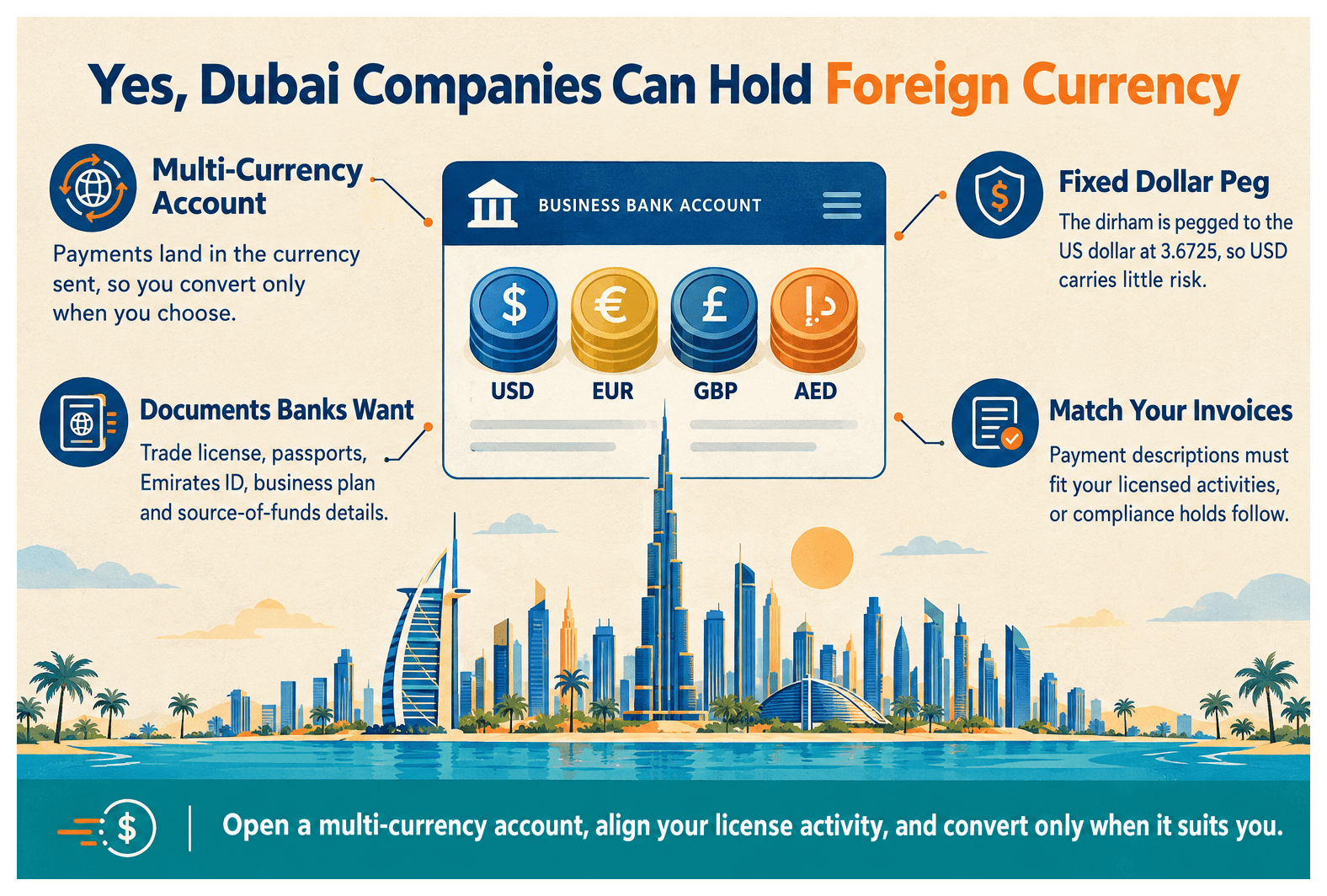
You need a valid trade license, a UAE corporate account with multi-currency enabled, and complete KYC (know your customer) documents. Banks also review your activity, expected volumes and client countries. Payments must match invoices and licensed activities, because mismatches trigger compliance holds.
Documents Banks Ask For
Trade license and incorporation documents.
Passports and Emirates ID or visa for shareholders and directors.
Business plan, expected monthly turnover and client countries.
Proof of address and source-of-funds details.
Roughly 40% of first-time founders report a delay or decline when opening accounts. A free zone trading company that attaches sample invoices and client contracts tends to move faster.
Why the License Activity Must Match Your Invoices
Banks compare payment descriptions with your licensed activities. A consultancy licensed for IT services that receives payments tagged as goods trading will face a compliance query. Align your activities before you bill.
Do Free Zone and Mainland Companies Face Different Rules
Not really. Bank policy, not license type, decides. A Dubai South Business Hub Free Zone company can open AED and USD accounts under one KYC file. See how to open a business bank account in Dubai.
Which Regulations in the UAE Govern Foreign Currency Receipts
The Central Bank of the UAE regulates banks and AML/KYC controls. The Federal Tax Authority governs VAT and corporate tax treatment. Receiving foreign currency is legal, but you must document the source, issue compliant invoices and record amounts in AED for tax.
Central Bank and AML Expectations
There's no cap on foreign currency inflows, but banks must screen transactions, including sanctions and high-risk-country checks. A bank may ask for a contract and invoice before releasing a USD 150,000 inflow. Have them ready.
VAT and Corporate Tax on Foreign Currency Income
Foreign currency invoices must show the VAT amount in AED.
Use the Central Bank rate or a documented rate for tax records.
VAT is 5%. Corporate tax is 9% above AED 375,000 of profit (Ministry of Finance, 2023).
Exchange gains and losses can affect taxable income.
A EUR 10,000 invoice with 5% VAT should state the AED equivalent of that VAT. Our guide on getting paid by international clients in the UAE covers more.
Step-by-Step Guide to Receive Foreign Currency in Your Dubai Company Account
Secure a trade license, open a corporate account, request multi-currency activation, share IBAN and SWIFT details, issue compliant invoices, then receive funds in the original currency. Convert to AED only when you need local cash or when rates suit you.
Step 1: Get Your Trade License in Place
Choose activities that match your billing. Confirm availability with the name check tool, then estimate fees with the cost calculator.
Step 2: Open the Corporate Account and Activate Currencies
Apply with a full KYC pack. Request USD and EUR sub-accounts at onboarding, not later. Confirm fees, FX spread and minimum balances in writing.
AED-Only Account vs Multi-Currency Account (Indicative Fees in AED, Verify Date With Your Bank)
Feature | AED-Only Account | Multi-Currency Account |
|---|---|---|
Monthly maintenance fee (AED) | AED 0 to 150, one balance to maintain | AED 0 to 250, covers several currency balances |
Incoming SWIFT fee (AED) | AED 25 to 100, plus conversion on arrival | AED 25 to 100, credited in original currency |
FX spread on conversion | 0.3% to 2% on every inbound payment | 0.3% to 2% only when you choose to convert |
Control over conversion timing | Bank sets rate and timing | You pick the moment and the rate |
Best suited for | Mostly domestic AED trading | Exporters, consultancies and importers paid or paying abroad |
Step 3: Share Payment Details and Issue Compliant Invoices
Give clients your IBAN, SWIFT/BIC and currency, and ask for the OUR or SHA charge option. Show your TRN if VAT-registered, plus the currency and AED VAT. An invoice might read USD 5,000 plus the AED VAT equivalent. Read how to accept international payments from a UAE company.
Step 4: Hold, Convert or Pay Out in the Same Currency
Set a treasury rule. One company keeps 60% of USD receipts for USD supplier bills and converts the rest quarterly. Reconcile monthly in AED for books and tax.
How Much Does It Cost and How Long Does It Take to Hold Foreign Currency
Costs vary by bank. Expect account opening of AED 0 to 1,000, monthly fees of AED 0 to 250, incoming SWIFT fees of AED 25 to 100 and FX spreads of 0.3% to 2%. Approval typically takes two to six weeks. These figures are indicative as of May 2026, so confirm with your bank.
Typical Fee Ranges in AED
The spread matters most. On AED 100,000 of USD receipts, a 1.5% spread costs AED 1,500, versus AED 500 at 0.5%. That gap is why a well-run FX account in Dubai pays for itself.
How Long Approval and Activation Take
Account approval runs two to six weeks depending on documents. Currency sub-accounts often activate within days. Incomplete KYC causes the most delays, and about 40% of first-time founders report delays or declines. A founder with a full pack can see approval in three weeks.
Which Mistakes Should You Avoid When a Dubai Company Receives Foreign Currency
Common errors include letting the bank auto-convert, giving clients wrong currency details, mismatching invoices and licensed activities, ignoring AED VAT figures and leaving balances unmonitored. Agree conversion rules upfront and keep contracts and invoices ready for every inflow.
Auto-Conversion and Hidden Spreads
Some banks convert unless a matching currency account exists.
Compare the quoted rate with the mid-market rate.
Negotiate spreads once volumes grow.
Documentation and Compliance Gaps
No contract or invoice for large inflows.
Payment references that don't match your activity.
Mixing personal and business funds.
A transfer from a third-party payer, for instance, will likely be held until you explain it.
Crypto and Non-Standard Payments
Digital assets follow different rules, and banks ask questions when clients pay in crypto. Check can a Dubai free zone company accept cryptocurrency payments first.
What Should You Do Next to Receive Foreign Currency in Your Dubai Company
Confirm your license activities match your billing, shortlist banks with multi-currency accounts, prepare KYC documents and set a conversion policy. No company yet? Form one with Dubai South Business Hub Free Zone, check your name and estimate costs before applying.
Prepare Your Setup and Banking Plan
Run the name check and cost calculator.
Choose license activities and your residency visa package needs.
Gather KYC documents.
Review Your Process Quarterly
Compare bank spreads, review balances per currency and update invoices and tax records. A quarterly review might move excess EUR into AED when the rate suits you.
A Dubai company can receive foreign currency without converting it, as long as it holds a multi-currency account, keeps documentation clean and sets its own conversion rules. The savings come from account setup and spread negotiation. Check your company name, estimate setup costs with the cost calculator, and speak with Dubai South Business Hub about forming your free zone company and residency visa package.
References
Frequently Asked Questions