
Topic Summary
Three Approvals Required Before First Shipment
A cargo handling business in Dubai must secure a free zone trade license, Dubai Customs registration via Dubai Trade, and sector-specific approval from the GCAA or RTA before legally moving any goods. Holding only a trade license is the most common and costly misconception among new operators.
DSBH Licenses Issued in One Business Day
Free zone trade licenses from DSBH for cargo handling start at AED 12,500 and are issued within a single business day once documents and payment are complete. This fast turnaround allows operators to move immediately to Customs and sector authority registration.
Know Exactly Which Activities Your License Covers
The activity descriptions listed on your trade license legally define what your company can invoice for, including loading, unloading, packing, container inspection, and onward dispatch coordination. Missing a required activity means you cannot bill for that work, and amending the license after the fact is an expensive fix.
VAT Registration Triggers at AED 375,000 Turnover
Once taxable turnover reaches AED 375,000, VAT registration becomes mandatory under Federal Tax Authority rules. Late registration carries a flat AED 10,000 penalty, so tracking revenue thresholds from day one is essential.
Dubai Sits in a Massive Global Cargo Market
Dubai's airports processed over 3.5 million tonnes of air cargo in 2024, and the UAE ranks as the world's 9th largest re-export hub by value. This scale creates substantial opportunity but also means the regulatory environment is structured and strictly enforced.
ISIC Classification Determines Your Primary Activity
Cargo handling falls under ISIC Revision 4, Class 5224 (Transportation and Storage), covering stevedoring, freight loading, and container handling. If your business spans multiple freight modes, the mode generating the most value added becomes the primary classification used by UAE licensing agencies.
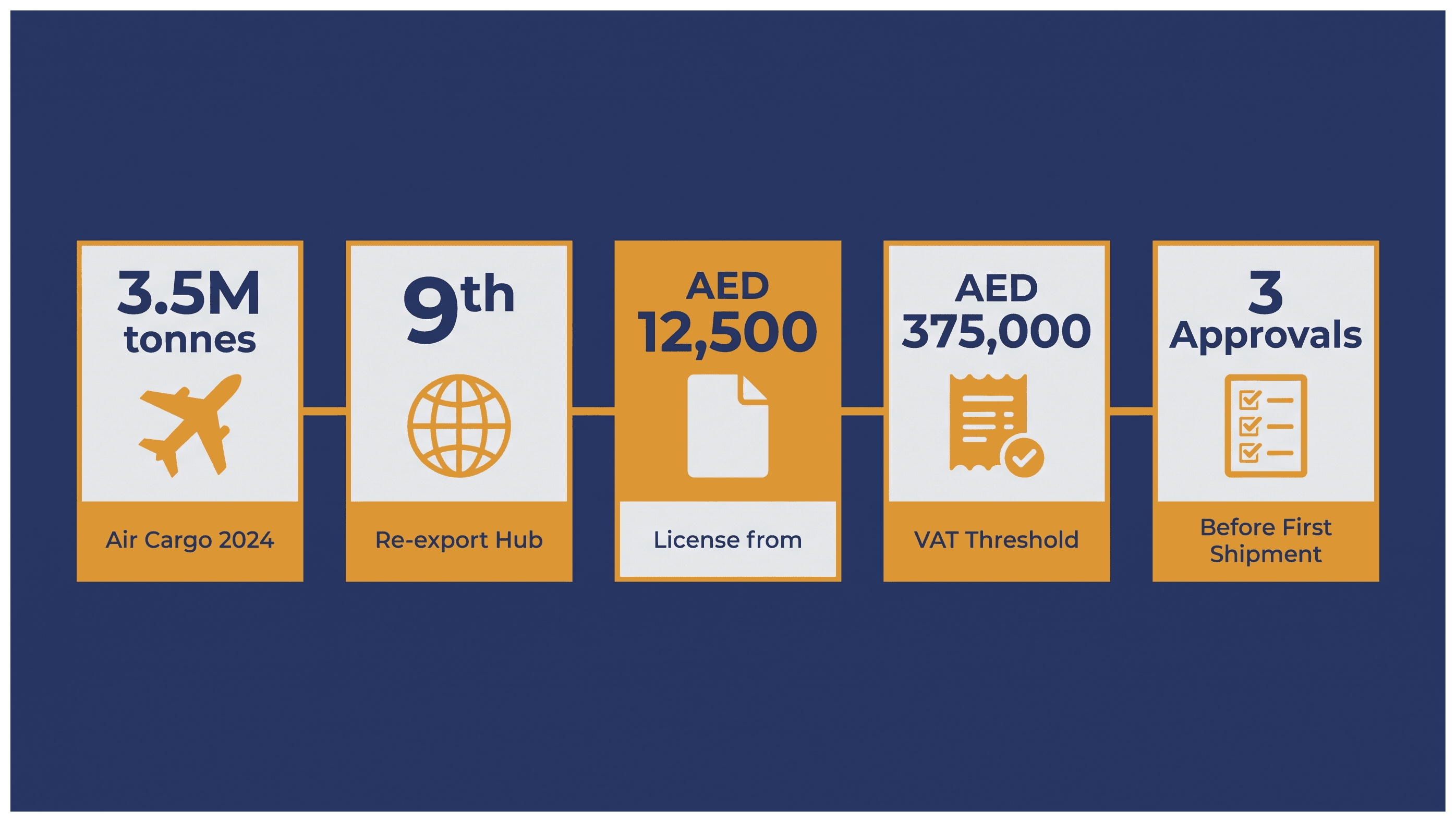
Dubai's airports processed over 3.5 million tonnes of air cargo in 2024 alone (Dubai Airports, 2025). The UAE ranks as the world's 9th largest re-export hub by value (World Bank, 2024). DSBH free zone licenses for cargo handling start at AED 12,500 and are issued in 1 business day. VAT registration becomes mandatory at AED 375,000 in taxable turnover, with a flat AED 10,000 penalty for late registration (Federal Tax Authority, 2025). Three separate regulatory approvals are required before a cargo handling business in Dubai can legally move its first shipment.
This guide covers what a cargo handling business in Dubai actually requires: the regulatory approvals, realistic startup costs, and the step-by-step process to get licensed and operational, so you can move from planning to trading without avoidable delays.
What Is a Cargo Handling Business in Dubai
A cargo handling business in Dubai covers the loading, unloading, packing, and transferring of goods at ports, airports, and logistics hubs. Under ISIC Revision 4 (Class 5224), it sits within Transportation and Storage (Section H). Operators need a trade license, Dubai Customs registration, and sector-specific regulatory approval before handling any shipment. The activity scope on your license is legally binding, it defines what you can invoice and which regulators you must satisfy.
How ISIC Classifies Cargo Handling
ISIC Revision 4 places cargo handling under Section H (Transportation and Storage), Division 52, Group 522, Class 5224 (UN Statistics Division, 2008, still accurate as of 2026). Activities in this class include stevedoring services, freight loading and unloading, and container handling at terminals.
UAE licensing agencies reference this classification when defining permitted activities on a trade license. If your operations span air, sea, and road freight, the principal activity is determined using the top-down value-added method: whichever mode generates the most value added becomes the primary classification. A Dubai-based logistics company managing container unloading at a port terminal would be classified under ISIC 5224 as its principal activity, even if it also provides ancillary warehousing.
What Cargo Handling Activities a Dubai License Covers
Before submitting your application, confirm the exact list of business activities with DSBH. The activity descriptions on the license set the legal boundary of what the company can do and invoice for. Typical permitted activities include:
Loading and unloading of cargo at air, sea, and road terminals
Freight packing, lashing, and securing for domestic and international shipments
Container inspection and inventory management at logistics hubs
Onward dispatch coordination for multi-modal freight
An operator receiving electronics from Asia at Dubai International Airport would need cargo handling activity on the license to legally manage unloading, inspection, and onward dispatch. Missing this activity description means the company can't bill for that work, and that's an expensive amendment to fix after the fact.
Regulatory Requirements for a Cargo Handling Business in Dubai
A cargo handling business in Dubai requires a free zone trade license, Dubai Customs registration via Dubai Trade, and approval from the GCAA for air cargo or the RTA for road freight operations. Each regulator governs a specific part of the activity. The trade license alone is not sufficient to begin operations, that's the most common misconception operators bring to their first setup meeting.
Trade License From a Free Zone
DSBH Free Zone licenses the cargo handling activity. Once your documents are complete and payment is received, the license is issued in one business day. That speed matters: it lets you move straight to Customs and sector authority registration without sitting in a queue.
Worth flagging: DSBH is not a designated zone, so goods moving through DSBH are not automatically bonded. Free zone status means goods within the zone are duty-suspended, not duty-exempt. Import duty applies the moment goods cross into the UAE mainland. The license must list the correct ISIC-aligned activity descriptions to satisfy downstream regulatory checks from the GCAA, RTA, or port authorities.
Dubai Customs and Dubai Trade Registration
All cargo handling operators must register with Dubai Customs through the Dubai Trade portal before moving any commercial shipment. Key obligations include:
Linking the trade license to import/export declarations via a Customs client code
Accurate cargo manifests and proper HS code classification for every shipment
Declared values that match commercial invoices, discrepancies trigger holds
Ongoing compliance; non-compliance can result in cargo holds, financial penalties, or license suspension
A newly licensed cargo handling company would apply for a Customs client code on Dubai Trade immediately after receiving the DSBH trade license, so it can clear its first shipment without delay.
Sector Authority Approvals: GCAA and RTA
Air cargo handling at Dubai International Airport or Al Maktoum International requires GCAA (General Civil Aviation Authority) approval, DSBH licenses the activity, and the GCAA approves it separately
Road freight and ground transport-linked handling operations require RTA (Roads and Transport Authority) approval in addition to the trade license
Sea freight handlers working with port terminals operate under port authority frameworks; confirm the relevant authority based on the specific terminal
Operators spanning more than one transport mode need approvals from each relevant authority, there's no single combined approval
A cargo handler managing both air freight unloading at Al Maktoum International and road distribution would need both GCAA and RTA approvals alongside the DSBH trade license. That's three separate approvals before the first shipment moves.
Is a free zone license enough to start cargo handling operations in Dubai?
No. A free zone trade license from DSBH is the first of three required approvals. You also need a Dubai Customs client code obtained through the Dubai Trade portal, plus sector authority approval from the GCAA for air cargo or the RTA for road freight. All three must be in place before handling commercial shipments.
DSBH Free Zone License Packages for Cargo Handling
Package | Price | What Is Included |
|---|---|---|
0 Visa Package | AED 12,500 | License, Articles of Association, share register, flexi-desk space, lease agreement |
1 Visa Package | AED 16,350 | All above, plus one visa allocation (investor or partner visa) and establishment card |
2 Visa Package | AED 18,200 | All above, plus two visa allocations and establishment card (maximum allocation available) |
Visa Processing | Quoted separately | Entry permit, status change, medical, Emirates ID, applies to all packages |
License Issuance Timeline | 1 business day | Applies to all packages once documents are complete and payment is received |
Costs of Running a Cargo Handling Business in Dubai
Startup costs for a cargo handling business in Dubai begin at AED 12,500 for the DSBH 0 Visa Package, which includes the license, Articles of Association, share register, flexi-desk space. VAT registration applies above AED 375,000 in taxable turnover, and late registration carries a flat AED 10,000 penalty. Use the business setup cost calculator to get a precise figure before committing.
DSBH Free Zone License Packages
0 Visa Package, AED 12,500: License, Articles of Association, share register, flexi-desk space, and lease agreement. Suited to operators who don't need UAE residency through the company.
1 Visa Package, AED 16,350: Everything above, plus one visa allocation (investor or partner visa) and establishment card.
2 Visa Package, AED 18,200: Everything above, plus two visa allocations and establishment card. This is the maximum allocation available at DSBH.
Visa processing costs (entry permit, status change, medical, Emirates ID) are quoted separately for all packages.
A sole founder setting up a cargo handling company at DSBH with one partner would select the 2 Visa Package at AED 18,200, then budget separately for visa processing for both individuals.
Tax Obligations and Registration Thresholds
VAT registration is mandatory once taxable turnover reaches AED 375,000. Miss the registration date and the Federal Tax Authority applies a flat AED 10,000 penalty, regardless of how much you're over the threshold. A cargo handling operator billing AED 500,000 in its first year must register immediately; there's no grace period based on the excess amount.
Corporate tax registration is required for all UAE businesses, with a one-time flat AED 10,000 penalty for late registration. Qualifying Free Zone Person (QFZP) status can apply a 0% corporate tax rate, but only if the business meets all four QFZP conditions: adequate substance, qualifying income, no mainland election, and compliant transfer pricing. Don't assume 0% without confirming all four conditions with a qualified tax adviser.
How to Set Up a Cargo Handling Business in Dubai: Step-by-Step
Setting up a cargo handling business in Dubai takes six steps: select your business activities, choose a company name, apply for a DSBH free zone license, register with Dubai Customs, obtain sector authority approval from the GCAA or RTA, then open a corporate bank account. The license is issued in one business day, the rest of the timeline depends on how quickly you move through Customs and sector authority registration. This cargo handling dubai guide covers each step in sequence.
Step 1: Define Your Business Activities and Structure
Identify whether your operations cover air, sea, road, or multi-modal cargo handling, this determines which sector approvals you need before you can operate
Select the correct activity descriptions from the DSBH business activities list; activity scope is legally binding and limits what you can invoice for
Decide on your ownership structure: sole shareholder, two shareholders, or a corporate shareholder
Check company name availability before proceeding, the name must comply with UAE naming rules and not duplicate an existing registration
An operator planning to handle air freight exclusively would select air cargo handling as the primary activity and confirm GCAA approval is required before submitting the license application, not after.
Step 2: Apply for the DSBH Free Zone License
Submit the license application to Dubai South Business Hub Free Zone with required documents: passport copies, No Objection Certificate if applicable, and completed application forms
Select the appropriate visa package (0, 1, or 2 Visa Package) depending on how many founders require UAE residency
The license is issued in one business day once the application is complete and payment is received
The package includes the license, Articles of Association, share register, flexi-desk space
A two-founder cargo handling company would submit documents for the 2 Visa Package at AED 18,200 and receive the trade license the following business day, then move straight to Step 3.
Step 3: Complete Regulatory and Customs Registrations
Register with Dubai Customs through the Dubai Trade portal using the issued trade license, obtain your Customs client code before attempting to move any shipment
Apply for GCAA approval if handling air cargo, or RTA approval for road freight, DSBH licenses the activity and the named regulator approves it separately
Register for VAT with the Federal Tax Authority if you expect to exceed AED 375,000 in taxable turnover within 12 months
Open a UAE corporate bank account, most banks require the trade license, Customs registration, and proof of address before processing the application
After receiving the DSBH license, a cargo handler targeting airport contracts would submit the GCAA application in parallel with the Dubai Trade Customs registration to avoid operational delays. Running these in parallel, not sequentially, is the practical approach most experienced operators use.
What documents do I need to apply for a cargo handling license at DSBH?
You'll need passport copies for all shareholders, a completed DSBH application form, and a No Objection Certificate if any shareholder holds an existing UAE residency visa. The specific document checklist may vary by ownership structure, so confirm the exact requirements with DSBH before submitting.
Operating Your Cargo Handling Business in Dubai: What Comes Next
Once licensed, a cargo handling business in Dubai must maintain active Customs compliance, renew the trade license annually, and meet ongoing GCAA or RTA conditions. VAT returns are filed quarterly, and corporate tax registration must be completed regardless of whether tax is payable. Residency visa holders must also renew Emirates IDs on schedule.
Ongoing Compliance and License Renewal
DSBH trade licenses are renewed annually. Set a renewal reminder at least 30 days before expiry, a lapsed license means you can't legally trade, and clients won't wait. Customs client codes and sector authority approvals (GCAA, RTA) have their own renewal cycles; confirm the timelines with each authority at registration, not when the renewal notice arrives.
Any change to business activities, ownership, or company name requires a license amendment before the change takes effect. Keep financial records for at least five years to meet UAE corporate tax and VAT audit requirements. A cargo handling operator whose GCAA approval lapses mid-contract can't legally handle air freight until the renewal processes, and that gap can mean client penalties and reputational damage that far outweigh the cost of staying on top of renewal dates.
Staffing, Visas, and Employment Obligations
DSBH packages allow up to six visa allocations, with published packages offering 0, 1 or 2; additional employee visas are processed through UAE residency services separately from the package
All employees must be registered with MoHRE (Ministry of Human Resources and Emiratisation) and covered under the Wages Protection System
References
Frequently Asked Questions