
Topic Summary
Confirm the Trade License Is Active
A legitimate Dubai company holds a current trade license issued by DET for mainland entities or the relevant free zone authority. You can verify license status through official public portals at no cost, so there is no excuse to skip this step.
Match Licensed Activities to Services Offered
A company's licensed activities must align with what it is actually selling or providing. A logistics firm quoting for regulated customs clearance under a general trading license is operating outside its permitted scope, which is a serious red flag.
Verify the Registered Address Is Real
A P.O. box alone does not satisfy address requirements for most licensed activities in Dubai. The registered address should trace to a verifiable physical or flexi-desk location.
Check Ultimate Beneficial Owner Disclosure
UAE Cabinet Decision No. 58 of 2020 requires all onshore and free zone companies to disclose beneficial owners holding 25% or more ownership or control. An ownership chain that leads nowhere is a significant legitimacy concern.
Understand the Legal Risk of Unlicensed Counterparties
Contracting with an unlicensed or struck-off entity can void your agreement under Federal Decree-Law No. 32 of 2021, leaving you with no civil recourse. Funds transferred to such a company carry real recovery risk, as one founder discovered after a counterparty's license lapsed unnoticed.
Gather Key Details Before Opening Any Portal
You need the company's full legal name, trade license number, and issuing authority before running any verification. Having these three details ready lets you cross-reference both the issuing authority's portal and the UAE Ministry of Economy's business registry efficiently.
Know That Your Own Business Can Be Affected
UAE banks scrutinise the legitimacy of your commercial counterparties during account reviews, meaning poor due diligence can put your own banking relationship at risk. In regulated sectors, you may even face joint liability for dealings with improperly licensed entities.
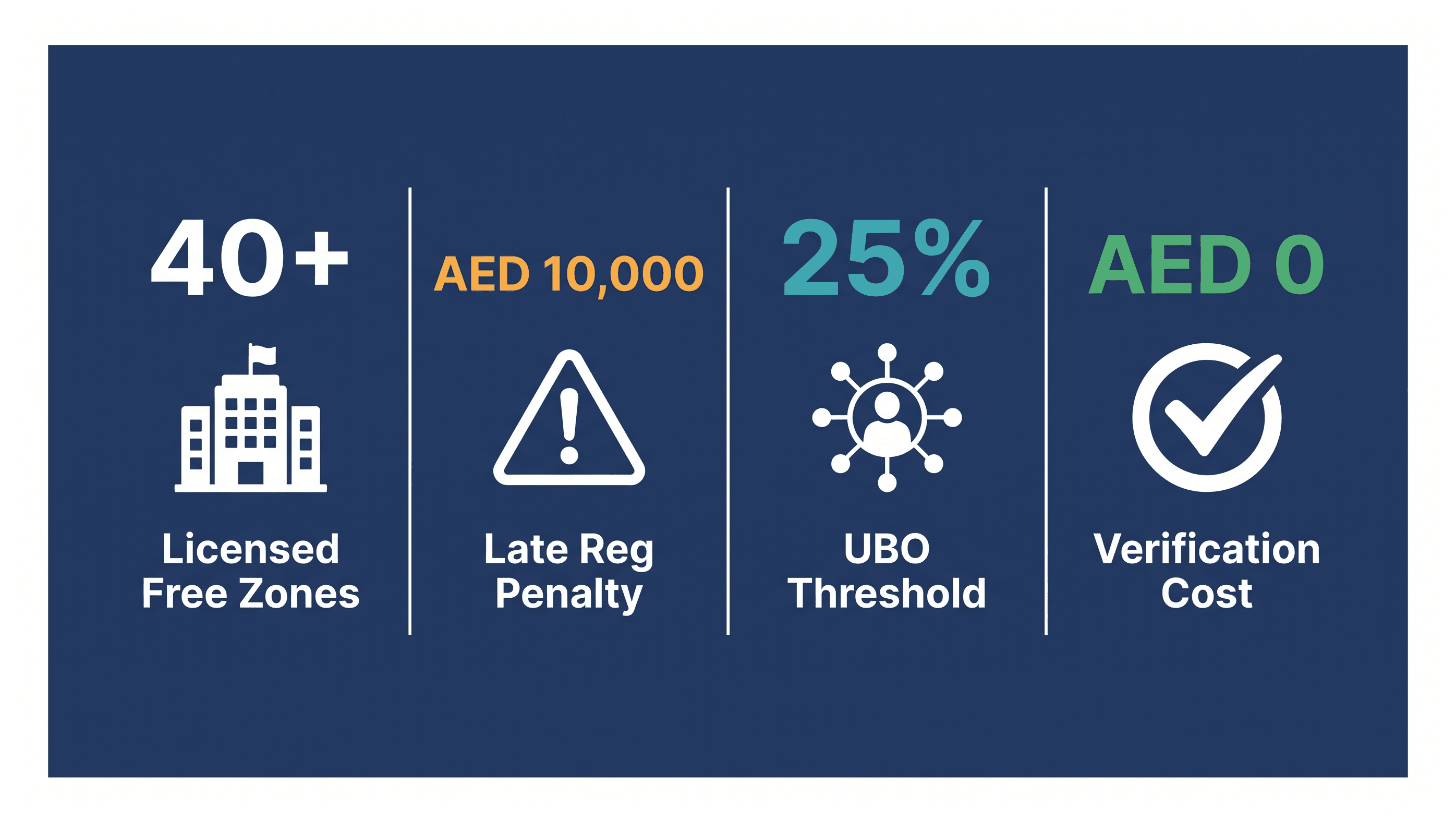
In 2026, the UAE hosts more than 40 licensed free zones and hundreds of thousands of registered companies across mainland and free zone jurisdictions (Dubai Chamber of Commerce, 2025). That density creates genuine commercial opportunity. It also creates cover for entities that are not what they claim to be. The UAE Commercial Companies Law (Federal Decree-Law No. 32 of 2021) governs contract validity, and an expired or wrongly licensed counterparty can leave you with no civil recourse. The VAT late registration penalty is a flat AED 10,000. The corporate tax late registration penalty is also AED 10,000. The UBO disclosure threshold under Cabinet Decision No. 58 of 2020 is 25% ownership or control. And checking if a Dubai company is legitimate through official portals costs exactly zero dirhams.
This guide walks first-time founders through the requirements, costs, and step-by-step process for checking if a Dubai company is legitimate, covering license verification, trade license number checks, UBO transparency, and the warning signs to watch for before you sign a contract or transfer funds.
What Checking If a Dubai Company Is Legitimate Actually Means
Checking if a Dubai company is legitimate means confirming its trade license is active, its licensed activities match the services it offers, its registered address is real, and its beneficial owners are disclosed. A legitimate Dubai company holds a valid license issued by DET or a recognised free zone authority and appears in official public registers.
The Four Pillars of Company Legitimacy in Dubai
When you are checking if a company in Dubai is operating correctly, four elements matter most:
A valid, active trade license. DET issues mainland trade licenses; free zone authorities issue their own equivalent documents. Both must be current.
Licensed activities that match the service offered. A logistics company presenting a trade license listing only "general trading" but quoting for regulated customs clearance services is operating outside its licensed scope, a clear legitimacy gap.
A verifiable registered address. A P.O. box alone is insufficient for most licensed activities. The address must be traceable to a real physical or flexi-desk location.
Disclosed ultimate beneficial owners. UAE Cabinet Decision No. 58 of 2020 mandates UBO disclosure for all onshore and free zone companies. If the ownership chain leads nowhere, that is a problem.
Why This Matters Before You Sign Anything
Contracting with an unlicensed or wrongly licensed entity can void the agreement under UAE law. Federal Decree-Law No. 32 of 2021 ties contract validity to the legal standing of the parties, and a company struck off the DET register is not a legal party to anything.
Funds transferred to a company not registered for the stated activity carry real recovery risk. One founder paid a deposit to a counterparty whose license had lapsed three months earlier. By the time the dispute arose, the registration had been struck off the DET register, leaving no civil avenue for recovery.
There is a reputational dimension too. UAE banks scrutinise counterparty legitimacy during bank account opening in UAE, and your own account relationship can be affected by the quality of your commercial counterparties. In regulated sectors, regulators can hold the contracting party jointly liable. Checking if a company in Dubai is legitimate is not optional due diligence, it is basic commercial hygiene.
Requirements for Checking If a Dubai Company Is Legitimate
To check if a Dubai company is legitimate, you need the company's trade license number, its registered legal name, and the name of its issuing authority, either DET or a specific free zone. With those three details you can run a verification against the issuing authority's public portal and cross-reference the UAE Ministry of Economy's business registry.
Information You Need Before You Start
Gather these four items before you open any portal:
Full legal name, exactly as it appears on the license document, including any "LLC", "FZE", or "FZCO" suffix.
Trade license number, a unique identifier printed on every UAE trade license, typically in the top-right corner of the document. When a supplier hands you a PDF, that number is your starting point for the DET portal check.
Issuing authority, DET for Dubai mainland entities; the specific free zone authority for free zone entities. Free zone licenses are not issued by DET.
License expiry date, a legitimate counterparty supplies this without hesitation. If they resist, that itself is a signal.
Dubai Company Verification: Four Checks at a Glance
Verification Check | Where to Do It | What to Confirm |
|---|---|---|
Trade license number and status | DET portal (mainland) or the relevant free zone authority's verification page | License is active (not expired, cancelled, or suspended); legal name matches the document supplied |
Licensed activities vs. services offered | Same portal as above; activities are listed on the license face | The specific activity covering the service being procured appears on the license, not just a broad parent category |
UBO register and ownership disclosure | UAE Ministry of Economy business registry; UBO declaration requested directly from counterparty | At least one natural person identified as UBO with 25% or more ownership or control; register is current |
VAT / TRN registration status | Federal Tax Authority portal, TRN verification tool | TRN exists and is active; mandatory if annual turnover exceeds AED 375,000 |
Corporate tax registration status | Federal Tax Authority portal, corporate tax registration check | All UAE juridical persons must be registered; late registration carries a one-time AED 10,000 flat penalty |
Documents a Legitimate Company Should Provide on Request
A counterparty operating correctly will not hesitate to share the following. If they do hesitate, note what is missing:
Current trade license, not expired, with the correct business activities in Dubai listed for the service being procured.
Certificate of incorporation or Articles of Association, confirms the legal structure and founding shareholders.
Share register, shows current shareholders and their percentages.
UBO declaration or register extract, mandatory under Cabinet Decision No. 58 of 2020. Refusal to share this is a material warning sign.
VAT registration certificate, required if the company is VAT-registered. The threshold is AED 375,000 annual turnover. A company that avoided registration despite exceeding that threshold carries a flat AED 10,000 late-registration penalty, and may have compliance gaps elsewhere.
Is it free to check a Dubai company's trade license?
Yes. Checking a Dubai company's trade license through the DET portal, the UAE Ministry of Economy registry, or the Federal Tax Authority's TRN verification tool is free. You need only a browser and the company's trade license number. All four key government verification portals offer public searches at no charge.
Step-by-Step Guide to Checking If a Company in Dubai Is Legitimate
To verify a Dubai company: obtain the trade license number, search it on the DET portal or the relevant free zone authority portal, confirm the license is active and the listed activities match the services offered, check UBO records via the Ministry of Economy, and review the company's VAT registration status on the Federal Tax Authority portal.
Step 1: Run a Trade License Number Check
Go to the DET portal and enter the trade license number in the business search tool. For free zone entities, go to the issuing free zone authority's verification page directly.
Confirm the legal name on the portal matches the name on the document supplied to you. Any discrepancy warrants clarification before you proceed.
Check the license status. Options typically include: active, expired, cancelled, or suspended. An expired license is not a minor administrative matter, it means the company is not currently authorised to trade.
One founder verifying a potential distributor found the DET portal showed the license as "under renewal" for four months. That prompted a payment hold until reinstatement was confirmed. A cautious call that proved correct.
Step 2: Confirm Licensed Activities Match the Service Offered
Every UAE trade license specifies the exact activities a company is authorised to conduct. These are drawn from a standardised list of business activities in Dubai, aligned with ISIC Rev.4 classification codes at the activity level.
A company offering financial advisory services must hold an activity covering financial services, not merely "management consultancy". The gap between those two categories is legally significant.
A tech startup once engaged a "consulting company" for software development, only to discover the vendor's license listed management consulting only, not IT services. The contract was legally ambiguous as a result.
Request written confirmation of which specific licensed activity covers the service being procured. A single license can hold multiple activities, so the absence of the right one is not always obvious at first glance.
Step 3: Check UBO Records and Ownership Transparency
The UAE introduced mandatory UBO disclosure under Cabinet Decision No. 58 of 2020. All companies must maintain a UBO register identifying natural persons who own or control 25% or more.
Request the UBO declaration from the counterparty directly. Legitimate companies maintain this as standard and produce it without resistance.
Cross-reference director and shareholder names against the UAE Ministry of Economy business registry where available.
One founder discovered a supplier's UBO register listed a nominee company in a third jurisdiction as the sole shareholder, with no natural person identified. That structure is inconsistent with UAE UBO rules, and it was a clear signal to walk away.
Step 4: Verify VAT and Tax Registration Status
A company charging VAT must hold a valid VAT registration certificate from the Federal Tax Authority. Request the TRN (Tax Registration Number) and verify it on the Federal Tax Authority portal.
A company above the AED 375,000 annual turnover threshold that is not VAT-registered has a compliance gap, and a flat AED 10,000 late registration penalty on record.
Corporate tax registration is now mandatory for all UAE juridical persons. Late registration carries a one-time flat AED 10,000 penalty. A company missing either registration is telling you something about its compliance culture.
One distributor quoted VAT-inclusive prices but could not produce a TRN. The Federal Tax Authority portal confirmed no registration existed, meaning VAT charged was not being remitted to the authority. That is not a minor oversight.
How to Verify a Trade License in Dubai: Costs Involved
Checking a Dubai trade license through official government portals is free. Costs arise only if you engage a professional due-diligence firm to produce a formal counterparty report. Government portal searches require only a browser and the company's trade license number.
What Government Portal Verification Costs
DET trade license search: no fee, publicly accessible.
UAE Ministry of Economy business registry search: no fee for basic status checks.
Federal Tax Authority TRN verification: no fee.
Free zone authority portals: most provide public license status searches at no charge.
A founder completing pre-contract due diligence on three counterparties spent zero dirhams on government portal checks and completed all four verification steps in under 30 minutes. That is the baseline. You should clear it before any commercial engagement.
When Professional Due Diligence Is Worth the Investment
For high-value contracts, typically above AED 500,000, a paid counterparty report from a licensed due-diligence provider is a sensible addition. Regulated sectors including financial services, healthcare, and real estate carry higher compliance stakes that the public portals simply cannot cover. A professional report reaches court records, litigation history, and credit standing: information that no government portal surfaces.
A regional distributor committing to a three-year exclusivity agreement commissioned a paid counterparty report that revealed an ongoing commercial court case against the supplier. That information was invisible on every public portal. The cost of the report was a fraction of the exposure it prevented.
Budget any due-diligence cost as part of your business setup cost in Dubai planning, not as an afterthought. UNVERIFIED: <AED range for professional counterparty due-diligence reports in UAE> Confirm before publishing.
UBO Transparency and Ownership Records in the UAE
The UAE's UBO framework, introduced under Cabinet Decision No. 58 of 2020, requires every company to maintain a register of natural persons who ultimately own or control 25% or more of the entity. This register must be held at the company's registered address and submitted to the relevant licensing authority on request.
What the UAE UBO Register Must Contain
Full legal name of each beneficial owner.
Nationality and date of birth.
Nature and extent of ownership or control, direct or indirect.
Date on which the individual became, or ceased to be, a beneficial owner.
The 25% threshold triggers mandatory disclosure. Control through voting rights or board appointment also triggers it, even without a direct equity stake.
A company with four equal shareholders, each holding 25%, must register all four as UBOs, not just the managing director. That is a common misunderstanding, and one that creates a compliance gap.
Red Flags in Ownership Structures
No identifiable natural person as UBO, only corporate shareholders with no further disclosure chain.
UBO register that is more than 12 months out of date.
Nominee directors with no operational role and no beneficial ownership declared.
Ownership structure passing through multiple offshore jurisdictions with limited transparency standards.
A counterparty whose share register showed a single corporate shareholder registered in a low-transparency jurisdiction, with no natural person UBO declared, failed basic due diligence despite holding a valid UAE trade license. The UAE is a Financial Action Task Force (FATF) member and has committed to beneficial ownership transparency standards. Non-compliance with UBO rules can result in license suspension (u.ae, 2024).
Warning Signs in a Dubai Counterparty
Warning signs in a Dubai counterparty include an expired or unverifiable trade license, licensed activities that do not cover the service being sold, refusal to provide a UBO declaration, an unregistered physical address, pressure to pay in cash or to an account in a different company name, and VAT charged without a valid TRN
References
Frequently Asked Questions