Topic Summary
Certificate of Conformity Is Your Customs Gateway
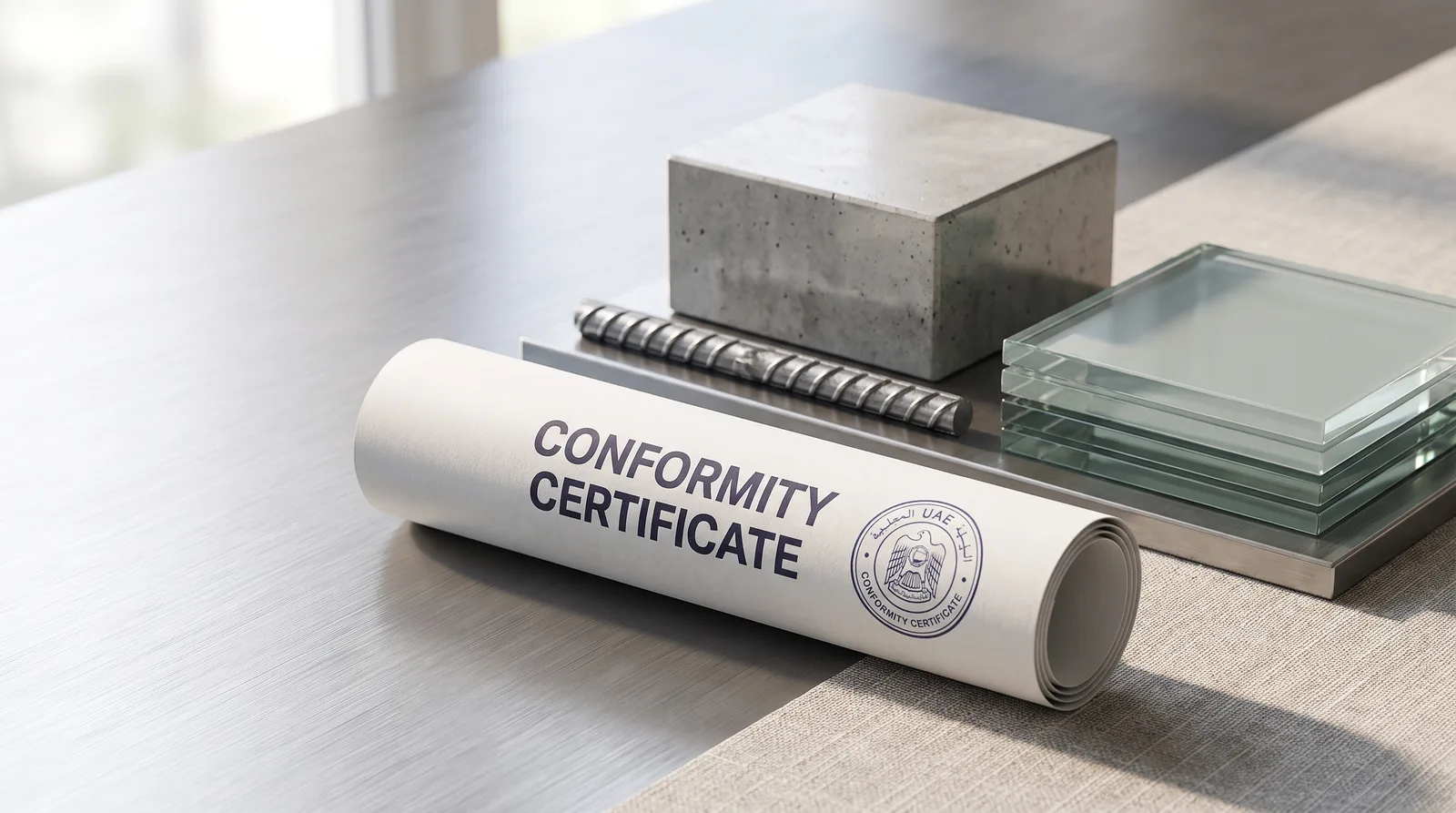
A Certificate of Conformity (CoC) issued by an MoIAT-accredited body is the primary document required before building materials can clear UAE customs. It is typically valid for 12 months and is invalidated by any change to the manufacturing site, product formulation, or if applied to a batch outside its original scope.
MoIAT Sets the Federal Standard for All Materials
The Ministry of Industry and Advanced Technology, established under Federal Law No. 28 of 2001, sits at the top of the UAE conformity hierarchy for building materials. It defines the technical standards that imported products must meet before entering the supply chain.
Dubai Municipality Adds an Emirate-Level Layer
Beyond federal MoIAT requirements, Dubai Municipality enforces conformity through its Building Materials Approval System. Materials used on Dubai infrastructure projects often need both an MoIAT Certificate of Conformity and a Dubai Municipality material approval number.
Foreign Marks Like CE and UL Are Not Enough
CE marks, UL listings, BS Kitemarks, and DIN marks are not automatically accepted by MoIAT as proof of conformity. Importers must obtain either a UAE National Conformity Mark (ECAS) or a test report from an MoIAT-accredited third-party laboratory to clear customs.
GSO Marks Offer the Fastest Path to MoIAT Acceptance
The UAE aligns its standards with Gulf Standards Organization (GSO) frameworks, and MoIAT recognizes GSO marks as equivalent conformity evidence for Gulf-harmonized standards. For suppliers already holding a GSO mark, this is typically the quickest route to UAE market access.
Accredited Lab Reports Underpin Every Certificate
An ENAS-accredited or ILAC mutual recognition body test report is the technical foundation behind any valid CoC. The report is invalidated if the lab's accreditation lapses, if it was issued for a different product variant, or if the relevant standard has been revised since the report was produced.
Pre-Shipment Verification Eliminates Costly Port Holds
Shipments that arrive without complete conformity documentation are held or returned at the importer's expense. Building a pre-shipment document verification step into your procurement process is the single most effective way to avoid port delays and associated costs.
The UAE construction sector generates over AED 200 billion in annual project value (UNVERIFIED: <figure>, Confirm before publishing), with imported building materials forming a critical share of that supply chain. Every regulated material in that pipeline requires conformity certificates for building UAE customs clearance before a single pallet moves. Miss one document, and your shipment sits at port, at your cost. This guide walks you through the conformity certificates UAE checklist for building materials: what each document is, who issues it, what it is used for, and exactly what invalidates it, so your shipments clear on time.
What Are Conformity Certificates for Building Materials in the UAE
Conformity certificates for building materials in the UAE are mandatory documents confirming that a product meets UAE technical standards set by MoIAT or a sector regulator. They are required before customs clearance and cover one product category per certificate. Without them, shipments are held or returned at the importer's cost.
The Regulatory Framework Behind the Requirement
MoIAT (the Ministry of Industry and Advanced Technology) is the primary federal authority setting UAE technical standards for building materials. It was established under Federal Law No. 28 of 2001 and sits at the top of the conformity hierarchy for most product categories.
Dubai Municipality enforces conformity at the emirate level through its Building Materials Approval System. Some materials fall under dual regulation: MoIAT sets the product standard, while a sector body approves the specific application. Fire-rated panels, electrical conduit, and pressure pipe all work this way.
The UAE aligns its standards with ISO and Gulf Standards Organization (GSO) frameworks. A GSO mark is often the fastest route to MoIAT acceptance because GSO marks are recognized by MoIAT as equivalent conformity evidence for Gulf-harmonized standards (UAE Ministry of Economy, 2025).
A practical example: a shipment of HDPE water supply pipes must carry both an MoIAT Certificate of Conformity referencing the relevant GSO standard and a Dubai Municipality material approval number before a contractor can use them on a Dubai infrastructure project.
Why Traders Cannot Rely on Country-of-Origin Certifications
CE marks, UL listings, and national marks from exporting countries are not automatically accepted by MoIAT. You need either a UAE National Conformity Mark (ECAS) or a test report from an MoIAT-accredited third-party laboratory. These are not equivalent to foreign marks, they are separate requirements.
Common foreign marks that are insufficient on their own:
CE mark (European conformity)
UL listing (Underwriters Laboratories, USA)
BS Kitemark (British Standards)
DIN mark (German Institute for Standardization)
A European steel supplier holding a CE mark for structural sections still needs an MoIAT-recognized test report from an accredited body before the bars can enter a UAE construction site. Traders who ship on foreign certifications alone routinely face port holds while supplementary documentation is gathered. Building a pre-shipment verification step into your procurement process eliminates this delay entirely.
UAE Conformity Certificate Checklist: At a Glance
Document | Issued By | Used For / What Invalidates It |
|---|---|---|
Certificate of Conformity (CoC) | MoIAT-accredited conformity assessment body, or MoIAT directly for ECAS-registered products | Primary proof at customs. Invalidated by: expiry (typically 12 months), change to manufacturing site or formulation, or use for a product batch outside the original scope |
Accredited Laboratory Test Report | ENAS-accredited laboratory or ILAC mutual recognition body (covers 100+ economies) | Technical evidence underpinning the CoC. Invalidated by: lapsed lab accreditation, report issued for a different product variant, or standard revision post-dating the report |
Declaration of Conformity (DoC) | Manufacturer, on company letterhead, signed by an authorized representative | Self-declaration supplementing the CoC. Invalidated by: signatory no longer authorized, undated document, or obsolete standard reference |
Dubai Civil Defence Product Approval | Dubai Civil Defence | Required for fire-rated boards, fire-stopping materials, and sprinkler components. Separate from the MoIAT CoC; operates on its own approval register |
Dubai Municipality BMA Number | Dubai Municipality Building Materials Approval System | Required for structural and finishing materials used in permitted construction projects. Invalidated by change of product specification or manufacturing source |
The Conformity Certificates UAE Checklist: Document by Document

The conformity certificates UAE checklist for building materials includes a Certificate of Conformity, an accredited laboratory test report, a manufacturer's Declaration of Conformity, and where applicable a sector-specific approval. Each document is product-specific. A missing or expired version of any one item is sufficient to trigger a customs hold.
Certificate of Conformity (CoC)
Issued by: An MoIAT-accredited conformity assessment body, or MoIAT directly for ECAS-registered products.
Used for: Primary proof at customs that the product meets the applicable UAE or GSO technical standard. The CoC must cite the specific standard number, a generic "meets all UAE requirements" statement is not accepted by Dubai Trade or Abu Dhabi Customs.
What invalidates it: Expiry of the certificate period (typically 12 months); any change to product formulation, manufacturing site, or production process; use for a batch outside the original scope; or presenting a CoC for a different product category than the actual goods.
Real scenario: a trader importing 500 tonnes of Portland cement in March presents a CoC issued in February of the prior year. Because the certificate has passed its 12-month validity, customs holds the shipment until a fresh CoC is obtained. That delay is entirely avoidable with a renewal calendar.
Accredited Laboratory Test Report
Issued by: A laboratory accredited by the Emirates National Accreditation System (ENAS), or by a recognized foreign accreditation body accepted under ILAC mutual recognition (which covers laboratories in over 100 economies).
Used for: Technical evidence that the product sample tested meets the mechanical, chemical, or performance parameters of the relevant standard. The CoC is built on this report, without it, the CoC has no foundation.
What invalidates it: The report was issued for a different product variant or grade; the testing laboratory's accreditation has lapsed; the report pre-dates a standard revision that changed the acceptance thresholds; or the test sample was not representative of the imported batch.
An importer of ceramic floor tiles submitted a test report from a laboratory whose ENAS accreditation had expired three months prior. Dubai Municipality rejected the report and required retesting by a currently accredited facility. You can verify any laboratory's accreditation status on the ENAS public registry before you commission testing.
Declaration of Conformity (DoC)
Issued by: The manufacturer, on company letterhead, signed by an authorized representative (typically a technical director or quality manager, not a sales contact).
Used for: A self-declaration that the product as manufactured meets the referenced standard. It supplements the third-party CoC and test report; it does not replace them.
What invalidates it: The signatory no longer holds authority at the manufacturing company; the document is undated or references an obsolete standard version; or the declaration covers a product model range but the imported batch contains a variant outside that range.
Worth flagging: many UAE customs authorities now require the DoC to be notarized and attested by the UAE embassy in the country of manufacture. A Chinese manufacturer's DoC signed by a sales manager rather than a technical director was rejected at Jebel Ali port. The consignee had to obtain a replacement DoC from the factory's engineering director before clearance was granted.
Sector-Specific Approvals for Regulated Material Categories
Certain building material categories need an additional approval layer beyond the core CoC, test report, and DoC. The license covers your trading activity; the named regulator approves the product separately.
Dubai Civil Defence: Required for fire-rated boards, fire-stopping materials, and sprinkler components.
DEWA: Required for electrical conduit, cable tray, and wiring accessories for installation in Dubai's power network.
Dubai Municipality BMA number: Required for structural and finishing materials used in permitted construction projects.
A company with a trading license in Dubai importing fire-rated gypsum board needs both the MoIAT CoC and a Dubai Civil Defence product approval certificate before a main contractor will accept delivery on a commercial building site. Dubai Civil Defence, DEWA, and Dubai Municipality each operate independent product approval registers, none of them overlap.
Step-by-Step Guide to Obtaining Conformity Certificates for Building Materials in the UAE
Obtaining conformity certificates for building materials in the UAE follows six steps: identify the applicable UAE or GSO standard, engage an MoIAT-accredited testing laboratory, submit product samples for testing, obtain the test report and manufacturer DoC, apply for the Certificate of Conformity through an accredited body, and verify all documents before shipment.
Step 1: Identify the Applicable Standard Before You Order
Search the MoIAT standards catalogue or the GSO portal for the standard number covering your material category. Confirm whether the standard is mandatory (enforced at customs) or voluntary (recommended but not blocked at the border). Check whether a Dubai Municipality BMA number is also required for your specific product end-use.
Identifying the correct standard before placing the purchase order is the single highest-value step in the process. Discovering a documentation gap after the goods have shipped means re-testing, re-certification, and potential storage charges, all avoidable with a 30-minute standard check upfront.
Step 2: Engage an Accredited Laboratory and Submit Samples
Select a laboratory accredited by ENAS or an ILAC-recognized foreign body for the specific test scope your standard requires.
Submit representative product samples from the same production batch intended for export, not marketing samples or pre-production prototypes.
Allow 10 to 25 working days for testing, depending on the material category and laboratory queue (UNVERIFIED: <figure>, Confirm before publishing).
Retain the original test report. Customs may ask for it alongside the CoC at clearance.
Step 3: Apply for the Certificate of Conformity and Prepare the Full Document Set
Submit the test report, manufacturer DoC, product specifications, and packing list to your chosen MoIAT-accredited conformity assessment body. Obtain the CoC and confirm it references the correct standard number and covers the exact product batch being shipped.
Compile the full document set: CoC, test report, DoC, commercial invoice, packing list, and any sector-specific approvals. Then upload everything to Dubai Trade or the relevant emirate customs portal before the vessel arrives. Pre-arrival submission is accepted and actively reduces clearance time.
How to Keep Your Conformity Certificates Valid After Clearance
Conformity certificates for building materials in the UAE are invalidated by expiry, product or supplier changes, and lapsed laboratory accreditation. Traders should calendar renewal 60 days before expiry, re-test if the manufacturer changes any input material, and verify accreditation status of the issuing laboratory before each new shipment.
Common Causes of Certificate Invalidation
Expiry of the 12-month CoC validity period, the most frequent cause of port holds for repeat importers.
Change of manufacturing site, even within the same supplier group, without notifying the conformity assessment body.
Reformulation of the product, a different cement additive ratio, for example, takes the product outside the tested scope.
Lapse of the issuing laboratory's ENAS accreditation, which weakens the evidentiary value of its test reports.
Using a CoC issued for one product grade to clear a shipment of a different grade from the same manufacturer.
A trading company sourcing insulation panels from a factory that relocated its production line to a new facility used the original CoC for three subsequent shipments. Dubai Municipality's site inspection flagged the manufacturing address discrepancy and required full re-certification, a costly and time-consuming outcome that a simple supplier notification would have prevented.
Building a Certificate Renewal Calendar into Your Import Process
Set a calendar reminder 60 days before each CoC expiry to initiate the renewal application. Laboratory slots fill quickly, especially for high-demand material categories.
Maintain a central document register listing every CoC, its standard reference, its expiry date, and the accredited body that issued it.
For high-volume product lines, negotiate a standing testing agreement with an ENAS-accredited laboratory to reduce turnaround time on renewals.
Traders re-exporting to GCC markets should verify that the receiving country accepts MoIAT certificates directly or requires separate local conformity marking.
The business support services at Dubai South Business Hub Free Zone can help you manage document attestation and government transactions alongside your conformity certification process.
What happens if my CoC expires mid-shipment?
If your CoC expires between the date of shipment and the date of customs presentation, the certificate is invalid at clearance. Customs will hold the goods until you obtain a fresh CoC from an MoIAT-accredited body. There is no grace period. The 60-day renewal lead time exists precisely to prevent this scenario.
Setting Up a Building Materials Trading Company in the UAE
A building materials trading company in the UAE requires a trade license and, for any regulated product category, a conformity certificate strategy before the first shipment. A free zone license from AED 12,500 covers the trading activity. Product approvals from MoIAT and relevant sector regulators are obtained separately and must be in place before customs clearance.
License Options and What Each Package Covers
Dubai South Business Hub Free Zone offers three standard packages. Every package includes the license, Articles of Association, share register, flexi-desk space.
0 Visa Package, AED 12,500: Suitable for a sole trader or an overseas company opening a UAE entity without immediate staffing needs.
1 Visa Package, AED 16,350: Adds a visa allocation (investor or partner visa) and establishment card.
2 Visa Package, AED 18,200: Covers up to two visa allocations with the establishment card.
Visa processing (entry permit, status change, medical, Emirates ID) is quoted separately from the package price. The license is issued in one business day. A sole founder importing construction adhesives and sealants can start a business in Dubai on the 0 Visa Package at AED 12,500 and add a visa allocation later when headcount grows.
Note: Dubai South Business Hub Free Zone is not a designated zone. Goods stored in the free zone are duty-suspended, customs duty applies when goods enter the UAE mainland. DSBH does not provide bonded warehousing.
References
Frequently Asked Questions