
Topic Summary
Know the Law Governing UAE Content Licensing
UAE Federal Law No. 7 of 2002 on Copyrights and Neighboring Rights is the primary statute covering content licensing across literary works, software, audiovisual content, and more. Copyright protection arises automatically at creation, but registering with the Ministry of Economy creates a dated record that is invaluable in disputes.
Understand Which Content Types Are Covered
UAE licensing law covers a broader range than most founders expect, including written content, software, photography, video, animations, branded assets, and music under neighboring rights provisions. Getting clarity on your content category upfront determines how your license agreement must be structured.
Secure a Trade License Before Operating
You must hold a valid trade license that explicitly lists content licensing as a permitted activity before entering licensing agreements commercially. A DSBH Free Zone license covering content licensing activities starts at AED 12,500.
Register for VAT at the Right Threshold
VAT at 5% applies once your annual turnover exceeds AED 375,000, and failing to register on time triggers a one-time AED 10,000 penalty. Corporate tax late registration carries a separate one-time AED 10,000 flat penalty, so tracking both thresholds independently is essential.
Draft License Agreements With Precise Terms
Every content license agreement must specify territory, duration, exclusivity, and permitted modifications to be enforceable under Federal Law No. 7 of 2002. Missing or ambiguous terms can void the agreement entirely, exposing both parties to civil claims.
Exclusivity Decisions Have Major Commercial Impact
Whether a license is exclusive or non-exclusive directly affects your fee structure and whether the licensee can sub-license the content to third parties downstream. Founders should make this decision deliberately, not as an afterthought, since it shapes the entire commercial relationship.
Structure IP Revenue for Potential 0% Tax Rate
Content licensing revenue can potentially qualify under Qualifying Free Zone Person rules, which may allow a 0% corporate tax rate rather than the standard 9% rate on income above AED 375,000. This requires meeting four specific conditions, so licensing structure should be built into company formation decisions from day one.
The UAE's digital content economy is growing fast, with software, media production, and IP licensing now significant contributors to non-oil GDP, yet a large share of founders launching content-driven businesses in 2026 still operate without a properly structured content licensing usage UAE framework in place. UAE Federal Law No. 7 of 2002 governs copyright and related rights (Ministry of Economy, 2002). A DSBH Free Zone license covering content licensing activities starts at AED 12,500. VAT at 5% applies once turnover exceeds AED 375,000. Late VAT registration carries a one-time AED 10,000 penalty. Corporate tax late registration carries a separate one-time AED 10,000 flat penalty. This guide covers the regulatory requirements, realistic costs, and a clear step-by-step process for structuring content licensing and usage rights correctly in the UAE, so you can operate without exposure to intellectual property or tax penalties.
What Is Content Licensing and Usage Rights in the UAE
Content licensing in the UAE is a legal arrangement under which the holder of intellectual property, such as written content, software, images, or video, grants another party the right to use that content under defined conditions. UAE Federal Law No. 7 of 2002 governs copyright and related rights, administered by the Ministry of Economy.
The Legal Definition Under UAE Federal Law
Federal Law No. 7 of 2002 on Copyrights and Neighboring Rights is the primary statute governing content licensing usage UAE. Copyright protection arises automatically at the point of creation, you don't need to register to own rights. That said, registering with the Ministry of Economy creates an official dated record, which is invaluable if a dispute arises later.
The law covers literary works, software, databases, audiovisual works, photographs, and architectural designs. A Dubai-based SaaS company licensing its dashboard software to a regional distributor, for example, must ensure the license agreement specifies territory, duration, exclusivity, and permitted modifications, all enforceable under Federal Law No. 7 of 2002. Getting those terms wrong isn't just a legal inconvenience; it can void the agreement entirely.
Types of Content Covered by UAE Licensing Law
The scope of content licensing usage UAE is broader than most founders expect. Key categories include:
Written and editorial content: articles, scripts, training materials
Digital and software products: applications, platforms, source code
Visual and audiovisual works: photography, video productions, animations
Brand and marketing assets: logos, campaign creative, branded templates
Music and audio recordings, which fall under neighboring rights provisions of the same law
A media production house in Dubai licensing stock footage to an advertising agency must define whether the grant is exclusive or non-exclusive, that single distinction affects both the fee structure and whether the agency can sub-license the material downstream.
Why Content Licensing Usage UAE Matters for Founders
Unlicensed use of third-party content exposes your business to civil claims and regulatory fines under UAE law
A properly drafted license agreement defines usage scope, protecting both licensor and licensee from ambiguity
Content licensing revenue can be structured to qualify under QFZP rules, subject to four specific conditions, potentially accessing a 0% corporate tax rate rather than the standard 9% rate on income above AED 375,000
Founders building IP-heavy businesses should factor licensing structure into their company formation decisions from day one, not after signing the first client contract
Content Licensing UAE Requirements: What You Need Before You Start
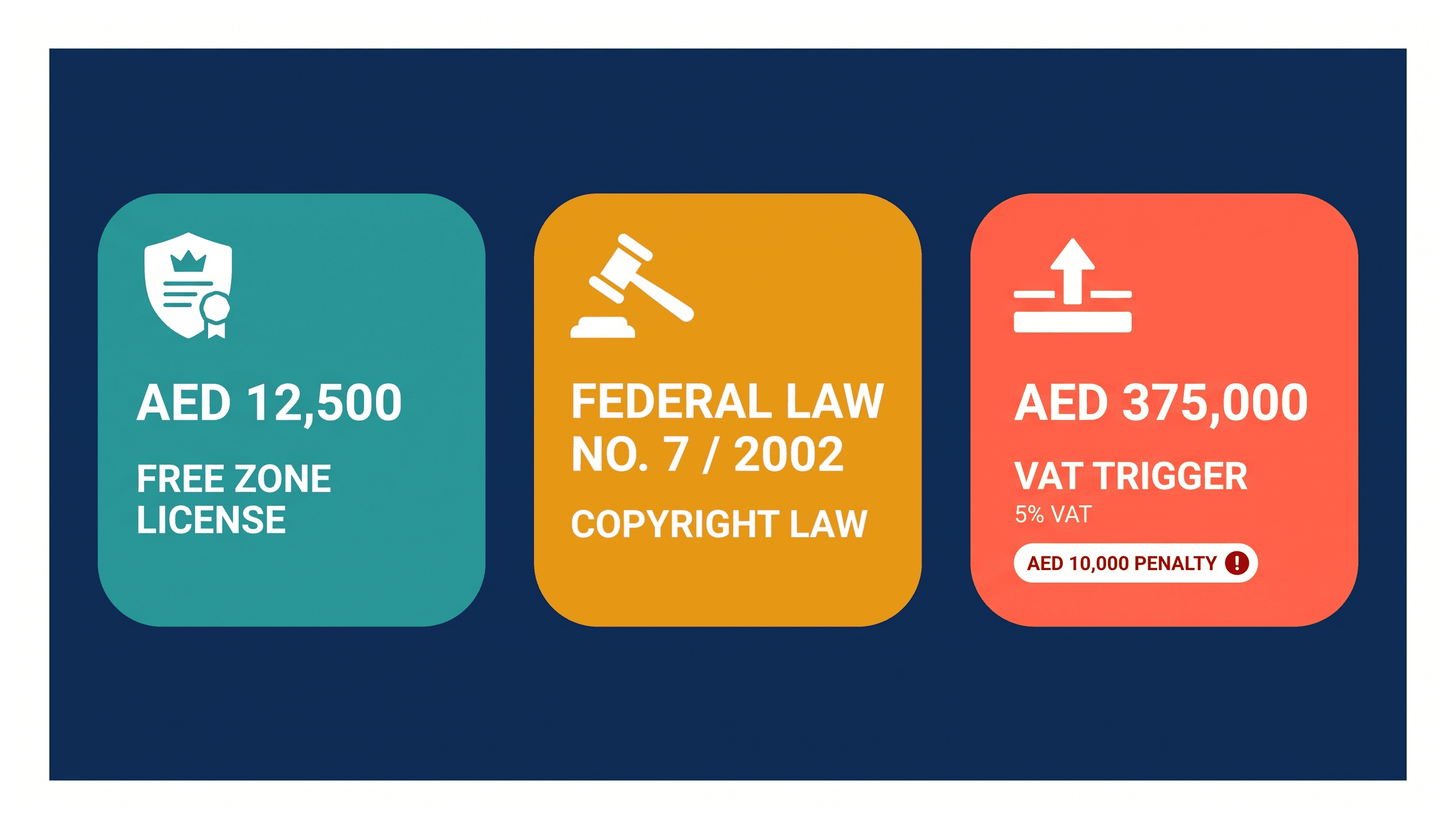
To operate a content licensing business in the UAE, you need a valid trade license listing the licensed activity, a compliant license agreement under UAE law, VAT registration if turnover exceeds AED 375,000, and, for regulated content categories, approval from the relevant sector authority in addition to your trade license.
Trade License and Activity Classification
Your trade license must list an activity that covers content licensing, rights management, or IP commercialisation. DSBH Free Zone licenses the activity; for regulated content categories, the named sector regulator approves it separately, both steps are required before you sign a single client contract.
ISIC Rev.4 Section J (Information and Communication) covers many digital content licensing activities (UN Statistics Division, 2008). Aligning your activity code to this classification matters practically: it affects how your business is categorised for tax and statistical purposes. A founder licensing e-learning modules to corporate clients, for instance, would list an activity under information and communication or professional services, both available through DSBH Free Zone's business activities.
Contractual Requirements for a Valid License Agreement
Every content license agreement operating under UAE law must address these elements:
Scope of use: what the licensee can and cannot do with the content
Territory: which countries or regions the license covers
Duration: a defined start and end date, or an ongoing term with termination provisions
Exclusivity: whether the licensor can grant the same rights to other parties simultaneously
Sublicensing permissions: whether the licensee can pass rights to a third party
Governing law: UAE law, with a designated dispute resolution forum
For software licenses: modification rights and source code access terms
One point that catches founders off guard: moral rights of the original creator cannot be waived under Federal Law No. 7 of 2002. Any agreement that attempts to strip those rights is partially unenforceable, so your legal advisor needs to acknowledge them explicitly rather than try to contract around them.
Regulated Content Categories and Dual Approval
Some content categories require a second regulatory approval on top of your DSBH trade license. Budget time and cost for both before commencing operations:
Broadcast and media content: DSBH licenses the activity; the relevant media authority approves separately
Financial content and investment research: DSBH licenses the activity; the Central Bank of UAE or relevant authority approves separately
Healthcare and medical information content: DSBH licenses the activity; MOHAP or DHA approves separately
DSBH Free Zone License Package Comparison for Content Licensing
Feature | 0 Visa Package | 1 Visa Package | 2 Visa Package |
|---|---|---|---|
Price | AED 12,500 | AED 16,350 | AED 18,200 |
Trade License | Included | Included | Included |
Articles of Association and Share Register | Included | Included | Included |
Flexi-Desk Space and Lease Agreement | Included | Included | Included |
Visa Allocation | None | 1 investor or partner visa | 2 investor or partner visas (maximum) |
Establishment Card | Not included | Included | Included |
Visa Processing (Entry Permit, Emirates ID) | Not applicable | Quoted separately | Quoted separately |
Costs, Taxes, and Penalties You Must Know
A DSBH Free Zone license for content licensing activities starts at AED 12,500 for the 0 Visa Package. VAT at 5% applies to licensing fees once turnover exceeds AED 375,000. Late VAT registration and late corporate tax registration each carry a one-time AED 10,000 penalty.
DSBH Free Zone License Packages
0 Visa Package: AED 12,500, includes trade license, Articles of Association, share register, flexi-desk space. No visa allocation.
1 Visa Package: AED 16,350, adds one investor or partner visa allocation and an establishment card
2 Visa Package: AED 18,200, adds two visa allocations and establishment card; two is the maximum available
Visa processing, entry permit, status change, medical, Emirates ID, is always quoted separately from the package price
The trade license is issued in 1 business day
VAT and Corporate Tax Obligations
Content licensing fees are taxable supplies subject to 5% VAT once your annual turnover crosses AED 375,000. Register with the Federal Tax Authority via tax.gov.ae before you reach that threshold, not after.
On the corporate tax side, the standard rate is 9% on taxable income above AED 375,000. Qualifying Free Zone Persons may access a 0% rate on qualifying income, but only when all four QFZP conditions are met: maintaining adequate substance in the free zone, deriving qualifying income, keeping non-qualifying income within the de minimis threshold, and satisfying transfer pricing rules. For more on how banking and tax registration interact, see the banking and taxation guidance at DSBH.
Penalties for Late Registration
Late VAT registration: one-time AED 10,000 penalty
Late corporate tax registration: one-time flat AED 10,000 penalty
Both penalties apply whether or not tax was actually owed, the registration obligation is separate from any payment obligation
Set a calendar reminder at company formation; don't wait for the regulator to contact you
How to Set Up for Content Licensing Usage UAE: Step-by-Step
Setting up for content licensing usage UAE involves four core steps: selecting the right license activity, registering your company, drafting compliant license agreements, and registering for VAT and corporate tax while opening a UAE business bank account. DSBH Free Zone issues the trade license in 1 business day.
Step 1: Select Your License Activity and Check Name Availability
Start by identifying the ISIC Rev.4-aligned activity code that best covers your content licensing model. Options include IP rights management, digital content distribution, software licensing, and media production, all falling broadly within ISIC Section J (Information and Communication). Before you submit anything, check your company name availability to avoid delays. Also confirm at this stage whether your content category, media, financial research, healthcare information, requires dual approval from a sector regulator, as that affects your timeline.
Step 2: Register Your Company and Receive Your License
Submit your application to DSBH Free Zone with passport copies, your proposed activity list, and your chosen company name
DSBH issues the trade license in 1 business day
Every package includes the license, Articles of Association, share register, flexi-desk space
If you need a UAE residency visa, select the 1 Visa Package at AED 16,350 or the 2 Visa Package at AED 18,200; visa processing is quoted separately
Step 3: Draft License Agreements and Register IP
Engage a UAE-qualified legal advisor to draft or review all content license agreements before you sign any client contract
Register your copyright or other IP with the Ministry of Economy, this creates a formal dated record that strengthens your position in any future dispute
Every agreement must specify scope, territory, duration, exclusivity status, sublicensing permissions, and dispute resolution under UAE law
Step 4: Register for VAT, Corporate Tax, and Open a Bank Account
Register for VAT with the Federal Tax Authority before your taxable turnover reaches AED 375,000, not when you cross it
Register for corporate tax separately; late registration triggers a one-time AED 10,000 flat penalty regardless of tax owed
Open a UAE business bank account; most banks require your trade license, Memorandum of Association, and proof of address
Worth flagging: free zone goods passing through the UAE are duty-suspended, not duty-exempt, factor this into any physical media distribution model from the start
Is a free zone the right structure for content licensing revenue?
For most founders whose licensing revenue comes primarily from clients outside the UAE mainland, a free zone structure is well-suited. It provides a clear legal entity, potential access to the 0% QFZP corporate tax rate on qualifying income (subject to four conditions), and a straightforward setup process. Founders whose primary clients are UAE mainland businesses should take separate legal advice on structure before committing.
Key Benefits of Content Licensing Usage UAE for Entrepreneurs
Content licensing usage UAE lets founders monetise intellectual property across multiple markets without transferring ownership. Free zone company structures offer a clear legal framework, potential access to a 0% corporate tax rate under QFZP conditions, and a licensing revenue model that scales without proportional cost increases.
Scalable Revenue Without Asset Transfer
A license grants usage rights while the licensor retains full ownership. That means you can license the same content to multiple parties simultaneously, each contract generates revenue from the same underlying asset. Recurring license fee structures also provide predictable income, which banks find easier to assess when you're opening accounts or applying for credit facilities.
A Dubai-based e-learning company licensing its curriculum to ten corporate clients across the GCC, for example, generates ten revenue streams from a single set of assets with no additional production cost. That's the core commercial logic of content licensing usage UAE: create once, license repeatedly.
Tax Efficiency Through Proper Structuring
Qualifying Free Zone Persons may access a 0% corporate tax rate on qualifying income, subject to four QFZP conditions: adequate substance, qualifying income, de minimis non-qualifying income threshold, and transfer pricing compliance (Ministry of Finance, 2023)
Licensing revenue from international clients may qualify as qualifying income under the free
References
Frequently Asked Questions