Topic Summary
What Is UAE Corporate Tax for IT Companies and Why It Matters
UAE corporate tax for IT companies is a federal tax on net profit. The rate is 0% on taxable income up to AED 375,000 and 9% above it. It covers software developers, SaaS providers and IT consultancies, and every licensed company must register with the Federal Tax Authority.
Free Zone Corporate Tax 2026 for IT Companies
Free Zone Corporate Tax 2026 for IT Companies
How Software, SaaS and Consultancy Revenue Are Taxed
Software licenses, SaaS subscriptions and consultancy fees are all business income within taxable profit. Timing differs: SaaS is recognised over the term, consultancy as services are delivered. IT company tax UAE treatment for free zone status depends on the client and activity.
Step-by-Step Registration and Filing for UAE Corporate Tax for IT Companies
To register and file, create an EmaraTax account, submit your registration, record your Tax Registration Number, keep audited records, and file within nine months of year-end. Registration costs AED 0 with the Federal Tax Authority, as of January 2026 ( Federal Tax Authority , 2026).
How Much Does It Cost and How Long Does It Take
Registering costs AED 0 as of January 2026. Real costs come from licenses, audits and accounting. A first-year technology company setup starts from about AED 18,350, per the technology company cost breakdown .
Regulations in the UAE That Shape IT Company Tax
IT company tax UAE rules come from the Federal Corporate Tax Law, Ministry of Finance decisions on QFZPs, transfer pricing rules and Small Business Relief. Each decides whether income is taxed at 0% or 9%.
Common Mistakes and What Should You Do Next to Start Re-Exporting From Dubai South
Common errors include missing registration, ignoring the de minimis limit, mixing revenue types and skipping audits. Next, confirm your classification, secure a license, check your name, register and start bookkeeping.
More than 350,000 businesses are registered with the Federal Tax Authority in 2026 [1]. UAE corporate tax for IT companies is 9% on taxable profit above AED 375,000, and the first AED 375,000 is taxed at 0% [1]. Free zone firms keep 0% on qualifying income only as Qualifying Free Zone Persons, with non-qualifying revenue capped at the lesser of 5% of revenue or AED 5,000,000 [2]. This guide helps owners and finance leads apply those numbers to software, SaaS and consultancy income.
What Is UAE Corporate Tax for IT Companies and Why It Matters
UAE corporate tax for IT companies is a federal tax on net profit. The rate is 0% on taxable income up to AED 375,000 and 9% above it. It covers software developers, SaaS providers and IT consultancies, and every licensed company must register with the Federal Tax Authority.
How the 9% Rate and AED 375,000 Threshold Work
Tax applies to taxable profit, not gross revenue. The threshold applies per taxable person, not per project or client. An IT consultancy with AED 1,200,000 taxable profit pays 9% on AED 825,000, which is AED 74,250.
Why Classification of IT Activities Matters
Under ISIC Rev.4, software publishing, programming and consultancy sit in Section J, Information and Communication, one of 21 sections (UN Statistics Division, 2008). E-commerce is classified by what you sell, not the channel. So a SaaS vendor and a bespoke software agency can fall into different classes, and that affects free zone qualifying-income analysis.
Who Must Register and When
Every UAE-incorporated company registers, whatever its revenue.
Free zone firms register even if they expect 0%.
Late registration triggers administrative penalties.
A two-person startup with no revenue still registers, as covered in registering for corporate tax after company formation.
Free Zone Corporate Tax 2026 for IT Companies
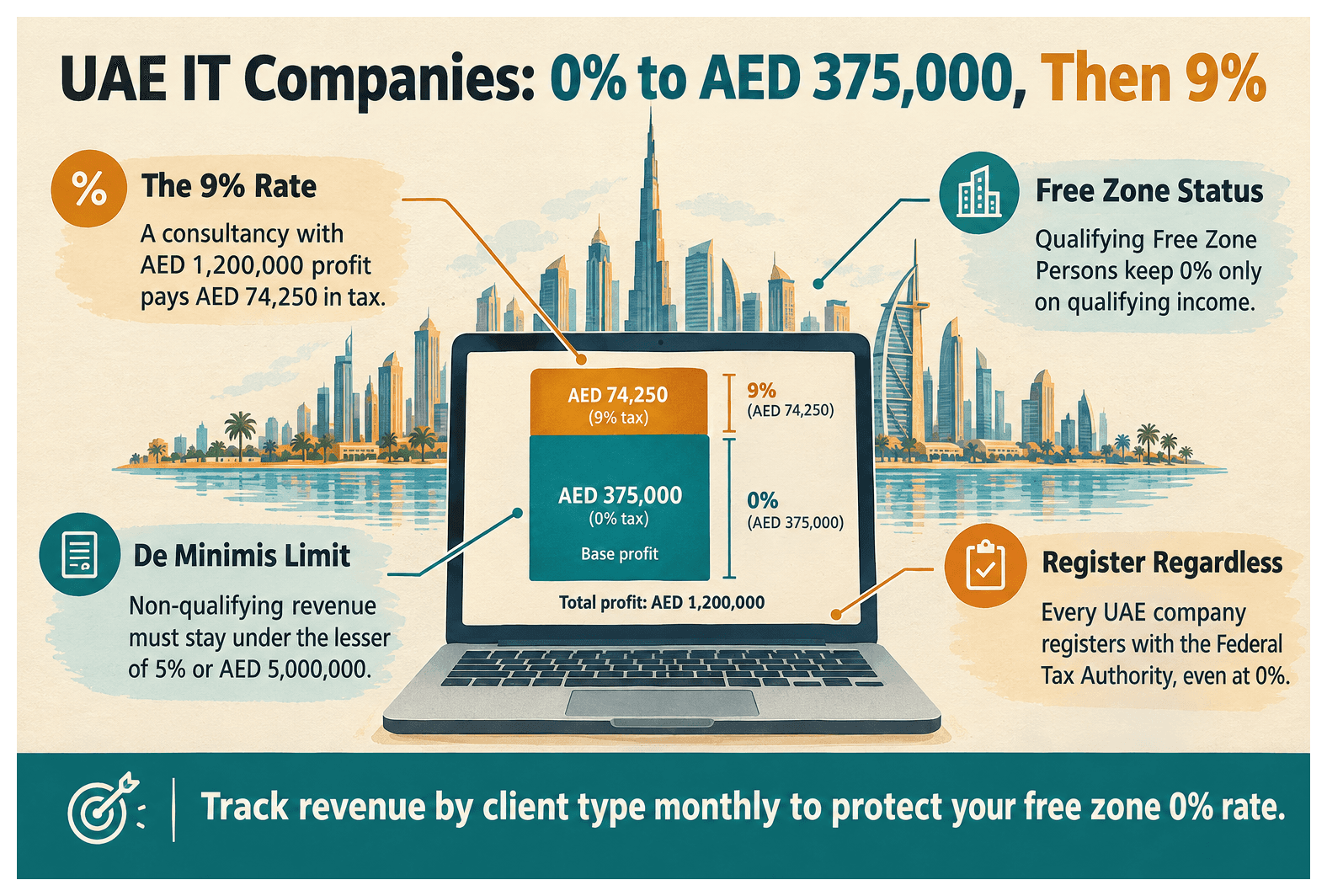
A free zone IT company can pay 0% on qualifying income if it is a Qualifying Free Zone Person. It needs adequate substance, qualifying income, and non-qualifying revenue under the de minimis limit. Failing the test moves the company to the standard 9% rate.
Qualifying Free Zone Person Conditions Explained
Adequate substance in the free zone.
Qualifying income, such as software sold to overseas clients.
No election for the standard rate.
Transfer pricing compliance and audited financials.
A Dubai South Business Hub Free Zone software firm selling abroad is the typical fit. Read the qualifying activities guide for edge cases.
The De Minimis Rule in Plain Terms
Non-qualifying revenue must stay at or below the lesser of 5% of total revenue or AED 5,000,000. With AED 10,000,000 revenue, your limit is AED 500,000, because 5% is the lesser figure. Breach it and you lose QFZP status for that period and the following four (Ministry of Finance, 2023). Track revenue by client type monthly.
Mainland Clients and Free Zone IT Revenue
Mainland-sourced revenue is often non-qualifying and counts toward the limit. One large retainer can tip a small consultancy over. Keep contracts and invoices clean, and see free zone companies with mainland clients.
How Software, SaaS and Consultancy Revenue Are Taxed
Software licenses, SaaS subscriptions and consultancy fees are all business income within taxable profit. Timing differs: SaaS is recognised over the term, consultancy as services are delivered. IT company tax UAE treatment for free zone status depends on the client and activity.
Software Development and Licensing Income
Taxable profit is accounting profit, adjusted. Bespoke development fees and license royalties are recognised differently under accounting standards. A firm licensing its own product abroad has a different profile from one building custom apps for a UAE retailer. See setting up a software company in Dubai.
SaaS Subscription Revenue
Recognise recurring revenue over the subscription term.
Prepaid annual plans create deferred revenue.
A December annual bill mostly lands in next year's profit.
Customer location drives qualifying-income analysis.
IT Consultancy and Managed Services
Time-and-materials and fixed-fee projects follow delivery.
Retainers are spread across the service period.
Billing a group company abroad requires arm's length pricing.
Step-by-Step Registration and Filing for UAE Corporate Tax for IT Companies
To register and file, create an EmaraTax account, submit your registration, record your Tax Registration Number, keep audited records, and file within nine months of year-end. Registration costs AED 0 with the Federal Tax Authority, as of January 2026 (Federal Tax Authority, 2026).
Step 1: Create an EmaraTax Account and Register
Have your trade license, shareholder IDs and year-end ready.
Pay AED 0 (January 2026).
Receive your Tax Registration Number.
Corporate Tax Treatment for a UAE IT Company: Free Zone vs Standard (AED, as of January 2026)
Feature | Qualifying Free Zone Person | Standard Taxable Person |
|---|---|---|
Rate on income up to AED 375,000 | 0% on qualifying income | 0% |
Rate on income above AED 375,000 | 0% qualifying, 9% non-qualifying | 9% |
De minimis limit on non-qualifying revenue | Lesser of 5% of revenue or AED 5,000,000 | Not applicable |
Audited financial statements | Required | Depends on size and license |
FTA registration fee (AED 0, January 2026) | AED 0 | AED 0 |
Step 2: Keep Records and Prepare Financial Statements
Keep records for seven years.
Get audited accounts if you want QFZP status.
Tag each invoice by client location and type.
Step 3: File the Return and Pay Any Tax Due
Filing and payment fall due nine months after year-end. A December year-end company files by 30 September. Late filing brings penalties; the step-by-step filing guide shows the process.
How Much Does It Cost and How Long Does It Take
Registering costs AED 0 as of January 2026. Real costs come from licenses, audits and accounting. A first-year technology company setup starts from about AED 18,350, per the technology company cost breakdown.
Cost Table: Typical Compliance and Setup Costs in AED
Item | Indicative Cost (AED) | Date Quoted | Timeline |
|---|---|---|---|
FTA registration | 0 | January 2026 | Days |
Year-one technology setup | From 18,350 | January 2026 | Varies |
Audit (estimate) | Quote-based | January 2026 | Weeks |
Return preparation (estimate) | Quote-based | January 2026 | Weeks |
Timelines From Registration to First Return
A company licensed in March with a December year-end has nine months after year-end to file. Book audit time early if you're a QFZP.
Estimate Your Own Costs
A three-visa startup should budget setup and compliance together. Use the cost calculator for license and visa packages.
Regulations in the UAE That Shape IT Company Tax
IT company tax UAE rules come from the Federal Corporate Tax Law, Ministry of Finance decisions on QFZPs, transfer pricing rules and Small Business Relief. Each decides whether income is taxed at 0% or 9%.
Transfer Pricing and Related Party Rules
Group IT services must meet the arm's length standard. A shared development team billed to a parent needs documented pricing and disclosure in the return.
Small Business Relief and Its Limits
It applies under the AED 3,000,000 revenue cap.
QFZPs can't use it.
It has an end date, so confirm current status.
Keeping Up With Legislative Updates
Review qualifying activity lists every January. Track UAE corporate tax changes as they land.
Common Mistakes and What Should You Do Next to Start Re-Exporting From Dubai South
Common errors include missing registration, ignoring the de minimis limit, mixing revenue types and skipping audits. Next, confirm your classification, secure a license, check your name, register and start bookkeeping.
Five Mistakes IT Companies Make With Corporate Tax
Skipping registration because revenue is zero.
Breaching the de minimis rule untracked.
No audited financials for QFZP.
Misclassifying SaaS or consultancy revenue.
Missing the nine-month deadline.
One free zone SaaS firm lost 0% status for four following periods after a single large mainland contract.
Your Next Steps as a Dubai South Business Hub Free Zone Company
Run the company name check.
Pick a license activity matching your IT services.
Get a license and residency visa package.
Register for corporate tax at AED 0 and set up accounting.
Where to Get Licensing Guidance
Developers can choose between consultancy and programming activities. Start with the IT consultancy license guide.
Final Thoughts on UAE Corporate Tax for IT Companies
UAE corporate tax for IT companies comes down to three numbers: 0% to AED 375,000, 9% above it, and the de minimis limit. On AED 1,200,000 profit, tax is AED 74,250. Register early, track revenue by type and review rules each January. Figures are dated January 2026.
Budget with the cost calculator, run the name check, then start your license application.
References
Frequently Asked Questions