
Topic Summary
What Is a Courier Account for a UAE Online Store?
A courier account is a business shipping account that lets your store book pickups, print waybills, track parcels and collect COD. A courier account UAE online store setup gives you contract rates, API access and settlement terms that walk-in shipping can't match.
What Are the Courier Account Requirements in Dubai?
What Are the Courier Account Requirements in Dubai?
How Do You Open a Courier Account Step by Step?
To open a courier account, shortlist providers, compare rate cards, submit documents, sign the agreement, then run test shipments. Having bank details ready before your first call speeds everything up.
How Do You Connect a Courier Account to Your Store?
Courier integration with an online store works through a plugin, an API or a CSV upload. Plugins suit Shopify and WooCommerce, APIs suit higher volume, and CSV suits small start-ups. Match the method to your orders and technical resources.
How Does COD Settlement Work With a Courier Account?
With a COD courier service UAE sellers rely on, the driver collects payment at the door, deducts fees and remits the balance on an agreed cycle. Remittance timing and fees vary by courier, so confirm them in your agreement.
How Does a Courier Account Handle Customs and Cross-Border Orders?
For international orders, your courier acts as carrier and often customs broker, filing through Mirsal 2, Dubai Customs' electronic declaration system. You supply the commercial invoice, HS code (Harmonised System code classifying goods) and value. Duties vary, so verify current rules via Dubai Trade .
What Does a Courier Account Cost and What Mistakes Should You Avoid?
Costs usually include per-parcel rates, fuel surcharges, COD, return and remote-area fees. Opening is often free or low-cost, but fees may vary, so check the official source. Compare total cost per order, not base rates.
A courier account is a business contract with a delivery company that gives your store pickups, waybills, tracking and cash on delivery (COD). To open one, prepare your trade license, ID and bank details, compare rate cards, sign the agreement and test before launch.
UAE e-commerce is projected to pass USD 8 billion in 2026 (Statista, 2026). A courier account UAE online store setup is how your orders join that flow. This guide is for founders who need to act, not just read.
What Is a Courier Account for a UAE Online Store?
A courier account is a business shipping account that lets your store book pickups, print waybills, track parcels and collect COD. A courier account UAE online store setup gives you contract rates, API access and settlement terms that walk-in shipping can't match.
How a Courier Account Differs From Walk-In Shipping
Walk-in shipping is priced per parcel at retail rates, with no tracking feed to your store. A business account adds negotiated rates, scheduled pickups and bulk waybills (the label and document identifying each parcel). It also adds an API (the link that lets two systems exchange data automatically).
Picture a home-fashion seller sending 15 parcels a day. Driving to a counter daily wastes hours. A scheduled pickup under a business shipping account UAE sellers use frees that time.
What a Courier Account Typically Includes
Rate card by zone and weight band.
Pickups, tracking, proof of delivery and returns.
COD collection and remittance terms.
Support line for claims.
Read the rate card closely. Fuel surcharge and remote-area lines often appear in small print.
Why Do Online Sellers Need One Early?
Delivery drives reviews and repeat orders. Tracking also cuts "where is my order" messages. If you're still licensing, start with an online internet retail trading license or an e-trader license.
What Are the Courier Account Requirements in Dubai?
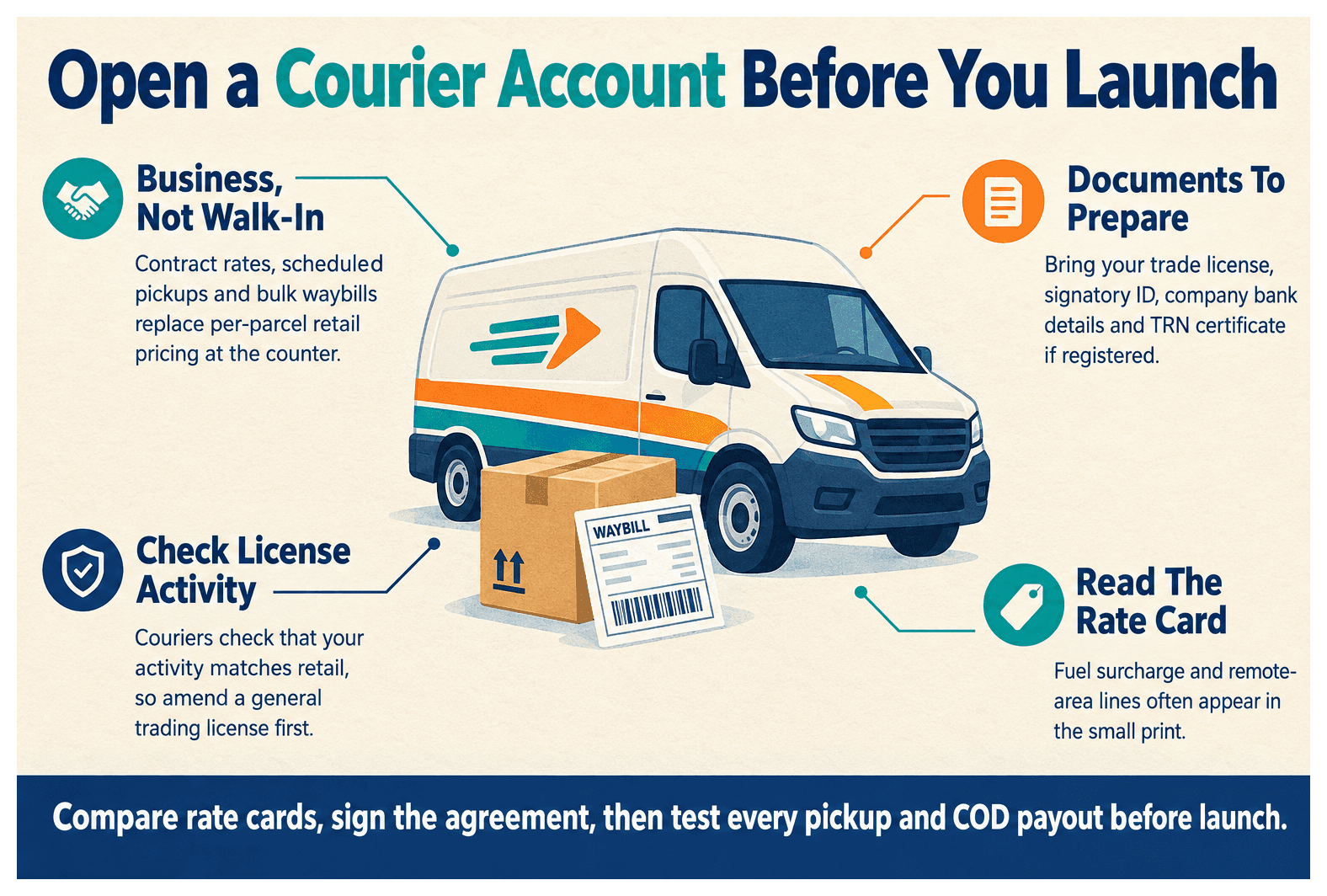
Courier account requirements Dubai couriers usually set include a valid trade license, owner ID, a company bank account and a UAE address. Some also ask for tax registration. Documents vary, so confirm the current list with your provider.
Documents Checklist for Opening an Account
Trade license covering online retail.
Passport and Emirates ID of the signatory.
Company bank details for COD and billing.
Tax Registration Number (TRN) certificate, if registered with the Federal Tax Authority (FTA).
Signed application and terms.
A Dubai South Business Hub Free Zone company would apply with its license, owner Emirates ID and a bank letter.
Why Your License Activity Matters
Couriers check that your activity matches retail or trading. A store holding a general trading license without an e-commerce activity may be asked to amend it first. Our free zone vs mainland e-commerce guide covers that choice.
Credit Checks, Deposits and Volume Thresholds
Some couriers ask for deposits, minimum volumes or a credit review. Start-ups often begin on prepaid billing, then move to monthly invoicing. Fees and requirements may vary, so check the official source before applying.
How Do You Open a Courier Account Step by Step?
To open a courier account, shortlist providers, compare rate cards, submit documents, sign the agreement, then run test shipments. Having bank details ready before your first call speeds everything up.
Shortlist by coverage. Compare same-day, next-day and cross-emirate reach. "Best courier for e-commerce UAE" is a fit question, not one winner. One seller might pick a Dubai same-day courier plus a nationwide next-day one. See choosing a delivery partner for a Dubai online store.
Compare total cost. Price a 1 kg parcel across your top three zones, with every surcharge included.
Submit documents and sign. Check liability limits, claims windows and COD remittance days. Confirm who may sign.
Activate and test. You'll get an account number, portal login and API credentials. Send two or three test parcels.
Practical tip: Always test one COD parcel and one return before launch. A COD test to a friend in Sharjah proves tracking and remittance work.
Comparison of Courier Account Integration and Account Types
Feature | Direct Courier Account | Multi-Carrier Aggregator |
|---|---|---|
Setup effort and documents | Full document set and agreement per courier | One sign-up covers several carriers |
Rates and negotiation room | Room to negotiate as volume grows | Pre-set rates, limited negotiation |
Number of carriers available | One carrier per account | Several carriers in one dashboard |
COD handling and remittance | Remitted by the courier under your contract | Remitted via the platform, so check the extra layer |
Best fit by order volume | Steady, higher daily volume | Start-ups with low or uneven volume |
How Do You Connect a Courier Account to Your Store?
Courier integration with an online store works through a plugin, an API or a CSV upload. Plugins suit Shopify and WooCommerce, APIs suit higher volume, and CSV suits small start-ups. Match the method to your orders and technical resources.
Plugin, API or Manual Upload: Which Fits You?
Plugin: quick setup, limited customisation.
API: automates waybills, tracking and checkout rates.
CSV: cheap, but admin time grows fast.
A WooCommerce store might start on a plugin and move to API as orders climb. Costs and support vary among e-commerce delivery partners UAE sellers use.
Syncing Tracking, Returns and Fulfilment
Push tracking links to customer emails and SMS, and map return reasons to restock rules. If you outsource pick and pack, see e-commerce fulfilment business setup.
How Does COD Settlement Work With a Courier Account?
With a COD courier service UAE sellers rely on, the driver collects payment at the door, deducts fees and remits the balance on an agreed cycle. Remittance timing and fees vary by courier, so confirm them in your agreement.
Remittance Cycles and Reconciliation
COD means cash on delivery: the customer pays the courier on receipt. Ask for the remittance schedule, statement format and dispute window. Reconcile weekly. One seller found a missing amount by matching statement lines to order IDs.
COD Risks and Compliance
Refused parcels add return costs.
COD fees can erase profit on low-value items.
Late remittance ties up working capital.
You'll typically need a UAE company bank account to receive remittances, and records for VAT and corporate tax. Read how cash on delivery works for a UAE online seller and the Central Bank of the UAE for payment rules.
How Does a Courier Account Handle Customs and Cross-Border Orders?
For international orders, your courier acts as carrier and often customs broker, filing through Mirsal 2, Dubai Customs' electronic declaration system. You supply the commercial invoice, HS code (Harmonised System code classifying goods) and value. Duties vary, so verify current rules via Dubai Trade.
Commercial invoice and packing list.
Correct HS code and declared value.
Permits for restricted goods, such as skincare ingredient details.
Decide who pays import charges: Delivered Duty Paid or Delivered at Place. Surprise duties at the door cause refusals.
What Does a Courier Account Cost and What Mistakes Should You Avoid?
Costs usually include per-parcel rates, fuel surcharges, COD, return and remote-area fees. Opening is often free or low-cost, but fees may vary, so check the official source. Compare total cost per order, not base rates.
Choosing one courier for every route.
Skipping claims and liability terms.
Not testing COD and returns.
Common mistake: Picking the cheapest base rate, then paying more once COD and return fees apply. Keep a backup account for peak sales. Start-ups can use an aggregator first, then open direct accounts. Also plan where to store stock.
Your Next Step
A courier account UAE online store setup links your license, bank account and delivery network. Choose couriers by coverage and total cost, integrate properly and confirm COD terms in writing.
Shortlist two couriers, request rate cards and gather your license, ID and bank details. No license for online retail yet? Speak to Dubai South Business Hub Free Zone about company formation and a trade license.
Rules in the UAE change often. Always verify the latest requirements with the official authority before taking action.
References
Frequently Asked Questions