
Topic Summary
What Is a Customs Duty Exemption in a Dubai Free Zone?
A customs duty exemption Dubai free zone setup means goods brought in for use or storage there are not charged the standard 5% duty. Duty is suspended, and it can become payable when goods enter the mainland for local consumption.
Are Free Zones Exempt From Customs Duty, and Is It 0%?
Are Free Zones Exempt From Customs Duty, and Is It 0%?
How Do You Claim a Customs Duty Exemption in a Dubai Free Zone Step by Step?
To claim a customs duty exemption Dubai free zone companies can use, license the company, get a customs client code, appoint a clearing agent, declare through Mirsal 2, then keep records. Fees and requirements may vary, so check the official source before applying.
What Happens to Customs Duty on Goods Moved From a Free Zone to the Mainland?
Customs duty on goods moved from free zone to mainland becomes payable at release for local consumption. The importer declares the goods, classifies them by HS code and pays duty on customs value. A license alone doesn't allow unrestricted mainland sales.
Which Conditions Must You Meet to Keep the Exemption?
Customs duty exemption conditions UAE businesses face include a valid license, goods kept in the zone or re-exported, accurate declarations and licensed activities only. Breaches can trigger duty, fines or lost privileges, which erases free zone import duty benefits.
How Do Designated Zones Affect Customs and VAT?
A designated zone is one the Federal Tax Authority ( FTA ) treats as outside the UAE for certain VAT purposes. Designated zone customs UAE rules are separate from VAT, so check both. See what a designated zone means for VAT .
How Much Does It Cost and How Long Does It Take?
The customs duty exemption Dubai free zone benefit has no separate fee. You pay for the license, client code, warehouse space and clearing services. Timelines depend on documents. Fees and requirements may vary, so check the official source before applying.
A customs duty exemption Dubai free zone businesses use means goods imported for storage or use inside the zone avoid the standard 5% UAE duty. The duty is suspended, not erased, and it applies if goods are released to the mainland.
This guide is for cold chain founders, importers and investors who want to plan stock flows. Dubai's ports handle over 14 million TEUs (twenty-foot equivalent container units) a year (DP World, 2024), and much of that cargo moves under suspended duty first.
What Is a Customs Duty Exemption in a Dubai Free Zone?
A customs duty exemption Dubai free zone setup means goods brought in for use or storage there are not charged the standard 5% duty. Duty is suspended, and it can become payable when goods enter the mainland for local consumption.
How Duty Suspension Differs From a True Exemption
Customs duty is a tax charged when goods enter a country's customs territory. Free zones are treated as outside that territory while goods stay inside. Suspension ends the moment goods are released for local consumption.
Say a cold chain operator imports refrigeration units into a free zone warehouse. It pays nothing while they're stored, then pays duty only on units sold to a mainland buyer. For a broader primer, see what a free zone actually is in Dubai.
Who Regulates Free Zone Customs Treatment
Dubai Customs administers customs in the emirate. The Federal Authority for Identity, Citizenship, Customs and Port Security (ICP) sets the federal framework. The free zone authority handles licensing and zone rules, so check all three before shipping.
Are Free Zones Exempt From Customs Duty, and Is It 0%?
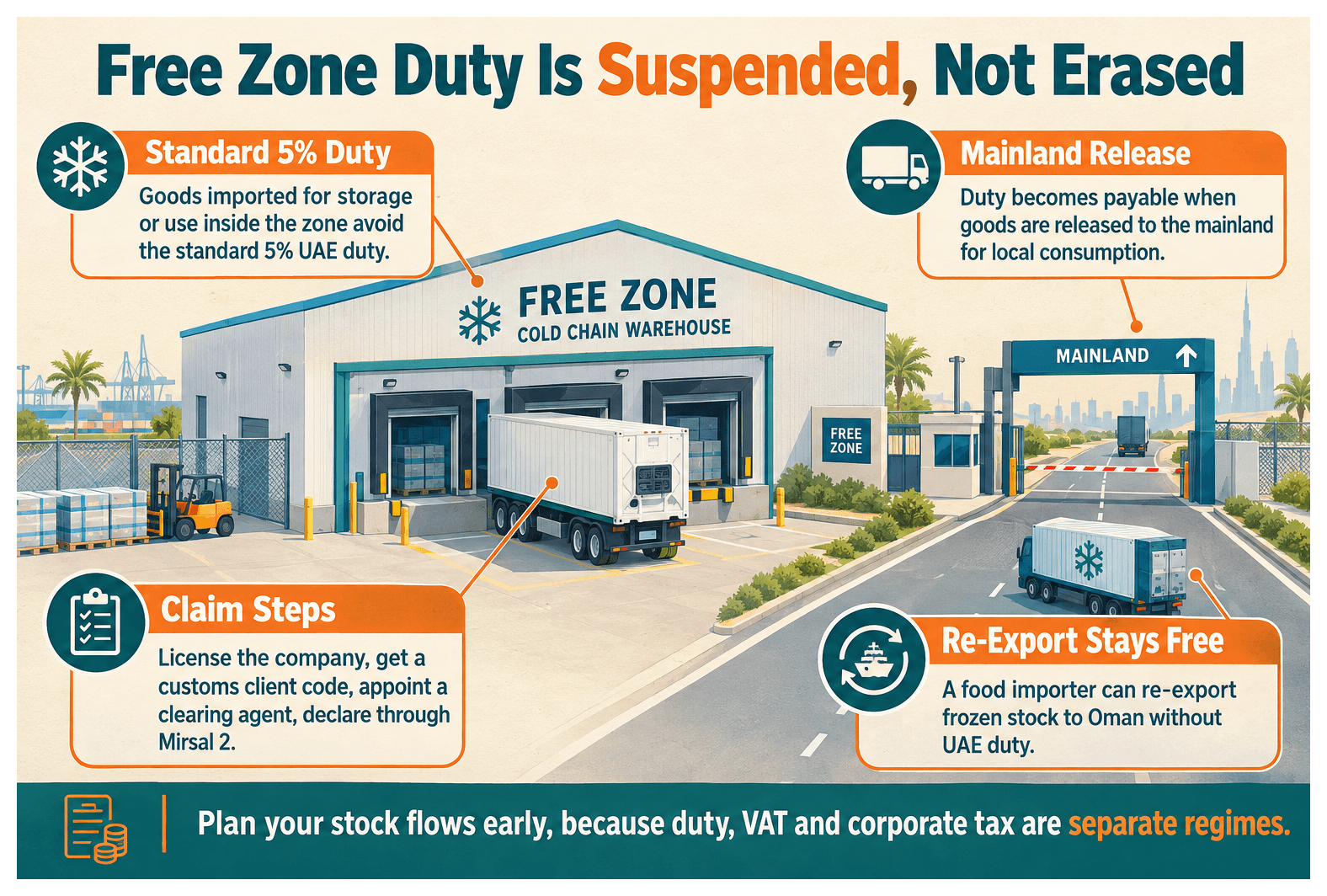
Free zones aren't automatically exempt from all duty. Goods held, processed or re-exported inside the zone generally face 0% customs duty free zone UAE treatment. Duty applies on mainland sale, and product type and documents decide the outcome.
When Duty-Free Import Applies in Practice
Goods stored or assembled inside the zone.
Equipment for your licensed activity.
Re-exports to GCC or international buyers.
A food importer, for instance, can store frozen goods in a free zone cold store and re-export part of the stock to Oman without UAE duty.
Common Myths About Free Zone Duty
A license doesn't remove duty permanently. It also doesn't remove VAT or corporate tax obligations, because duty, VAT and corporate tax are separate regimes. Many new founders learn this at their first filing.
Why This Matters for Cold Chain Operators
Refrigeration equipment and stock carry high value, so duty exposure is real. Pre-cleared paperwork protects time-sensitive cargo. Ministry of Industry and Advanced Technology (MoIAT) and Dubai Municipality food rules apply whatever the duty status.
How Do You Claim a Customs Duty Exemption in a Dubai Free Zone Step by Step?
To claim a customs duty exemption Dubai free zone companies can use, license the company, get a customs client code, appoint a clearing agent, declare through Mirsal 2, then keep records. Fees and requirements may vary, so check the official source before applying.
Set up the licensed company. Get a free zone trade license with the right activity and secure warehouse space. Confirm permits cover your goods.
Register a customs client code. This unique ID lets you import and export. Registration is AED 100, with AED 100 yearly renewal; see what a customs client code costs.
Declare through Mirsal 2. This is Dubai Customs' electronic declaration system. Enter the free zone destination and correct HS code, via a licensed clearing agent if needed.
Keep records. Retain invoices, bills of lading and stock logs for every movement in or out.
What Happens to Customs Duty on Goods Moved From a Free Zone to the Mainland?
Customs duty on goods moved from free zone to mainland becomes payable at release for local consumption. The importer declares the goods, classifies them by HS code and pays duty on customs value. A license alone doesn't allow unrestricted mainland sales.
When Duty Becomes Payable
Value, origin and HS code drive the calculation. A trader selling cold room panels to a mainland contractor declares duty at release. Read more on when duty becomes payable on free zone goods.
Selling to Mainland Customers Legally
Use a mainland distributor or the correct permissions. A founder serving supermarkets might sign a distributor agreement first. Our guide on selling to mainland customers covers the routes.
Which Conditions Must You Meet to Keep the Exemption?
Customs duty exemption conditions UAE businesses face include a valid license, goods kept in the zone or re-exported, accurate declarations and licensed activities only. Breaches can trigger duty, fines or lost privileges, which erases free zone import duty benefits.
Documents Checklist for Duty-Free Imports
Trade license and lease.
Customs client code.
Invoice, packing list, bill of lading or airway bill.
Certificate of origin where relevant.
Product permits.
Duty, VAT and Corporate Tax Treatment by Goods Movement
Feature | Goods Kept or Re-Exported From the Zone | Goods Released to the Mainland |
|---|---|---|
Customs duty | Suspended (0%) while inside or re-exported | Usually 5% on customs value at release |
VAT treatment | Can be outside VAT if a designated zone applies | VAT generally due on mainland supply |
Corporate tax angle | 0% only on qualifying income | Mainland income may be taxed at 9% |
Documentation needed | Stock logs, re-export proofs | Customs declaration, HS code, duty receipt |
Typical risk | Undocumented re-exports trigger duty claims | Wrong HS code or unpermitted sales |
Common Mistake: Wrong HS Code or Destination
Wrong HS codes cause incorrect duty and delays. Declaring a mainland address instead of the free zone can trigger unnecessary duty, as one importer found before correcting the entry. Confirm codes with your clearing agent first.
Penalties for Non-Compliance
Expect duty recovery, fines and possible loss of customs privileges. An operator that can't document re-exports faces a duty claim. Penalty amounts vary, so check Dubai Customs. Bonded storage can help; see bonded warehousing for Dubai companies.
How Do Designated Zones Affect Customs and VAT?
A designated zone is one the Federal Tax Authority (FTA) treats as outside the UAE for certain VAT purposes. Designated zone customs UAE rules are separate from VAT, so check both. See what a designated zone means for VAT.
Corporate tax is a third layer: 9% on taxable profit above AED 375,000, with 0% only for qualifying free zone income (Ministry of Finance, 2023).
How Much Does It Cost and How Long Does It Take?
The customs duty exemption Dubai free zone benefit has no separate fee. You pay for the license, client code, warehouse space and clearing services. Timelines depend on documents. Fees and requirements may vary, so check the official source before applying.
Dubai South Business Hub Free Zone licenses start at AED 12,500 (zero-visa option, confirm current pricing).
Client code: AED 100 to register.
Cold storage lease and agent fees on top.
Sequence matters: license, lease, client code, first declaration. Apply for product permits early while the license processes.
Practical tip: Ask your clearing agent to check the HS code and destination before the container sails, not after it arrives.
What Should You Do Next?
A customs duty exemption Dubai free zone structure suspends duty on goods held or re-exported inside the zone. Duty applies on mainland release, and VAT and corporate tax follow separate rules. Accurate declarations and clean records protect the benefit.
Map your cold chain flow, separating stock held, re-exported and sold locally. Then speak with Dubai South Business Hub Free Zone about a license and warehouse that fit that plan.
Rules in the UAE change often. Always verify the latest requirements with the official authority before taking action.
References
Frequently Asked Questions