Topic Summary
What Is a Designated Zone and Does It Affect Your VAT in Practice
A designated zone is a fixed geographic area listed by UAE Cabinet Decision where goods are treated as outside the UAE for VAT while they remain inside it. It does affect your VAT, but only for qualifying goods movements. Services and most mainland sales stay taxable at 5%.
How VAT Treats Goods and Services Inside a Designated Zone
How VAT Treats Goods and Services Inside a Designated Zone
Free Zone Company vs Designated Zone: Where Founders Get Confused
A free zone company is a licensed entity. A designated zone is a VAT-listed location. You can hold a free zone license in a non-designated area, or sit in a designated zone and still owe VAT on services. Free zone VAT registration follows the same rules either way.
How to Confirm Your VAT Position Step by Step
To confirm your position: check the list, map your flows, test the threshold, register through EmaraTax if required, and document everything. Review again when your business model changes.
Deadlines, Penalties and Records to Keep
Register within 30 days of passing AED 375,000. File VAT201 within 28 days after each tax period. Late registration costs AED 10,000, and you must keep records five years for designated zone VAT treatment.
Practical Examples
A designated zone affects VAT mainly for goods held or traded inside it. Your business model decides the outcome.
Your Next Move
Understanding a designated zone and whether it affects your VAT comes down to three steps: check the official list, map your flows, and register on time. Review your sales mix this week, then speak with the Dubai South Business Hub team about license and visa packages that fit your trading model.
More than 350,000 UAE businesses are VAT-registered (Federal Tax Authority, 2025), yet many free zone owners still think a license removes VAT. This guide helps owners and finance managers see what a designated zone is and whether it affects your VAT. The standard rate is 5%, the registration threshold is AED 375,000, and late registration costs AED 10,000.
What Is a Designated Zone and Does It Affect Your VAT in Practice
A designated zone is a fixed geographic area listed by UAE Cabinet Decision where goods are treated as outside the UAE for VAT while they remain inside it. It does affect your VAT, but only for qualifying goods movements. Services and most mainland sales stay taxable at 5%.
The Legal Definition Under UAE VAT Law
Federal Decree-Law No. 8 of 2017 and its Executive Regulations define the term. The area must be fenced, with controlled entry and exit and customs controls. Cabinet Decision No. 59 of 2017 lists the zones, and the FTA publishes the current list (UAE Cabinet, 2017).
Picture a trading company storing electronics in a listed, fenced warehouse area for onward export. That location is what matters.
Why the Label Matters More Than the License
VAT follows the location of the goods and the zone's listing, not your license type. Take two free zone companies selling the same goods, one in a listed zone and one not. They get different treatment. Understanding what a free zone actually is in Dubai helps here, because some free zones are designated and some aren't.
How VAT Treats Goods and Services Inside a Designated Zone
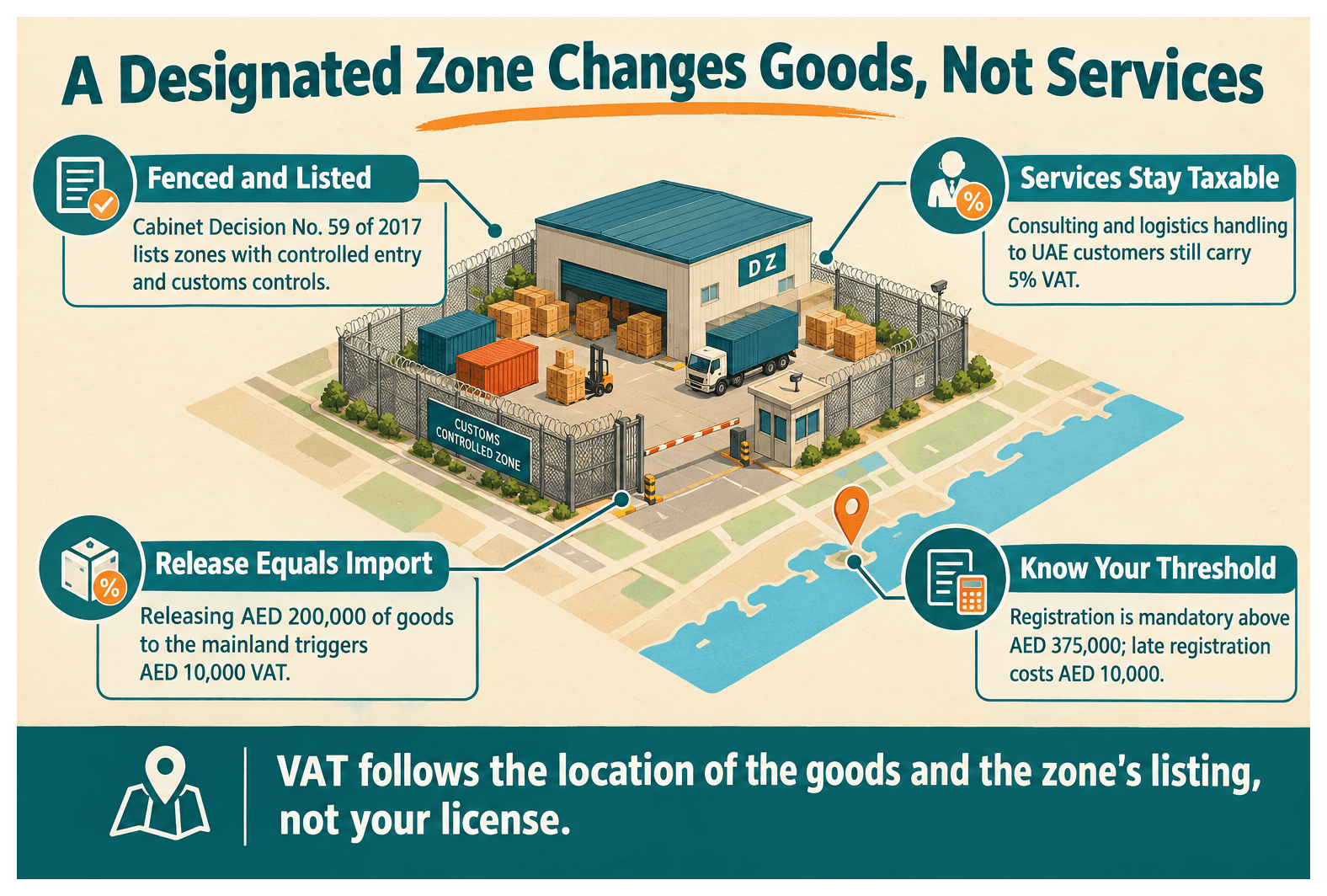
Goods supplied between businesses inside designated zones are generally outside VAT scope while they stay there. Services get no such relief. They follow place-of-supply rules, so a service to a UAE customer is normally taxed at 5%.
Goods Moving Within and Between Designated Zones
Zone-to-zone supplies can be outside UAE VAT.
Goods must stay under customs control.
They can't be released for local consumption.
Conditions sit in Cabinet Decision No. 59 of 2017.
Services Are Not Covered by Zone Relief
Consulting, logistics handling and licensing fees don't become VAT-free by location. A free zone consultancy invoicing UAE mainland clients must charge 5% once registered. Registration is mandatory above AED 375,000.
Designated Zone vs Non-Designated Free Zone Location: VAT Comparison
Feature | Designated Zone | Non-Designated Location |
|---|---|---|
Goods supplied between zones | Can be outside UAE VAT if conditions are met | Treated as a UAE supply, 5% VAT applies |
Services supplied to UAE customers | No relief, 5% VAT applies | No relief, 5% VAT applies |
Goods released to the mainland | Treated as an import, VAT due at release | Ordinary domestic supply, VAT on the invoice |
VAT registration threshold | AED 375,000 on taxable supplies | AED 375,000 on taxable supplies |
Record and customs requirements | Storage and customs proof of zone status | Standard tax invoices and records |
When Goods Leave the Zone for the Mainland
Release into the mainland counts as an import. Say you release AED 200,000 of goods to a retailer: VAT of AED 10,000 is due at 5% on the customs value (Ministry of Finance). Keep customs declarations aligned with your VAT return.
Free Zone Company vs Designated Zone: Where Founders Get Confused
A free zone company is a licensed entity. A designated zone is a VAT-listed location. You can hold a free zone license in a non-designated area, or sit in a designated zone and still owe VAT on services. Free zone VAT registration follows the same rules either way.
VAT Status vs Corporate Tax Status
Designated zone is a VAT label. Qualifying Free Zone Person is a corporate tax label, with 0% on qualifying income versus 9% standard. A company meeting those conditions still files VAT returns. Mainland income can also affect corporate tax for free zone companies with mainland clients.
What This Means for a Dubai South Business Hub Company
Confirm your zone's listing in the latest Cabinet decision before assuming any treatment. Your license and visa package don't change VAT duties. Register within 30 days of crossing the threshold, and document how goods are stored and moved.
How to Confirm Your VAT Position Step by Step
To confirm your position: check the list, map your flows, test the threshold, register through EmaraTax if required, and document everything. Review again when your business model changes.
Check the list. Match your zone name and address to Cabinet Decision No. 59 of 2017. Save a dated PDF.
Map flows. Split revenue into zone, mainland and export lines. Test against AED 375,000 over a rolling 12 months.
Register. Use EmaraTax within 30 days. Voluntary registration starts at AED 187,500.
Record. Issue invoices with your TRN (Tax Registration Number). Keep customs and storage records for five years.
Deadlines, Penalties and Records to Keep
Register within 30 days of passing AED 375,000. File VAT201 within 28 days after each tax period. Late registration costs AED 10,000, and you must keep records five years for designated zone VAT treatment.
A quarterly period ending 31 March means filing and paying by 28 April.
Late filing and payment trigger further FTA penalties.
Correct filed errors through Form VAT 211, a voluntary disclosure.
Practical Examples
A designated zone affects VAT mainly for goods held or traded inside it. Your business model decides the outcome.
Example: A Goods Trading Company
A trader sells AED 500,000 of electronics zone-to-zone with no VAT. Then it releases AED 80,000 to a mainland retailer, so AED 4,000 of VAT is due at 5%. The reverse charge and customs paperwork must match.
Example: A Services Company With Mainland Clients
A marketing consultancy bills AED 40,000 monthly to UAE clients. That's AED 480,000 a year, above the threshold. No zone relief applies, so registration and 5% VAT follow. See also selling to mainland customers.
Your Next Move
Understanding a designated zone and whether it affects your VAT comes down to three steps: check the official list, map your flows, and register on time. Review your sales mix this week, then speak with the Dubai South Business Hub team about license and visa packages that fit your trading model.
References
Frequently Asked Questions