
Topic Summary
Start With the Right Activity Code
UAE licensing authorities classify your business by what it primarily delivers, not the technology it uses. Choosing the wrong activity code at incorporation creates compliance risk when regulators like KHDA review your operations.
KHDA Approval Is Non-Negotiable
Any EdTech business delivering instruction or educational content to Dubai-based learners must obtain separate KHDA approval alongside its trade license. This applies regardless of how the content is delivered, including via SaaS platforms or apps.
Free Zone Licensing Offers a Fast Start
A DSBH Free Zone license can be issued in a single business day once documents are complete, with costs starting at AED 12,500. Free zone structures also allow 100% foreign ownership and full profit repatriation with no local sponsor required.
Know Your Tax and VAT Obligations Early
Corporate tax of 9% applies from financial years starting 1 June 2023, and VAT registration becomes mandatory once annual turnover reaches AED 375,000. Planning for these thresholds from day one prevents costly surprises as your business scales.
Dubai Gives Access to Six GCC Markets
A single Dubai free zone entity can legally serve clients across GCC, South Asia, and African education markets without requiring separate legal presences in each country. This geographic leverage is a major cost advantage for EdTech founders targeting regional growth.
EdTech Spans Two Regulatory Categories
Under ISIC Revision 4, EdTech activity straddles Section J (Information and Communication) and Section P (Education), and your primary activity determines which regulator gets involved. The classification is based on where the highest share of value is generated, not the technology channel used.
Government Demand Creates a Built-In Market
The UAE's National Education Strategy and Vision 2031 generate consistent public-sector demand for EdTech products. With the global EdTech market projected to exceed USD 400 billion in 2026, Dubai's policy environment positions founders to capture both government and private sector opportunities.
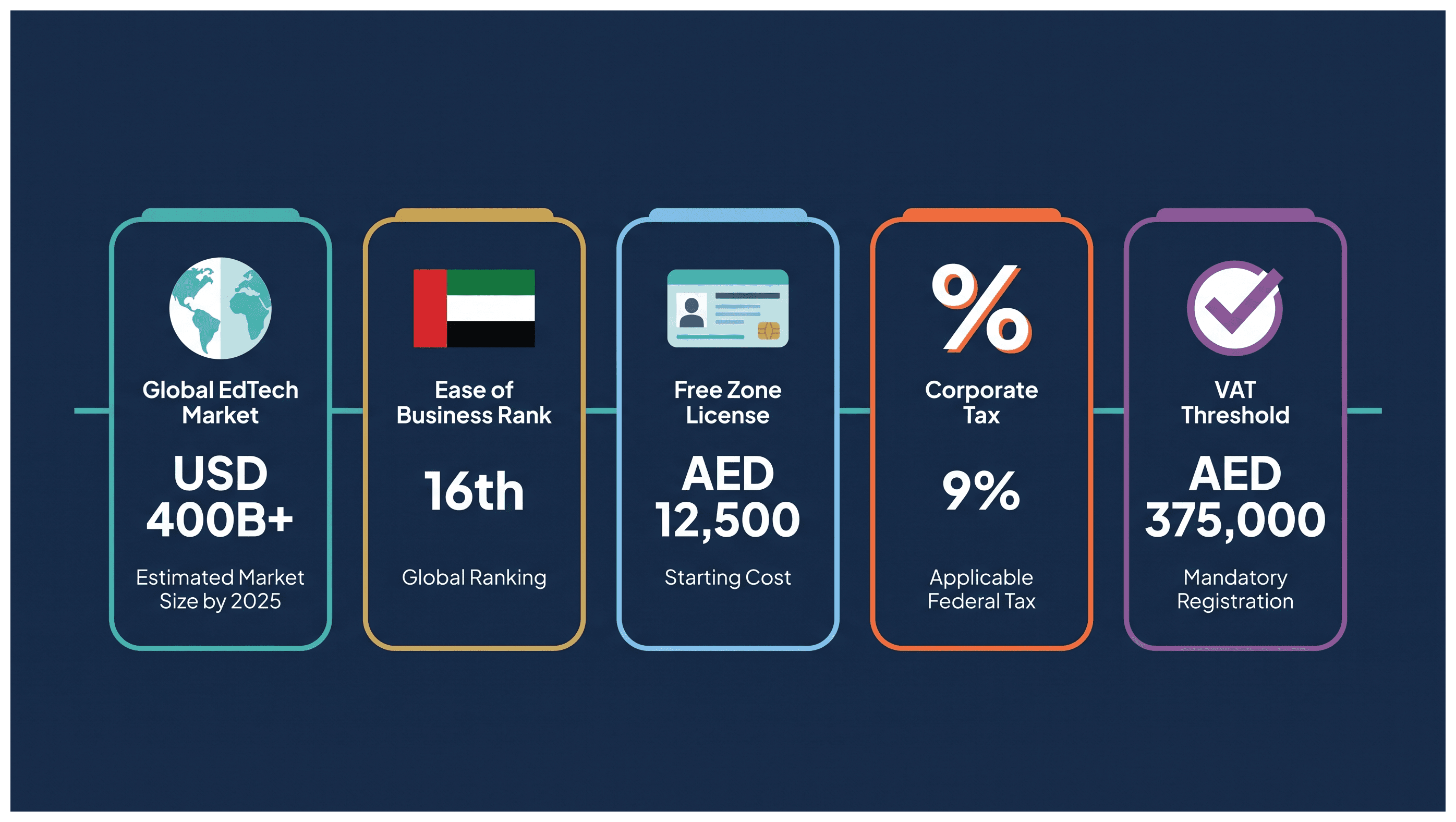
In 2026, the global EdTech market is projected to exceed USD 400 billion (Statista, 2025), and the UAE sits at the centre of that expansion. Government-backed digital learning mandates, a young digitally native population, and a free zone licensing environment that lets you launch an edtech business in Dubai in a single business day make this one of the most accessible markets for education technology founders. The DSBH Free Zone license starts at AED 12,500. The UAE ranked 16th globally for ease of doing business (World Bank, 2024). Corporate tax applies from financial years starting 1 June 2023 at 9%. VAT registration is mandatory at AED 375,000 annual turnover. KHDA approval is required before any instruction reaches Dubai-based learners.
This guide covers the regulatory requirements, realistic costs, and exact steps to set up your edtech business in Dubai, including which regulator approves your activity alongside your free zone license.
What Is an EdTech Business in Dubai and Why It Matters
An EdTech business in Dubai is a company that delivers education technology products or services, such as e-learning platforms, digital curricula, or learning management systems, under a UAE free zone or mainland license, with regulated activities requiring separate approval from the Knowledge and Human Development Authority (KHDA).
How EdTech Is Defined Under UAE Commercial Law
EdTech is not a single license category. It spans software-led instruction, content licensing, assessment tools, corporate training platforms, and hybrid learning products. Under ISIC Revision 4, the activity straddles Section J (Information and Communication) and Section P (Education). The principal activity is the one generating the highest share of value added, determined using the ISIC top-down method, and that classification drives which regulator gets involved.
UAE licensing authorities classify the activity by what the business primarily delivers, not by the technology channel used. A Dubai-based startup offering a subscription SaaS platform for K-12 Arabic-language tutoring, for example, would be classified primarily under education services. That classification triggers KHDA involvement alongside the free zone license, regardless of how sophisticated the underlying software is.
Why Dubai Is a Competitive Location for EdTech Founders
The UAE's National Education Strategy and Vision 2031 create consistent public-sector demand for EdTech products (UAE Government Portal, 2024).
Free zone structures offer 100% foreign ownership and full repatriation of profits, no local sponsor required.
Dubai's geography connects you to GCC, South Asia, and African education markets from one legal entity. A European corporate training provider can serve clients across six GCC countries using a single Dubai free zone entity without establishing separate legal presences in each country.
EdTech Business Dubai Requirements: Licenses and Approvals
To operate an edtech business in Dubai you need a free zone or mainland trade license covering your specific activity, plus separate regulatory approval from the Knowledge and Human Development Authority for any activity that involves delivering instruction or issuing educational content to learners in Dubai.
The Commercial License You Need
A free zone license from DSBH covers the legal entity and permits commercial operation. It's issued in one business day once your documents are complete. But the activity code you select at incorporation matters enormously. E-learning platform, education technology consultancy, digital content publishing, and learning management systems are distinct activity codes, not interchangeable labels.
Choosing the wrong code creates compliance risk when KHDA or DET review your operations. A founder launching an AI-powered language-learning app, for instance, should select a technology and education-aligned activity rather than a generic management consultancy code. You can explore the full list of business activities in Dubai to identify the right match before you submit.
KHDA Approval: The Regulated Layer
DSBH licenses the commercial entity. KHDA approves the regulated educational activity. Both are required before instruction begins. The Knowledge and Human Development Authority regulates all private education and training providers operating in Dubai, covering curriculum review, instructor qualifications, and platform content standards.
Corporate training platforms targeting only B2B clients may follow a different KHDA pathway than those targeting individual learners or schools. A platform offering accredited professional certification courses, for example, must obtain KHDA's private training institute registration before marketing those courses to Dubai-based learners. For mainland-registered EdTech entities, DET (Dubai Economy and Tourism) is also relevant alongside KHDA.
Document Checklist for Incorporation
Passport copies of all shareholders and directors
Proof of residential address for each shareholder (utility bill or bank statement, not older than three months)
Proposed trade name, check trade name availability before submission to avoid delays
Business activity description matching the intended KHDA-regulated scope
DSBH Free Zone EdTech License Package Comparison
Feature | Package | Price and Inclusions |
|---|---|---|
0 Visa Package | Company only, no visa allocation | AED 12,500, includes license, Articles of Association, share register, flexi-desk space |
1 Visa Package | Company plus one investor or partner visa allocation | AED 16,350, all 0 Visa inclusions, plus one visa allocation and establishment card |
2 Visa Package | Company plus two investor or partner visa allocations (maximum available) | AED 18,200, all 0 Visa inclusions, plus two visa allocations and establishment card |
Core inclusions, all packages | Included in every package regardless of visa tier | License, Articles of Association, share register, flexi-desk space, and lease agreement |
Visa allocation and establishment card | 1 Visa Package and 2 Visa Package only | Investor or partner visa allocation included; establishment card issued with the license |
Visa processing costs | Quoted separately, applies to all packages | Entry permit, status change, medical examination, Emirates ID application are priced separately from all package fees |
EdTech Business Dubai Costs: Packages and What They Include
Setting up an edtech business in Dubai through DSBH Free Zone starts at AED 12,500 for the 0 Visa Package. The 1 Visa Package is AED 16,350 and the 2 Visa Package is AED 18,200. Every package includes the license, Articles of Association, share register, flexi-desk space.
DSBH Free Zone Package Breakdown
0 Visa Package, AED 12,500: License, Articles of Association, share register, flexi-desk space, and lease agreement. No visa allocation.
1 Visa Package, AED 16,350: All of the above, plus one investor or partner visa allocation and establishment card.
2 Visa Package, AED 18,200: All of the above, plus two visa allocations and establishment card. This is the maximum allocation available on a DSBH license.
Visa processing: Entry permit, status change, medical, Emirates ID, and stamping are quoted separately for every package.
A solo EdTech founder who needs a company and a UAE residence visa would select the 1 Visa Package at AED 16,350, then budget separately for visa processing costs. You can calculate your business setup cost using the DSBH cost calculator before committing.
Additional Costs to Budget For
KHDA registration and annual renewal fees, charged directly by KHDA, not included in the DSBH package
Visa processing fees for each visa holder (entry permit, status change, medical, Emirates ID)
Corporate bank account opening, required for operations; fees vary by bank
Annual license renewal, plan for this from year one
AED 10,000 one-time penalty for late corporate tax registration with the Federal Tax Authority (FTA, 2023)
AED 10,000 penalty for late VAT registration once the AED 375,000 annual turnover threshold is reached
How to Set Up an EdTech Business in Dubai: Step-by-Step
To set up an edtech business in Dubai: choose your license activity, check your trade name, submit incorporation documents to DSBH Free Zone, receive your license within one business day, then apply for KHDA approval for regulated educational activities before delivering any instruction to learners.
Step 1: Define Your Activity and Structure
Map your EdTech product to the correct education business license activity, e-learning, digital content publishing, education technology consultancy, or learning management systems.
Decide on shareholder structure: solo founder, co-founders, or a corporate shareholder holding shares in the Dubai entity.
Decide whether you need visa allocations at launch or can start with the 0 Visa Package and upgrade at renewal.
Step 2: Check Your Trade Name and Submit Documents
Check trade name availability before submission, a rejected name adds unnecessary delay.
Submit passport copies, proof of address (not older than three months), proposed trade name, and activity description to DSBH.
DSBH issues the license in one business day once all documents are complete and approved.
Step 3: Obtain KHDA Approval
Submit your platform or curriculum for KHDA review after the free zone license is issued.
Provide instructor qualifications, content samples, and delivery methodology as part of KHDA's assessment process.
KHDA approval timelines vary by activity type, factor this into your go-to-market schedule from day one.
Only begin delivering instruction to Dubai-based learners after KHDA approval is confirmed.
A corporate upskilling platform targeting UAE enterprises should engage KHDA early. Approval timelines can directly affect client contract start dates, so treat the KHDA process as parallel to your commercial setup, not sequential.
How long does KHDA approval take for an EdTech business in Dubai?
KHDA approval timelines vary by activity type and the complexity of the curriculum or platform submitted for review. Corporate training providers typically experience a shorter assessment period than those seeking accredited qualification delivery. Engage KHDA immediately after your DSBH license is issued and build at least four to eight weeks into your go-to-market schedule.
Step 4: Open a Bank Account and Register for Tax
Open a UAE corporate bank account using your DSBH license documents, Articles of Association, and share register. For guidance on bank account opening in Dubai, DSBH's beyond-hub services cover this process.
Register for corporate tax with the Federal Tax Authority. Late registration carries a one-time AED 10,000 penalty.
Register for VAT once annual taxable turnover reaches or is expected to reach AED 375,000. Late VAT registration also carries an AED 10,000 penalty.
Free zone companies may qualify for 0% corporate tax on qualifying income if all four Qualifying Free Zone Person (QFZP) conditions set by the FTA are met simultaneously. The standard rate is 9%.
Tax and Compliance Obligations for an EdTech Business in Dubai
An edtech business in Dubai must register for corporate tax with the FTA. Free zone companies may qualify for 0% on qualifying income if all four QFZP conditions are met; otherwise the standard 9% rate applies. VAT registration is mandatory once annual taxable turnover reaches AED 375,000.
Corporate Tax: What EdTech Founders Must Know
The UAE corporate tax rate is 9% for financial years starting on or after 1 June 2023. Free zone companies may qualify for 0% on qualifying income under the Qualifying Free Zone Person regime, but all four FTA conditions must be met simultaneously, there is no partial qualification. The late registration penalty is a one-time flat AED 10,000 charge, so register as soon as your license is issued, regardless of revenue.
Worth flagging: never describe a free zone structure as tax-free. That framing is factually incorrect and can mislead investors or lenders reviewing your financials. The correct position is that qualifying income may attract a 0% rate subject to QFZP conditions, while non-qualifying income is taxed at 9% (Federal Tax Authority, 2023).
VAT Obligations for Digital Education Services
VAT registration is mandatory once annual taxable turnover reaches AED 375,000.
EdTech services delivered to UAE-based B2B clients are generally standard-rated at 5%. B2C and cross-border supplies may be treated differently, seek qualified tax advice for your specific product and delivery model.
Late VAT registration carries an AED 10,000 penalty.
Maintain accurate records from your first invoice. Retrospective VAT calculation is both complex and risky.
Visa Options and Residency for EdTech Business Owners
A DSBH Free Zone EdTech license supports up to two visa allocations. The investor or partner visa is included in the 1 Visa Package at AED 16,350 and the 2 Visa Package at AED 18,200. Visa processing, entry permit, status change, medical, Emirates ID, is quoted separately.
Understanding the Visa Allocation
The visa allocation in the 1 and 2 Visa Packages is the investor or partner visa. Each slot is a single allocation, not two separate visas per slot. The maximum available on any DSBH Free Zone license is two allocations total.
Two co-founders setting up an EdTech company together would select the 2 Visa Package at AED 18,200, then each budget individually for their own visa processing costs. Visa processing steps, entry permit, status change, medical examination, Emirates ID application, are completed after license issuance and priced separately. Full details on the UAE residency visa process are available through DSBH's residency services.
What happens if you need more than two visas?
DSBH Free Zone licenses support up to six visa allocations, with published packages offering 0, 1 or 2 per license. Founders who anticipate hiring employees requiring UAE residence visas beyond those two allocations should plan their staffing model and entity structure accordingly before incorporation. Discuss your headcount requirements with a DSBH adviser before selecting your package.
Setting up an edtech business in Dubai is a structured two-track process: secure your free zone license through DSBH (issued in one business day from AED 12,500) and obtain KHDA approval for your regulated educational activity before
References
Frequently Asked Questions