
Topic Summary
Maximum Probation Duration Is Six Months
Under Federal Decree-Law No. 33 of 2021, probation cannot exceed six months from the first working day. Any contract clause that sets a longer period is automatically void, and the excess time carries full permanent-employee protections.
Written Contract Clause Is Legally Required
The probation period must be stipulated in writing within the employment contract before the employee's first day of work. Adding it later as an amendment is not permitted under UAE law.
Minimum 14 Days' Notice Must Be Given
Both employers and employees must provide at least 14 calendar days' written notice when terminating during probation. Failing to serve this notice can result in mandatory compensation and MoHRE complaints.
Annual Leave Does Not Accrue During Probation
Employees on probation do not accumulate annual leave entitlements during that trial period. Sick leave also only becomes available after three months of continuous service.
No Gratuity Owed on Compliant Probation Termination
If an employer follows the correct notice procedures when ending employment during probation, no end-of-service gratuity is owed. This represents a significant cost saving compared to terminating a confirmed employee.
Wrongful Termination Can Cost AED 75,000 or More
Non-compliant termination during probation can trigger MoHRE-awarded compensation of up to three months' remuneration, plus administrative fees. A single case can easily exceed AED 75,000 in total costs.
Employees Can Only Serve One Probation Per Employer
An employee may only undergo one probation period with the same employer. If a worker is rehired, any new probation clause for that individual is unenforceable under UAE law.
In 2026, the UAE's private sector workforce exceeds 5 million employees, yet a significant share of employers still misapply employee probation UAE rules in ways that expose them to MoHRE complaints and wrongful-termination claims (Ministry of Human Resources and Emiratisation, 2025). Under Federal Decree-Law No. 33 of 2021, a probation period set incorrectly or terminated without proper notice can trigger mandatory compensation equivalent to three months' remuneration. The maximum probation duration is six months. The minimum notice period is 14 calendar days. Annual leave does not accrue during probation. Sick leave kicks in only after three months of continuous service. Non-compliant termination can cost an employer AED 75,000 or more in a single case.
This guide covers every rule governing employee probation in the UAE: the legal definition, employer requirements, notice obligations, permitted duration, termination procedures, and the step-by-step process for setting up a compliant probation clause in your employment contract. For more detail, see our guide on employment contract clauses in the UAE.
What Is Employee Probation in the UAE and Why It Matters
Employee probation in the UAE is a legally defined trial period of up to six months during which both the employer and employee can terminate the contract with reduced notice. It is governed by Federal Decree-Law No. 33 of 2021 and must be written into the employment contract before the employee starts work.
UAE Employee Probation Rules: Quick-Reference Summary
Rule | Requirement |
|---|---|
Maximum probation duration | Six months from the first working day; any clause exceeding this is void by operation of law |
Minimum notice period (employer or employee) | 14 calendar days' written notice, calculated from the date of delivery |
Annual leave accrual during probation | Does not accrue during the probation period |
Sick leave entitlement threshold | Begins after three months of continuous service; not applicable in the first 90 days |
End-of-service gratuity on probation termination | Not owed if the employer follows correct notice procedures during probation |
Maximum compensation for wrongful termination | Up to three months' remuneration, awarded by MoHRE |
Legal Definition Under Federal Decree-Law No. 33 of 2021
Under Article 9 of Federal Decree-Law No. 33 of 2021, employee probation in the UAE is a formal trial period capped at six months. Any clause that exceeds this cap is automatically void; the excess period carries full permanent-employee protections. The probation period must be stipulated in writing in the employment contract before the first day of work, not added later as an amendment (MoHRE, 2021).
One detail that trips up many HR teams: an employee may only serve one probation period with the same employer. If you re-hire someone who previously completed a probation with your company, a second probation clause for that same worker is unenforceable.
Take this real scenario: a logistics company in Dubai inserts a nine-month probation clause into its driver contracts. Under Article 9, the clause is automatically reduced to six months. The remaining three months carry full employment protections, meaning the employer cannot terminate without cause or without full notice entitlements during that window.
Why Correct Probation Setup Protects Your Business
Wrongly structured employee probation UAE clauses expose employers to MoHRE complaints and mandatory compensation of up to three months' remuneration. The flip side is equally important: a compliant probation clause protects you too. Termination during probation with correct notice carries no end-of-service gratuity obligation, which is a meaningful cost saving.
Errors in probation clauses are among the most common triggers for labour disputes filed through the MoHRE inquiry portal. Consider this: an HR manager at a Dubai retail chain terminates a sales associate on day 45 of probation without serving any notice. MoHRE rules this a breach; the employer pays 14 days' remuneration as compensation plus administrative fees. A single procedural gap becomes a direct financial loss.
Key Requirements for Employee Probation in the UAE
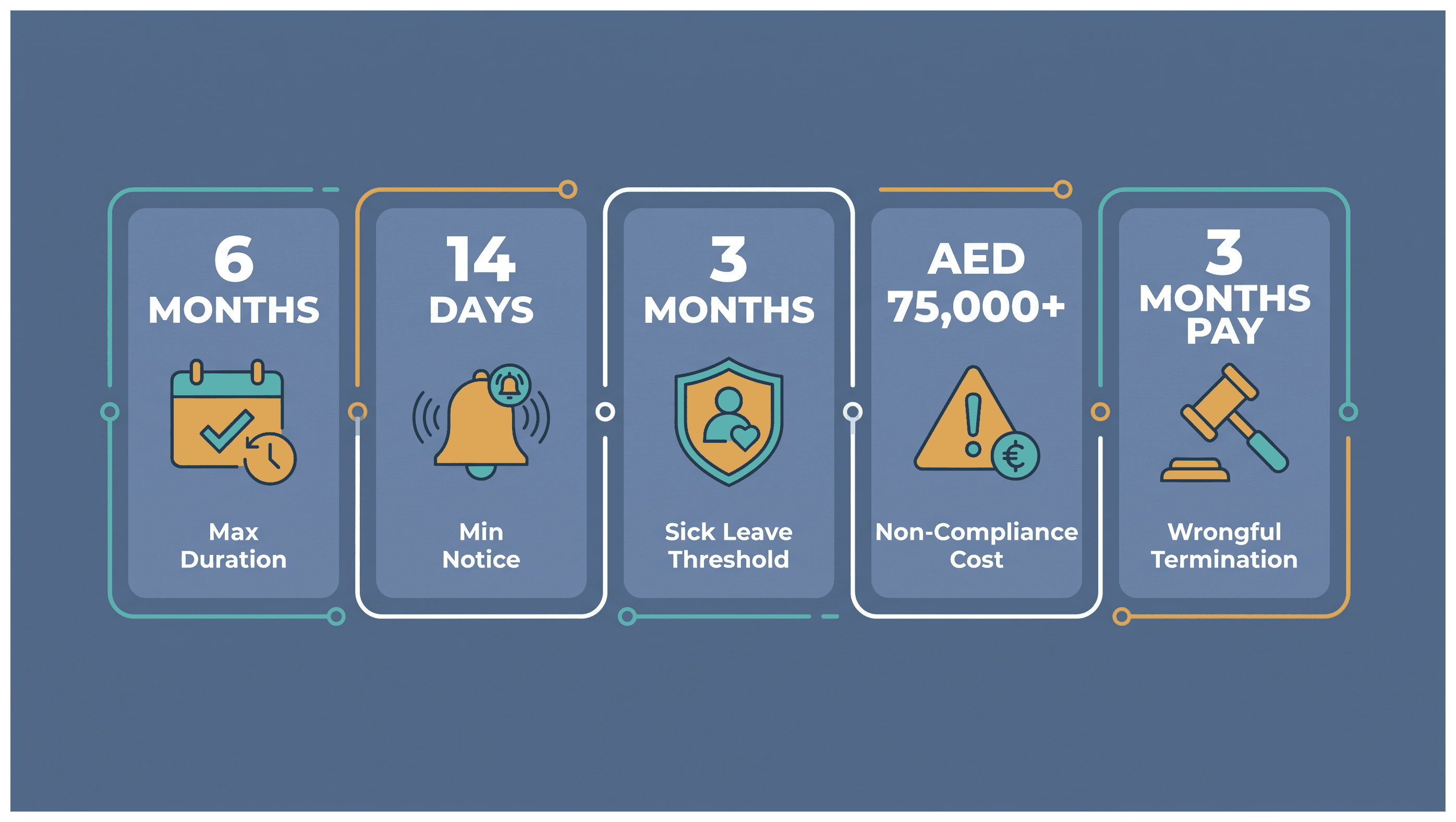
UAE law requires probation to be written into the employment contract, capped at six months, and terminated with a minimum 14 days' notice by the employer or employee. If the employee resigns to join a competitor during probation, the employer can claim compensation. Emiratisation quotas still apply during the probation period.
Contract and Duration Requirements
Probation must appear explicitly in the written employment contract. Verbal probation agreements have no legal standing.
Maximum duration is six months from the first working day. The period cannot be extended or renewed under any circumstances.
Annual leave does not accrue during probation.
Sick leave entitlement begins only after three months of continuous service.
All other statutory protections apply from day one: working hours, overtime rules, and workplace safety obligations remain in full effect.
Here's a practical illustration: a Dubai-based technology consultancy signs a contract with a new project manager specifying a four-month probation. The employee falls ill in month two. Sick leave entitlement does not apply until month three, but the employer cannot extend the probation to compensate for sick days taken. The four-month clock keeps running regardless.
Notice Obligations During Probation
Employer terminating during probation: minimum 14 calendar days' written notice is mandatory.
Employee resigning during probation: minimum 14 calendar days' written notice is mandatory.
If the employee resigns during probation to join another UAE employer, the new employer is liable to compensate the original employer for documented recruitment costs, unless the new employer waives this in writing.
If the employee leaves the UAE entirely after resigning during probation, no compensation is triggered, but a one-year UAE employment ban may apply (u.ae, 2024).
A marketing executive resigns on day 60 of a six-month probation to join a competitor agency. The original employer submits a compensation claim to MoHRE; the new agency pays an amount equivalent to the original employer's documented recruitment costs. This is not a hypothetical risk: MoHRE actively processes these claims.
Emiratisation and Workforce Obligations During Probation
Emiratisation quotas set by MoHRE count probationary Emirati employees toward the employer's quota from day one. Employers in targeted private-sector categories must maintain their Emiratisation ratios regardless of whether those Emirati employees are on probation or permanent contracts.
Nafis incentives, which provide wage support for Emirati hires, apply from the first month of employment, including during probation (Nafis, 2025). A financial services firm with 50 employees hires two Emirati graduates on six-month probation. Both count toward the firm's Emiratisation quota immediately, and the firm qualifies for Nafis wage-support payments from month one. The probationary status changes nothing from a quota or incentive perspective.
Costs and Financial Implications of Employee Probation in the UAE
There is no government fee to set a probation period, but non-compliance carries direct financial risk. Wrongful termination during employee probation in the UAE can trigger compensation of up to three months' remuneration. Employers must also budget for a trade license and visa package before onboarding any employee.
Direct Costs of Non-Compliance
Wrongful termination during probation: MoHRE can award up to three months' remuneration to the aggrieved employee.
Failure to serve 14 days' notice: the employer must pay wages in lieu for every unserved notice day.
Recruiting and onboarding a replacement after a failed probation termination adds indirect cost; industry estimates place average replacement cost at one to three months' salary.
The numbers add up fast. A construction project manager earning AED 25,000 per month is terminated on day 10 of probation with no notice. The employer pays AED 75,000 in wrongful-termination compensation (three months' salary) plus 14 days' wages in lieu of notice, bringing the total liability to approximately AED 87,000 from a single procedural error.
License and Visa Costs for Employers Setting Up in Dubai
You need a valid trade license and establishment card before you can legally employ staff in the UAE. A Dubai South Business Hub (DSBH) Free Zone trade license is issued in one business day. Use the business setup cost calculator to confirm your exact package before committing.
0 Visa Package: AED 12,500, includes the trade license, Articles of Association, share register, flexi-desk space.
1 Visa Package: AED 16,350, adds one investor or partner visa allocation and the establishment card.
2 Visa Package: AED 18,200, adds two investor or partner visa allocations and the establishment card.
Visa processing (entry permit, status change, medical, Emirates ID) is quoted separately.
A Dubai-based HR consultancy selects the 1 Visa Package at AED 16,350. The license arrives the next business day. The founder then uses the establishment card to initiate employee work permit applications through MoHRE. Without the establishment card, contract registration, including any probation clause, cannot proceed.
Step-by-Step Guide to Managing Employee Probation in the UAE
Managing employee probation in the UAE correctly requires six steps: draft a compliant contract, register it with MoHRE, set calendar reminders for key notice windows, document performance formally, serve written notice if terminating, and close the probation period in writing. Each step must be completed before moving to the next.
Step 1: Draft a Legally Compliant Employment Contract
State the probation period explicitly in the contract body, not in a side letter or addendum.
Specify the start date, end date, and the 14-day notice obligation for both parties.
Use the MoHRE-approved bilingual contract templates available on the MoHRE portal to avoid drafting errors.
The Arabic version governs in any dispute; always have it signed first.
An accounting firm drafts a bilingual contract using the MoHRE template, specifying a four-month probation period with a 14-day mutual notice clause. The Arabic version is signed first. This single step eliminates the most common source of probation disputes before the employee even starts.
Step 2: Register the Contract and Set Compliance Milestones
Register the employment contract with MoHRE through the Tasheel service or the MoHRE employer portal before the employee's first working day (MoHRE, 2024).
Set a calendar reminder at the 14-day pre-expiry mark to issue a probation-pass or termination notice in time.
Set a separate reminder at day 75 if the contract includes a three-month sick-leave threshold.
In practice, an HR manager registers a new employee's contract on the MoHRE portal on the same day the contract is signed, then sets two calendar alerts: one at day 75 (sick-leave threshold) and one at day 167 (14 days before a six-month probation ends). This two-alert system is a simple safeguard that many HR teams overlook. For guidance on using the MoHRE employer portal, the MoHRE inquiry system guide walks through each step.
Step 3: Document Performance and Issue a Formal Closing Notice
Maintain a written performance log throughout the probation period. Verbal feedback alone is insufficient if a dispute arises.
If performance is satisfactory, issue a written probation-pass confirmation on or before the final day of probation.
If terminating, serve written notice at least 14 calendar days before the intended last working day.
Update the MoHRE contract record to reflect the transition from probationary to permanent status once the employee passes.
A Dubai hospitality group confirms a new front-of-house manager's probation by email on day 178 of a six-month contract, simultaneously updating the MoHRE record to permanent status. The paper trail eliminates any ambiguity about the employee's protections going forward.
Is there a standard MoHRE template for probation contracts?
Yes. MoHRE provides bilingual Arabic-English employment contract templates on its employer portal. These templates include a dedicated field for the probation period, start and end dates, and the 14-day notice clause. Using the official template reduces the risk of clauses being deemed unenforceable in a labour dispute.
Termination During Employee Probation in the UAE: Employer Rules
An employer can terminate an employee during UAE probation by serving at least 14 calendar days' written notice. No end-of-service gratuity is owed on a compliant probation termination. However, terminating without notice or on discriminatory grounds triggers mandatory compensation and potential MoHRE sanctions.
Grounds and Procedures for Employer Termination
Employers do not need to prove cause to terminate during probation, but the termination must not be discriminatory or retaliatory.
Serve a written termination notice stating the last working day; retain a copy signed by the employee as acknowledgment.
Calculate 14 calendar days from the date of notice delivery, not from the date of signing.
Settle all outstanding wages, including any taken-leave deductions, on or before the last working day.
A Dubai media company decides not to retain a content writer after 90 days of probation. HR delivers a written notice on 1 March; the last working day is 15 March. Final wages and any taken-leave deductions are processed by 15 March. Clean, documented, and compliant. If you need support with UAE residency visa processing for employees who are continuing, that runs separately through the establishment card.
Situations Where Termination Triggers Compensation
Terminating without serving the 14-day notice: the employer pays wages in lieu for the unserved days.
Terminating for discriminatory reasons (gender, nationality, religion, pregnancy): MoHRE can award up to three months' remuneration.
Terminating after the probation period has already lapsed without formal extension: the employee is deemed permanent and full redundancy rules apply.
References
Frequently Asked Questions