
Topic Summary
Understand Options vs. Direct Share Grants
An employee share option grants the right to buy shares later at a fixed price, while a direct grant transfers ownership immediately. This distinction matters because no free zone authority approval is triggered at grant date with options, giving employers valuable early-stage flexibility.
Know Which Company Types Can Participate
Free zone LLCs, mainland LLCs, and public joint stock companies can all legally issue share options, but the procedural path differs for each. Mainland transfers require DET registration and potential notarisation, while free zone transfers need authority approval within 10 to 15 business days.
Choose the Right Vesting Structure Early
Cliff vesting grants 100% of options on a single future date and is simple to administer, but creates a resignation risk once that date passes. Graded vesting spreads incentives across the employment period and can better support long-term retention goals.
Document Every Option Agreement Before Granting
UAE law requires that the grant date, exercise price, vesting schedule, and lapse conditions all be specified in writing before any options are issued. Missing documentation can create legal and tax complications that are costly to unwind later.
Plan Around the 9% Corporate Tax Rate
The UAE's 9% corporate tax applies from financial years starting 1 June 2023, and equity-settled share plans are treated differently from cash-settled phantom schemes for deductibility purposes. Getting the structure right from the outset avoids expensive rework at tax time.
Factor In Free Zone Registration Costs and Timelines
A DSBH Free Zone license, which includes the share register required for a compliant plan, can be issued in one business day at AED 12,500. By contrast, late corporate tax registration carries a one-time AED 10,000 penalty, making early compliance a clear financial priority.
Address Talent Retention Before It Becomes a Crisis
Fewer than one in five early-stage UAE companies has a documented share option plan, yet talent retention is the top growth barrier cited by Gulf founders. Launching a structured employee share scheme early positions a company to compete for and keep key hires.
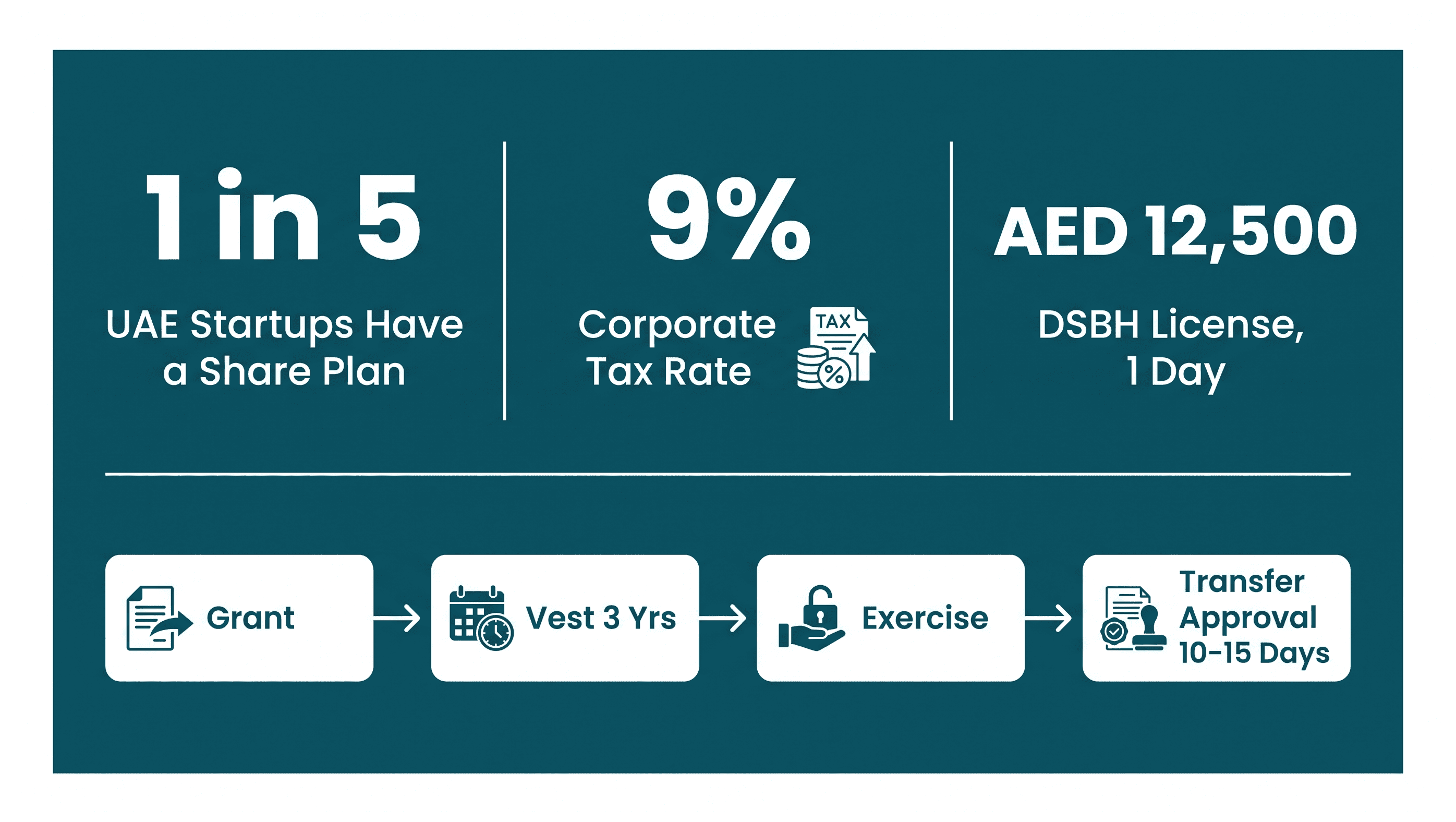
Fewer than one in five early-stage UAE companies has a documented employee share company UAE plan in place, yet talent retention is consistently the top growth barrier cited by Gulf founders (Magnitt, 2025). The UAE's 9% corporate tax rate applies from financial years starting 1 June 2023 (Federal Tax Authority, 2023). Late corporate tax registration carries a one-time AED 10,000 penalty. Free zone share transfer approvals typically require 10 to 15 business days. And a DSBH Free Zone license, including the share register you need, is issued in one business day at AED 12,500.
This guide covers the legal requirements, vesting structures, valuation rules, the free zone authority position on share transfers, and the corporate tax treatment employers need to understand before launching a share option scheme for their employee share company UAE setup.
What Are Employee Share Options in a UAE Company
An employee share option in a UAE company is a contractual right granted to an employee to purchase a set number of shares at a fixed price on or after a future date. The right is typically conditional on continued service and is governed by UAE Federal Law No. 2 of 2015 and the relevant free zone authority rules. The option is not a share itself, it is the right to acquire one, subject to conditions you define in the agreement.
How Share Options Differ from Direct Share Grants
An option gives the right, but not the obligation, to buy shares at a pre-agreed exercise price. A direct grant transfers ownership immediately. That distinction matters operationally: with a direct grant, the free zone authority must approve the share transfer on day one. With an option, no transfer occurs until the employee exercises, so no free zone approval is triggered at grant date.
Consider a Dubai South Business Hub (DSBH) Free Zone technology company that grants 10 employees options over 5% of its shares at a strike price of AED 1 per share, exercisable after a three-year cliff vest. No share transfer occurs until exercise, so no free zone approval is needed at grant date. That timing gap is a practical advantage when you're building your employee share company UAE structure early and want flexibility.
The distinction also affects corporate tax deductibility. Equity-settled plans (where actual shares transfer) are treated differently from cash-settled phantom schemes (where the company pays a cash equivalent). Getting this right from the start saves rework later.
Which UAE Company Types Can Issue Share Options
Free zone LLCs (FZ-LLCs): The most common vehicle for employee share option plans among UAE SMEs. Share transfers require free zone authority approval.
Mainland LLCs: Can issue options, but any resulting share transfer must be registered with the Department of Economic Development (DET) and, where applicable, notarised.
Public joint stock companies (PJSCs): Face additional Securities and Commodities Authority requirements, which are outside the scope of most SME plans.
Both mainland and free zone structures can legally support an employee share company UAE plan. The procedural path differs; the legal right to issue options does not (Ministry of Economy, 2024).
Vesting Schedules and Option Agreement Requirements
A UAE employee share option agreement must specify the grant date, exercise price, vesting schedule, and conditions for lapse. Cliff vesting (full entitlement after a single period) and graded vesting (incremental rights over time) are both valid under UAE employee share uae requirements. The chosen structure must be documented before any options are granted.
Cliff Vesting vs. Graded Vesting
Cliff vesting means 100% of options vest on a single future date, commonly 12 or 36 months after grant. It's simple to administer, but it creates a resignation risk immediately after the cliff passes.
Graded vesting spreads the incentive across the employment period. A UAE-based SaaS company, for example, might use a four-year graded vest with a one-year cliff: 25% vests at month 12, then 6.25% per quarter thereafter. This structure aligns with international investor expectations and is common across Gulf tech companies.
One practical point worth flagging: MoHRE labour contracts govern the underlying employment relationship, and option agreements sit alongside those contracts, not inside them. If an employee is terminated without cause, the option agreement must address whether unvested options lapse immediately or are pro-rated. Silence on this point creates disputes. You can check your obligations via the MoHRE inquiry portal before finalising the agreement.
Mandatory Clauses in a UAE Option Agreement
Grant date and number of shares under option.
Exercise price, stated in AED or a foreign currency with a documented conversion mechanism.
Vesting conditions: time-based, performance-based, or both.
Good leaver and bad leaver provisions covering vested and unvested options on termination.
Governing law clause: UAE law is standard; DIFC or ADGM law applies for entities incorporated in those jurisdictions.
Your Articles of Association must permit the issuance of options before any grant is made. If they don't, amend them first. MoHRE employment contract terms cannot be reduced by a separate option agreement.
Valuation and Regulatory Requirements for UAE Share Option Plans
UAE companies must establish a defensible fair market value at both the grant date and the exercise date. Unlisted companies typically use discounted cash flow or net asset value methods. The Ministry of Economy and free zone authorities do not prescribe a single methodology but expect documented, auditable valuations for any share transfer approval as part of employee share uae guide compliance.
Accepted Valuation Methodologies for Unlisted UAE Companies
Discounted cash flow (DCF) projects future free cash flows and discounts at a risk-adjusted rate. It works best for companies with predictable, recurring revenue.
Net asset value (NAV) sums the fair value of assets less liabilities. It's more appropriate for asset-heavy businesses where cash flows are harder to project.
Comparable transactions or revenue multiples benchmark your company against recent deals in the same sector. Magnitt publishes regional deal data that supports comparable-transaction valuations for Gulf tech and venture-backed companies.
Whichever method you choose, apply it consistently across grant cycles. Switching methodology without documented justification creates audit risk, particularly now that corporate tax filing requires auditable records.
Free Zone Authority Position on Share Transfers
Every free zone authority must approve share transfers before they are legally effective. This applies when an employee exercises their option and shares are issued or transferred. The transfer is void without written authority approval, not voidable, void.
When an employee at a DSBH Free Zone company exercises options, the employer files a share transfer application with the free zone authority, attaches the signed transfer deed and updated share register, and waits for written approval before the employee is recorded as a shareholder. Required documents typically include:
The original option agreement.
A board resolution approving the specific transfer.
An updated shareholder register.
The authority's prescribed transfer form.
Build a buffer of at least 10 to 15 business days into the exercise window. Updated Articles of Association may also be required if the option pool changes the total issued share capital.
Step-by-Step Guide to Setting Up an Employee Share Option Plan
Setting up an employee share company UAE plan involves four core phases: preparing your corporate documents, obtaining a valuation and drafting the agreement, passing the board resolution, and managing exercise and transfer approval. Here's how each phase works in practice.
Step 1: Review Your Articles of Association and Share Structure
Confirm whether your current Articles of Association permit the creation of an option pool. If not, pass a shareholder resolution to amend them and file the updated version with your free zone authority.
Decide the total option pool size as a percentage of issued share capital. A range of 10% to 15% is commonly cited in early-stage Gulf company term sheets (UNVERIFIED: <10%–15%>. Confirm before publishing).
Check whether existing shareholders hold pre-emption rights that would be triggered by new share issuances. These must be waived or addressed before you create the pool.
Confirm that your chosen business activities are compatible with share issuance under your free zone authority's rules.
Step 2: Obtain a Valuation and Draft the Option Agreement
Commission an independent valuation using DCF, NAV, or comparable-transaction methodology. Audited financial statements strengthen the report significantly.
Draft the option agreement covering all mandatory clauses: grant date, exercise price, vesting schedule, good/bad leaver provisions, and governing law.
Have the agreement reviewed by a UAE-qualified lawyer. This article is not legal advice and does not substitute for qualified legal counsel.
Align vesting terms with any investor shareholder agreement already in place to avoid conflicts at a future funding round.
Step 3: Pass the Board Resolution and Notify the Authority
Pass a formal board or shareholder resolution approving the option scheme, the pool size, and the grant terms.
Notify your free zone authority of the option pool creation. Some authorities require a pre-approval or a note on the share register at this stage.
Issue individual grant letters to each participating employee and retain signed copies on file.
Update the internal share register to reflect the reserved option pool.
Step 4: Manage Exercise and Free Zone Transfer Approval
When an employee exercises options, prepare the transfer deed, updated share register, and a board resolution approving the specific transfer.
Submit the share transfer application to the free zone authority with all supporting documents.
Allow 10 to 15 business days for processing. Do not record the employee as a shareholder until written approval is received.
Update the Certificate of Incorporation and share register once approval is confirmed. Keep copies of all transfer approvals for corporate tax and audit purposes.
What happens to unvested options if an employee resigns?
Under a well-drafted UAE option agreement, unvested options lapse on the termination date unless the employee qualifies as a "good leaver" under the agreement's definitions. Good leaver status typically preserves a pro-rated portion of unvested options. The agreement, not the MoHRE contract, governs this outcome, so the drafting must be precise.
Tax Treatment of Employee Share Options in the UAE
The UAE does not impose personal income tax on employees, so no tax liability arises for the employee at grant, vest, or exercise. Employers face corporate tax considerations: equity-settled share-based payments may be deductible in the period of exercise, but the plan must be structured carefully to qualify. This is a key part of any employee share uae guide for 2026.
Corporate Tax Implications for the Employing Company
The UAE introduced a 9% corporate tax rate for financial years starting on or after 1 June 2023 (Federal Tax Authority, 2023). Equity-settled share-based compensation is generally deductible when shares are actually transferred to the employee, not at grant. Timing matters: a grant in year one may not generate a deduction until year four when the employee exercises.
Cash-settled phantom schemes, where the company pays cash equal to the share price gain rather than issuing actual shares, are treated as a salary expense and deducted in the period of payment. That's simpler from a deduction standpoint but removes the employee's ownership stake.
Companies that qualify as a Qualifying Free Zone Person (QFZP) may benefit from a 0% rate on qualifying income, but four conditions must all be met: the entity must be a free zone person, derive qualifying income, not elect to be subject to the standard rate, and satisfy the de minimis non-qualifying revenue test. Late corporate tax registration carries a one-time flat penalty of AED 10,000.
DSBH Free Zone Package Comparison for Share Option Companies
Package | Price (AED) | What Is Included |
|---|---|---|
0 Visa Package | AED 12,500 | License, Articles of Association, share register, flexi-desk space, lease agreement. Ideal for founders already resident who need the corporate structure for option pool creation. |
1 Visa Package | AED 16,350 | All 0 Visa inclusions plus one investor or partner visa allocation and establishment card. Suits a sole founder relocating to manage the option-issuing entity. |
2 Visa Package | AED 18,200 | All 0 Visa inclusions plus two investor or partner visa allocations and establishment card. up to six visa allocations, with published packages offering 0, 1 or 2 available. Suited to co-founding teams of two. |
Visa Processing | Quoted separately | Entry permit, status change, medical, Emirates ID. Not included in any package price above. |
License Issuance Time | 1 business day | Share register available immediately after incorporation, enabling option pool setup without delay. |
VAT Considerations and Registration Triggers
The grant or exercise of share options is not a taxable supply for UAE VAT purposes. Shares are exempt financial instruments under UAE VAT law.
Advisory or management services provided in connection with the scheme may carry a VAT liability. Check whether your service provider charges VAT on scheme administration fees.
If the option scheme triggers a corporate restructuring that changes your VAT group, notify the Federal Tax Authority promptly.
Late VAT registration carries a separate AED 10,000 penalty. Both the corporate tax and VAT penalties can apply simultaneously if a single corporate event triggers both registration obligations.
For a broader view of your UAE tax obligations, the banking and taxation services guide covers registration timelines and compliance requirements in detail.
DSBH Free Zone License Options for Companies Issuing Share Options
Any UAE company can implement an employee share option plan regardless of where it is licensed, provided the underlying company structure supports share issuance. A DSBH Free Zone license is issued in one business day and includes the Articles of Association, share register, flexi-desk space, giving you the foundational documents a share option plan requires from day one.
Which DSBH Package Suits an Option-Issuing Company
A co-founding team of two setting up a technology consultancy at DSBH chose the 2 Visa Package at AED 18,200. Both founders received investor visa allocations. Before their first employee joined, they amended the Articles to create a 10% option pool, using the share register issued at incorporation as the base document. The entire corporate structure was ready within one business day of license issuance.
0 Visa Package at AED 12,500: License, Articles of Association, share register, flexi-desk, and lease agreement. Best for founders already resident in the UAE who need the corporate structure for option issuance.
1 Visa Package at AED 16,350: Adds one investor or partner visa allocation and establishment card.
2 Visa Package at AED 18,200: Adds two investor or partner visa allocations and establishment card. up to six visa allocations, with published packages offering 0, 1 or 2 available. Visa processing (entry permit, status change, medical, Emirates ID) is quoted separately from all package prices.
References
Frequently Asked Questions