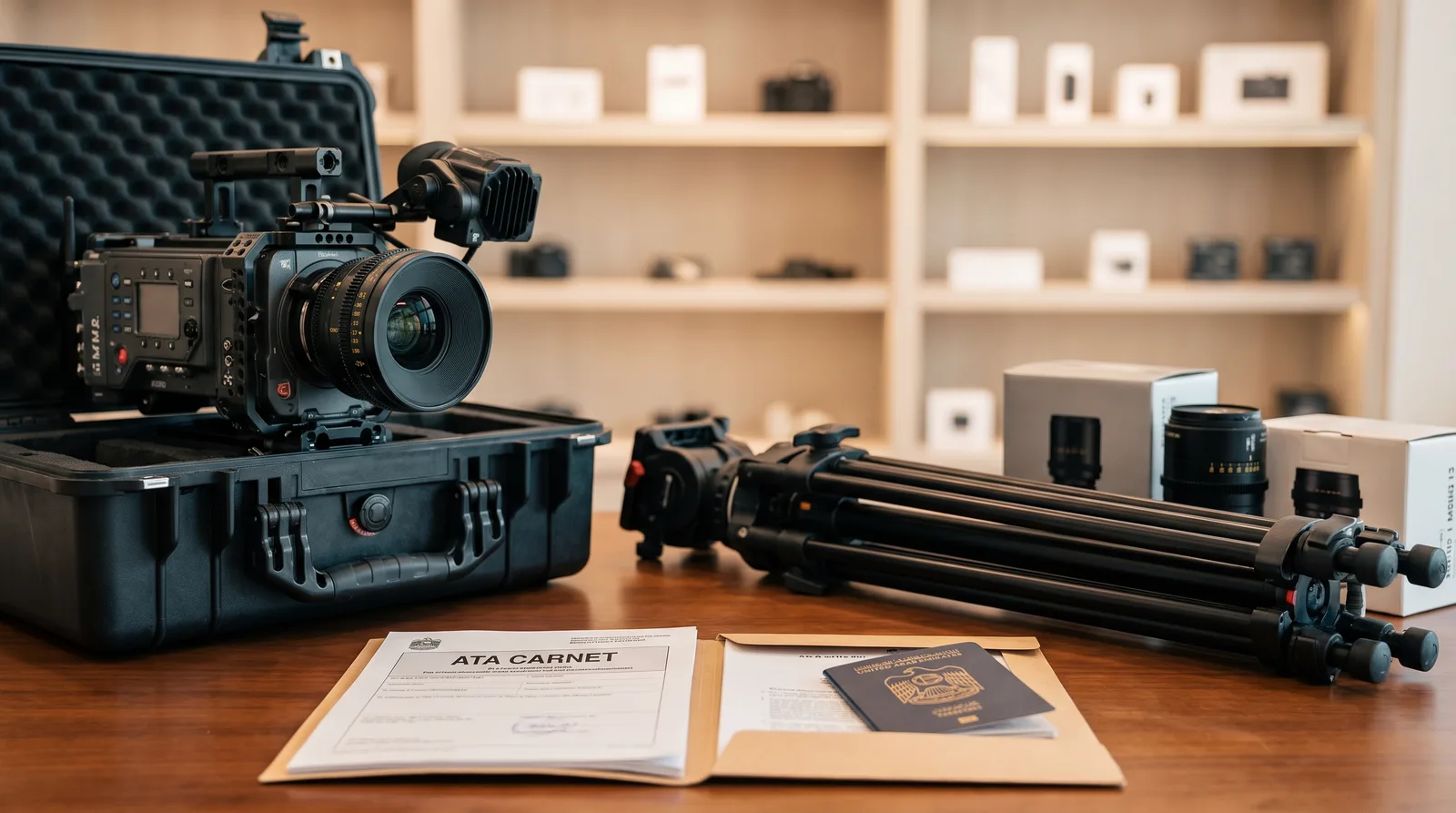
Topic Summary
Understand What an ATA Carnet Actually Does
An ATA Carnet lets production crews bring professional equipment into the UAE temporarily without paying import duty or VAT upfront. It acts as both a customs declaration and a financial guarantee, valid for up to 12 months from first entry.
Know the Duty-Suspended vs. Duty-Exempt Distinction
Equipment admitted under an ATA Carnet is duty-suspended, not duty-exempt, meaning full duty and VAT become payable immediately if the gear is not re-exported before the carnet expires. The standard GCC customs duty rate is 5% of CIF value, plus a flat 5% VAT on imports.
Keep Consumables Off Your Carnet General List
Items like replacement batteries, film stock, or any goods purchased for use inside the UAE are ineligible for carnet coverage and will be rejected at the desk. These consumables require a separate import declaration, which can cause unexpected delays and costs on set.
Prepare Every Document Before You Reach the Port
A complete equipment import checklist includes the ATA Carnet, a commercial or pro-forma invoice with correct HS tariff codes and currency denomination, and a valid trade license matching your production activity. Any mismatch between the General List values and your invoice is grounds for invalidation.
List Every Item With Full Serial Number Detail
Each piece of equipment on the Carnet General List must include a precise description, serial number where applicable, quantity, weight, and declared value. Missing or vague entries are a common reason customs clearance stalls, even for experienced production companies.
Report Damaged Equipment to Customs Immediately
If any equipment is damaged beyond repair while inside the UAE, you must notify Dubai Customs right away, as a duty assessment will follow. Failing to report damage before re-export can trigger the full duty and VAT liability on that item.
Verify Which Entry Points Accept ATA Carnets
Dubai Customs, Abu Dhabi Customs, and Sharjah Customs all recognise ATA Carnets, but using an unlisted port of entry can invalidate the document entirely. Confirm your specific entry point is named or permitted under your carnet before travel.
In 2026, the UAE processes over 70 million tonnes of cargo annually through its ports and airports (DP World, 2025). Dubai International Airport alone handled 2.7 million tonnes of air freight in 2024 (Dubai Airports, 2025). The standard GCC customs duty rate sits at 5% of CIF value. VAT on imports is a flat 5%. Late VAT registration carries a AED 10,000 penalty (Federal Tax Authority, 2025). Yet equipment import carnet UAE procedures still catch production companies off guard every year, producing avoidable duty bills and shoot delays.
This guide gives you a complete equipment import UAE checklist: every document you need, who issues it, what it's used for, and exactly what invalidates it, so your production clears customs without surprises.
What Is an ATA Carnet and How It Works for UAE Productions
An ATA Carnet is an international customs document that allows professional equipment to enter the UAE temporarily without payment of import duty or VAT. Issued by a guaranteeing chamber of commerce, it serves as both a customs declaration and a financial guarantee, valid for up to 12 months from first importation.
The Legal Basis for Temporary Admission in the UAE
The UAE is a contracting party to the Istanbul Convention on temporary admission, which is the treaty framework underpinning the ATA Carnet system globally. Domestically, the GCC Common Customs Law provides the procedural rules for temporary admission at UAE ports. Dubai Customs, Abu Dhabi Customs, and Sharjah Customs all recognise ATA Carnets at their respective entry points.
One distinction that matters: equipment admitted under an equipment import carnet UAE is duty-suspended, not duty-exempt. If the equipment is not re-exported before the carnet expires, full duty and VAT become payable immediately. The three broad categories eligible for carnet coverage are:
Professional equipment (cameras, broadcast units, grip rigs)
Commercial samples
Exhibition goods
A UK-based documentary crew flying into Dubai International with 14 items of camera and audio equipment used an ATA Carnet issued by the London Chamber of Commerce to pass through customs in under 30 minutes, with no duty deposit required at the desk.
What ATA Carnets Cover and What They Do Not
Eligible items include cameras, lenses, lighting rigs, sound recording equipment, editing workstations, grip equipment, and broadcast transmission units. Each item must appear on the General List with a precise description, serial number where applicable, quantity, weight, and declared value.
Ineligible items are consumables (film stock, batteries purchased for use in the UAE), disposable materials, and any goods intended for sale inside the UAE. One production company tried to include replacement drone batteries on its carnet General List; Dubai Customs rejected them as consumables and required a separate informal import declaration. Equipment damaged beyond repair inside the UAE must be reported to Dubai Customs immediately, and a duty assessment will follow.
Equipment Import UAE Checklist: Document-by-Document Reference
Document | Issued By | Used For / Invalidated By |
|---|---|---|
ATA Carnet | Guaranteeing chamber of commerce in the country of origin (e.g., Dubai Chamber for UAE-originating outbound carnets) | Serves as customs declaration and duty guarantee / Invalidated by: expiry before re-export, General List altered after issue, items missing at exit, or use at an unlisted port |
Commercial Invoice or Pro-Forma Valuation | Equipment owner or production company (pro-forma); supplier (commercial invoice for permanent imports) | Establishes customs value for duty and VAT calculation / Invalidated by: values differing from General List, missing HS tariff code, missing currency denomination, or undervaluation |
Trade License | DET for mainland entities; relevant free zone authority for free zone companies | Confirms importer is legally authorised for the activity linked to the equipment / Invalidated by: expiry, suspension, or activity mismatch |
Packing List | Production company or freight forwarder | Itemises the consignment for customs verification against the General List / Invalidated by: serial numbers missing or not matching the physical equipment presented |
Bill of Lading or Airway Bill | Carrier (airline or shipping line) | Proves shipment details and routing to customs / Invalidated by: consignee name differing from the trade license holder |
Equipment Import UAE Checklist: Documents You Must Carry
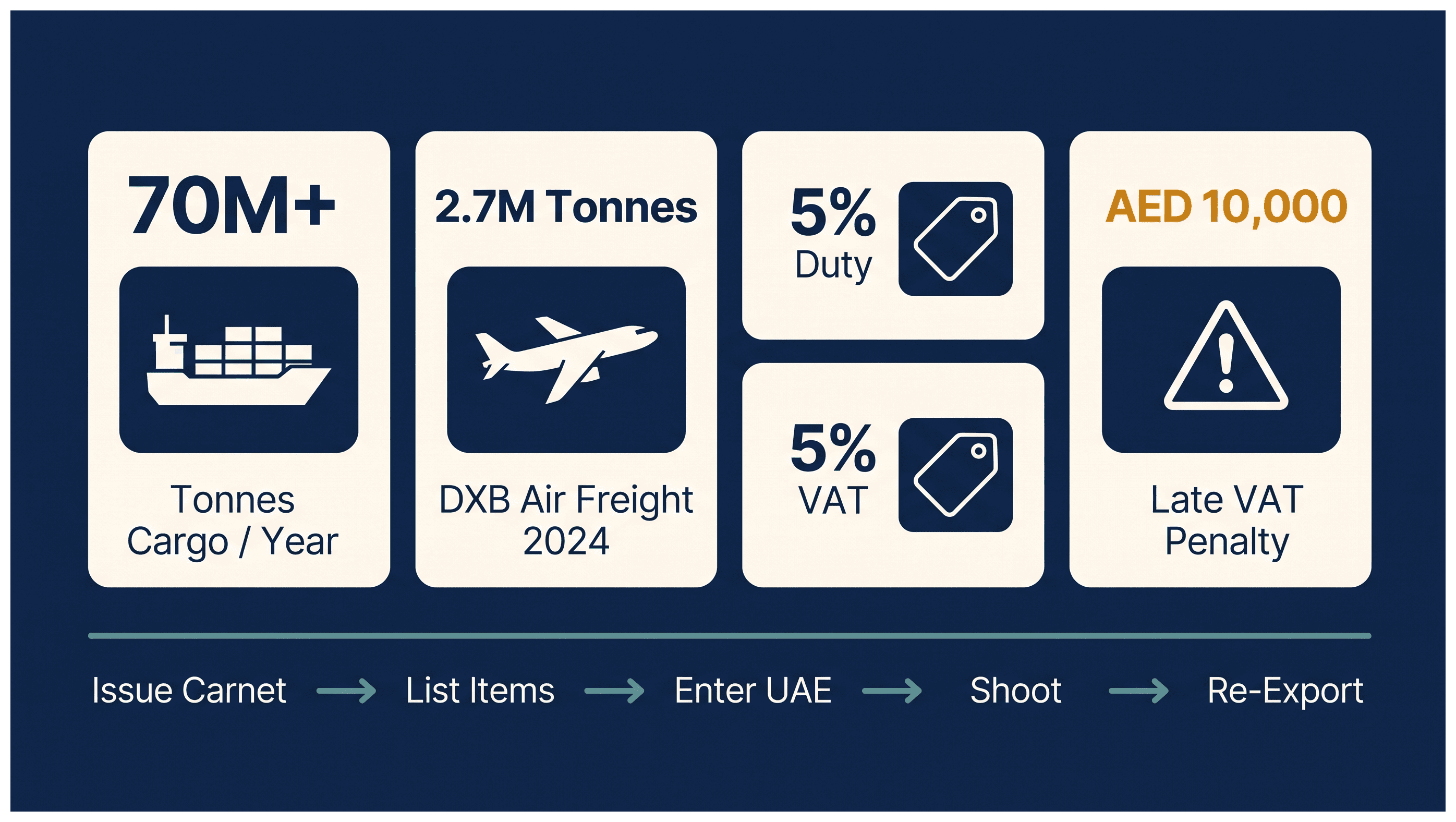
The core equipment import UAE checklist includes the ATA Carnet or customs import declaration, a detailed packing list with serial numbers, the commercial invoice or pro-forma valuation, the importer's trading license, and any activity-specific permits. Each document has a distinct issuing authority and a specific invalidation trigger.
ATA Carnet
Issued by: The guaranteeing chamber of commerce in the country of origin. For UAE-originating outbound carnets, that's Dubai Chamber. For inbound carnets, it's the foreign equivalent (e.g., the London Chamber of Commerce for UK crews).
Used for: Serving simultaneously as the import declaration, the export re-declaration, and the financial guarantee covering duties and VAT. The carnet holder must stamp each counterfoil at the port of entry and retain the customs-stamped voucher as proof of importation.
Invalidated by: Expiry before re-export, failure to present all listed items at exit, alteration of the General List after issue, or use for goods whose description doesn't match the listed items. One production company altered its General List to add two additional lenses after the carnet was issued; Dubai Customs voided the document and assessed full duty on the entire equipment list.
Commercial Invoice or Pro-Forma Valuation
Issued by: The equipment owner or production company (pro-forma valuation) or the supplier (commercial invoice for permanent imports).
Used for: Establishing the customs value on which duty and VAT are calculated. It also populates the General List on the carnet. For rental equipment, the replacement value is the correct figure to declare, not the weekly hire cost.
Invalidated by: Values that differ from the carnet General List, a missing currency denomination, absence of the HS tariff code, or a declared figure that appears understated. Dubai Customs can reassess value independently. A UAE-based production house declared rented drones at their weekly hire cost rather than replacement value; Dubai Customs issued a revised valuation and assessed the difference.
Trade License and Activity Permit
Issued by: DET for mainland entities; the relevant free zone authority for free zone companies. Dubai South Business Hub Free Zone issues licenses in one business day.
Used for: Demonstrating to Dubai Customs that the importing entity is legally authorised to conduct the business activity linked to the equipment being imported.
Invalidated by: Expiry of the license, suspension by the licensing authority, or a mismatch between the licensed activity and the equipment. Productions importing broadcast or transmission equipment may also need a separate permit from the Telecommunications and Digital Government Regulatory Authority (TDRA). A production company licensed only for "event management" was held at Jebel Ali port because its activity didn't cover broadcast equipment importation; the shipment cleared only after a 72-hour activity amendment.
Step-by-Step Guide to Clearing Equipment Import Carnet UAE at the Port
To clear an equipment import carnet UAE at the port: obtain the carnet from the issuing chamber, prepare a matching General List with serial numbers and values, present the full document set at the customs desk, have each counterfoil stamped, and retain the stamped import voucher. Repeat the process in reverse at departure.
Step 1: Apply for the ATA Carnet Before Departure
Apply to your home country's guaranteeing association (or Dubai Chamber for UAE-originating outbound carnets) at least five working days before travel.
Submit a completed General List, commercial valuation, copy of your trade license, and the guarantee deposit.
The chamber issues the carnet booklet with counterfoil pairs: yellow for exportation, white for importation, blue for transit.
Confirm that all UAE ports of entry you plan to use are listed on the carnet cover page.
A Dubai-based production company applying for an outbound carnet to film in Europe submitted its General List to Dubai Chamber five days before departure and received the carnet booklet within two working days.
Step 2: Present and Stamp the Carnet at UAE Customs
Present the carnet at the UAE port of entry along with the packing list, commercial invoice, and trade license.
The customs officer verifies each item against the General List; serial numbers are cross-checked for high-value electronics.
The import counterfoil is detached and retained by customs; the stamped import voucher is returned to you.
Keep the stamped import voucher with the carnet booklet until re-export. It's your proof of legal importation.
A French film crew arriving at Dubai International Airport presented their carnet at the cargo customs desk; the officer checked 23 serial numbers against the General List and stamped the import voucher in 45 minutes.
Step 3: Re-Export Equipment Before the Carnet Expires
Present the carnet at the port of exit with the stamped import voucher and the full equipment consignment.
The export counterfoil is detached; the stamped export voucher is returned as proof of re-exportation.
If equipment can't be re-exported before the 12-month deadline, apply to Dubai Customs for a written extension before the expiry date. Extensions aren't guaranteed.
Once re-exported, notify the issuing chamber to release the guarantee deposit.
A production company shooting a 10-month documentary in the UAE applied for a three-month carnet extension at the nine-month mark; Dubai Customs approved the extension in writing, allowing re-export in month 12.
VAT and Duty Obligations When Importing Production Equipment
Equipment imported permanently into the UAE is subject to GCC Common Customs Law duty rates, typically 5%, plus 5% VAT at the point of importation. Equipment admitted under a valid ATA Carnet is duty-suspended for the carnet's validity period. If the carnet expires or is invalidated, full duty and VAT become payable immediately. This equipment import UAE guide covers both scenarios.
Duty Rates Under the GCC Common Customs Law
The standard GCC customs duty rate for most production equipment is 5% of the customs value, calculated on a CIF basis (cost plus insurance plus freight). Certain broadcast and telecommunications equipment may attract different rates, so confirm the correct HS tariff code with a licensed customs broker before shipment. Duty must be paid before the equipment is released from the customs area on a formal entry filed through Dubai Trade.
Free zone companies importing equipment into the free zone benefit from duty suspension, not duty exemption. Duty becomes payable if the equipment moves to the UAE mainland. A UAE production company permanently importing a broadcast camera system with a CIF value of AED 180,000 would pay AED 9,000 in customs duty plus AED 9,450 in VAT at the point of entry.
VAT Recovery on Imported Equipment
A UAE VAT-registered business can recover import VAT paid on equipment used for taxable business activities by claiming it as input tax on the VAT return. The VAT registration threshold is AED 375,000 in taxable supplies. Miss that threshold and you're looking at a AED 10,000 flat penalty from the Federal Tax Authority.
Productions operating as non-registered entities can't recover import VAT, making the equipment import carnet UAE route significantly more cost-effective for temporary equipment. A UAE-registered production company recovered AED 9,450 in import VAT on its broadcast camera system by claiming the amount as input tax in its quarterly VAT return filed through the Federal Tax Authority portal.
Is a carnet always better than a formal import for short productions?
For visits under 12 months, yes. A carnet avoids upfront duty cash outflow entirely. A formal import requires duty and VAT payment before equipment is released. If your production entity is VAT-registered, you can recover the VAT, but the cash flow gap during a short shoot can be significant. The carnet is almost always the better route for visiting productions.
When to Use a Formal Customs Entry Instead of a Carnet
Use a formal customs entry declaration instead of an ATA Carnet when equipment will remain in the UAE permanently, when the equipment type is excluded from carnet coverage, when your production entity isn't eligible for carnet membership, or when the equipment will be sold or transferred to a UAE entity during the project. This equipment import UAE guide covers both routes to help you choose correctly.
Permanent Import: The Formal Entry Route
Required documents for a formal customs entry filed through Dubai Trade:
Commercial invoice with HS tariff code on each line item
Bill of lading or airway bill
Packing list with serial numbers
Certificate of origin
Copy of the trade license
Duty and VAT are assessed and must be paid before release. A licensed customs broker can file on your behalf; ensure the broker is registered with Dubai Customs. A UAE-based production studio purchasing editing workstations from Germany filed a formal customs entry through Dubai Trade, paid 5% duty and 5% VAT on the CIF value, and recovered the VAT in its next quarterly return.
Choosing the Right Route for Your Production Structure
Productions with a permanent UAE entity and ongoing equipment needs should consider formal import with VAT recovery rather than repeated carnet applications. Short-term visiting productions (under 12 months) almost always benefit from the carnet route. Mixed productions can use a carnet for the visiting crew's kit and a formal entry for UAE-purchased or UAE-retained assets.
A production company based at Dubai South Business Hub Free Zone retained its UAE-owned grip equipment on a formal import entry and used carnets only for the overseas director's personal camera kit on each visit. If you're ready to start your business in Dubai, having the right entity structure from day one makes every subsequent equipment import simpler.
Common Mistakes That Invalidate an Equipment Import Carnet UAE
The most common mistakes that invalidate an equipment import carnet UAE include altering the General List after issue, failing to re-export all listed items before the expiry date, presenting equipment at an unlisted port of entry, and allowing the carnet to lapse without applying for an extension. Each mistake triggers a duty and VAT claim against the guarantor.
Documentation Errors That Trigger Customs Claims
Altering the General List after issue: Even a spelling correction requires the issuing chamber to issue a new carnet entirely.
Mismatched serial numbers: Any discrepancy between the General List and the physical equipment is grounds for immediate customs hold.
Lost stamped import voucher: Without it, you can't prove legal importation at exit. Always keep it with the carnet booklet.
Using an unlisted port of entry: This is an automatic invalidity event with no remedy at the port.
One production company lost its stamped import voucher mid-shoot. It had to apply to Dubai Customs for a replacement declaration, a process that took four working days and
References
Frequently Asked Questions