Topic Summary
UAE Targets 42,000 Charging Points by 2030
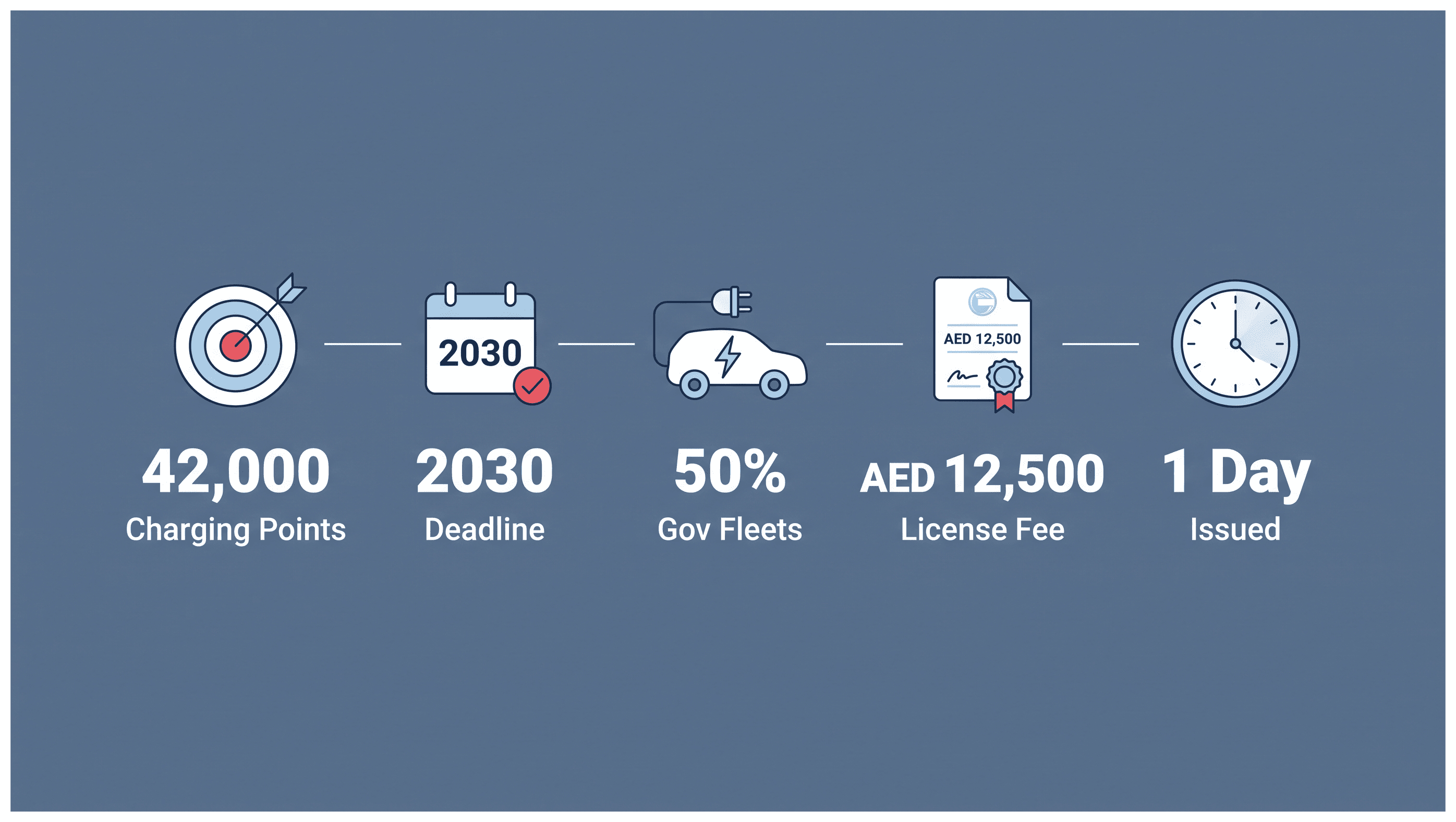
The UAE National Electric Vehicles Policy mandates 42,000 public and private EV charging points nationwide by 2030, with Dubai accounting for the largest share. This scale of deployment creates significant opportunity for private operators entering the market early.
Two Separate Approvals Are Always Required
Starting an EV charging business in Dubai requires a trade license from a free zone authority and a separate DEWA operational approval before any charger can go live. Neither approval substitutes for the other, so operators must complete both processes.
Licensing Costs AED 12,500 and Takes One Day
A DSBH free zone trade license starts at AED 12,500 and is issued in a single business day. It establishes your legal entity and right to contract, but does not permit grid connection or charger operation.
DEWA Governs Every Charger on Dubai's Grid
DEWA's EV Green Charger initiative sets the technical standards that every charger connected to Dubai's electricity network must meet. Operators must obtain DEWA approval before energising any equipment, regardless of charger type or location.
Government Fleet Mandates Create Structural Demand
The UAE Cabinet has committed to electrifying 50% of government vehicles by 2050, meaning public-sector demand for charging infrastructure is long-term and policy-driven. This gives early-stage operators a reliable and growing client base beyond retail consumers.
Early Site Agreements Lock In Competitive Advantage
Operators who secure long-term site agreements with malls, logistics parks, or hospitality venues early can establish recurring revenue streams that later entrants cannot replicate at the same locations. Dubai's high vehicle ownership per capita makes prime sites especially valuable.
Multiple Business Models Are Viable Under One License
Operators can structure their business around hardware supply, network management, or end-to-end charging-as-a-service, all under a single DSBH license. A common model involves installing AC and DC chargers at a commercial site and charging fleet clients a per-kWh fee.
In 2026, the UAE government's National Electric Vehicles Policy targets 42,000 public and private EV charging points across the country by 2030 (u.ae, 2023). Dubai accounts for the largest share of that rollout. The UAE Cabinet has committed to electrifying 50% of government vehicles by 2050 (UAE Cabinet). EV sales as a proportion of total vehicle sales are rising year-on-year (Statista). The licensing cost starts at AED 12,500. The license is issued in one business day. And a separate DEWA approval is required before a single charger can go live.
This ev charging dubai guide covers what the activity involves, the ev charging dubai requirements you must satisfy, what it costs to get started, and the exact steps to obtain your DSBH free zone license and the separate DEWA operational approval. Read it before you commit to any site or hardware.
What Is an EV Charging Business in Dubai and Why It Matters
An EV charging business in Dubai installs, operates, and manages electric vehicle charging infrastructure for residential, commercial, or public use. Operators must hold a valid trade license and a separate DEWA approval before connecting any charger to the grid. The sector is governed by the UAE National Electric Vehicles Policy and DEWA's EV Green Charger initiative.
How the Activity Is Defined Under UAE Regulations
EV charging is classified as an energy infrastructure service activity under UAE federal and emirate-level regulation. Operators can structure their business around hardware supply, network management, or end-to-end charging-as-a-service models. The Ministry of Energy and Infrastructure sets the national policy framework; DEWA implements it at emirate level and acts as the grid authority, setting technical standards for every charger connected to Dubai's electricity network.
The UAE targets 42,000 EV charging points by 2030 (u.ae, 2023). That scale of deployment requires private operators. A free zone company that installs AC and DC chargers at a logistics park in Dubai South, then charges fleet operators a per-kWh fee, is a typical ev charging business dubai model. You can review the full range of business activities in Dubai available under a DSBH license before you apply.
Why Dubai Is a Strong Market for EV Charging Operators
Government fleet electrification mandates are accelerating demand from public-sector clients.
Dubai's high vehicle ownership per capita creates a large addressable user base.
Mall and hospitality developers face growing pressure to provide EV infrastructure as a tenant amenity.
Early movers can lock in prime site agreements before the market fills up.
A charging network operator that secures a 10-year site agreement with a Dubai mall group in year one effectively creates a recurring revenue stream that latecomers cannot replicate at the same location. The UAE Cabinet's 50% government fleet electrification commitment by 2050 means public-sector demand is structural, not cyclical (UAE Cabinet).
EV Charging Dubai Requirements: License and Regulatory Approvals
Starting an ev charging business dubai requires two separate steps: a trade license from a UAE free zone authority, and an operational approval from DEWA under its EV Green Charger initiative. The license covers your legal right to trade; the DEWA approval covers your right to install and energise chargers. Neither substitutes for the other.
The Trade License: What DSBH Covers
Dubai South Business Hub (DSBH) Free Zone licenses the EV charging activity under its energy and clean technology category. The license gives you a legal entity, a UAE trade name, and the right to contract with clients. DSBH issues the license in one business day, the fastest part of the overall process.
Think of the DSBH license as your business passport. It proves your company exists and can sign contracts. But DEWA's approval is the operational permit that lets you plug in. The license alone does not permit you to connect equipment to the DEWA grid or operate chargers commercially. Both approvals are mandatory.
DSBH Free Zone Package Comparison for EV Charging Business
Package | Price | Inclusions |
|---|---|---|
0 Visa Package | AED 12,500 | License, Articles of Association, share register, flexi-desk space, lease agreement. No visa allocation. |
1 Visa Package | AED 16,350 | All above, plus one investor or partner visa allocation and establishment card. |
2 Visa Package | AED 18,200 | All above, plus two investor or partner visa allocations and establishment card. Maximum available. |
Visa Processing | Quoted separately | Entry permit, status change, medical, Emirates ID. Applies to all packages. |
License Issuance Time | 1 business day | Applies to all packages once documentation is complete. |
The DEWA Approval: What the Regulator Requires
All EV chargers connected to Dubai's electricity network must be registered with DEWA under the EV Green Charger initiative. The documentation DEWA requires includes:
Charger technical specifications and model details
Installation drawings and single-line electrical diagrams
Metering plans and network integration details
Confirmation that equipment meets DEWA's approved list and IEC or equivalent international standards
NOC from the site landlord (for private land installations)
Road or plot permit from the relevant municipality (for public-facing locations)
An operator installing a 150 kW DC fast charger at a petrol station forecourt in Dubai must submit DEWA-compliant single-line diagrams and pass a site inspection before the charger can be switched on. DEWA inspects every installation before energisation. No charger goes live without a passing inspection, regardless of how long your trade license has been active. If you're ready to set up a company in Dubai, the DSBH application is the logical first step before beginning your DEWA submission.
Cost of Starting an EV Charging Business in Dubai
The base cost to license an ev charging business dubai through DSBH Free Zone starts at AED 12,500 for the 0 Visa Package. The 1 Visa Package is AED 16,350 and the 2 Visa Package is AED 18,200. Visa processing, entry permit, status change, medical, Emirates ID, is quoted separately on application.
DSBH Free Zone Package Pricing
0 Visa Package, AED 12,500: Includes the license, Articles of Association, share register, flexi-desk space. No visa allocation.
1 Visa Package, AED 16,350: Adds one investor or partner visa allocation and establishment card.
2 Visa Package, AED 18,200: Adds two investor or partner visa allocations and establishment card. This is the maximum allocation available.
All packages include identical core company formation documents. The visa allocation is the only differentiator between tiers.
Visa processing costs, entry permit, status change, medical, Emirates ID, are always quoted separately for all packages.
A founder setting up with one business partner would select the 2 Visa Package at AED 18,200, then budget separately for two sets of visa processing fees. Use the business setup cost calculator to model your total first-year spend before committing.
Additional Costs to Budget For
DEWA application and registration fees for the EV Green Charger programme (UNVERIFIED: confirm current fee with DEWA before publishing)
Equipment procurement: AC chargers (7-22 kW) cost significantly less than DC fast chargers (50-350 kW), hardware tier drives the biggest variable in your capital budget
Civil and electrical installation works at each charger site
VAT registration once taxable supplies exceed AED 375,000 annually; late registration carries an AED 10,000 penalty (Federal Tax Authority)
Corporate tax registration for all UAE entities; late registration carries a one-time flat AED 10,000 penalty
A pilot deployment of four 22 kW AC chargers at a residential tower will have a very different capital budget than a six-unit DC fast-charging hub at a highway rest stop. Model your hardware costs before finalising your business plan, the license cost is the smallest line item once you factor in equipment and civil works.
Step-by-Step Guide to Setting Up Your EV Charging Business in Dubai
Setting up an ev charging business dubai involves these core steps: choose your legal structure, reserve a trade name, apply for the DSBH free zone license, complete company incorporation, open a UAE corporate bank account, apply for DEWA EV Green Charger registration, obtain site-specific permits, and pass DEWA's pre-energisation inspection before going live.
Step 1: Choose Your Structure and Reserve Your Trade Name
Decide on your ownership structure, sole shareholder or multiple partners, before starting the application.
Use the DSBH name-availability tool to check your company name before it's taken.
Your trade name must not reference regulated terms like "electricity authority" or imply government affiliation.
Confirm that EV charging and related activities appear on your intended business activities list before submission.
A founder planning to offer both charger installation and network management should list both service activities on the license from day one. Amending the activity list after incorporation adds cost and time, get it right at the start.
Step 2: Apply for the DSBH Free Zone License
Submit your application with passport copies, a business plan summary, and activity selection.
DSBH issues the license in one business day once documentation is complete.
You receive the license, Articles of Association, share register, flexi-desk space, and lease agreement as a package.
Select your visa package at this stage, 0, 1, or 2 visa allocations, based on how many founders need UAE residency.
Most solo founders choose the 1 Visa Package at AED 16,350 so they can apply for their own investor visa immediately after incorporation.
Step 3: Open Your Corporate Bank Account and Apply for DEWA Approval
Open a UAE corporate bank account using your incorporation documents, you'll need this to receive client payments and pay suppliers. See the bank account opening in UAE guide for what banks require.
Submit your DEWA EV Green Charger application with technical specifications for each charger model you intend to deploy.
Provide site drawings, metering plans, and network integration documentation as part of the DEWA submission.
Obtain any required NOC from site landlords and municipality permits for public or road-facing installations.
DEWA will inspect the installed chargers before issuing energisation approval, schedule this inspection as part of your project timeline.
An operator targeting corporate car parks should approach the facilities manager for a site NOC in parallel with the DEWA application. Running these tracks simultaneously can save weeks compared to sequencing them end-to-end.
Is the DSBH License Enough to Start Operating Chargers?
No. The DSBH trade license gives you a legal entity and the right to contract, but it does not permit you to connect equipment to the DEWA grid. You must hold a separate DEWA EV Green Charger approval before any charger can be energised. Both approvals are mandatory and neither replaces the other.
DEWA and Utility Approvals for Charger Installation
DEWA governs every EV charger connected to Dubai's electricity network under the EV Green Charger initiative. Operators must register charger models against DEWA's approved equipment list, submit technical drawings, pass a pre-energisation inspection, and comply with ongoing metering and reporting requirements. No charger may go live without a DEWA clearance, regardless of license status.
DEWA's EV Green Charger Initiative: What Operators Must Know
DEWA launched the EV Green Charger initiative to standardise charger deployment across Dubai and integrate private networks with the city-wide grid. Operators must register on the DEWA portal and submit charger specifications before purchasing hardware. Buying non-approved equipment is a costly mistake, one that has delayed projects by several weeks when hardware modifications were required to pass the pre-energisation inspection.
DEWA's approved equipment list covers both AC and DC charger types. Check the current list before finalising any hardware procurement. Ongoing compliance includes smart metering, data reporting to DEWA, and maintaining chargers to the approved technical standard. An operator who imported 20 DC chargers before checking the approved equipment list found that two models needed costly hardware modifications before they could pass inspection, a real-world delay that a pre-purchase check would have prevented entirely.
Site-Specific Permits Beyond DEWA
Public road-facing chargers require a Road and Transport Authority (RTA) permit in addition to DEWA approval.
Chargers on private land, car parks, malls, residential towers, require a NOC from the property owner or management company.
Dubai Municipality may require a building permit for any civil works associated with the charger installation.
Multi-site operators should build a permit-tracking process from day one, each location has its own approval chain.
A network planning 30 charger locations across Dubai should assign a dedicated PRO or use a business support service in the UAE to manage the parallel approval workflows at each site. The administrative load scales quickly once you move beyond a handful of locations.
Visa and Residency Options for EV Charging Business Founders
DSBH Free Zone offers up to two visa allocations tied to a company license. The 1 Visa Package at AED 16,350 covers one investor or partner visa allocation; the 2 Visa Package at AED 18,200 covers two. Visa processing, entry permit, status change, medical, Emirates ID, is priced separately and quoted on application.
Understanding the Visa Allocation in Each Package
A visa allocation means your company license includes the right to sponsor that number of investor or partner visas, one per allocation.
The allocation is not the visa itself. Visa processing (entry permit, status change, medical, Emirates ID) is a separate service quoted on application.
up to six visa allocations, with published packages offering 0, 1 or 2 are
References
Frequently Asked Questions