
Topic Summary
Federal Law No. 10 of 2015 Sets the Foundation
UAE food contact packaging compliance is a pass/fail obligation under Federal Law No. 10 of 2015 on food safety. Any packaging that touches food must carry a valid Emirates conformity mark before entering local distribution channels.
GSO 1863 Governs Chemical Migration Limits
The Gulf Standardization Organization's GSO 1863 standard specifies migration limits and material composition rules for all GCC member states, including the UAE. Regulated materials range from plastics and metals to adhesives, inks, and silicone.
EU Certification Does Not Replace UAE Approval
European conformity marks are useful supporting evidence but cannot substitute for the Emirates conformity mark required by MoIAT. Importers must reference GSO standards directly, even if their packaging is already certified in another jurisdiction.
Multiple Regulators Can Reject Non-Compliant Shipments
MoIAT, MOCCAE, and Dubai Municipality's Food Safety Department each hold independent authority to reject shipments at the border or pull products from shelves. A single non-conforming SKU can trigger a hold on an entire container.
A Licensed UAE Entity Is a Prerequisite
Importers must hold a valid UAE trade license before submitting any conformity application to MoIAT. Free zone trade licenses, such as those available at Dubai South Business Hub Free Zone, can be issued in as little as one business day.
Migration Testing Varies by Material and Food Type
Packaging for dry goods, chilled products, and liquids each carry different migration test requirements because the food simulants used in testing vary by food type and contact temperature. Testing costs per material type range from AED 1,500 to AED 4,000.
Full Documentation Package Is Non-Negotiable
Importers must provide a Declaration of Compliance from the manufacturer, lab test reports from an accredited body, and MoIAT conformity marking on the packaging. Dubai Municipality adds additional local food-handling rules for goods distributed within the emirate.
Food contact packaging UAE compliance is one of the most commonly misunderstood requirements for trading and logistics companies importing goods into the UAE. Federal Law No. 10 of 2015 on food safety makes it a pass/fail obligation: packaging that touches food must carry a valid Emirates conformity mark before it enters local distribution channels. The Ministry of Industry and Advanced Technology (MoIAT) enforces this requirement. GSO 1863 sets the chemical migration limits that every material must satisfy. Migration testing per material type runs from AED 1,500 to AED 4,000 (UNVERIFIED: confirm before publishing). A licensed UAE trading entity is a prerequisite for any conformity application. Free zone trade licenses at Dubai South Business Hub Free Zone start at AED 12,500 and are issued in one business day. Miss any one of these elements and your shipment will not clear customs.
This guide covers the exact food contact packaging UAE requirements you must satisfy, what approval costs, and the step-by-step process to get your materials cleared before your goods reach a UAE shelf or warehouse.
What Is Food Contact Packaging in the UAE and Why Approval Matters
Food contact packaging in the UAE covers any material that directly touches food during manufacture, storage, or distribution. UAE law requires such packaging to meet MoIAT and GSO standards, carry a conformity mark, and pass migration testing before import or sale. Non-compliance can result in shipment seizure or fines.
Defining Food Contact Materials Under UAE Law
Under Federal Law No. 10 of 2015, food contact materials span a wide range of substrates. The law covers any material that may transfer its components into food, whether through direct contact or indirect migration through a secondary layer.
Material types regulated under this framework include:
Plastics (polyethylene, polypropylene, PET, PVC)
Paper and paperboard
Metals and metal alloys
Glass and ceramic coatings
Silicone and rubber
Adhesives, inks, and functional barrier coatings
GSO 1863, published by the Gulf Standardization Organization, sets the specific migration limits and material composition rules that apply across GCC member states including the UAE. Packaging for dry goods, chilled products, and liquids each carry different migration test requirements because the food simulants used in testing vary by food type and contact temperature.
A Dubai-based importer bringing in polypropylene containers for a supermarket chain must certify each container grade against GSO migration limits before the goods pass through Dubai Customs. That certification cannot be borrowed from a European conformity mark; it must reference the GSO standard directly.
Why Regulators Treat This as a Pass/Fail Requirement
The core risk regulators are controlling is chemical migration: harmful substances moving from packaging material into food during storage or heating. MoIAT, the Ministry of Climate Change and Environment (MOCCAE), and Dubai Municipality's Food Safety Department each hold independent authority to reject shipments at the border or pull products from shelves (u.ae, 2024).
Worth flagging here: a single non-conforming SKU can trigger a hold on an entire container, not just the affected product line. A logistics company handling re-exports through Jebel Ali Port discovered that packaging certified in the EU still required a UAE-specific conformity mark before local distribution. EU certification is useful supporting evidence, but it does not substitute for the Emirates conformity mark.
Food Contact UAE Requirements Every Importer Must Meet
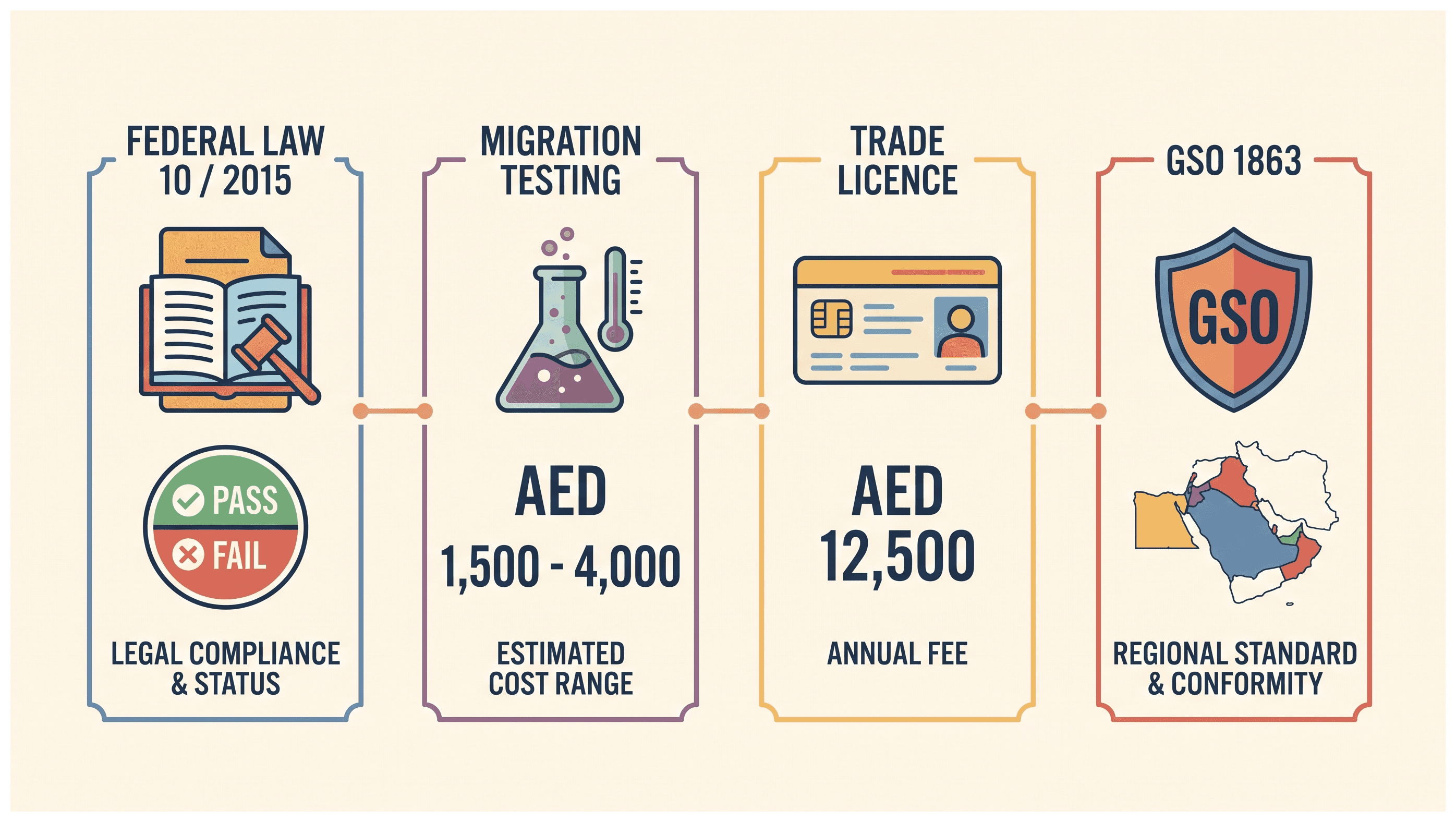
Food contact UAE requirements include compliance with GSO standards for chemical migration, mandatory MoIAT conformity marking, a Declaration of Compliance from the manufacturer, lab test reports from an accredited body, and registration of the importer as a licensed UAE entity. Dubai Municipality adds local food-handling rules for goods distributed within the emirate.
Documentation Your Manufacturer Must Provide
Before you submit anything to MoIAT or a conformity assessment body, your manufacturer must supply a complete documentation package. Incomplete paperwork is the single most common cause of application delays.
Declaration of Compliance (DoC): Signed by the manufacturer, referencing GSO 1863 or equivalent standards accepted by MoIAT. A DoC citing EU Regulation 10/2011 alone is not sufficient.
Full material composition disclosure: Lists every additive, colorant, processing aid, and stabiliser by CAS number. Proprietary blend descriptions are rejected.
Migration test reports: From an MoIAT-accredited or internationally recognised laboratory, covering both overall migration limits and specific migration limits for restricted substances.
Country-of-origin certificate: Where available, this supports the conformity application and speeds the review process.
A Chinese packaging manufacturer supplying PE film to a UAE food brand must provide a DoC referencing GSO 1863, supported by a migration test report dated within the past 12 months. Reports older than 12 months are treated as expired.
Conformity Marking and Local Regulatory Layers
The Emirates Conformity Assessment Scheme (ECAS) mark is the visible output of a successful conformity application. Food contact materials are a regulated product category under ECAS, which means the mark is mandatory before the packaging can be placed on the UAE market (moet.gov.ae, 2024).
MOCCAE holds federal oversight and can issue import bans on non-compliant materials. Dubai Municipality's Food Safety Department runs market surveillance and has authority to recall products already on shelves. Free zone operators handling food-grade packaging for re-export must still comply if any portion of their goods will enter UAE domestic consumption channels.
VAT and Import Duty Obligations on Packaging Shipments
Imported food contact packaging is subject to the standard 5% UAE VAT unless the packaged contents qualify for zero-rating as basic food items. The packaging itself does not inherit the zero-rating of the food it contains.
Packaging materials imported as manufacturing inputs may qualify for duty suspension inside a free zone structure. The distinction matters: goods are duty-suspended, not duty-exempt. Duty becomes payable if the goods leave the free zone for UAE domestic distribution. Late VAT registration carries a flat AED 10,000 penalty from the Federal Tax Authority (tax.gov.ae, 2024).
Food Contact Packaging UAE Approval Costs Overview
Cost Item | Indicative Cost |
|---|---|
Migration testing per material type | AED 1,500 to AED 4,000 (UNVERIFIED: confirm before publishing) |
MoIAT conformity certification body fee | Varies by accredited body (UNVERIFIED: confirm before publishing) |
Free zone trade license, 0 Visa Package | AED 12,500 |
Free zone trade license, 1 Visa Package | AED 16,350 |
Free zone trade license, 2 Visa Package | AED 18,200 |
Visa processing (entry permit, status change, medical, Emirates ID) | Quoted separately |
Costs Involved in Food Contact Packaging UAE Approvals
Food contact packaging UAE approval costs include laboratory migration testing at AED 1,500 to AED 4,000 per material type, MoIAT conformity certification fees, and importer registration costs. A licensed UAE trading entity is a prerequisite; free zone company packages start at AED 12,500 and are issued within one business day.
Laboratory Testing and Certification Fees
Single material type migration testing: AED 1,500 to AED 4,000 depending on test scope (UNVERIFIED: confirm before publishing).
MoIAT-accredited conformity body fees: Vary by body; budget this as a separate line item from lab costs.
Multi-material laminates: Each functional layer requires individual testing. A three-layer laminate combining plastic, foil, and paper means three separate test scopes.
Certificate validity: 12 months from issue date. Any change to the material formulation requires a fresh application regardless of how recently the certificate was issued.
A trading company importing a three-layer laminate pouch for a snack brand budgeted AED 9,000 for migration testing across all three material layers before applying for the MoIAT conformity mark. That figure covered lab fees only; the conformity body fee and company setup costs were additional.
Company Setup Costs as a Prerequisite
A licensed UAE entity is required to open an import file and apply for conformity approvals. A trading license in Dubai through a free zone is the most efficient route for packaging importers.
0 Visa Package: AED 12,500, includes license, Articles of Association, share register, flexi-desk. License issued in one business day.
1 Visa Package: AED 16,350, adds a visa allocation (investor or partner visa) and establishment card.
2 Visa Package: AED 18,200, adds a second visa allocation and establishment card. up to six visa allocations, with published packages offering 0, 1 or 2 available.
Visa processing costs (entry permit, status change, medical, Emirates ID) are quoted separately from all package prices.
Use the business setup cost calculator to model your total outlay before committing.
Step-by-Step Guide to Food Contact Packaging UAE Approval
The food contact packaging UAE approval process runs in six steps: establish a licensed UAE entity, obtain a Declaration of Compliance from your manufacturer, submit samples to an accredited lab, apply for MoIAT conformity certification, register the product with the relevant emirate authority, and clear customs with the conformity certificate attached to your shipping documentation.
Steps 1 to 3: Lay the Legal and Documentation Foundation
Register a licensed UAE trading entity. Dubai South Business Hub Free Zone licenses the trading activity; MoIAT and MOCCAE approve the packaging separately. Without a valid trade license you cannot open an importer file or sign a conformity application. A Dubai logistics company setting up a food packaging import line used the list of business activities in Dubai to confirm that general trading covers food contact materials before finalising their license application.
Collect the full documentation package from your manufacturer. You need the Declaration of Compliance, full material composition sheet with individual additive CAS numbers, existing migration test reports, and a country-of-origin certificate where available.
Submit packaging samples to an accredited laboratory. Specify the food type and contact conditions (aqueous, fatty, dry, hot-fill) so the lab applies the correct migration test protocol. Mismatching the food simulant to the actual end use is one of the most common and costly errors at this stage.
Steps 4 to 6: Certification, Registration, and Customs Clearance
Apply to an MoIAT-accredited conformity assessment body. Submit your lab reports and DoC. The body reviews the documentation and issues a conformity certificate, which authorises the ECAS mark to be applied to the finished packaging.
Register the certified product with the relevant emirate authority. In Dubai, notify Dubai Municipality's Food Safety Department. In Abu Dhabi, the Abu Dhabi Agriculture and Food Safety Authority (ADAFSA) holds that role. Each emirate has its own product registration step separate from the federal MoIAT process.
Attach the conformity certificate to your customs declaration. When the shipment arrives, the certificate and product registration confirmation must accompany the import file. Dubai Trade handles the import clearance file for goods entering through Dubai ports.
Plan for four to eight weeks total from sample submission to cleared shipment. Expedited laboratory processing is available at higher cost if your timeline is tight.
What happens if my packaging has EU certification, does it count?
EU certification under Regulation 10/2011 is useful supporting evidence but does not replace UAE-specific approval. MoIAT requires the Declaration of Compliance to reference GSO 1863 directly. You'll still need UAE migration test reports and the ECAS conformity mark before goods enter local distribution channels.
Common Compliance Gaps That Delay Food Contact Packaging UAE Clearance
The most common food contact packaging UAE compliance gaps are an incomplete Declaration of Compliance, migration test reports that do not cover the intended food type or contact temperature, missing MoIAT conformity marks on finished packaging, and importers operating without a valid UAE trade license. Each gap can result in a customs hold or shipment rejection.
Documentation Errors That Trigger Customs Holds
DoC citing EU Regulation 10/2011 only: MoIAT reviewers frequently reject applications that reference EU standards without confirming alignment with GSO 1863.
Food simulant mismatch: Migration test reports generated for aqueous food simulants cannot clear packaging intended for fatty or acidic foods. This is a lab-level error that requires a full retest.
Proprietary blend descriptions: Manufacturer composition sheets that list blends without disclosing individual additive CAS numbers are rejected outright.
Expired certificates: The 12-month validity period can lapse during long transit times or warehouse storage. Presenting an expired certificate at customs triggers an automatic hold.
Operational Gaps on the Importer Side
Trading without a UAE license: Some companies attempt to clear goods under a third party's license. Customs rejects the shipment when the importer of record cannot produce a valid conformity application in its own name.
No VAT registration before first import: The AED 10,000 late registration penalty from the Federal Tax Authority applies regardless of import volume (tax.gov.ae, 2024).
Failure to notify Dubai Municipality: Distributing certified packaging to local food businesses without notifying Dubai Municipality's Food Safety Department can trigger market surveillance action even after customs clearance.
Business support services can help you coordinate the regulatory filings so nothing falls through the gap between your license and your conformity applications.
Food Contact UAE Guide: Setting Up the Right Business Structure
A food
References
Frequently Asked Questions