
Topic Summary
What Is Import and Export Between Malaysia and Dubai: What License You Need and Why It Matters
Import and export between Malaysia and Dubai requires a UAE trade license listing your goods as approved activities, plus a customs code linked to it. Malaysian nationals can usually hold full ownership in a free zone, and the license can anchor an investor or partner residency visa.
Which Trade License Fits Your Goods
Which Trade License Fits Your Goods
Step-by-Step Guide to Import and Export Between Malaysia and Dubai: What License You Need
Choose your goods, apply for a free zone trade license, register a customs code, open a bank account and secure residency, in that order. This sequence avoids rejected declarations and port delays.
Tax, VAT and Trade Agreement Points for Malaysian Traders
The UAE applies 5% VAT and 9% corporate tax on qualifying income above the threshold, with possible free zone incentives. A Malaysia UAE trade agreement (CEPA) and a double taxation agreement also exist, so confirm current terms.
Residency Visa and Document Attestation for Malaysian Nationals
You'll typically need an attested passport copy and any corporate or academic papers the license requires. Attestation runs through Wisma Putra, the UAE Embassy in Kuala Lumpur, then the UAE Ministry of Foreign Affairs. Once your license is active, you can apply for a residency visa through ICP.
Banking and Cash Flow Considerations for Cross-Border Trade
Open a UAE corporate account early. Banks review trade activity, source of funds and shareholder profile, so bring your license, MOA, passport, Emirates ID and business plan. Supplier quotes from Malaysia help prove expected turnover.
Common Mistakes and Practical Tips for Malaysian Founders
The biggest errors are wrong license activities, skipped customs registration, ignored VAT rules and late attestation. Avoiding them is simple.
Dubai's non-oil foreign trade passed AED 2.2 trillion in 2024 (Dubai Chamber, 2024), and its ports and airports handle over 14 million TEUs a year (DP World, 2025). This guide to import and export between Malaysia and Dubai: what license you need is for Malaysians relocating to trade from the UAE. You'll leave knowing which license, codes and documents to line up first.
What Is Import and Export Between Malaysia and Dubai: What License You Need and Why It Matters
Import and export between Malaysia and Dubai requires a UAE trade license listing your goods as approved activities, plus a customs code linked to it. Malaysian nationals can usually hold full ownership in a free zone, and the license can anchor an investor or partner residency visa.
How the License and Customs Code Work Together
The license authorises the activity. The customs code lets you clear shipments. Dubai processes over 16 million customs declarations a year (Dubai Trade, 2025), and a declaration is rejected if your activities don't match the HS-coded goods. Picture a Malaysian founder importing palm-oil-based cosmetics: she lists general trading plus cosmetics activities, then registers her code before the first shipment. Our import export license in Dubai guide covers the detail.
Why Malaysian Traders Choose Dubai as a Hub
One base reaches the Middle East, Africa and South Asia. Halal trade is a natural fit, too. A Kuala Lumpur halal food exporter, for instance, can use a Dubai South company to redistribute to Saudi and East African buyers, close to Al Maktoum International Airport.
Which Trade License Fits Your Goods
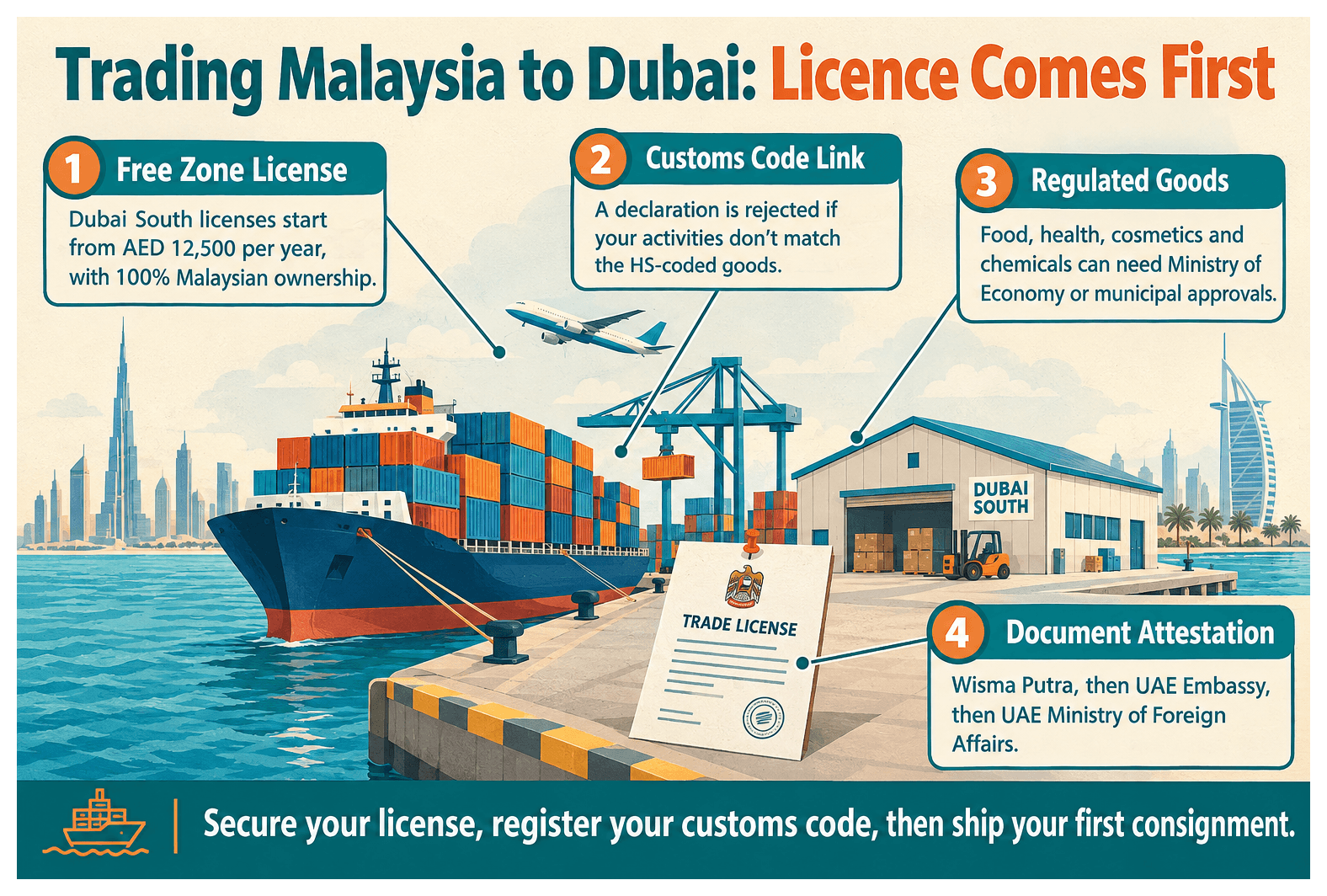
Most Malaysian traders use a free zone trading license covering general trading or named commodities. Your license must name the goods you handle. Food, cosmetics or chemicals may need extra approvals before clearance, so confirm activity codes before applying.
Free Zone Trading License Options
Dubai South licenses start from AED 12,500 per year (Dubai South Business Hub, 2026).
Malaysian nationals can hold 100% ownership.
Choose a flexi-desk or warehouse by cargo volume.
A Penang electronics reseller, for example, would pick a trading license with a small warehouse for stock.
Licensing and Registration Checklist for Malaysian Traders
Requirement | What It Covers |
|---|---|
Free zone trade license | Approved trading activities, from AED 12,500 per year |
Customs code registration | Importer/exporter code via Dubai Trade, linked to your license |
VAT registration (if applicable) | 5% VAT filings with the Federal Tax Authority above thresholds |
Document attestation | Wisma Putra, UAE Embassy, then UAE Ministry of Foreign Affairs |
Corporate bank account | Trade finance, letters of credit and AED/USD settlement |
Residency visa and Emirates ID | Investor or partner visa, medical test, family sponsorship |
Regulated Goods and Extra Approvals
Food, health, cosmetics and chemicals can need Ministry of Economy or municipal approvals. Malaysian products should also carry halal certification from a JAKIM-recognised body. A Johor snack producer would secure food-product approvals before shipping its first pallet. See which license you need to import goods into Dubai.
Mainland Access and Distribution
Free zone companies trade internationally and reach onshore buyers through approved distributors. A Selangor furniture exporter might sell to Dubai retailers this way. Singapore traders use a similar model, covered in import and export between Singapore and Dubai.
Step-by-Step Guide to Import and Export Between Malaysia and Dubai: What License You Need
Choose your goods, apply for a free zone trade license, register a customs code, open a bank account and secure residency, in that order. This sequence avoids rejected declarations and port delays.
Define goods and HS codes. A Malaysian rubber-glove supplier maps codes to medical consumables first.
Apply for the license. Submit passport, photo and business plan to Dubai South Business Hub.
Register your customs code. Apply through Dubai Trade, then clear your first shipment with a licensed agent.
Open a bank account and get residency. More than 230,000 investor and partner applications have been processed (ICP, 2026).
Compare the process with import and export between India and Dubai.
Tax, VAT and Trade Agreement Points for Malaysian Traders
The UAE applies 5% VAT and 9% corporate tax on qualifying income above the threshold, with possible free zone incentives. A Malaysia UAE trade agreement (CEPA) and a double taxation agreement also exist, so confirm current terms.
Register with the Federal Tax Authority if turnover thresholds apply.
Check qualifying free zone person conditions.
Never assume you're fully tax free.
An exporter should check CEPA tariff treatment for its HS code before pricing. MATRADE and the Ministry of Economy are good reference points.
Residency Visa and Document Attestation for Malaysian Nationals
You'll typically need an attested passport copy and any corporate or academic papers the license requires. Attestation runs through Wisma Putra, the UAE Embassy in Kuala Lumpur, then the UAE Ministry of Foreign Affairs. Once your license is active, you can apply for a residency visa through ICP.
A Sdn Bhd director attesting a certificate of incorporation is a typical case. The investor or partner visa needs a medical test and Emirates ID, and you can sponsor your spouse and children. A Malaysian couple relocating with two children follows exactly this route.
Banking and Cash Flow Considerations for Cross-Border Trade
Open a UAE corporate account early. Banks review trade activity, source of funds and shareholder profile, so bring your license, MOA, passport, Emirates ID and business plan. Supplier quotes from Malaysia help prove expected turnover.
The AED is pegged to the USD, so MYR exposure comes through USD. An importer might use a letter of credit for the first large order, then move to 30-day terms. The Philippines and Dubai guide shows a similar flow.
Common Mistakes and Practical Tips for Malaysian Founders
The biggest errors are wrong license activities, skipped customs registration, ignored VAT rules and late attestation. Avoiding them is simple.
Match HS codes to activities. A cosmetics shipment gets held when the license lacks that activity.
Register your customs code before shipping.
Track tax deadlines monthly.
Start attestation in Malaysia four weeks before you travel.
Next Steps for Malaysian Traders
Import and export between Malaysia and Dubai: what license you need comes down to a free zone trade license, a linked customs code, tax awareness, attested documents, a bank account and a residency visa. Get the order right and shipments keep moving. Contact Dubai South Business Hub for a free consultation to confirm your activities, customs registration and residency plan before you relocate.
References
Frequently Asked Questions