
Topic Summary
What Is the Process to Import and Store Goods in Dubai South?
You set up a company in Dubai South Business Hub Free Zone, get a trade license, lease a unit, register with Dubai Customs and clear shipments through Mirsal 2. That is the full chain. Each step feeds the next.
Why Is Dubai South a Good Place to Import and Store Goods?
Why Is Dubai South a Good Place to Import and Store Goods?
How Do You Import Goods to Dubai South Step by Step?
Secure a license, lease storage, register with Dubai Customs, appoint a clearing agent, submit the declaration through Mirsal 2, pay duty or VAT, then move cargo into your warehouse. Follow this Dubai South import procedure in order.
Which Documents and Approvals Do Importers Need?
You need a trade license, import code, commercial invoice, packing list, airway bill or bill of lading, and certificate of origin. Regulated goods may need Ministry of Industry and Advanced Technology (MoIAT) or Dubai Municipality approval.
What Storage Options Exist: Standard Warehouse vs Bonded Warehouse?
A standard Dubai South warehouse holds duty-paid goods for local sales. A Dubai South bonded warehouse holds goods under customs control with duty unpaid until release. Bonded suits re-exports but needs approval and stricter records.
How Much Does It Cost to Import and Store Goods in Dubai South?
Costs include the license, rent, duties, agent fees and handling. Licenses start from AED 12,500 per year. Fees and requirements may vary, so check the official source before applying.
How Do VAT and Customs Duties Apply to Stored Goods?
Imported goods generally carry customs duty and VAT on entry unless they move under duty suspension or into a designated zone. Treatment depends on product, location and storage status. Confirm with the Federal Tax Authority (FTA) and Dubai Customs first.
To import and store goods Dubai South, you get a free zone license, lease warehouse space, register with Dubai Customs and clear cargo through Mirsal 2. Goods then sit in your warehouse as duty-paid or duty-suspended stock.
Al Maktoum International Airport is planned for 12 million tonnes of annual cargo capacity (Dubai South, 2024). Dubai handles over 14 million TEUs a year (DP World, 2025). Licenses start from AED 12,500 per year, and fees may vary.
What Is the Process to Import and Store Goods in Dubai South?
You set up a company in Dubai South Business Hub Free Zone, get a trade license, lease a unit, register with Dubai Customs and clear shipments through Mirsal 2. That is the full chain. Each step feeds the next.
Quick Answer and Core Definition
A free zone is a designated area with its own licensing rules. Customs registration gives you an import code. Bonded storage holds goods under customs control before duty is paid. All of it sits inside the Dubai South logistics district, next to the airport.
Picture a food trader flying in packaged goods. The cargo lands, clears and reaches a nearby unit the same day.
Who Needs This Process
General traders and distributors.
E-commerce sellers needing fulfilment space.
Cold chain operators needing temperature control near air freight.
Investors wanting a license and storage in one place.
Why Is Dubai South a Good Place to Import and Store Goods?
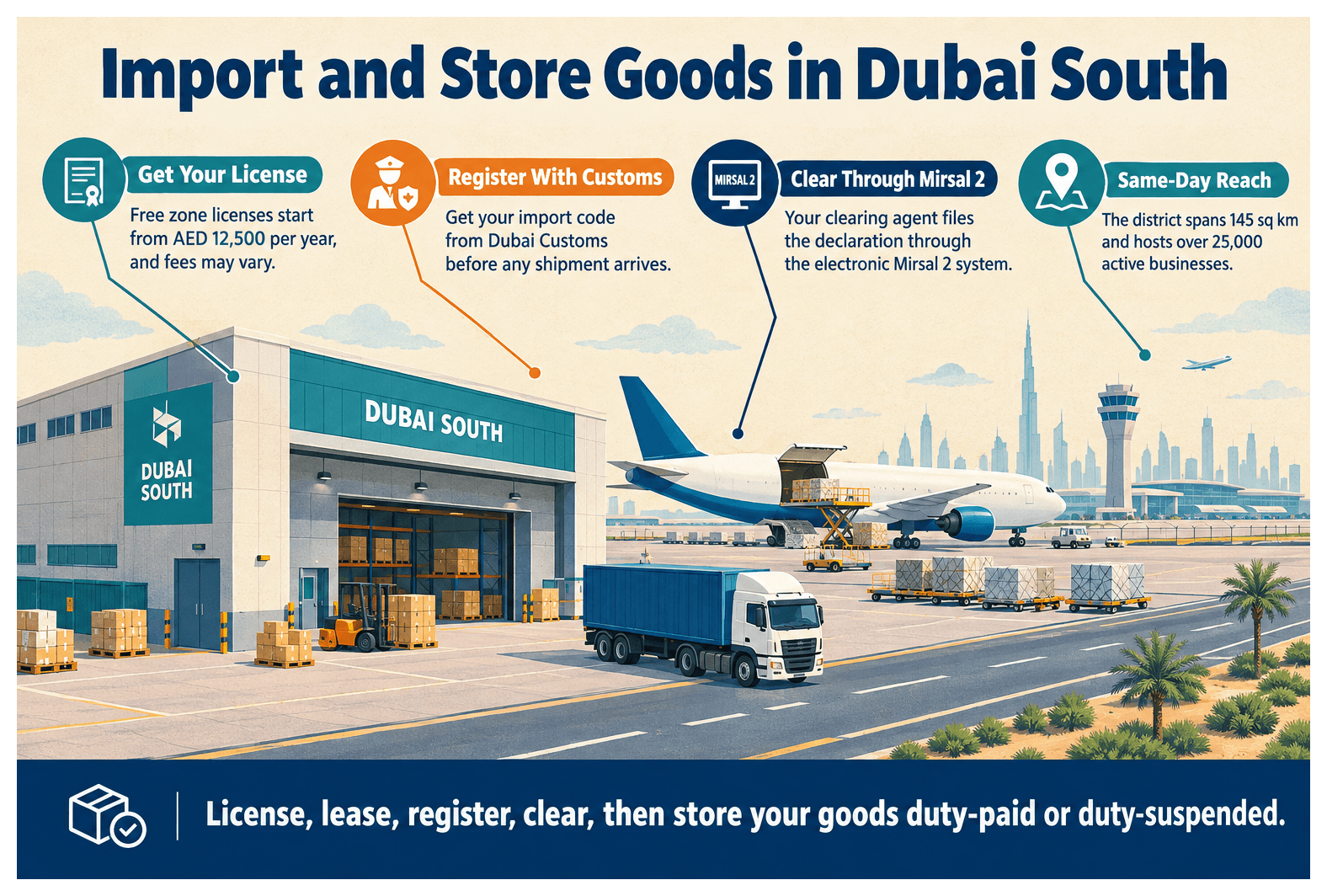
Dubai South joins air, road and sea access in one master-planned district around Al Maktoum International Airport. You get a Dubai South warehouse, free zone licensing and quick links to Jebel Ali and the highways. Less handling happens between clearance and storage.
Location and Connectivity Advantages
The district spans 145 sq km and hosts over 25,000 active businesses (Dubai South, 2026). Shorter inland trucking cuts cost. An importer can receive air freight and dispatch to Abu Dhabi and Dubai within the same day. See the warehouse Dubai South guide for unit types.
Dubai South E-Commerce Zone and Storage Options
UAE e-commerce is projected to exceed USD 8 billion (Statista, 2025). Dubai South storage for importers scales with demand.
Fulfilment-ready units for online sellers.
Industrial and storage space for bulk stock.
Room to upgrade as orders grow.
How Do You Import Goods to Dubai South Step by Step?
Secure a license, lease storage, register with Dubai Customs, appoint a clearing agent, submit the declaration through Mirsal 2, pay duty or VAT, then move cargo into your warehouse. Follow this Dubai South import procedure in order.
Step 1: Set Up Your License and Warehouse
Pick a trading activity matching your goods.
Lease a unit suited to the product.
Step 2: Register With Customs and Appoint an Agent
Get your import code from Dubai Customs. Mirsal 2 is the electronic customs declaration system. A clearing agent files for you, which helps on a first shipment.
Step 3: Clear, Pay and Move Goods Into Storage
Submit the airway bill, invoice and packing list. Pay duty and VAT, or use suspension where eligible. Inspection may apply. Then truck cargo to your unit. Our guide to starting an import business covers more.
Typical Timeline Considerations
Timing depends on product, inspection and document accuracy. One shipment stalled because the invoice lacked an HS code. Ask your agent and Dubai Customs for current timelines.
Which Documents and Approvals Do Importers Need?
You need a trade license, import code, commercial invoice, packing list, airway bill or bill of lading, and certificate of origin. Regulated goods may need Ministry of Industry and Advanced Technology (MoIAT) or Dubai Municipality approval.
Documents Checklist for Every Shipment
Valid license and customs import code.
Invoice and packing list.
Airway bill or bill of lading.
Certificate of origin.
HS code (the Harmonized System code that classifies your product).
Product Compliance and Food Approvals
MoIAT covers conformity of regulated products. Dubai Municipality covers food safety, so a chilled food importer needs approval before storage. See the foodstuff import and export guide.
Practical Tip: Common Mistake Box
Common mistake: shipping before confirming approvals or the HS code. One cargo sat at the port for lack of a certificate. Practical tip: have your agent pre-check documents before the cargo leaves origin.
What Storage Options Exist: Standard Warehouse vs Bonded Warehouse?
A standard Dubai South warehouse holds duty-paid goods for local sales. A Dubai South bonded warehouse holds goods under customs control with duty unpaid until release. Bonded suits re-exports but needs approval and stricter records.
Standard Warehouse Storage
It suits fast domestic sales, like a retailer restocking weekly. Costs can run AED 15 to AED 40 per sq ft annually, and cold chain options depend on the facility. Compare stock storage costs.
Bonded Storage and Duty Suspension
Bonded storage means customs-controlled holding before duty applies. Dubai Customs oversees more than 60 licensed bonded warehouses (Dubai Trade, 2026). A trader can hold goods before re-exporting to Africa. Read about bonded warehousing for Dubai companies.
Standard Warehouse vs Bonded Warehouse in Dubai South
Feature | Standard Warehouse | Bonded Warehouse |
|---|---|---|
Duty status on entry | Duty and VAT paid before entry | Duty suspended until release |
Approval requirements | License and lease | Dubai Customs approval on top |
Best use case | Fast local distribution | Re-export or staged release |
Record keeping | Standard inventory and VAT records | Detailed stock logs for customs audit |
Typical users | Retailers, e-commerce sellers | Re-exporters, transit traders |
How Much Does It Cost to Import and Store Goods in Dubai South?
Costs include the license, rent, duties, agent fees and handling. Licenses start from AED 12,500 per year. Fees and requirements may vary, so check the official source before applying.
Dubai South License Cost and Setup Fees
Base Dubai South license cost from AED 12,500 per year.
Residency visa packages tie to the company license.
Totals vary by activity and package.
Storage, Clearance and Hidden Costs
Rent, handling and insurance.
Agent fees per declaration.
Demurrage after a delayed customs release.
Fulfilment costs, the gap most start-ups miss when they import and store goods Dubai South wide.
How Do VAT and Customs Duties Apply to Stored Goods?
Imported goods generally carry customs duty and VAT on entry unless they move under duty suspension or into a designated zone. Treatment depends on product, location and storage status. Confirm with the Federal Tax Authority (FTA) and Dubai Customs first.
Customs Duty and Import VAT Basics
Customs duty is a tax on imported goods. VAT is a consumption tax on supplies. Rates depend on the HS code, so we don't quote them here. VAT-registered importers may recover input VAT. Corporate tax may also apply to your profits.
Common Mistakes to Avoid
Using the wrong HS code.
Mixing duty-paid and bonded stock without records.
Skipping product approvals.
Understating declaration values, which can bring penalties.
Where Do You Start?
To import and store goods Dubai South, you need a license, customs registration, compliant clearance and the right warehouse model. List your product, expected volumes and storage needs, then speak with Dubai South Business Hub Free Zone about a license and warehouse plan.
Rules in the UAE change often. Always verify the latest requirements with the official authority before taking action.
References
Frequently Asked Questions