
Topic Summary
Three Formal Pathways Exist Under UAE Law
Federal Decree-Law No. 9 of 2016 created three distinct insolvency options: preventive composition, financial restructuring, and formal bankruptcy. Which pathway a business can access depends on whether it is anticipating difficulty or already unable to pay debts.
The 30-Day Director Notification Window Is Critical
Once insolvency becomes known, directors have a hard statutory deadline of 30 business days to file with the competent court. Missing this window can expose directors to personal liability, making early action essential.
Acting Early Keeps More Options Open
A business that foresees cash-flow trouble before a debt falls due can access the preventive composition route without waiting for an actual default. The pre-insolvency distinction in the law is designed to reward proactive decision-making.
A Confirmed Restructuring Plan Binds All Creditors
Once a court confirms a restructuring plan, every creditor is legally bound by its terms, including those who voted against it. This gives the process real teeth and makes court-supervised restructuring a powerful tool for debtors.
Free Zone Companies Mostly Use Federal Courts
Most free zone authorities have not established their own insolvency regimes, so free zone companies typically file under the federal law in UAE federal courts. Directors of free zone entities carry the same 30-business-day notification obligation as onshore directors.
Tax Registration Penalties Add Up Quickly
Late corporate tax registration and late VAT registration each carry a flat AED 10,000 penalty from the Federal Tax Authority. These costs compound the financial pressure on a business already facing insolvency, making compliance deadlines doubly important.
Court Filing Requires Audited Financials and a Creditor List
To initiate proceedings, a business must provide audited financial statements and a full creditor list to the court. A court-approved trustee or expert is also required to oversee the process from the outset.
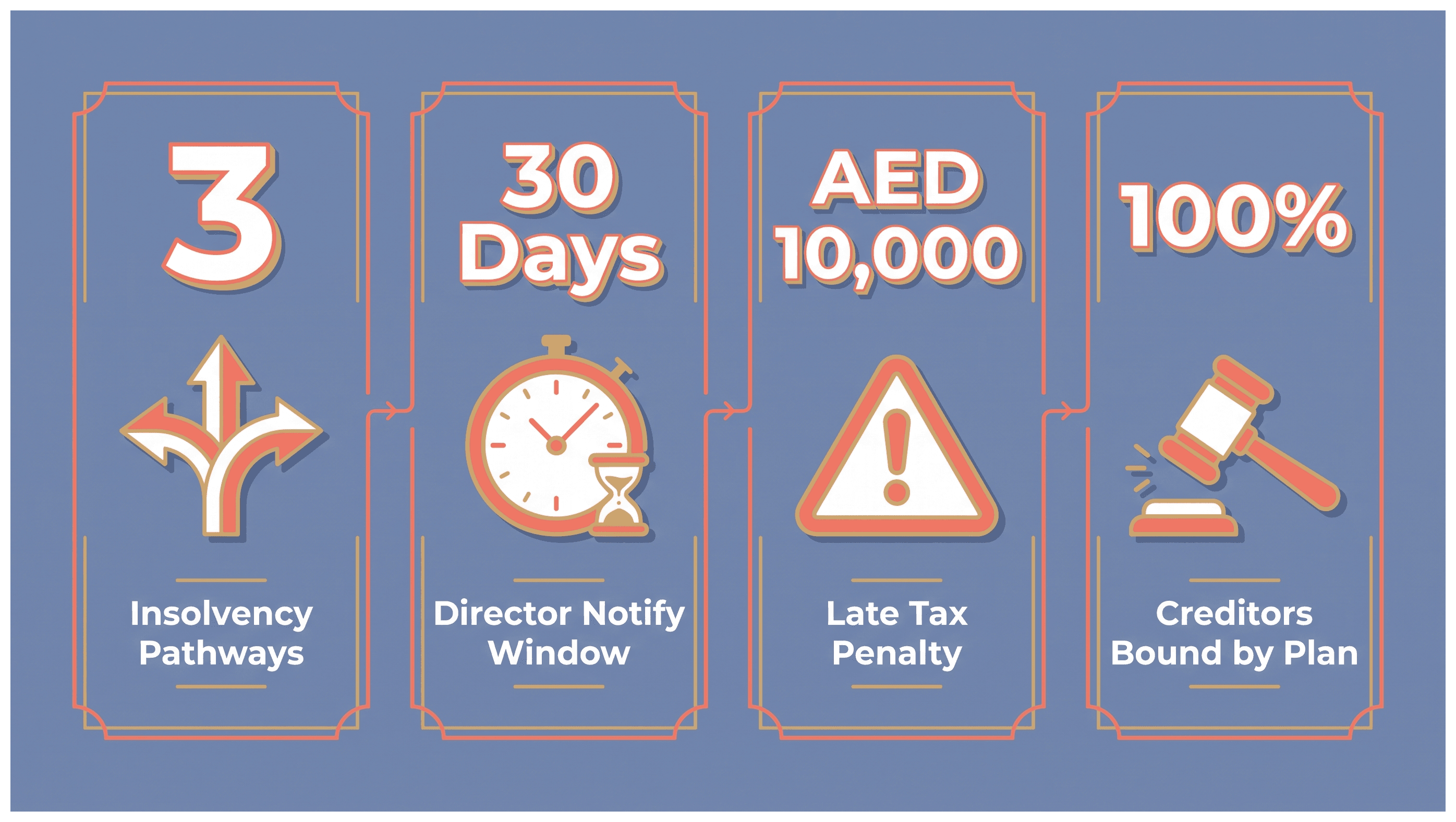
Federal Decree-Law No. 9 of 2016 created three distinct insolvency pathways for UAE commercial entities. The 30-business-day director notification window is a hard statutory deadline. Late corporate tax registration carries a flat AED 10,000 penalty (Federal Tax Authority, 2023). VAT late registration carries the same AED 10,000 penalty. A court-confirmed restructuring plan binds all creditors, including those who voted against it. These aren't abstract rules, they're the numbers that determine whether a director faces personal liability or walks away clean.
This guide covers what insolvency restructuring in the UAE means for free zone company owners and finance managers: the requirements you must meet, the formal options available, the costs involved, and the step-by-step process for each pathway. The goal is to help you make an informed decision before a cash-flow crisis forces your hand.
This article is for general information only and does not constitute legal advice. Consult a licensed UAE legal practitioner before taking any formal step in an insolvency or restructuring matter.
What Is Insolvency Restructuring in the UAE and Why It Matters
Insolvency restructuring in the UAE refers to the formal legal process under Federal Decree-Law No. 9 of 2016 that allows businesses unable to meet financial obligations to either renegotiate debts under court supervision or wind down in an orderly way, protecting both creditors and, where possible, the business itself.
The Legal Framework: Federal Decree-Law No. 9 of 2016
Passed in 2016, this law replaced the older commercial companies insolvency provisions and introduced a structured, court-supervised framework for the first time in UAE legal history (UAE Ministry of Economy, 2016). It applies to commercial entities registered onshore and, in many cases, to free zone companies where the free zone authority does not have its own insolvency regime.
The law makes a critical distinction: a debtor who foresees difficulty (pre-insolvency) gets different treatment from one who is already unable to pay (insolvent). That distinction matters enormously in practice, because it determines which of the three formal pathways you can access: preventive composition, financial restructuring, or formal bankruptcy.
A Dubai South Business Hub Free Zone trading company that sees its receivables drying up six months before a debt falls due can use the preventive composition route under this law. It does not need to wait until it defaults. That's the practical value of the pre-insolvency distinction: acting early keeps more doors open.
How Free Zone Companies Fit Into the Framework
Free zone entities are subject to the Decree-Law unless their free zone authority has its own insolvency regulations. In practice, most free zone companies use the federal courts for insolvency matters, because most free zone authorities have not established parallel insolvency regimes.
If you hold a Dubai South Business Hub Free Zone license, verify with your authority whether parallel free zone rules apply or whether the federal law governs exclusively. Directors of free zone companies carry the same notification obligations as onshore directors, including the 30-business-day window once insolvency becomes known.
A logistics services company holding a free zone license that stops being able to pay suppliers would file in the UAE federal courts under the Decree-Law, not through a separate free zone tribunal. That's the default position for most free zone entities, and it's worth confirming before a crisis arrives.
Requirements for Insolvency and Restructuring Proceedings in the UAE
To initiate insolvency restructuring in the UAE, a business must demonstrate either anticipated or actual inability to pay debts, file with the competent court within the statutory 30-business-day window, provide audited financials and a creditor list, and appoint a court-approved trustee or expert to oversee the process.
Eligibility Conditions You Must Satisfy
A finance manager at a free zone import company who notices that the next three months of supplier invoices cannot be covered from projected cash flow should assess eligibility for preventive composition immediately, before the company defaults. The eligibility conditions differ by pathway:
Commercial entity status: The debtor must be a commercial entity. Sole traders and individuals engaged in trade qualify. Pure investment holding vehicles may receive different treatment.
Preventive composition: The business must not yet be insolvent but must face financial difficulties that make insolvency foreseeable.
Formal bankruptcy: The business must have ceased or be unable to pay debts as they fall due.
Prior bankruptcy restriction: A debtor must not have been declared bankrupt in the three years preceding the application under certain provisions.
Notification deadline: Once insolvency is known, the 30-business-day window to notify the court starts immediately.
Documents and Financial Records Required
The court requires a complete documentary picture of the business's financial position. You'll need to prepare:
Audited or certified financial statements for the most recent financial period
A complete creditor list with amounts owed and due dates
A full asset list with estimated values
A written statement of financial position and the reasons for the difficulty
Existing contracts, security agreements, or guarantees that may affect creditor priority rankings
Audited financials are the baseline requirement. If your accounts are not current, updating them before filing is not optional, it's a condition of the application being accepted.
UAE Insolvency Restructuring Options Compared
Feature | Preventive Composition | Financial Restructuring |
|---|---|---|
Trigger condition | Foreseeable financial difficulty; no default yet | Already insolvent but underlying operations remain viable |
Business continues trading | Yes, trading continues throughout negotiations | Possible, subject to court and trustee oversight |
Court involvement level | Supervisory; court appoints expert and confirms plan | Active; trustee appointed, FRC may be involved for complex cases |
Creditor vote required | Yes, majority by value must approve the plan | Yes, majority by value required; court sets threshold |
Maximum plan duration | 3 years, extendable by 1 further year | Set by court based on case specifics |
Outcome if plan fails | Court may convert proceedings to formal bankruptcy | Court converts to formal bankruptcy; liquidator appointed |
Restructuring Options Available to UAE Businesses
UAE law offers three main insolvency restructuring options: preventive composition for businesses facing foreseeable difficulty, financial restructuring for those already insolvent but viable, and formal bankruptcy for those that cannot be rescued. Each has different eligibility thresholds, court involvement levels, and outcomes for directors and creditors.
Preventive Composition: Before Insolvency Strikes
Preventive composition is available when a business anticipates financial difficulty but has not yet defaulted. It's the earliest intervention point the law provides, and it's the one that preserves the most operational continuity.
A small professional services company holding a free zone license, with contracts due to expire and a cash shortfall projected in four months, can use preventive composition to lock in a 24-month repayment schedule with its three main creditors before a single payment is missed. The court supervises negotiations, a court-appointed expert reviews the plan's viability, and once the required creditor majority approves it, the court confirms the plan, making it binding on all creditors, including those who voted against it.
Business continues trading throughout the process
Plan can run up to 3 years with a possible 1-year extension
Court-appointed expert reports on plan viability before creditor vote
Court confirmation makes the plan binding on dissenting creditors
Financial Restructuring: Court-Supervised Recovery
Financial restructuring applies when the business is already insolvent but has viable underlying operations worth preserving. A trustee is appointed to manage the process, and the Financial Restructuring Committee (FRC), operating under the UAE Ministry of Economy, may be involved for larger or more complex cases.
Creditors vote on the restructuring plan, with a majority by value required to approve. If the plan is rejected or fails during implementation, the court can convert proceedings to formal bankruptcy. The FRC's involvement signals that the UAE treats financially distressed but viable businesses as worth saving, not just liquidating.
Formal Bankruptcy: Orderly Wind-Down
Formal bankruptcy applies when the business cannot be rescued and assets must be liquidated to pay creditors. A court-appointed liquidator takes control of assets, and directors lose management authority from the point of the bankruptcy declaration.
Worth flagging clearly: the law includes provisions for discharge of debt after the proceedings conclude, allowing individuals to recover and re-enter commerce. That's distinct from criminal liability, which can arise separately if the court finds a director concealed assets or incurred debts knowing repayment was impossible. Civil insolvency and criminal exposure are two different tracks, don't conflate them.
Step-by-Step Guide to the Insolvency Restructuring Process in the UAE
The insolvency restructuring process in the UAE involves assessing your financial position, obtaining legal advice, preparing court documents, filing with the competent court, appointing a trustee or expert, negotiating a creditor plan, obtaining court confirmation, and then either implementing the plan or proceeding to liquidation if the plan is rejected.
Step 1: Assess Your Financial Position Honestly
Update your management accounts to identify the exact cash shortfall and when it materialises. Determine whether you are pre-insolvency (foreseeable difficulty) or already insolvent (unable to pay current obligations). That distinction determines which pathway you're eligible for.
Acting early preserves access to preventive composition, which is the most business-friendly route. Once you cross into actual insolvency, the 30-business-day notification window starts. Engage a licensed UAE legal practitioner and a financial adviser at this stage, not after filing, the quality of advice at this point shapes every subsequent decision.
Step 2: Compile Documents and File With the Court
Gather the full document set before approaching the court:
Audited or certified financial statements
Complete creditor schedule with amounts and due dates
Full asset list with estimated values
Written statement of financial difficulty and its causes
Copies of relevant contracts, security agreements, and guarantees
File the application at the competent UAE court, for most free zone entities, that's the federal commercial court. Court filing fees vary by case type and jurisdiction (UNVERIFIED: confirm before publishing). The court reviews the application and decides whether to accept it and appoint an expert or trustee.
Step 3: Negotiate the Plan and Seek Creditor Approval
Work with the court-appointed expert or trustee to draft a repayment or restructuring plan. The trustee manages creditor meetings, and the required majority by value must vote to approve the plan. The court sets the approval threshold.
Once creditors approve, the plan goes to the court for confirmation. Court confirmation is the critical step, it makes the plan binding on all creditors, including those who voted against it. That's what gives a confirmed plan its commercial teeth.
Step 4: Implement the Plan or Proceed to Liquidation
A confirmed plan runs under ongoing court supervision for the agreed term, up to 3 years with a possible 1-year extension. If the plan is rejected or the business fails to comply with its terms, the court converts proceedings to formal bankruptcy and appoints a liquidator.
During liquidation, assets are distributed in priority order: secured creditors first, then preferred creditors (including employee wages), then unsecured creditors. The process closes once assets are distributed and the court issues a final order. If you're exploring business activities for a successor entity, that planning can begin once the prior proceedings formally close.
What triggers the 30-business-day notification clock?
The clock starts the moment a director becomes aware that the company cannot meet its financial obligations as they fall due. "Aware" is interpreted broadly by UAE courts, a board resolution acknowledging a cash shortfall, or management accounts showing a deficit, can be sufficient. Directors should document when awareness occurred and take legal advice immediately.
Costs Associated With Insolvency Restructuring in the UAE
Insolvency restructuring costs in the UAE include court filing fees, court-appointed trustee or expert fees set by the court based on asset values and case complexity, and separate legal advisory fees. No single fixed fee applies across all cases. Budget for all three categories from the outset to avoid mid-process funding gaps.
Court and Trustee Fees
Court filing fees are set by the competent court and vary by case type and jurisdiction (UNVERIFIED: confirm before publishing). Trustee and expert fees are determined by the court, typically as a percentage of assets under administration or a fixed sum approved at appointment.
These fees rank as costs of the proceedings and are paid from the estate before any creditor distributions. If the estate has insufficient assets to cover proceedings costs, the court may require the debtor to advance funds directly. That's a cash demand that can arrive at the worst possible moment, plan for it.
Legal Advisory and Financial Consultant Costs
You'll need a UAE-licensed legal practitioner to prepare and file documents. Hourly rates and fixed-fee retainers vary significantly by firm and case complexity. Financial advisers or restructuring consultants may be engaged separately to build the creditor plan and run financial models. These costs are borne directly by the debtor company and are not automatically recoverable from the estate.
For a company that intends to keep trading after restructuring, link your compliance obligations to the restructuring timeline. Late corporate tax registration carries a flat AED 10,000 one-time penalty from the Federal Tax Authority, and VAT late registration carries the same AED 10,000 penalty (Federal Tax Authority, 2023). Missing either deadline during a restructuring adds a fixed cost to an already strained balance sheet.
You can also review banking and taxation obligations relevant to your restructuring timeline before engaging advisers.
Key Obligations Directors Must Not Overlook
UAE directors facing insolvency must notify the court within 30 business days of becoming aware of insolvency, must not dispose of assets to favour specific creditors, must cooperate fully with any appointed trustee, and must continue filing tax returns and meeting regulatory obligations throughout the proceedings.
Statutory Notification and Ongoing Duties
30-business-day notification: Missing this deadline can result in personal liability for directors. It's a hard deadline, not a guideline.
No preferential payments: Directors must not make payments to connected parties or dispose of assets below market value once insolvency is foreseeable.
Trustee cooperation: Full cooperation with the court-appointed trustee or expert is a legal obligation, not optional.
Employee wages: Salary obligations under MoHRE rules continue during restructuring. Unpaid wages are a priority claim in the creditor hierarchy.
Tax and Regulatory Filings During Proceedings
VAT returns and corporate tax filings must continue during insolvency proceedings unless the Federal Tax Authority specifically suspends the obligation. Don't assume restructuring creates a filing holiday, it doesn't.
Notify your free zone authority of the proceedings. Failure to do so may affect your license status. If your restructuring plan involves changing your business activities in Dubai, check whether your current
References
Frequently Asked Questions