
Topic Summary
What Is a Purchase Order in the UAE and Why It Matters
A purchase order in the UAE is a legally binding commercial document issued by a buyer to a supplier that confirms the details of a transaction before goods or services are delivered. It specifies price, quantity, delivery terms, and payment conditions, protecting both parties un
Purchase Order UAE Requirements: What Every Document Must Include
Purchase Order UAE Requirements: What Every Document Must Include
Step-by-Step Guide to Issuing a Purchase Order in the UAE
To issue a purchase order in the UAE: confirm your trade license and TRN are active, agree terms with the supplier, draft the PO using a compliant template, obtain internal sign-off, send to the supplier and secure written acknowledgement, file the confirmed PO against the result
VAT and Corporate Tax Implications of Purchase Orders in the UAE
Purchase orders in the UAE directly affect VAT compliance: buyers must match each PO to a valid tax invoice to reclaim input VAT. For corporate tax, purchase documentation supports deductible expense claims. Late VAT registration carries a flat AED 10,000 penalty; late corporate
Setting Up the Business Structure That Makes Purchase Orders Work
To issue and receive purchase orders legally in the UAE, you need an active trade license. A Dubai South Business Hub (DSBH) Free Zone license starts at AED 12,500, is issued in one business day, and includes 100% foreign ownership. The license is the legal identity behind every
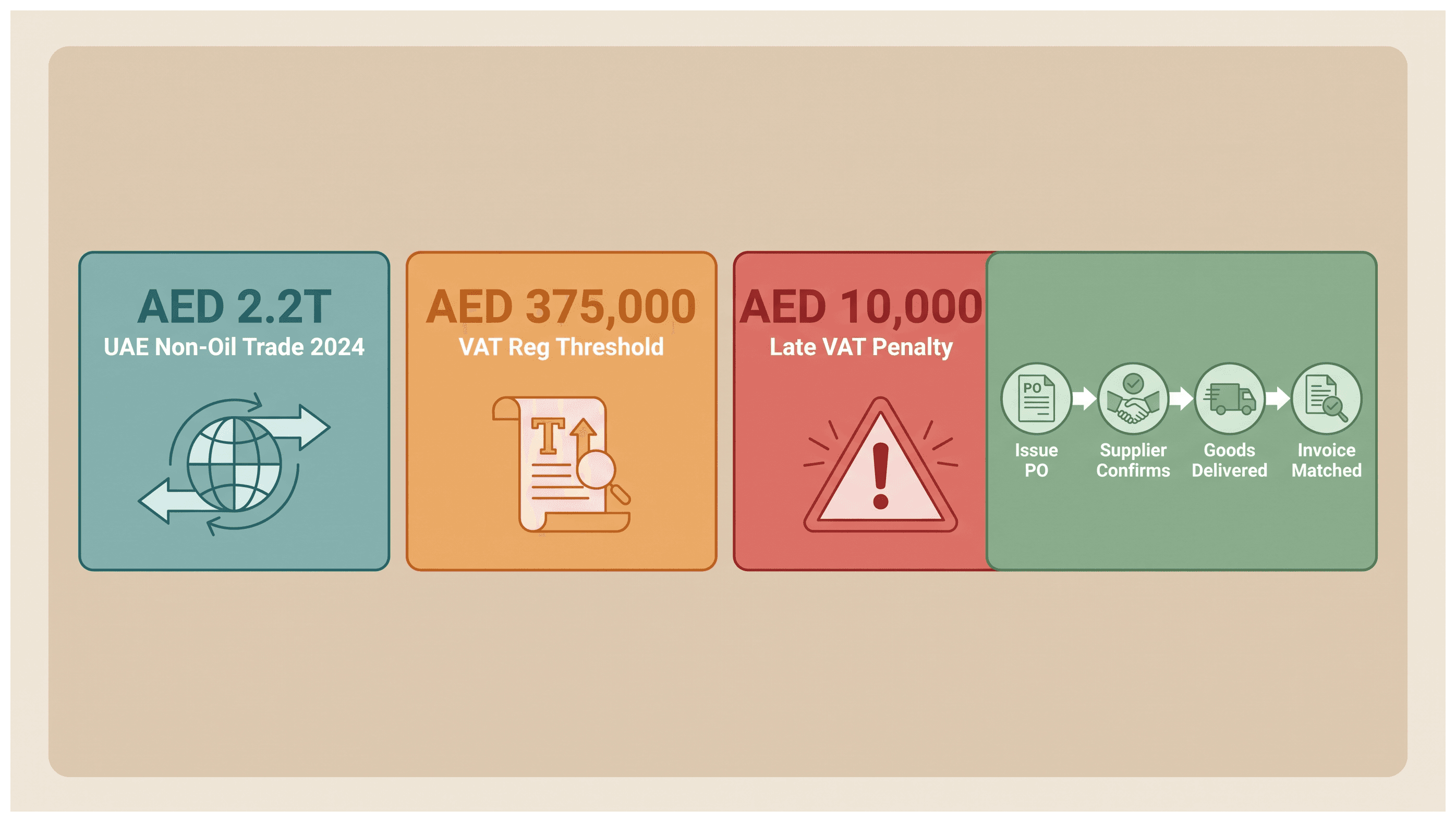
The UAE processed over AED 2.2 trillion in non-oil foreign trade in 2024 (Dubai Chamber of Commerce, 2025). A meaningful share of B2B disputes in that volume traces back to one root cause: no written purchase order was issued before goods or services changed hands. The VAT registration threshold sits at AED 375,000 (Federal Tax Authority, 2026). Late VAT registration carries a flat AED 10,000 penalty. Late corporate tax registration carries a separate AED 10,000 one-time penalty. A purchase order UAE businesses issue correctly is not a formality. It locks in price, quantity, delivery terms, and payment conditions before any obligation is created.
This guide covers what a UAE purchase order must include, what it costs to put the right business structure behind it, and the exact steps to issue your first purchase order correctly, whether you're sourcing inventory, commissioning a service provider, or importing goods through a free zone.
What Is a Purchase Order in the UAE and Why It Matters
A purchase order in the UAE is a legally binding commercial document issued by a buyer to a supplier that confirms the details of a transaction before goods or services are delivered. It specifies price, quantity, delivery terms, and payment conditions, protecting both parties under UAE commercial law and supporting VAT compliance.
The Legal Standing of a Purchase Order Under UAE Commercial Law
UAE Federal Law No. 18 of 1993 (the Commercial Transactions Law) governs commercial contracts. An accepted purchase order constitutes a binding agreement under that framework. Once a supplier acknowledges a purchase order, in writing, by email, or by beginning performance, the buyer cannot unilaterally alter price or quantity without the supplier's consent.
Both free zone companies and mainland companies operate under this framework. A free zone license does not create a carve-out from commercial contract obligations. Consider a practical example: a Dubai-based trading company issues a purchase order to a Sharjah supplier for 500 units of industrial filters at AED 120 per unit. Once the supplier acknowledges that PO by email, it is enforceable in UAE courts without a separate written contract.
Why New Businesses Cannot Afford to Skip the Purchase Order Step
Without a purchase order, price disputes become a "your word against theirs" situation with no documentary anchor.
VAT-registered businesses need a tax invoice that ties back to an original order document; missing POs create audit risk with the Federal Tax Authority.
Banks reviewing trade finance applications expect to see a purchase order trail as evidence of genuine commercial activity.
A startup importing electronics without a PO receives goods at 15% above the quoted price; without a written order, the supplier's invoice price prevails in any dispute.
Purchase Order UAE Requirements: What Every Document Must Include
A UAE purchase order must include the buyer's trade license details, supplier details, a unique PO number, itemised description of goods or services, unit price and total value, currency, delivery address, delivery date, payment terms, and VAT treatment. Free zone buyers should also state whether the transaction is within or outside the designated zone.
Mandatory Fields for a Compliant UAE Purchase Order
Buyer identity: Full legal company name, trade license number, and registered address.
Supplier identity: Full legal name and, if VAT-registered, their Tax Registration Number (TRN).
PO number: A unique sequential reference for internal tracking and audit trail.
Line-item detail: Product or service name, unit of measure, quantity, unit price, and line total.
Financial totals: Total value in AED or agreed currency, with VAT stated separately if applicable.
Delivery terms: Delivery address, expected delivery date, and Incoterms for cross-border orders.
Payment terms: Due date, payment method, and any early-payment discount conditions.
A free zone company purchasing office equipment should state its license number and TRN on every PO. The supplier's TRN on the resulting tax invoice is what allows the buyer to reclaim input VAT, miss it, and the reclaim is blocked.
Additional Fields That Protect Your Business in Disputes
Acceptance clause: State that the PO is confirmed only upon written supplier acknowledgement.
Cancellation policy: Specify conditions under which the buyer can cancel without penalty.
Governing law clause: UAE law and UAE courts, or DIFC courts for international contracts.
Authorised signatory: Name and designation of the person authorised to commit the company to expenditure.
HS code (imports): Including the Harmonised System code for imported goods aligns the PO with UAE Customs documentation, avoiding holds at port.
Step-by-Step Guide to Issuing a Purchase Order in the UAE
To issue a purchase order in the UAE: confirm your trade license and TRN are active, agree terms with the supplier, draft the PO using a compliant template, obtain internal sign-off, send to the supplier and secure written acknowledgement, file the confirmed PO against the resulting invoice, and reconcile on delivery. Seven steps in total.
The Seven Steps to a Compliant Purchase Order
Confirm your trade license and TRN are active. If your taxable turnover exceeds AED 375,000, VAT registration with the Federal Tax Authority is mandatory before you issue commercial documents (Federal Tax Authority, 2026).
Agree all commercial terms with the supplier. Nail down price, quantity, delivery date, Incoterms, and payment schedule before you draft anything.
Draft the PO using a compliant template. Include every mandatory field from the requirements section and assign a unique sequential PO number.
Route the draft for internal approval. Set a monetary threshold above which a second signatory is required before the PO is issued.
Issue the PO and request written acknowledgement. Send by email or through your procurement system; define a response window (48 hours is standard).
File the confirmed PO against the resulting invoice. The PO, tax invoice, and delivery note form the three-way match your auditor will check.
Reconcile on delivery. Confirm quantity, specification, and condition match the PO before releasing payment.
A logistics startup based in Dubai South runs a three-way match on every order above AED 5,000: the PO, delivery note, and supplier invoice must align before the finance team releases payment. That discipline alone prevents the most common source of invoice disputes in early-stage businesses.
Common Mistakes New UAE Businesses Make at Each Step
Issuing a PO before the trade license is active, the document lacks legal standing and suppliers may refuse to transact.
Omitting the supplier's TRN when the supplier is VAT-registered, which blocks the buyer's input VAT reclaim entirely.
Sending a PO without requesting written acknowledgement, leaving the commitment legally ambiguous.
Failing to match PO currency to invoice currency on cross-border orders, creating foreign exchange reconciliation problems.
Approving invoices that exceed the PO value without raising a revised or supplemental PO. A founder who approves a supplier invoice for AED 18,500 against a PO raised for AED 15,000 creates an AED 3,500 overage that fails the auditor's three-way match.
What happens if a supplier ignores your purchase order acknowledgement request?
Under UAE Federal Law No. 18 of 1993, a supplier who begins performance, by shipping goods or starting a service, is treated as having accepted the PO's terms. Silence alone is not acceptance. Always document the moment performance begins, such as a dispatch confirmation or a site attendance record, to establish the binding date.
VAT and Corporate Tax Implications of Purchase Orders in the UAE
Purchase orders in the UAE directly affect VAT compliance: buyers must match each PO to a valid tax invoice to reclaim input VAT. For corporate tax, purchase documentation supports deductible expense claims. Late VAT registration carries a flat AED 10,000 penalty; late corporate tax registration also carries a one-time flat AED 10,000 penalty.
DSBH Free Zone License Packages: What Is Included
Package | Price | What Is Included |
|---|---|---|
0 Visa Package | AED 12,500 | Trade license, Articles of Association, share register, flexi-desk space, and lease agreement. Sufficient to issue and receive purchase orders from day one. |
1 Visa Package | AED 16,350 | All of the above, plus one visa allocation (investor or partner visa) and the establishment card. |
2 Visa Package | AED 18,200 | All of the above, plus two visa allocations and the establishment card. This is the maximum available. |
Visa Processing | Quoted separately | Entry permit, status change, medical, Emirates ID. Costs vary by applicant circumstances. |
Key Terms | 1 business day | License issued in one business day. 100% foreign ownership permitted. No local sponsor required. |
How Purchase Orders Support VAT Input Tax Recovery
The Federal Tax Authority requires a valid tax invoice, not just a PO, to support an input VAT claim. But the PO is the document that proves the supply was planned, authorised, and commercially genuine. Without it, the auditor has no anchor for the invoice.
VAT registration is mandatory once taxable turnover reaches AED 375,000; voluntary registration is available from AED 187,500. The late registration penalty is a flat AED 10,000. Maintaining a PO trail is part of the audit-ready record that demonstrates precisely when taxable supplies began. For imports, the PO also supports the customs entry value declaration; under-declared import values attract separate penalties from UAE Customs.
Consider a trading company whose VAT audit covers 12 months of purchases. The auditor spot-checks 20 invoices against corresponding POs and delivery notes. Missing POs result in disallowed input VAT claims, meaning the company pays VAT it should have recovered.
Corporate Tax and the Purchase Order Paper Trail
Under the UAE Corporate Tax Law, effective for financial years starting on or after 1 June 2023, businesses must maintain records that substantiate deductible expenditure (Ministry of Finance, 2023). A purchase order matched to an invoice and proof of payment is the standard documentary chain that demonstrates an expense was genuinely incurred for business purposes.
Late corporate tax registration carries a one-time flat penalty of AED 10,000, separate from and in addition to any VAT registration penalty. Qualifying Free Zone Persons (QFZPs) can benefit from a 0% rate on qualifying income, but only if all four conditions are met:
Adequate substance in the free zone.
Qualifying income from eligible activities.
No election to be taxed on mainland income.
Transfer pricing compliance on related-party transactions.
A free zone technology company claiming QFZP status must show that its qualifying income arose from transactions with other free zone or foreign counterparties. POs and invoices are the primary evidence. Without a clean PO trail, that 0% rate is at risk.
Setting Up the Business Structure That Makes Purchase Orders Work
To issue and receive purchase orders legally in the UAE, you need an active trade license. A Dubai South Business Hub (DSBH) Free Zone license starts at AED 12,500, is issued in one business day, and includes 100% foreign ownership. The license is the legal identity behind every purchase order your business issues.
License Packages and What They Include
The 0 Visa Package at AED 12,500 includes the trade license, Articles of Association, share register, flexi-desk space, sufficient to issue and receive purchase orders from day one.
The 1 Visa Package at AED 16,350 adds one visa allocation (investor or partner visa) and the establishment card.
The 2 Visa Package at AED 18,200 adds two visa allocations and the establishment card; this is the maximum available.
Visa processing costs, entry permit, status change, medical, Emirates ID, are quoted separately from the package price.
The license is issued in one business day; 100% foreign ownership is permitted with no local sponsor required.
A first-time founder from India sets up a trading company at DSBH on the 1 Visa Package at AED 16,350, receives the license the next business day, and issues its first purchase order to a supplier in the same week. That's the practical timeline. To start your business at DSBH, you can explore the process entirely online before committing.
Choosing the Right Business Activity for Procurement-Heavy Operations
The business activity on your trade license must cover the goods or services you're purchasing and reselling. A trading license covers import, export, and re-export of specified goods. Service-oriented founders issuing POs for subcontracted work need a professional or services license activity that matches the nature of the work being commissioned.
You can review the full range of permitted business activities before committing to a license. Worth flagging: regulated activities, food trading, healthcare products, require both the DSBH trade license and separate approval from the named regulator. Dubai Municipality handles food; the Ministry of Health and Prevention handles medical products. An e-commerce founder sourcing electronics and issuing POs to Asian manufacturers needs a trading license activity covering electronic goods specifically,
References
Frequently Asked Questions