
Topic Summary
Start With a Formal Demand Letter
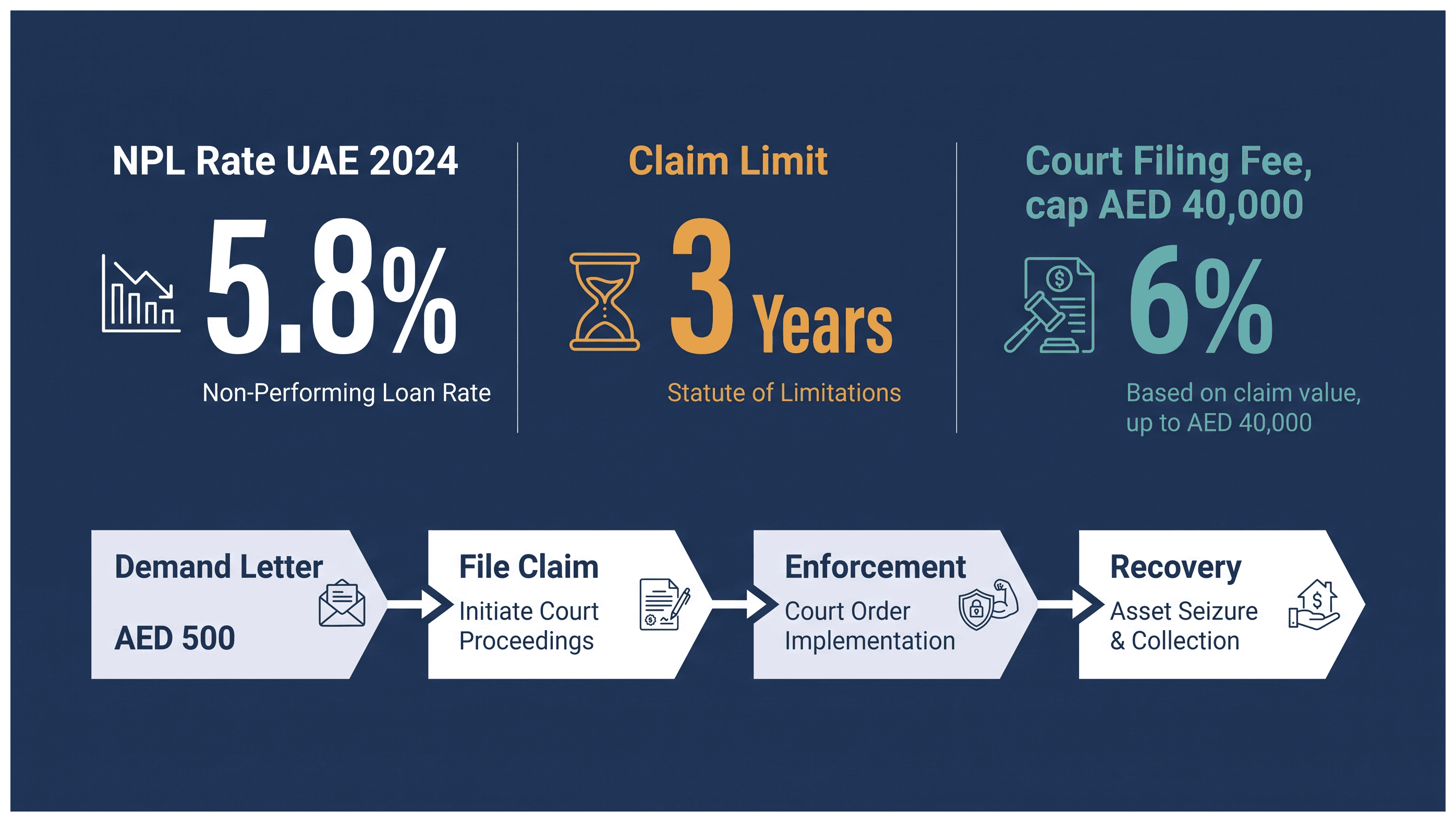
A written demand letter is a legal prerequisite before escalating a debt claim in the UAE and costs as little as AED 500. It also creates a paper trail that strengthens your position if the matter proceeds to court.
Know Your Three-Year Time Limit
UAE commercial law sets a three-year limitation period starting from the first missed payment date, after which your claim is time-barred. Acting quickly is essential, especially for new businesses managing tight cash flow.
Distinguish Disputed Debts From Defaulted Ones
A disputed debt, where the customer contests the amount or scope, requires a different legal strategy than a defaulted debt where the obligation is acknowledged but unpaid. Conflating the two wastes time and increases costs.
Gather the Right Documentation Before Filing
You will need a written or documented agreement, original invoices, proof of delivery or service completion, and evidence of your formal demand. Missing any of these makes every step of recovery harder and more expensive.
Budget Realistically for Court Filing Fees
Court filing fees in the UAE run to approximately 6% of the claim value, capped at AED 40,000. Factor this cost into your decision about whether to litigate or pursue an out-of-court settlement.
Free Zone Sellers Face Extra Jurisdictional Complexity
Free zone businesses selling to mainland customers may face disputes over which court has jurisdiction if no governing law clause exists in the contract. Without that clause, you default to UAE federal courts, which may not offer the fastest resolution.
Verbal Agreements Carry Very Limited Legal Weight
WhatsApp messages and verbal agreements are difficult to enforce in UAE courts compared to signed contracts. Building strong contract habits from day one is one of the most effective ways a new business can protect its receivables.
Non-performing loans in the UAE banking sector stood at approximately 5.8% of total loans as of the most recent reporting period (Central Bank of UAE, 2024) [1]. That figure excludes the far larger volume of inter-company trade debts that never reach a bank's books at all [2]. For a new free zone business, a single unpaid invoice can threaten cash flow and delay growth plans. The three-year limitation period for commercial claims means time matters [3]. Court filing fees run to approximately 6% of the claim value, capped at AED 40,000 [4]. A formal demand letter costs as little as AED 500 [5]. Recovering bad debt in the UAE is more structured than many new business owners realise, and the legal tools are genuinely effective when used correctly.
This guide covers the legal requirements for recovering bad debt in the UAE, the realistic costs involved, and a clear step-by-step process that finance managers and company owners can follow to pursue overdue payments through the right channels.
What Is Bad Debt Recovery in the UAE and Why It Matters
Bad debt recovery in the UAE is the legal process of collecting unpaid commercial invoices or loans from a defaulting customer. UAE law provides creditors with court-based, arbitration-based, and out-of-court remedies under Federal Decree-Law No. 50 of 2022 (UAE Cabinet, 2022) and related commercial legislation.
How UAE Commercial Law Defines a Bad Debt
A commercial debt becomes "bad" when payment is overdue beyond the contractually agreed terms and a formal demand has gone unanswered. Federal Decree-Law No. 50 of 2022 (the Commercial Transactions Law) governs trade credit obligations between businesses and sets the framework for enforcement. The limitation period for commercial debts is generally three years from the date payment was due, miss that window and your claim is time-barred.
There's an important distinction worth making early: a disputed debt (where the customer contests the amount or scope) requires a different strategy than a defaulted debt (where the customer acknowledges the obligation but won't or can't pay). Conflating the two is a common mistake that wastes time and money.
Consider this scenario: a Dubai free zone trading company supplies AED 180,000 of goods to a mainland buyer. The buyer accepts delivery but misses three consecutive payment dates. That invoice is now a recoverable bad debt under UAE commercial law, and the clock on the three-year limitation period started ticking on the first missed due date.
Why New Businesses Are Most Exposed
New companies are disproportionately vulnerable when recovering bad debt in the UAE. The main risk factors include:
Extending trade credit without a signed contract, verbal agreements and WhatsApp confirmations carry limited weight in court
Free zone entities selling to mainland customers face a jurisdiction complexity: the relevant court may be contested if no governing law clause exists
Without a signed contract specifying governing law and dispute resolution, you default to UAE federal courts, which isn't always the fastest route
Skipping credit checks on new customers because the relationship "feels right"
A first-year free zone consultancy that completes a AED 60,000 project for a mainland client with only an email chain as evidence is in a genuinely weak position if the client later disputes the scope. The absence of a signed contract doesn't kill the claim, but it makes every step harder and more expensive. Getting a professional license in Dubai is straightforward, building the contract habits to protect that business takes a little more deliberate effort.
Requirements for Recovering Bad Debt in the UAE
To pursue recovering bad debt in the UAE you need a written or documented agreement proving the debt exists, original invoices with proof of delivery or service completion, formal demand evidence, and a UAE-licensed lawyer or debt collection agent if the matter proceeds to court.
Documentation You Must Have Before Filing
Courts assess the strength of your evidence file before anything else. Here's the checklist:
Signed contract or purchase order specifying payment amount, due date, and governing law
VAT-compliant tax invoices issued in line with Federal Tax Authority format, courts treat non-compliant invoices with suspicion (Federal Tax Authority, 2024)
Proof of delivery: signed delivery note, courier confirmation, or email acknowledgement from the customer
Formal demand records: dated letters, emails, or WhatsApp messages with read receipts
Company trade license and authorised signatory documents to establish your legal standing as a creditor
A logistics company pursuing AED 95,000 in unpaid freight charges presented the Dubai Court of First Instance with signed delivery manifests, VAT-compliant invoices, and a series of dated demand emails. The judge ruled in their favour within six weeks on the expedited track. The documentation made the difference, not the size of the claim.
Legal Standing and Jurisdiction Requirements
Your company must be a licensed legal entity in the UAE. A free zone license is sufficient to file in UAE federal courts, you don't need a mainland license to pursue a mainland debtor.
On jurisdiction: if your contract doesn't specify otherwise, the Dubai Court of First Instance handles commercial claims where the debtor is based in Dubai. Free zone companies suing mainland debtors file in the relevant emirate's civil or commercial court, not the free zone's own tribunal. A UAE-licensed lawyer is required to represent a company (as opposed to an individual) in formal proceedings. For claims under AED 500,000, Dubai's expedited commercial track applies, which meaningfully shortens the timeline.
Understanding Bounced Cheques and Payment Defaults
A post-dated cheque returned unpaid by the bank is one of the strongest pieces of evidence in a UAE debt claim. Under Federal Law No. 18 of 1993 (as amended), a dishonoured cheque gives rise to both a civil claim and a potential criminal complaint against the drawer.
Worth flagging: 2022 amendments to the bounced cheque provisions introduced partial-payment protections. A cheque holder must now attempt partial collection from the bank before filing a criminal complaint. This changes the sequence, get legal advice on the correct order of steps before acting.
The criminal route creates real pressure on debtors. A Dubai free zone supplier held a AED 200,000 post-dated cheque from a customer. When the cheque bounced, the supplier filed both a civil claim and a police complaint simultaneously. The customer settled in full within two weeks to avoid criminal proceedings. That outcome is not unusual.
UAE Bad Debt Recovery: Cost Comparison by Route
Feature | Out-of-Court / Agency Route | Court Litigation Route |
|---|---|---|
Upfront cost | AED 500–AED 2,000 for a demand letter; agency fees on no-win-no-fee basis | ~6% of claim value in filing fees (capped AED 40,000) plus lawyer fees from AED 5,000 |
Timeline to resolution | Days to weeks if debtor responds to pressure | 6 weeks on expedited track; months for contested claims |
Legal representation required | Not mandatory for demand letters or agency engagement | UAE-licensed lawyer required to represent a company in court |
Suitable claim size | Most cost-effective for debts under AED 50,000 | Justified for claims above AED 20,000–AED 50,000 |
Confidentiality | Private; no public record created | Court proceedings are not confidential unless arbitration is used |
Enforcement power | Relies on debtor cooperation; no legal compulsion | Court can order account attachment, asset seizure, and travel ban |
Costs Involved in Recovering Bad Debt in the UAE
Costs for recovering bad debt in the UAE range from AED 500 to AED 2,000 for a pre-litigation demand letter, up to 6% of the claim value (capped at AED 40,000) in court filing fees, plus lawyer fees of AED 5,000 to AED 30,000 depending on claim complexity.
Pre-Litigation and Out-of-Court Costs
Formal demand letter from a UAE-licensed lawyer: AED 500 to AED 2,000, often the most cost-effective first step
Debt collection agency fee: typically 10% to 25% of the recovered amount on a no-win-no-fee basis
Document notarisation and translation (if required): AED 300 to AED 800 per document
These costs are almost always recoverable from the debtor if you win a court judgment
For debts under AED 10,000, the economics are clear: a collection agency on commission is almost always more sensible than litigation. The filing fee alone on a AED 10,000 claim would be AED 600 before you've paid a lawyer.
Court Filing Fees and Lawyer Costs
Dubai court filing fee: approximately 6% of the claimed amount, capped at AED 40,000 for commercial claims
Lawyer representation: AED 5,000 to AED 30,000 depending on claim size and complexity
Enforcement costs: if the debtor still doesn't pay after judgment, additional court fees apply for asset seizure orders
Document translation: all English-language evidence requires certified Arabic translation before submission
The World Bank (2024) notes the UAE consistently ranks among the stronger performers in the Middle East for contract enforcement efficiency, which is useful context when assessing whether litigation is worth the cost for larger claims. For business support with cost planning before a dispute escalates, your free zone's advisory team is a sensible first call.
Step-by-Step Guide to Recovering Bad Debt From a UAE Customer
To recover a bad debt from a UAE customer: document the debt, send a formal demand letter, attempt negotiation, file a police complaint if a cheque bounced, submit a court claim or initiate arbitration, obtain a judgment, and enforce it through asset attachment or account freezing.
Steps One Through Four: Prepare, Demand, and Escalate
Compile your evidence file. Gather the signed contract, all invoices, delivery proof, payment demand history, and your company's trade license and authorised signatory documents. Don't start step two until this file is complete.
Issue a formal notarised demand letter. Instruct a UAE-licensed lawyer to send this on your behalf, giving the debtor 7 to 15 days to pay. A notarised letter carries significantly more weight than an email from your own account.
Act on any bounced cheque immediately. Present the cheque to your bank for collection. If it's returned unpaid, file a police complaint at the relevant station without delay, the window for the criminal route is time-sensitive.
Attempt structured negotiation. Many debtors will agree a payment plan to avoid court proceedings. A free zone services company issued a notarised demand letter for AED 75,000 in outstanding fees. The debtor responded within five days with a settlement offer of AED 70,000, accepted, avoiding an estimated AED 15,000 in litigation costs. That's a rational outcome for both sides.
Steps Five Through Seven: File, Obtain Judgment, and Enforce
File a court claim or initiate arbitration. If negotiation fails, file at the Dubai Court of First Instance for commercial claims up to AED 500,000 on the expedited track. If your contract contains an arbitration clause, initiate DIAC (Dubai International Arbitration Centre) proceedings instead (Ministry of Economy UAE, 2024).
Attend hearings and submit all evidence. The court may issue an interim asset-freezing order while proceedings continue, request this early if you have reason to believe the debtor is moving assets.
Enforce the judgment. Once the court rules in your favour, instruct the execution department. Enforcement tools include bank account attachment, physical asset seizure, and a travel ban on the debtor's principals. Keep records of every enforcement step in case the debtor appeals.
What happens if the debtor has no assets in the UAE?
If the debtor's principal assets are held abroad, a UAE court judgment alone may not be sufficient. You'll need a lawyer with international enforcement experience to pursue recognition of the UAE judgment in the relevant foreign jurisdiction. This is a specialist area, general commercial lawyers may not have the cross-border expertise required.
How UAE Courts Handle Bad Debt Recovery Claims
UAE commercial courts process bad debt claims through a written-submission system. The Dubai Court of First Instance handles most commercial disputes, with an expedited track for claims under AED 500,000. Hearings are typically conducted in Arabic, and judgments are enforceable across all seven emirates.
The UAE Court System for Commercial Disputes
The UAE operates a three-tier court structure: Court of First Instance, Court of Appeal, and Court of Cassation. Commercial disputes sit within dedicated commercial circuits at the first-instance level. All proceedings are conducted in Arabic, which means every English-language document, contracts, invoices, emails, requires certified translation before submission. Budget for this early.
Worth noting: Dubai Courts offer an English-language track through the DIFC Courts for certain cross-border disputes. If your contract references DIFC jurisdiction, that changes both the procedural rules and the language of proceedings. Check your contract carefully before deciding where to file.
Arbitration and Alternative Dispute Resolution Options
DIAC is the primary arbitration body for commercial disputes in Dubai
Federal Law No. 6 of 2018 on Arbitration governs all UAE-seated arbitrations (UAE Cabinet, 2018) and makes awards enforceable in UAE courts
Arbitration is faster and confidential but costs more upfront than a standard court claim
Include an arbitration clause in future contracts, it gives you control over the dispute resolution process from the start
Protecting Your Business Against Future Bad Debts
Prevent bad debts by requiring signed contracts with clear payment terms, conducting credit checks before extending trade credit, issuing VAT-compliant invoices immediately, and using advance deposits or bank guarantees for high-value orders. Good documentation is your strongest legal protection in any UAE debt dispute.
Contract and Invoice Best Practices
Always use a written contract, even
References
Frequently Asked Questions