
Topic Summary
What Is UAE Customs Authority Importer Registration and Why Does It Matter?
UAE Customs Authority importer registration is the process of getting a customs code (also called an importer code or client code) that identifies your company to customs. Without it, you can't lodge declarations, clear cargo or pay duties.
Which License Do You Need Before Registering as an Importer?
Which License Do You Need Before Registering as an Importer?
How Do You Complete UAE Customs Authority Importer Registration Step by Step?
Get your trade license, create a Dubai Trade account, submit the application with documents, pay the fee and wait for approval. Then link the code to Mirsal 2 (the electronic system for lodging customs declarations). Fees and requirements may vary, so check the official source before applying.
What Documents Are Required for Customs Registration?
Most applications need a trade license, the owner's passport and Emirates ID or visa copy, proof of premises and signatory details. Requirements vary by authority and activity, so confirm the current list on the official portal.
How Much Does Customs Registration Cost and How Long Does It Take?
Customs code registration involves a fee and annual renewal, plus license costs. Amounts and timing can change, so fees and requirements may vary; check the official source before applying. Complete documents are the biggest speed factor.
How Does Customs Registration Connect to VAT and Duties?
Your code lets you declare goods, but duty and VAT are separate obligations. Customs collects duty on import value, and the Federal Tax Authority (FTA) administers VAT.
Which Mistakes and Penalties Should New Importers Avoid?
Common mistakes include mismatched license activities, incomplete documents, wrong HS codes and importing before the code is active. These cause rejection, delays, storage charges or fines.
UAE Customs Authority importer registration means getting a customs code linked to a valid trade license, then activating it through the Dubai Trade portal. You can't clear cargo without it.
Dubai handles over 16 million declarations a year (Dubai Trade, 2026), and over 98% are processed digitally. Each one needs a registered code. This guide is for entrepreneurs and cold chain operators who want to complete UAE Customs Authority importer registration without costly delays.
What Is UAE Customs Authority Importer Registration and Why Does It Matter?
UAE Customs Authority importer registration is the process of getting a customs code (also called an importer code or client code) that identifies your company to customs. Without it, you can't lodge declarations, clear cargo or pay duties.
What Does the Customs Code Actually Do?
It's a unique number linking your trade license to every declaration you file. Importer code, client code and trader code mean the same thing in practice, and the importer exporter code UAE is issued per company, not per shipment. Picture a new cold chain company importing frozen seafood: its first container can't move until that code is live.
Who Needs to Register as an Importer?
Trading companies and cold chain operators.
E-commerce sellers importing stock.
Manufacturers bringing in raw materials.
Mainland and free zone companies alike.
Individuals can't substitute for a licensed company. An investor running a refrigerated warehouse that imports its own pharmaceuticals stock needs its own code.
How Do Federal and Emirate-Level Customs Bodies Fit Together?
The Federal Authority for Identity, Citizenship, Customs and Port Security (ICP) is the federal body, so any Federal Customs Authority registration reference points there. Dubai Customs runs emirate-level operations and issues the Dubai Customs importer code. A company in Dubai South registers through Dubai Customs and clears goods through Dubai ports. Our guide to the Dubai customs code for new importers covers the emirate side in more detail.
Which License Do You Need Before Registering as an Importer?
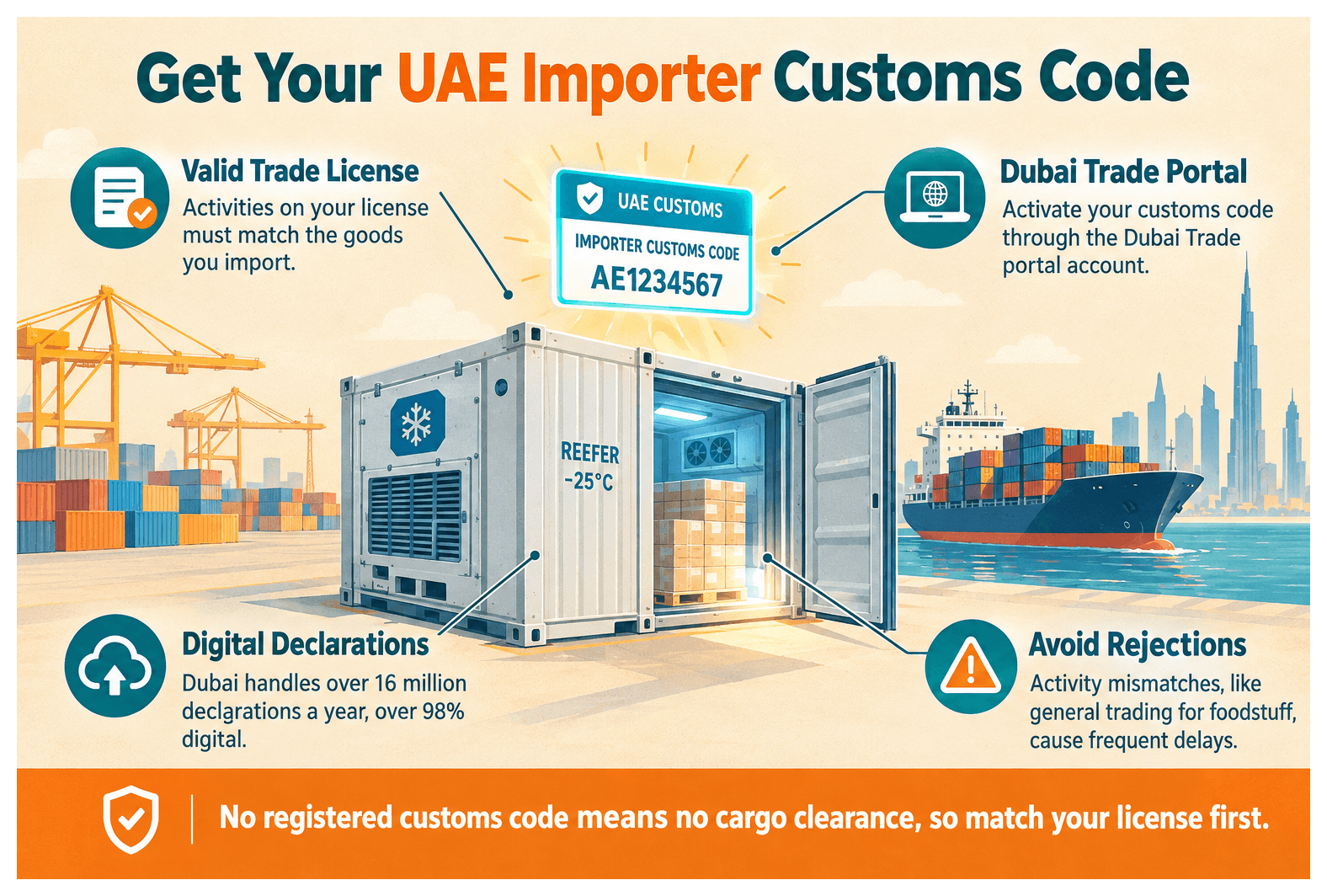
You need a valid trade license listing import or trading activities before applying. Customs links the code to your license, so activities, legal form and licensing authority must match. A Dubai South Business Hub Free Zone license is one route for new companies.
Which Trade Activities Must Appear on the License?
Activities must reflect the goods you import, such as foodstuff trading.
Mismatches are a frequent cause of rejection.
Some goods need extra approvals from MoIAT or Dubai Municipality.
A food importer whose license says general trading, but not foodstuff, will face delays. See which license you need to import goods into Dubai before you apply.
Customs Registration Checklist by Stage
Feature | Stage | What You Need |
|---|---|---|
Trade license with import activities | Before applying | Active license whose activities match your goods |
Dubai Trade portal account | Account setup | Company profile and a named authorised signatory |
Customs code application | Submission | Scanned documents and online fee payment |
Product approvals for regulated goods | Pre-shipment | Permits from Dubai Municipality, MoIAT or the Ministry of Health and Prevention |
Mirsal 2 declarations through you or an agent | Clearance | Active code, correct HS codes and shipping documents |
Free Zone or Mainland: What Changes for Customs?
Both can obtain a customs code, but cargo handling and duty treatment can differ. Dubai South Business Hub Free Zone offers company formation with a trade license and residency visa packages tied to that license. A startup can pick a lean free zone setup, then register its code against it. Duty and VAT treatment depends on where goods are stored and cleared, so check with the authority.
How Do You Complete UAE Customs Authority Importer Registration Step by Step?
Get your trade license, create a Dubai Trade account, submit the application with documents, pay the fee and wait for approval. Then link the code to Mirsal 2 (the electronic system for lodging customs declarations). Fees and requirements may vary, so check the official source before applying.
Confirm your license. Check it's active, lists import activities and matches your documents. A quick review avoids a resubmission.
Create your Dubai Trade account.Dubai Trade portal registration gives you the single window to government and logistics entities. Nominate an authorised signatory.
Submit and pay. Upload documents, complete the form and pay online. Review timing varies, so don't promise your supplier a date.
Activate and link. Use the code on Mirsal 2 declarations or through a clearing agent. A cold chain importer might appoint a freight forwarder for Dubai importers to handle its first reefer container.
What Documents Are Required for Customs Registration?
Most applications need a trade license, the owner's passport and Emirates ID or visa copy, proof of premises and signatory details. Requirements vary by authority and activity, so confirm the current list on the official portal.
Documents Checklist for New Companies
Trade license copy.
Passport and visa or Emirates ID for owner and signatory.
Lease or Ejari-type proof of premises.
Incorporation papers where applicable.
Authorisation or bank letters if requested.
Scan everything into one folder before you open the portal.
Extra Approvals for Regulated Goods
The UAE imports more than 80% of its food (u.ae), so food rules matter. Your customs code doesn't replace product compliance. A frozen food importer should complete food import registration and labelling before shipping.
How Much Does Customs Registration Cost and How Long Does It Take?
Customs code registration involves a fee and annual renewal, plus license costs. Amounts and timing can change, so fees and requirements may vary; check the official source before applying. Complete documents are the biggest speed factor.
Customs code registration and renewal.
Trade license and visa costs.
Clearing agent or forwarder fees.
Timelines hinge on document completeness, activity match and portal verification. Two companies applying the same week can see different outcomes: the one with matching activities gets approved first.
How Does Customs Registration Connect to VAT and Duties?
Your code lets you declare goods, but duty and VAT are separate obligations. Customs collects duty on import value, and the Federal Tax Authority (FTA) administers VAT.
Duty is generally charged on CIF value (cost, insurance and freight) by HS code, and rates vary by product. A refrigeration equipment importer should classify goods correctly before shipping. VAT registration depends on FTA thresholds, so confirm expected taxable turnover first. Corporate tax is a separate registration.
Which Mistakes and Penalties Should New Importers Avoid?
Common mistakes include mismatched license activities, incomplete documents, wrong HS codes and importing before the code is active. These cause rejection, delays, storage charges or fines.
Common mistake: shipping before the code is active. Confirm it's live and linked to your portal account before the vessel departs. A reefer container left waiting at port while the code is pending racks up storage charges fast.
Penalties vary by violation.
Incorrect classification can trigger an inquiry.
Verify amounts with the official authority.
What Should You Do Next?
UAE Customs Authority importer registration depends on a matching trade license, a Dubai Trade account, complete documents and an active code before your first shipment.
Confirm your license activities cover your goods, gather your documents and start your Dubai Trade account. If you still need a license, speak to Dubai South Business Hub Free Zone about company formation.
Rules in the UAE change often. Always verify the latest requirements with the official authority before taking action.
References
Frequently Asked Questions