
Topic Summary
SLAs Are Legally Binding Under UAE Civil Code
Federal Law No. 5 of 1985 treats every SLA breach as a contractual liability, not just a performance shortfall. Government tenders evaluate SLA compliance as a strict pass/fail criterion, making a precise document essential before submitting any bid.
Priority Tiers Have Fixed Time Targets
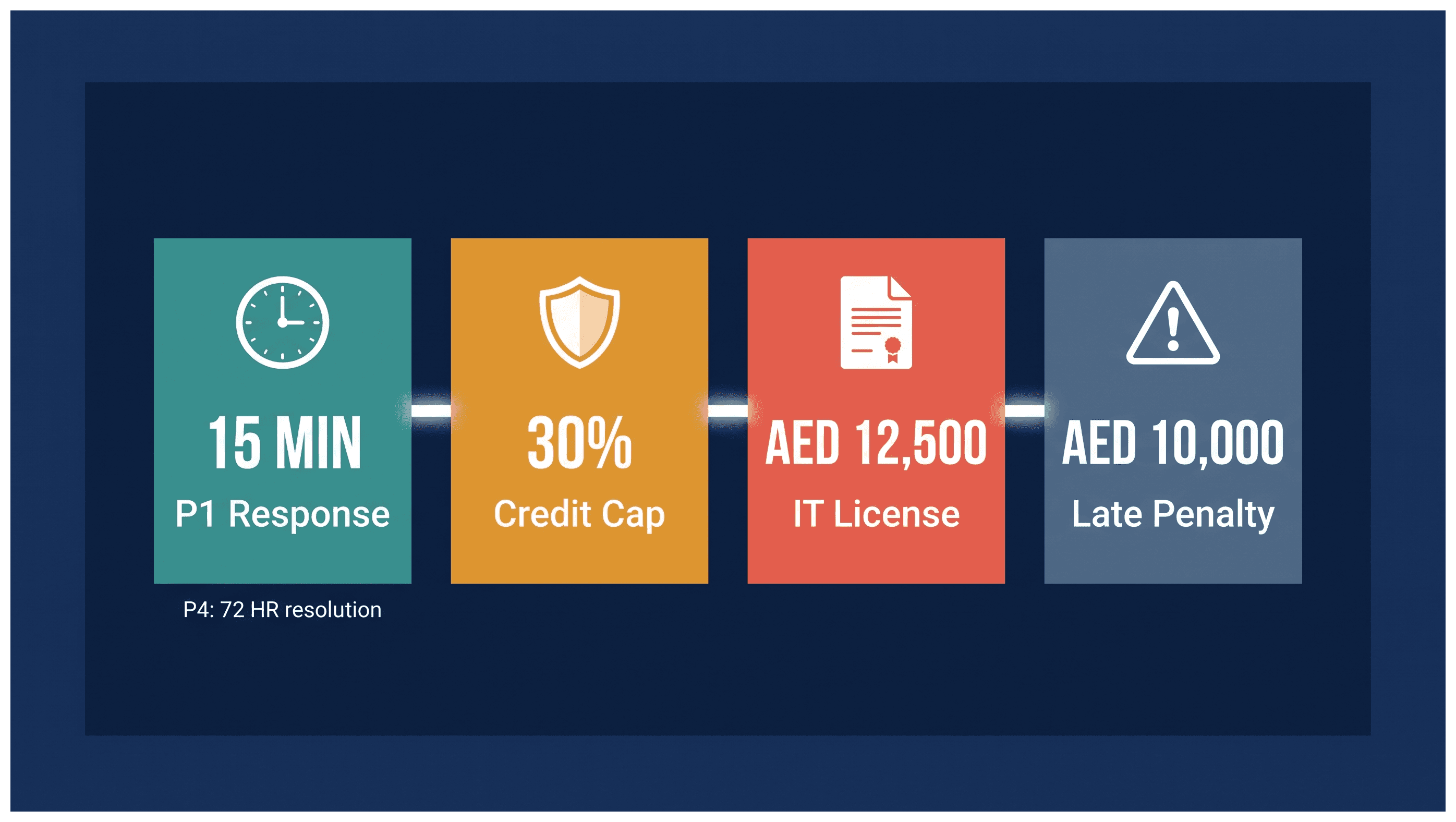
P1 critical incidents require a 15-minute response and a 4-hour resolution, while P4 low-impact tickets allow a 4-hour response and 72-hour resolution. These benchmarks represent the UAE enterprise standard and appear in most managed services contracts.
Regulated Sectors Face an Extra Approval Layer
Healthcare IT providers must align with DHA standards, financial services firms must satisfy Central Bank of UAE operational resilience guidelines, and telecoms providers answer to TDRA. A free zone license covers commercial activity, but each regulator approves operational standards separately.
Free Zone IT Licenses Start at AED 12,500
Dubai South Business Hub Free Zone can issue an IT license in a single business day, with the zero-visa package priced at AED 12,500 and the two-visa package at AED 18,200. Visa processing costs are always quoted separately from the license fee.
Service Credits Are Capped at 30% Monthly
The UAE market norm for service credits runs between 5% and 15% of monthly contract value per breach, with most contracts capping total monthly credits at 30%. Three missed P1 windows within a rolling quarter typically triggers client termination rights.
VAT and Corporate Tax Carry AED 10,000 Penalties
VAT registration becomes mandatory once taxable turnover exceeds AED 375,000, and late registration draws a flat AED 10,000 penalty. Late corporate tax registration is treated as a separate offense with its own AED 10,000 flat penalty.
UAE ICT Sector Exceeds AED 170 Billion in GDP
By 2026, the UAE's ICT sector contributes over AED 170 billion to national GDP, with managed IT services among the fastest-growing segments. This scale makes compliant, well-structured SLAs a genuine competitive differentiator for providers entering the market.
SLAs are legally binding under UAE Civil Code.
Federal Law No. 5 of 1985 treats every SLA breach as a contractual liability. Government tenders treat SLA compliance as a pass/fail criterion, not a scored item, so getting the document right before you submit a bid is non-negotiable.
Priority tiers carry specific time targets.
P1 critical incidents require a 15-minute response and a 4-hour resolution. P4 low-impact tickets allow a 4-hour response and a 72-hour resolution. These benchmarks are the UAE enterprise standard and appear in most managed services contracts.
Regulated sectors add a second approval layer. Healthcare IT providers must align with DHA standards; financial services providers must satisfy Central Bank of UAE operational resilience guidelines; telecoms providers answer to TDRA. Your free zone license covers the commercial activity, but each regulator approves the operational standards separately.
A free zone IT license starts at AED 12,500.
Dubai South Business Hub Free Zone issues the license in one business day. The zero-visa package costs AED 12,500; the two-visa package costs AED 18,200. Visa processing is always quoted separately.
Service credits are capped at 30% of monthly fees.
The UAE market norm is 5% to 15% of the monthly contract value per breach. Most contracts cap total monthly credits at 30%. Three missed P1 windows in a rolling quarter typically trigger client termination rights.
VAT and corporate tax deadlines carry AED 10,000 penalties.
Register for VAT once turnover exceeds AED 375,000. Late VAT registration carries an AED 10,000 penalty. Late corporate tax registration is a separate one-time flat penalty of AED 10,000.
In 2026, the UAE's ICT sector contributes over AED 170 billion to national GDP, with managed IT services among the fastest-scaling segments in the market. Service desk SLAs in the UAE are legally binding performance frameworks governed by Federal Law No. 5 of 1985. A P1 response window of 15 minutes is the enterprise standard. Free zone IT licenses start at AED 12,500. VAT registration is mandatory above AED 375,000 in taxable turnover, with a AED 10,000 penalty for late filing (Federal Tax Authority, 2026). Corporate tax late registration carries a separate AED 10,000 flat penalty. This guide covers what service desk SLAs in the UAE must include, what they cost to implement, and the step-by-step process for structuring compliant agreements if you're launching or growing an IT services company here.
What Are Service Desk SLAs and Why They Matter for UAE IT Providers
A service desk SLA (Service Level Agreement) is a formal contract between an IT provider and a client that defines measurable performance standards, including response times, resolution targets, uptime guarantees, and escalation procedures. In the UAE, service desk SLAs carry legal weight under the UAE Civil Code and are mandatory in most government and enterprise IT contracts. If you're planning to sell managed IT services here, you'll need a signed, precise SLA before you onboard a single client.
The Core Components of a Service Desk SLA
Every service desk SLA in the UAE should cover four non-negotiable areas:
Scope: List every service, system, and user group covered. Exclusions must be named explicitly, not implied.
Incident priority tiers: P1 critical through P4 low, each with a separate response clock and resolution clock.
Uptime commitment: Expressed as a percentage. 99.9% availability equates to roughly 8.7 hours of permitted downtime per year. 99.99% cuts that to 52 minutes.
Escalation matrix: Named contacts, escalation windows, and the sequence of notification at each tier.
A Dubai-based managed services provider serving a hospital network would typically commit to a 15-minute P1 response and a 4-hour resolution window to satisfy Dubai Health Authority (DHA) operational requirements. That's not a negotiating position; it's the baseline the regulator expects.
UAE Service Desk SLA Priority Tiers at a Glance
Priority Level | Response Target | Resolution Target |
|---|---|---|
P1 Critical, system-wide outage | 15 minutes | 4 hours |
P2 Major, key function degraded | 30 minutes | 8 hours |
P3 Minor, workaround available | 2 hours | 24 hours |
P4 Low, cosmetic or low-impact | 4 hours | 72 hours |
Service credit per breach | 5%–15% of monthly contract fees; total monthly credits capped at 30% |
Why SLAs Carry Legal Weight in the UAE
The UAE Civil Code (Federal Law No. 5 of 1985) treats an SLA breach as a contractual liability, not just a service failure. Dubai courts have upheld service credit clauses and penalty provisions in IT contracts, and government procurement regulations increasingly require SLA documentation at tender submission.
A semi-government entity in Abu Dhabi issuing an IT managed services tender will typically specify minimum SLA thresholds as a pass/fail eligibility criterion. You either meet the standard or you don't qualify. Without a signed SLA, dispute resolution defaults to general contract law, which gives clients far fewer protections and gives you far less clarity on your obligations.
If you're still working out which ICT license in Dubai fits your service model, confirm that before you draft a single SLA clause. The activity wording on your license determines what contracts you can legally sign.
Key Requirements for Service Desk SLAs in the UAE
Service desk SLAs in the UAE must address incident classification, response and resolution time commitments, uptime thresholds, penalty and credit structures, reporting frequency, and data handling obligations. Regulated sectors add a second layer: healthcare providers must align with DHA standards, and financial services firms must satisfy Central Bank of UAE guidelines.
Incident Classification and Response Time Standards
P1 (system-wide outage): 15-minute response, 4-hour resolution.
P2 (major function degraded): 30-minute response, 8-hour resolution.
P3 (minor disruption, workaround available): 2-hour response, 24-hour resolution.
P4 (cosmetic or low-impact): 4-hour response, 72-hour resolution.
Context matters for tiering. An IT provider supporting a retail chain across multiple Dubai locations would classify a point-of-sale system failure as P1 during trading hours but P3 after store closing. The same failure, different priority, because the business impact is different. Build that logic into your priority matrix explicitly so there's no ambiguity when a ticket lands at 11 PM.
Regulated Sector Overlay Requirements
Healthcare:DHA requires IT systems supporting patient data to meet specific availability thresholds and breach notification timelines.
Financial services: The Central Bank of UAE mandates operational resilience standards that feed directly into SLA design for any provider touching banking or payment infrastructure.
Telecommunications: TDRA governs data handling and network performance for providers operating licensed infrastructure.
Dual approval model: For each regulated client, the IT provider needs both the free zone license for the commercial activity and the relevant regulator's sign-off on operational standards.
An IT provider holding a Dubai South Business Hub Free Zone ICT license that takes on a private hospital client must ensure its SLA meets DHA requirements. The free zone licenses the commercial activity; DHA approves the operational standards separately. These are two different processes, and skipping the second one disqualifies you as a vendor.
Penalty Structures and Service Credit Mechanics
Service credits are the most common contractual remedy in UAE IT contracts. The market norm sits at 5% to 15% of the monthly contract value per breach, with a total monthly cap of 30% of monthly fees. That cap protects providers from cascading credits during a bad month, but it doesn't protect you from termination.
Consider a provider on an AED 50,000 per month contract with a 10% credit clause per P1 breach. One missed resolution window costs AED 5,000. Three missed windows in a rolling quarter typically triggers the client's right to terminate without penalty. That's a real financial and reputational exposure, and it's exactly why your infrastructure needs to back every uptime commitment you put in writing.
What It Costs to Deliver Service Desk SLAs in the UAE
Delivering SLA-compliant service desk operations in the UAE involves staffing, monitoring tooling, and the underlying business license. A free zone IT company license starts at AED 12,500. Ongoing SLA delivery costs vary by team size and tooling stack, but budget AED 15,000 to AED 40,000 per month for a small managed services operation.
Business License and Setup Costs
Zero-visa package (AED 12,500): Includes the license, Articles of Association, share register, flexi-desk space.
One-visa package (AED 16,350): Adds one visa allocation (investor or partner visa) and establishment card.
Two-visa package (AED 18,200): Adds two visa allocations and establishment card. This is the maximum under the package structure.
Visa processing: Entry permit, status change, medical fitness test, Emirates ID application, and stamping are always quoted separately.
License issued in one business day once documentation is complete.
A two-person IT consultancy founding team would typically choose the two-visa package at AED 18,200, covering both founders' visa allocations, then budget separately for visa processing. Use the business setup cost calculator to model your exact package cost before committing.
Operational Costs for SLA Delivery
Staffing is your largest ongoing cost. A Level 1 service desk agent in Dubai earns approximately AED 6,000 to AED 10,000 per month (UNVERIFIED: confirm before publishing). ITSM tooling such as ServiceNow, Freshservice, or Jira Service Management runs approximately AED 150 to AED 600 per agent per month (UNVERIFIED: confirm before publishing). Monitoring and alerting platforms add AED 500 to AED 3,000 per month depending on endpoint count (UNVERIFIED: confirm before publishing).
A three-agent service desk running Freshservice and a basic monitoring stack could expect combined tooling costs of roughly AED 3,000 to AED 5,000 per month before staffing. Redundancy infrastructure to hit 99.9% uptime commitments adds capital expenditure that must be priced into the contract from day one, not absorbed as an afterthought.
How to Set Up Your IT Services Company in the UAE
Setting up an IT services company in the UAE involves choosing a free zone, selecting the right business activities, registering the company, obtaining the license, and then structuring your SLA documentation before onboarding clients. The entire license process at Dubai South Business Hub Free Zone takes one business day from document submission. Here's how it works in practice.
Step 1: Choose Your Business Activities and License Type
Select IT-specific activities from the free zone's approved list. Common choices include IT consultancy, managed services, software support, and network management.
Confirm each activity name with the free zone before submitting. Activity wording determines what contracts you can legally sign.
Check the full list of business activities in Dubai to confirm your service desk offering is covered under the chosen activity codes.
Multiple activities can appear on a single license, so you don't need separate licenses for related services.
A provider offering both remote service desk support and on-site IT maintenance would typically list both managed IT services and IT facilities management as separate activities on one license.
Step 2: Register the Company and Obtain the License
Submit passport copies, your proposed company name, and selected activities to Dubai South Business Hub Free Zone.
Run a trade name availability search before submitting to avoid delays.
Choose your package: AED 12,500 (zero-visa), AED 16,350 (one-visa allocation), or AED 18,200 (two-visa allocations).
The license is issued in one business day once documentation is complete.
You'll receive the Articles of Association, share register, flexi-desk lease agreement, and establishment card (visa packages only).
A solo founder operating as sole director and shareholder would submit their passport, select the zero-visa package at AED 12,500, and have a licensed entity the next working day.
Step 3: Handle Tax Registration and Banking
Register for VAT with the Federal Tax Authority once taxable turnover exceeds AED 375,000. Late registration carries an AED 10,000 penalty (Federal Tax Authority, 2026).
Register for corporate tax with the FTA. Late registration is a one-time flat penalty of AED 10,000.
Open a UAE business bank account. Most banks require the license, Articles of Association, and Emirates ID of the director.
Explore bank account opening in the UAE options early. Processing times vary significantly by institution.
An IT provider that crosses the AED 375,000 VAT threshold in its second year of trading must register within 30 days of exceeding it. Miss that window and the AED 10,000 penalty applies automatically.
How to Structure SLA Documentation That Clients and Regulators Accept
A compliant SLA document in the UAE should cover scope, priority tiers with defined response and resolution times, uptime commitments, penalty mechanics, reporting cadence, and a governing law clause
References
Frequently Asked Questions