Topic Summary
What Is Japanese Nationals Financial UAE Planning and Why It Matters
Japanese nationals financial UAE planning means coordinating two tax systems when you own a Dubai company. The UAE taxes company profit at 0% on qualifying free zone income or 9% above AED 375,000, while Japan may tax residents on worldwide income. Planning aligns both so you avoid double taxation and missed filings.
How the UAE-Japan Investment Treaty Shapes Your Tax Position
How the UAE-Japan Investment Treaty Shapes Your Tax Position
UAE Corporate Tax and VAT Regulations in the UAE for Japanese Company Owners
UAE corporate tax is 9% on taxable income above AED 375,000, with a 0% rate on qualifying free zone income if conditions are met. VAT is 5%, and registration is mandatory above AED 375,000 in taxable supplies and imports. Missing deadlines triggers fixed penalties, so register and file on time.
Step-by-Step Process to Stay Tax Compliant as a Japanese Owner
To stay compliant, confirm your tax residency, register for UAE corporate tax, assess VAT, keep audited records, and report the company to Japan if you are a Japanese resident. Follow these steps in order each year, and document everything to support treaty claims and avoid penalties.
What Japan Expects From Residents Who Own a UAE Company
Japan may tax residents on dividends, salary and, under controlled foreign company rules, certain undistributed profits of low-taxed foreign companies. Japanese residents should report foreign income and assets and test whether an exemption applies. Because rules change, confirm treatment with a licensed Japanese tax adviser.
Common Mistakes Japanese Owners Make With a Dubai Company
The most common Mistakes are assuming 0% UAE tax means no tax anywhere, skipping corporate tax registration, ignoring VAT thresholds, mixing personal and company funds, and missing Japanese reporting. Each can trigger penalties or back taxes, and all are avoidable with early registration, clean books, and cross-border advice.
Next Steps for Japanese Nationals Financial UAE Planning
Start by confirming your residency, estimate costs, and secure your company name. Then register for UAE corporate tax, plan VAT, and book a review with a Japanese tax adviser. Dubai South Business Hub can support formation, licensing, and the residency visa tied to your license.
A Dubai company's profit is taxed in the UAE first: 0% on qualifying free zone income, 9% above AED 375,000 (Ministry of Finance, 2023) [1]. Your Japanese tax residency then decides whether Japan taxes the same income too.
This guide is for japanese nationals financial uae planning when you run a Dubai company from Japan or split your time. The UAE has no personal income tax (0%) and has signed over 140 double tax treaties (Federal Tax Authority, 2024) [2]. VAT is 5% and a missed registration deadline costs AED 10,000 [2]. We cover the treaties, corporate tax, VAT, Japanese reporting, a yearly process and common errors.
What Is Japanese Nationals Financial UAE Planning and Why It Matters
Japanese nationals financial UAE planning means coordinating two tax systems when you own a Dubai company. The UAE taxes company profit at 0% on qualifying free zone income or 9% above AED 375,000, while Japan may tax residents on worldwide income. Planning aligns both so you avoid double taxation and missed filings.
Why Two Tax Systems Apply to One Company
The company is taxed where it's registered. You're taxed where you live. Japanese tax residents are generally taxed on worldwide income, so UAE tax at 0% doesn't switch off your obligations at home.
Picture a Tokyo-based consultant who owns a Dubai South Business Hub free zone company. The company may pay 0% on qualifying income, yet the consultant still reports at home. Any dividend arrives in a UAE with 0% personal income tax, but Japan may tax it.
Who Needs This Guidance Most
Residents of Japan who own a Dubai company.
Founders who relocate but keep Japanese ties.
Owners running a UAE business from Japan remotely, like an Osaka trader with a Dubai-licensed entity.
Residency, not nationality alone, drives your Japanese exposure. For the formation side, read our guide to setting up a company in Dubai South as a Japanese national.
How the UAE-Japan Investment Treaty Shapes Your Tax Position
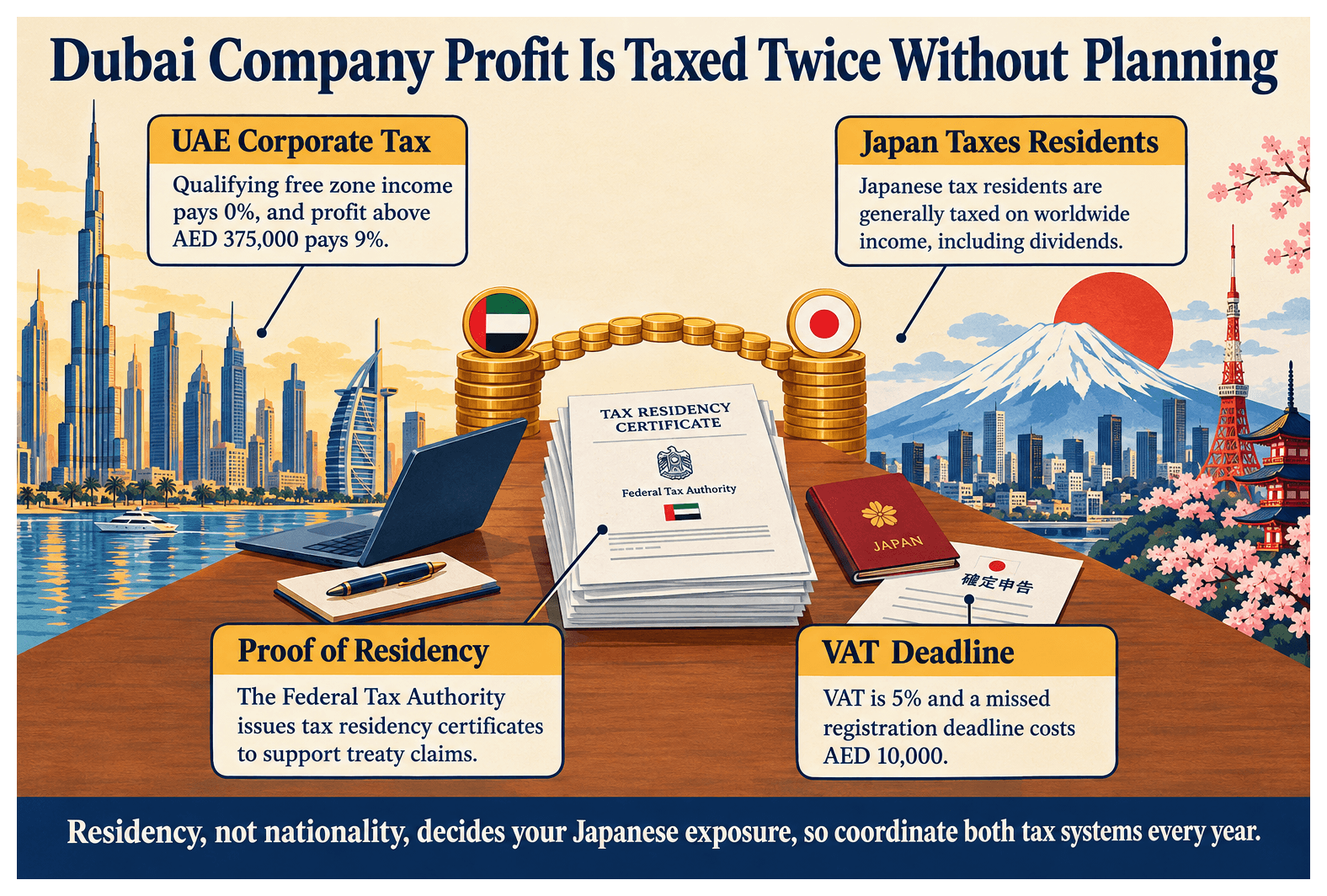
The UAE-Japan investment treaty protects Japanese investors in the UAE, and the separate UAE-Japan double tax agreement allocates taxing rights on income. Together they reduce the risk of being taxed twice. Treaty relief usually requires proof of tax residency and correct documentation, so confirm current terms before filing.
Investment Protection Versus Tax Relief
Don't conflate the two instruments. The investment treaty covers fair treatment and protection of your shareholding, not tax rates. The double tax agreement handles dividends, interest and business profits. A Japanese investor in a Dubai company relies on the first for protection and the second for dividend treatment.
Proving UAE Tax Residency
The Federal Tax Authority issues tax residency certificates.
Expect to show a residence visa, tenancy and days spent in the UAE.
Check current day-count rules with the FTA.
Certificates support treaty claims.
An owner with an UAE investor visa for Japanese nationals typically applies for this certificate before claiming dividend relief.
UAE Corporate Tax and VAT Regulations in the UAE for Japanese Company Owners
UAE corporate tax is 9% on taxable income above AED 375,000, with a 0% rate on qualifying free zone income if conditions are met. VAT is 5%, and registration is mandatory above AED 375,000 in taxable supplies and imports. Missing deadlines triggers fixed penalties, so register and file on time.
Corporate Tax and the Qualifying Free Zone Person Status
Federal Decree-Law No. 47 of 2022 sets the rules. Qualifying status needs real UAE substance: staff, premises and expenses. Audited financials are generally expected. Every company must register with the FTA, even at 0%. A Dubai South trading company earning qualifying income from non-resident customers keeps its rate by maintaining that substance. Non-qualifying income falls under the 9% rate. Our overview of tax benefits for Dubai free zone companies goes further.
VAT Registration and Filing Duties
Standard rate is 5%.
Registration is mandatory above AED 375,000, voluntary above AED 187,500.
Returns are quarterly or monthly, as the FTA assigns.
Late registration costs AED 10,000.
A Japanese-run e-commerce business crossing AED 375,000 in taxable supplies must register. More than 350,000 UAE businesses are VAT-registered (FTA, 2025) [2].
Cost and Tax Comparison Table
UAE and Japan Tax Treatment for a Dubai Company Owner (AED figures, dated May 2026)
Feature | UAE Treatment | Japan-Side Consideration |
|---|---|---|
Corporate income (0% qualifying / 9% above AED 375,000) | 0% on qualifying free zone income; 9% above AED 375,000 otherwise | Controlled foreign company rules may attribute low-taxed profit to you |
VAT (5%, registration above AED 375,000) | 5% on taxable supplies; AED 10,000 late registration penalty | Japanese consumption tax may apply to your Japan-side sales |
Personal income and dividends (0% in the UAE) | 0% on salary and dividends | Residents are generally taxed on dividends and salary; treaty credit may apply |
Reporting and filing deadlines | Corporate tax return within nine months of year end | Annual return plus foreign asset reporting where thresholds are met |
License cost (from AED 12,500, quote date stated) | Licenses start from AED 12,500 as of May 2026 | Setup costs are generally deductible only if the structure is treated as operating |
Use the cost calculator for current quotes.
Step-by-Step Process to Stay Tax Compliant as a Japanese Owner
To stay compliant, confirm your tax residency, register for UAE corporate tax, assess VAT, keep audited records, and report the company to Japan if you are a Japanese resident. Follow these steps in order each year, and document everything to support treaty claims and avoid penalties.
Step 1: Confirm Your Tax Residency in Japan and the UAE
Count days and ties in both countries. An owner spending 200 days in the UAE should document that before filing. Residency drives worldwide-income exposure, so ask a Japanese tax professional to confirm your status.
Step 2: Register for Corporate Tax and Assess VAT
Register on the FTA portal and test projected revenue against VAT thresholds. Missing the deadline costs AED 10,000. Check your trade name first with the name check tool.
Step 3: Keep Books, Open a Bank Account, and Pay Yourself Properly
Keep accounting records for the required retention period. The Central Bank of the UAE supervises more than 50 licensed banks [3], and a corporate account gives clean audit trails. Our guide to opening a UAE corporate bank account as a Japanese entrepreneur helps here. Document salary, board-approved dividends and loans separately.
Step 4: File in the UAE and Disclose in Japan
File the UAE return within nine months of year end. Then declare dividends and foreign holdings in Japan as required. Keep treaty and residency documents for audits.
What Japan Expects From Residents Who Own a UAE Company
Japan may tax residents on dividends, salary and, under controlled foreign company rules, certain undistributed profits of low-taxed foreign companies. Japanese residents should report foreign income and assets and test whether an exemption applies. Because rules change, confirm treatment with a licensed Japanese tax adviser.
Controlled Foreign Company Rules in Plain Terms
Japan can attribute a low-tax foreign subsidiary's income to its resident owners. Active-business and substance tests may provide exemptions. A Japanese resident owning 100% of a passive Dubai holding company may face attribution. An operating trading company with real UAE substance is assessed differently. Expect close attention to both the 9% rate and 0% free zone income.
Dividends, Salary, and Foreign Asset Reporting
UAE dividends are generally taxable for Japanese residents.
Credit UAE-paid tax where the treaty allows.
Salary follows residency and the double tax agreement.
Foreign asset reporting may apply above thresholds.
If your company ships goods, see import and export between Japan and Dubai.
Common Mistakes Japanese Owners Make With a Dubai Company
The most common Mistakes are assuming 0% UAE tax means no tax anywhere, skipping corporate tax registration, ignoring VAT thresholds, mixing personal and company funds, and missing Japanese reporting. Each can trigger penalties or back taxes, and all are avoidable with early registration, clean books, and cross-border advice.
Assuming UAE Tax Treatment Ends the Story
Treat a Dubai company as low tax with conditions, never tax free. A founder who moved only on paper still files as a Japanese resident. And income above AED 375,000 that isn't qualifying pays 9%.
Registration, Substance, and Record-Keeping Gaps
No tax registration, even at 0%.
No audited accounts for qualifying status.
Personal spending paid from the company account.
A late registration penalty of AED 10,000.
One company lost qualifying treatment after a documentation gap. Don't let that be you.
Next Steps for Japanese Nationals Financial UAE Planning
Start by confirming your residency, estimate costs, and secure your company name. Then register for UAE corporate tax, plan VAT, and book a review with a Japanese tax adviser. Dubai South Business Hub can support formation, licensing, and the residency visa tied to your license.
Price Your Setup and Reserve Your Name
Run the cost calculator; licenses start from AED 12,500 as of May 2026.
Run the name check before applying.
Compare plans against expected revenue.
Read the Rest of the Japanese Founder Series
More than 60% of new applications come from founders who haven't yet visited the UAE. Read what Japanese founders need to know before setting up in Dubai next.
Japanese nationals financial uae planning comes down to two filings in two countries. Align treaty claims, substance and records, then use the cost calculator to price your Dubai South Business Hub license and speak with the team about a residency visa package.
References
Ministry of Finance, UAE Corporate Tax, 2023.
Federal Tax Authority, corporate tax and VAT guidance, 2024-2025.
Central Bank of the UAE, licensed banks, 2026.
Frequently Asked Questions