
Topic Summary
What Is Ugandan Nationals Financial UAE Tax and How Does It Work
Ugandan nationals financial UAE tax covers what a Ugandan owner of a Dubai company pays in the UAE and in Uganda. The UAE applies 9% corporate tax above AED 375,000 and 5% VAT, with possible 0% on qualifying free zone income. Uganda may tax worldwide income if you're resident.
Which UAE Taxes Apply to a Dubai South Free Zone Company
Which UAE Taxes Apply to a Dubai South Free Zone Company
How Uganda Revenue Authority Rules Apply to a Dubai Company Owner
Uganda taxes residents on worldwide income, so a Ugandan resident who owns a Dubai company may owe tax on dividends or controlled profits. Non-residents are generally taxed only on Ugandan-source income. Treaty relief and foreign tax credits can reduce double taxation, so confirm your position with a Ugandan tax adviser. Running a UAE business from Uganda makes this the key question.
Step-by-Step Process to Stay Tax Compliant as a Ugandan Owner
To stay compliant, confirm residency, form your free zone company, register for corporate tax, assess VAT, keep proper books, and file annual returns. Then declare foreign income in Uganda if resident. These ordered steps keep both authorities satisfied for ugandan nationals financial uae obligations.
How East African Community Re-Export Routes Affect Your Tax Position
East African Community re-export routes let a Dubai company buy goods, hold them in the UAE and ship them to Uganda, Kenya or Tanzania. The tax effect depends on where title passes, VAT zero-rating on exports, customs duty on arrival and whether income qualifies for 0% free zone treatment. It's central to any UAE business from Uganda.
Cost and Tax Comparison for Ugandan Dubai Company Owners
A Ugandan owner's tax picture splits into UAE obligations and Ugandan obligations. The UAE charges 0% to 9% corporate tax and 5% VAT; Uganda taxes residents on worldwide income. Compare each item by rate, threshold and filing duty in AED, and verify fees on the date you apply. The table above sets this out for a Dubai company Ugandan national owner.
Common Mistakes Ugandan Owners Make With Dubai Company Tax
Common mistakes include assuming the UAE is fully tax free, skipping corporate tax registration, missing VAT thresholds, ignoring Ugandan residency duties and mixing personal and company funds. Each can trigger penalties such as AED 10,000 for late VAT registration, so build ugandan nationals financial uae compliance into your setup from day one.
For ugandan nationals financial uae planning, the UAE charges 9% corporate tax above AED 375,000 and 5% VAT (Federal Tax Authority, 2026). A Ugandan who owns a Dubai free zone company generally pays 0% to 9% UAE corporate tax, depending on income type and Qualifying Free Zone Person status. You may still owe Uganda Revenue Authority (URA) tax if you're tax-resident in Uganda. This guide is for Ugandan founders who want to know what they'll owe, and where.
What Is Ugandan Nationals Financial UAE Tax and How Does It Work
Ugandan nationals financial UAE tax covers what a Ugandan owner of a Dubai company pays in the UAE and in Uganda. The UAE applies 9% corporate tax above AED 375,000 and 5% VAT, with possible 0% on qualifying free zone income. Uganda may tax worldwide income if you're resident.
UAE Tax Basics for a Dubai Company Owner
The UAE levies no personal income tax on salary or dividends. The company, though, has duties. Picture a Ugandan consultant earning AED 600,000 through a Dubai South company: the first AED 375,000 sits at 0%, the remaining AED 225,000 at 9% (AED 20,250), subject to qualifying conditions. That's low-tax, not tax-free.
Why Ugandan Owners Face Two Tax Systems
The UAE taxes the company. Uganda may tax you personally. Residency, not nationality, drives that exposure. Take a Kampala-based founder who still lives in Uganda: the Dubai company's profits and dividends can land on a URA return, so document where management and control sit.
Where Ugandan Nationals Financial UAE Planning Starts
Decide residency first, then structure. Read what Ugandan founders need to know before setting up in Dubai, then model license costs in AED with the cost calculator before committing to a package. Fees change, so note the quote date.
Which UAE Taxes Apply to a Dubai South Free Zone Company
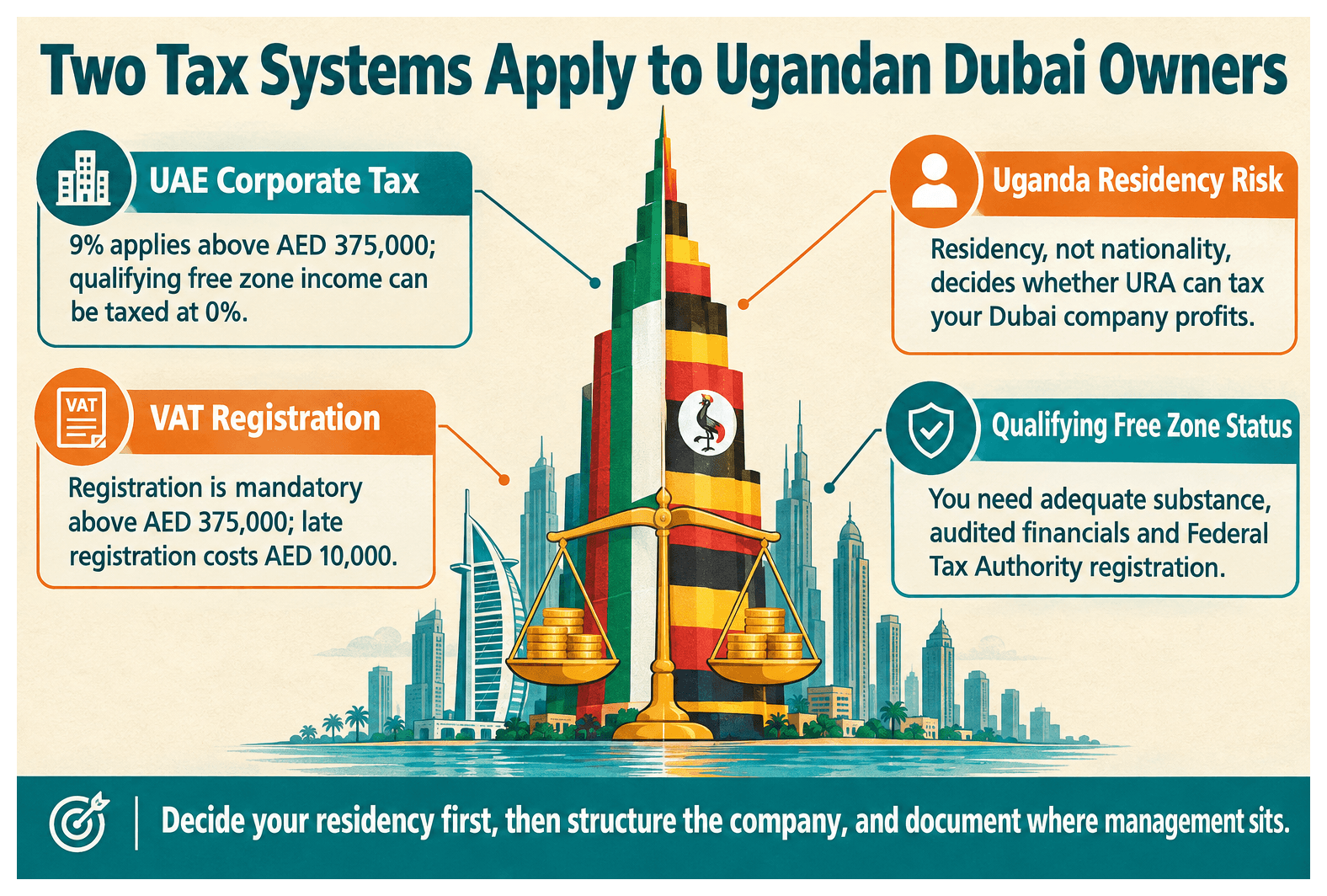
A Dubai South free zone company may face 9% corporate tax on income above AED 375,000, 5% VAT when registered, and excise duty on specific goods. Qualifying Free Zone Persons can access 0% on qualifying income if they meet substance, revenue and reporting conditions. Non-qualifying income is taxed at 9%. For a Dubai company Ugandan national owner, that split matters.
Corporate Tax and Qualifying Free Zone Person Status
0% applies to qualifying income only.
You need adequate substance and audited financials.
De minimis limits cap non-qualifying revenue.
Register with the Federal Tax Authority even at 0%.
A Ugandan-owned trading company selling to other free zone entities is treated differently from one selling to mainland customers.
VAT Registration and Filing Duties
Registration is mandatory above AED 375,000 in taxable supplies.
It's voluntary above AED 187,500.
Late registration costs AED 10,000 (Federal Tax Authority, 2026).
Quarterly returns are typical.
Other Costs: License, Audit and Banking
Budget for annual license renewal, audit and bookkeeping, and confirm each AED figure on the date you apply. Check trade name availability through the name check first. Banking affects reporting too; see opening a UAE corporate bank account as an Ugandan entrepreneur. The Ministry of Finance (MoF) publishes the corporate tax framework.
How Uganda Revenue Authority Rules Apply to a Dubai Company Owner
Uganda taxes residents on worldwide income, so a Ugandan resident who owns a Dubai company may owe tax on dividends or controlled profits. Non-residents are generally taxed only on Ugandan-source income. Treaty relief and foreign tax credits can reduce double taxation, so confirm your position with a Ugandan tax adviser. Running a UAE business from Uganda makes this the key question.
Tax Residency Tests for Ugandan Nationals
Ugandan law looks at factors like a permanent home and days present. Citizenship alone doesn't decide it. If you split time between Kampala and Dubai, keep travel and ownership records, and verify the current URA rules.
Dividends, Salary and Foreign Income Reporting
The UAE doesn't withhold tax on dividends.
Ugandan residents may need to declare them.
A dividend of AED 100,000 should be reported in the right currency.
Foreign tax credits may apply.
Double Tax Treaty and Credit Considerations
The UAE has a wide treaty network (Federal Tax Authority). Confirm whether a UAE-Uganda treaty applies on your filing date. If it doesn't, credit for UAE corporate tax paid depends on Ugandan domestic rules. Residency visas matter here, so read the UAE investor visa for Ugandan nationals guide.
Step-by-Step Process to Stay Tax Compliant as a Ugandan Owner
To stay compliant, confirm residency, form your free zone company, register for corporate tax, assess VAT, keep proper books, and file annual returns. Then declare foreign income in Uganda if resident. These ordered steps keep both authorities satisfied for ugandan nationals financial uae obligations.
Step 1: Confirm Residency and Structure
Decide where you'll live and manage the company.
Check your name via the name check.
Step 2: Register for Corporate Tax and VAT
Register on the Federal Tax Authority portal.
Do it even if you expect 0%.
Test VAT against AED 375,000 to avoid the AED 10,000 penalty.
Step 3: Keep Books, Audit and File Returns
Set up bookkeeping from month one.
Keep records for the statutory period.
Get audited financials if you seek QFZP status.
File the annual corporate tax return on time.
Step 4: Declare Foreign Income in Uganda
Report dividends and profit on your annual URA return if resident.
Keep UAE tax certificates.
Claim credits with evidence.
How East African Community Re-Export Routes Affect Your Tax Position
East African Community re-export routes let a Dubai company buy goods, hold them in the UAE and ship them to Uganda, Kenya or Tanzania. The tax effect depends on where title passes, VAT zero-rating on exports, customs duty on arrival and whether income qualifies for 0% free zone treatment. It's central to any UAE business from Uganda.
VAT and Customs on Re-Exports to Uganda
Exports can be zero-rated with proper evidence, and EAC customs duty applies on arrival. Take a Dubai company sending electronics via Mombasa to Kampala: keep bills of lading and invoices. Dubai handles over 14 million TEUs a year (DP World). Licensing details are in import and export between Uganda and Dubai.
UAE vs Uganda Tax Obligations for a Dubai Company Owner
Feature | UAE (Dubai Company) | Uganda (Resident Owner) |
|---|---|---|
Corporate or business tax | 0% up to AED 375,000, 9% above; 0% on qualifying free zone income | Worldwide income of residents may be taxable; confirm with URA |
VAT or consumption tax | 5%; mandatory above AED 375,000; exports can be zero-rated | Import VAT and EAC duty apply on arrival of goods |
Dividend treatment | No withholding tax on dividends | Foreign dividends may be declared; credits may apply |
Registration and filing duties | Corporate tax registration even at 0%; annual return; quarterly VAT typical | Annual personal return including foreign income |
Late penalties (AED, dated) | AED 10,000 for late VAT registration (as of June 2026) | Set by URA; verify the current schedule |
Free Zone Income Treatment on Goods Trading
Sales to mainland customers can be non-qualifying. Export sales may qualify depending on the activity. A Ugandan trader selling to Kenyan and Tanzanian buyers should map each revenue stream as qualifying or not before year-end.
Cost and Tax Comparison for Ugandan Dubai Company Owners
A Ugandan owner's tax picture splits into UAE obligations and Ugandan obligations. The UAE charges 0% to 9% corporate tax and 5% VAT; Uganda taxes residents on worldwide income. Compare each item by rate, threshold and filing duty in AED, and verify fees on the date you apply. The table above sets this out for a Dubai company Ugandan national owner.
Modelling Your Annual Cost
Start with the cost calculator for license and visa costs. Then add audit, VAT filing and bookkeeping. For a one-owner trading company, those three lines often decide whether QFZP status is worth pursuing. Fees are valid only as of your quote date.
Common Mistakes Ugandan Owners Make With Dubai Company Tax
Common mistakes include assuming the UAE is fully tax free, skipping corporate tax registration, missing VAT thresholds, ignoring Ugandan residency duties and mixing personal and company funds. Each can trigger penalties such as AED 10,000 for late VAT registration, so build ugandan nationals financial uae compliance into your setup from day one.
Assuming Zero Tax Everywhere
Free zone 0% needs conditions.
Skipped registration brings penalties.
Uganda may still tax you.
Poor Records and Banking Habits
Don't mix personal and company funds.
Missing invoices undermine export zero-rating.
A founder who can't prove export evidence loses the zero rate.
Ignoring Residency and Visa Links
A UAE residence visa doesn't end Ugandan residency if your home and family stay in Kampala. Days in each country count. Review the investor visa guide before you decide where you'll live.
Conclusion
Ugandan nationals financial uae planning means managing UAE obligations (0% to 9% corporate tax, 5% VAT) alongside Ugandan residency-based tax, with accurate records and clear East African Community re-export planning. Use the cost calculator and name check to start your Dubai South Business Hub Free Zone company today. Then adviser-check your Ugandan position before your first filing.
References
Frequently Asked Questions


